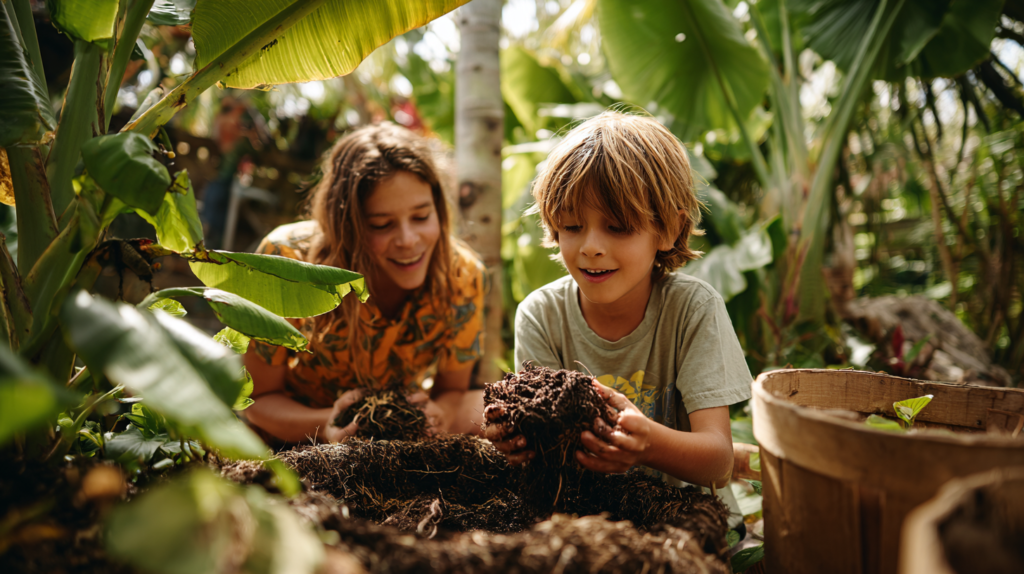
Composting with Kids: Turning Food Scraps into Learning (And Black Gold for Your Garden)
Is Your Family Ready to Compost? Take This Quick Quiz!
Your Compost Readiness Score: 0/4
Here’s something that might surprise you: the average family throws away approximately 200 pounds of kitchen scraps every year that could become rich, nutritious soil instead of methane-producing landfill waste. But here’s the beautiful truth nobody tells you—composting isn’t just about waste reduction. It’s about creating magic moments with your children.
When my little one was three, I watched her eyes light up as she discovered a wriggling earthworm in our backyard compost bin. “Mama, the worm is eating our banana!” she squealed with delight. That moment changed everything. What started as an eco-friendly experiment transformed into our family’s favorite learning adventure. And the truth is, composting with kids isn’t complicated—it’s one of the most rewarding, hands-on science lessons you’ll ever share together.
According to recent data, residential access to food waste collection increased 49% from 2021 to 2023, reaching 14.9 million households across the United States. Municipal composting programs now serve over 700 communities, and the composting industry produced 6 million tons of finished compost in 2023 alone. But here’s what the statistics don’t capture: the look on your child’s face when they understand that yesterday’s apple core becomes tomorrow’s garden nutrients.
Why Composting Matters More Than Ever
We live in a time when children are increasingly disconnected from where their food comes from and where it goes. Composting bridges that gap beautifully. Environmental educators emphasize that composting supports deep environmental literacy, sustainability awareness, and hands-on science education that builds lifelong stewardship habits.
The compost market reached $10.9 billion in 2025 and is projected to grow to $23.5 billion by 2034, reflecting an 8.9% compound annual growth rate. This isn’t just a trend—it’s a fundamental shift in how families approach waste, sustainability, and teaching the next generation about circular resource management.
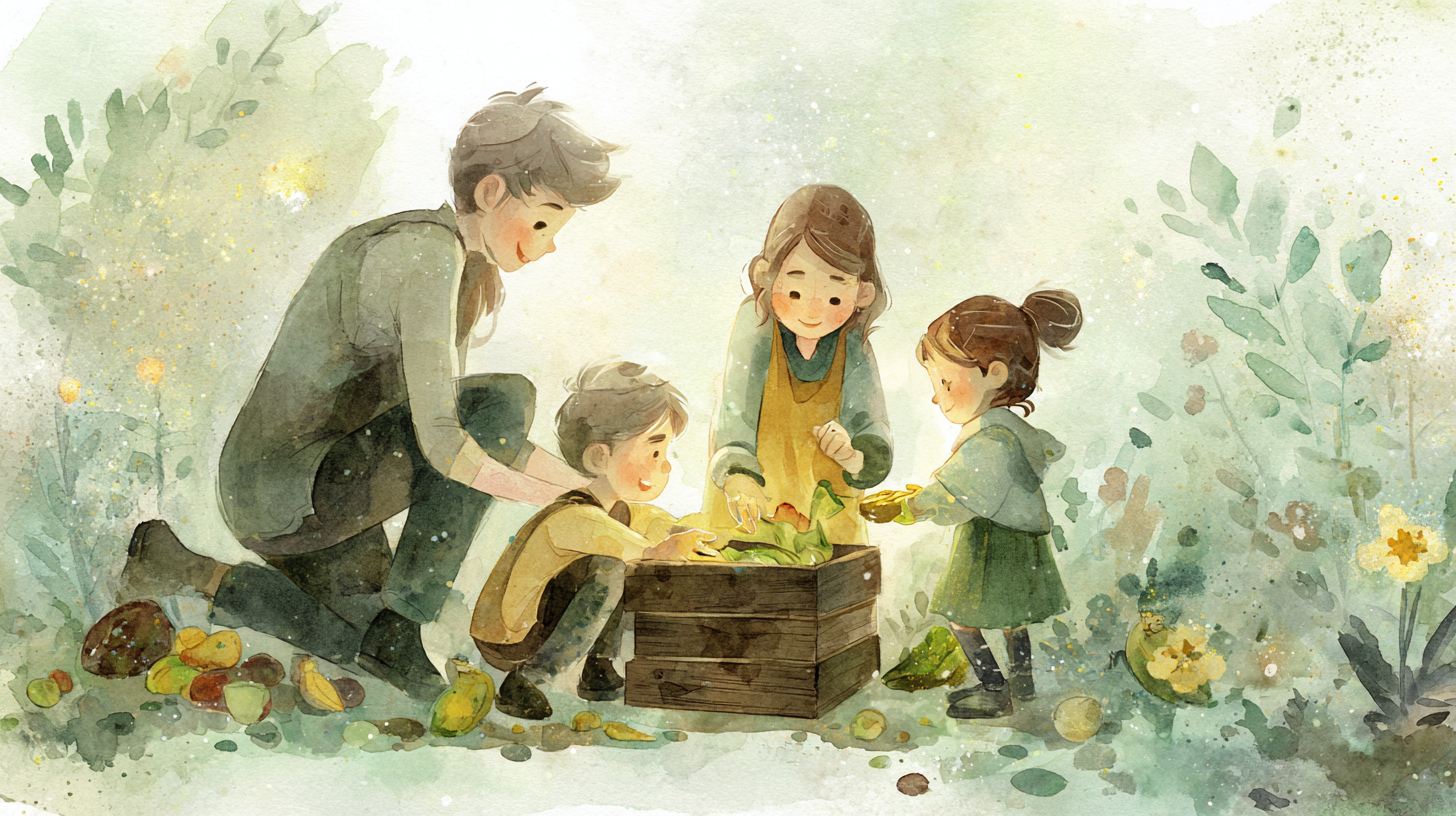
But beyond the market numbers and environmental impact, composting creates something priceless: moments of discovery. When your toddler learns that the orange peel from this morning’s snack will help grow the tomatoes you’ll harvest together next summer, you’re teaching systems thinking, patience, and respect for natural cycles. And let me tell you, as someone who’s passionate about introducing authentic flavors to little ones—including Caribbean-inspired ingredients like sweet potatoes, plantains, and coconut—composting those nutrient-rich scraps back into your garden creates the most vibrant, flavorful produce you’ll ever taste.
Starting Your Family Composting Journey
The beauty of composting is that you don’t need fancy equipment or a large backyard to begin. Families successfully compost using simple methods that work in apartments, suburban yards, and everything in between.
First, understand the basics: composting is the managed decomposition of organic materials through the activity of microorganisms in aerobic (oxygen-rich) conditions. You’re essentially creating the perfect environment for beneficial bacteria, fungi, and invertebrates to break down food scraps and yard waste into nutrient-rich soil amendment.
The fundamental ratio to teach your children: two parts “brown” materials (dried leaves, cardboard, paper) to one part “green” materials (fruit and vegetable scraps, fresh grass clippings, coffee grounds). Browns provide carbon, greens provide nitrogen, and together they create the perfect feast for decomposing microorganisms.
Here’s how to start:
- Choose your system: For beginners, a simple three-bin system made from wood pallets or purchased plastic bins works beautifully. If you have limited space, consider a tumbling composter or even an indoor worm composting system (vermicomposting).
- Pick your location: Select a spot with partial shade, good drainage, and easy access for your family. You want this close enough that adding scraps becomes a natural daily routine, not a chore.
- Collect a starter batch: Before you officially launch, save up a week’s worth of kitchen scraps. This gives you enough material to create the first layer and helps kids see the volume of waste they’re diverting from trash.
- Create the first layer: Start with a 4-6 inch layer of coarse browns (twigs, straw, shredded cardboard) for drainage, then alternate layers of greens and browns as you build.
- Maintain moisture: Your compost should feel like a wrung-out sponge—moist but not dripping. Too dry and decomposition slows; too wet and you’ll create odor issues.
Can You Compost It? Test Your Knowledge!
Click YES or NO for each item. Get instant feedback and learn what belongs in your compost bin!
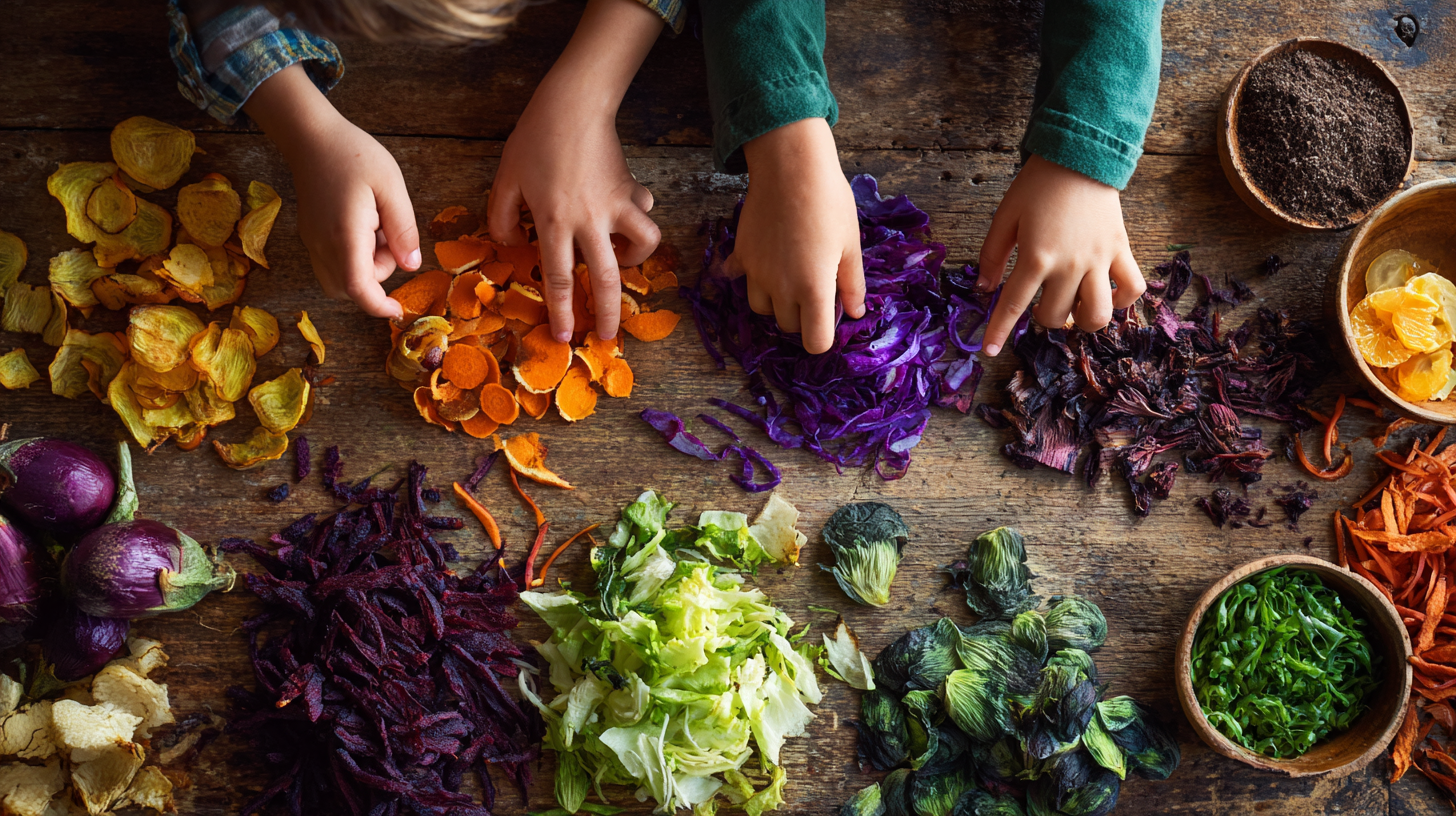
What Can and Can’t Be Composted
This is where composting gets interesting—and where teaching moments multiply. Not everything biodegradable belongs in your home compost bin, and understanding why teaches children about decomposition rates, pest attraction, and ecosystem balance.
Green light for composting (your “YES” pile):
- Fruit and vegetable scraps (including those sweet potato peels and plantain skins from your Caribbean-inspired baby meals)
- Coffee grounds and filters, tea bags (remove staples)
- Eggshells (crushed for faster breakdown)
- Nut shells (except walnut, which inhibits plant growth)
- Shredded paper, newspaper, cardboard (non-glossy)
- Grass clippings and leaves
- Houseplant trimmings
- Hair and pet fur
- Wood chips and sawdust (from untreated wood)
Yellow light (compost with caution or in small amounts):
- Citrus peels—while technically compostable, large quantities can slow decomposition and may repel beneficial worms. Use sparingly or chop finely.
- Bread and grains—can attract pests if not buried deeply in your pile
- Cooked vegetables without oils or sauces
Red light (keep OUT of your compost):
- Meat, fish, and bones—these attract rodents and create terrible odors as they decompose
- Dairy products (milk, cheese, yogurt)—same pest and odor issues
- Oils, fats, and greasy foods—these don’t break down well and can create water-resistant layers
- Pet waste from carnivores (dogs, cats)—contains pathogens harmful to humans
- Diseased plants—you’ll spread the disease when you use the finished compost
- Weeds with seeds—unless your pile gets hot enough (above 140°F) to kill seeds
- Treated wood products or glossy paper—contain chemicals you don’t want in your garden
Common problems families face include odor from improper mix ratios, excessive moisture causing anaerobic conditions, inconsistent results from neglecting to turn the pile, and pest attraction from adding inappropriate materials. The good news? All these challenges become teaching opportunities.
Involving Children at Every Age
One of the most powerful aspects of family composting is how it scales with your children’s development. From toddlers to teenagers, every age can contribute meaningfully and learn age-appropriate lessons about environmental stewardship.
Perfect Composting Activities for Your Child’s Age
Select your child’s age range to discover ideal composting tasks!
Select an age range above to see personalized activities!
Ages 2-4 (Toddlers): These little ones are sensory explorers. Let them collect scraps in a small bucket, tear up paper for browns, observe worms and bugs, and sprinkle water on the pile. My daughter’s favorite activity at this age was “feeding the compost monster”—we’d make silly voices as we dropped in banana peels and apple cores.
Ages 4-6 (Preschool): Now they can learn sorting skills. Create a simple chart showing what goes in compost versus trash versus recycling. Let them use child-safe tools to turn small sections of the pile, measure temperature with a compost thermometer, and document changes with drawings or photos. This is when you introduce the concept of decomposition in concrete, observable terms.
Ages 6-10 (Elementary): This is the golden age for composting education. Children can track weight of diverted waste, learn the carbon-nitrogen ratio, conduct experiments (what decomposes fastest?), maintain a composting journal, chop materials into smaller pieces for faster decomposition, and harvest finished compost for the garden. Connect composting to school science lessons about life cycles, ecosystems, and chemistry.
Ages 10+ (Tweens and teens): Older children can manage the entire composting process independently, troubleshoot problems, research and implement new techniques, calculate environmental impact, teach younger siblings, and even start community composting initiatives. Several teenagers have launched successful composting programs at their schools after starting with family projects at home.
Educators report that children who participate in composting programs develop stronger critical thinking skills, better understanding of cause-and-effect relationships, increased sense of environmental responsibility, and improved teamwork and communication abilities. Teaching kids to compost creates long-lasting environmental action habits that persist into adulthood.
The Science Behind the Magic
Here’s where composting becomes truly captivating for curious young minds: it’s a living, breathing science experiment happening right in your backyard. When you help children understand what’s actually occurring inside that pile of “garbage,” you unlock their natural fascination with the hidden world of microorganisms.
Composting happens in three main phases, each with its own temperature range and cast of microscopic characters:
The Mesophilic Phase (days 1-3): Moderate-temperature bacteria move in first, starting to break down easily degradable compounds. Temperatures rise from ambient to around 104°F as these bacteria multiply exponentially. Children can actually feel this warmth when they stick their hand deep into a fresh compost pile—it’s like the pile is alive and breathing.
The Thermophilic Phase (days 4-21): This is when things get hot—literally. Temperatures can reach 130-160°F as heat-loving bacteria take over, working at incredible speed to break down proteins, fats, and complex carbohydrates. This heat is intense enough to kill weed seeds and pathogens, making your compost safe and healthy. Have your children use a compost thermometer to track these temperature changes and graph the results.
The Cooling and Curing Phase (weeks to months): As easily decomposed materials become scarce, temperatures drop back to ambient levels. Fungi move in to break down tougher materials like cellulose and lignin. Larger decomposers—worms, beetles, millipedes, and other invertebrates—arrive to finish the job. This is when your pile transforms from recognizable food scraps into rich, dark, earthy-smelling humus.
⏱️ Track Your Compost’s Journey: From Scraps to Soil
Slide to see what’s happening in your compost pile week by week!
Week 0: Starting Your Pile
You’ve just added your first layers! Bacteria are beginning to colonize the fresh materials. Temperature is ambient, around 60-70°F. Time to add your greens and browns in the perfect 2:1 ratio!
The microorganisms doing this work are astounding in their diversity and efficiency. A single gram of compost can contain billions of bacteria, millions of fungi, and thousands of protozoa—all working together in a complex ecosystem. Teaching children about this invisible world opens their minds to the reality that life exists at every scale, not just what we can see with our eyes.
From Compost Bin to Garden Bounty
The true payoff of composting comes when you spread that finished black gold on your garden beds and watch the magic happen. Finished compost—ready when it’s dark, crumbly, and smells like rich earth—transforms your soil structure, water retention, and nutrient availability in ways that synthetic fertilizers simply cannot match.
Here’s what that finished compost does for your garden:
- Improves soil structure: Compost helps clay soils drain better and helps sandy soils retain moisture. It creates the ideal crumbly texture that plant roots love to explore.
- Provides slow-release nutrients: Unlike synthetic fertilizers that dump all their nutrients at once (often burning plants or running off into waterways), compost releases nutrients gradually as plants need them.
- Increases beneficial microorganisms: That diverse community of bacteria and fungi you cultivated in your compost pile moves into your garden soil, suppressing diseases and helping plants access nutrients.
- Improves water retention: Compost can hold up to 20 times its weight in water, reducing irrigation needs and helping gardens survive dry periods.
- Reduces erosion: The improved soil structure created by compost helps soil resist washing away during heavy rains.
When you grow vegetables with your children using compost you created together from kitchen scraps, you complete a beautiful circle. The apple they ate last month becomes the nutrients feeding the tomato plant they’ll harvest next month. Those sweet potato peels from their Caribbean-inspired baby food return to the soil to grow even more sweet potatoes next season.
Children who participate in the full cycle—from saving scraps to spreading compost to harvesting vegetables—develop a profound understanding of circular systems. They see firsthand that “waste” is just a resource in the wrong place, and that everything in nature operates in cycles rather than linear paths.
Choosing the Right Composting System for Your Family
Not all composting systems are created equal, and the “best” choice depends entirely on your family’s living situation, available time, physical space, and commitment level. The good news? There’s a composting method that works for virtually everyone, from apartment dwellers to suburban homeowners to rural homesteaders.
️ Find Your Perfect Compost System
Answer these questions to get a personalized recommendation!
Time commitment:
Your Ideal Compost System:
Vermicomposting (Worm Bins): Perfect for apartments and small spaces, worm composting uses special red wiggler worms to break down food scraps in a compact bin that can live under your kitchen sink or on a balcony. Kids absolutely love this method because the worms become pets with a purpose. You’ll produce finished compost (called worm castings) in 3-6 months, and it’s some of the richest fertilizer available.
Tumbling Composters: These barrel-style composters on stands make turning your compost effortless—just give the barrel a few spins every few days. They’re ideal for families who want faster composting (finished in 4-6 weeks) without the physical effort of turning a traditional pile. Great for suburban yards with limited space.
Three-Bin Systems: The classic choice for those with yard space and a commitment to active composting. You have one bin for fresh materials, one for active composting, and one for finished compost curing. This system produces large quantities of compost and gives children clear visual understanding of the decomposition timeline.
Open Pile Composting: The simplest, lowest-cost method—literally just a pile in your yard. Works beautifully if you have space and don’t mind a more relaxed timeline (6-12 months to finished compost). This method attracts the most wildlife and insects, creating wonderful observation opportunities for nature-loving children.
Bokashi Composting: An anaerobic method using specialized inoculant to ferment food waste in airtight buckets. This system accepts meat and dairy, making it ideal for families who want to compost everything. The process is fast (2 weeks), but requires purchasing the Bokashi bran and produces a pickled pre-compost that needs to be buried in soil or added to a traditional compost pile to finish breaking down.
According to market research, the household composters market is experiencing strategic growth from 2025-2034, with technological advances making composting easier, cleaner, and more accessible for families. In-vessel composting systems and aerated pile technologies ensure faster, higher-quality, and more consistent results than ever before.
Real-World Impact: Why This Matters
Let’s talk about the uncomfortable truth we often avoid: organic waste in landfills doesn’t just “decompose naturally.” When food scraps and yard waste are buried in oxygen-deprived landfills, they undergo anaerobic decomposition, producing methane—a greenhouse gas 25 times more potent than carbon dioxide over a 100-year period.
Shocking Truths: The Real Impact of Your Kitchen Scraps
Click each card to reveal the hidden environmental impact of composting!
Click to Reveal: Landfill Truth
Food waste makes up 22% of landfill content. When buried without oxygen, it produces methane gas 25x more potent than CO2. Your family’s yearly food scraps could generate greenhouse gases equivalent to driving a car 800 miles.
Click to Reveal: Water Savings
Gardens using compost require 30-50% less watering. A single cubic foot of compost can hold up to 200 pounds of water. In drought conditions, compost-enriched soil helps plants survive and thrive.
Click to Reveal: Carbon Capture
Compost-enriched soil sequesters carbon from the atmosphere. Just one acre of soil amended with compost can capture up to 3 tons of CO2 annually—equivalent to taking a car off the road for a year.
Click to Reveal: Money Saved
Families save $50-150 yearly on garbage bags and disposal fees. You’ll also eliminate the need to purchase fertilizers, mulch, and soil amendments—saving an additional $100-300 per year on garden supplies.
Click to Reveal: Food Quality
Vegetables grown in compost-enriched soil contain up to 50% more vitamins and minerals than those grown with synthetic fertilizers. They also taste significantly better—your kids will actually want to eat those homegrown carrots!
Click to Reveal: Community Ripple
When one family starts composting, neighbors notice and often follow suit. Studies show composting families are 3x more likely to inspire friends and neighbors to start their own programs, creating community-wide impact.
The environmental impact of family composting extends far beyond individual households. In 2023, U.S. composting facilities diverted millions of tons of organic material from landfills, with households providing 31.1% of feedstock. When scaled across millions of families, home composting represents a powerful climate action that reduces methane emissions, sequesters carbon in soils, and decreases the need for energy-intensive synthetic fertilizers.
But here’s what makes family composting truly transformative: it changes how children think about consumption, waste, and their relationship to natural systems. Children who compost develop what researchers call “ecological identity”—a deep sense of connection to and responsibility for the natural world. They understand that humans are part of ecosystems, not separate from them.
Social media analysis shows that composting content yields millions of views and inspires new eco-friendly habits worldwide. Instagram Reels and DIY tutorials featuring kid-led compost projects drive the most engagement, with creative approaches to bin building and garden integration capturing public imagination.
Troubleshooting Common Challenges
Let’s be honest: not every composting attempt goes smoothly. You’ll encounter problems, and that’s actually where some of the best learning happens. When something goes wrong with your compost pile, you and your children become scientific detectives, investigating causes and testing solutions.
Problem: Terrible smell
Diagnosis: Too much nitrogen (greens), not enough oxygen, or too wet
Kid-friendly solution: Have children add browns (the “carbon heroes”), fluff the pile with a pitchfork to add air, and create air channels with sticks
Problem: Pile isn’t heating up
Diagnosis: Too small, too dry, or insufficient nitrogen
Kid-friendly solution: Build a bigger pile (at least 3x3x3 feet), add water while turning, or mix in fresh grass clippings or coffee grounds
Problem: Attracting pests (flies, rodents)
Diagnosis: Exposed food scraps, inappropriate materials (meat, dairy, oils)
Kid-friendly solution: Bury fresh additions under browns, remove any forbidden items, consider adding a wire mesh barrier at the base
Problem: Materials not breaking down
Diagnosis: Items too large, pile too dry, insufficient microbial activity
Kid-friendly solution: Chop materials smaller, add moisture, introduce finished compost from elsewhere to “seed” beneficial microbes
Problem: Pile too wet and slimy
Diagnosis: Too many greens, insufficient browns, poor drainage
Kid-friendly solution: Mix in shredded paper, cardboard, or dried leaves; improve drainage at the base; cover during heavy rains
These troubleshooting moments teach children the scientific method in action: observe the problem, hypothesize about causes, implement a solution, and observe results. It’s experiential learning at its finest, and the lessons transfer far beyond composting into broader critical thinking skills.
Caribbean-Inspired Composting: A Cultural Connection
In Caribbean culture, nothing goes to waste—a wisdom passed down through generations who understood resource scarcity and the value of every precious scrap. This philosophy aligns beautifully with modern composting practices and offers rich cultural learning opportunities for families.
When you’re preparing Caribbean-inspired meals featuring ingredients like plantains, sweet potatoes, mangoes, and coconut, you’re generating compost materials that are particularly rich in nutrients. Those thick plantain peels? They’re loaded with potassium that your tomatoes will love. Sweet potato skins? Full of complex carbohydrates that feed soil microorganisms. Mango pits and skins? Rich in nitrogen and minerals.
Caribbean gardens traditionally used “kitchen gardens” where food scraps were returned directly to the soil, creating the rich, dark earth that produces those intensely flavorful vegetables and fruits. Teaching children this cultural approach to waste and resource management connects them to traditional ecological knowledge that’s been proven effective for centuries.
Many Caribbean ingredients also offer unique composting benefits: coconut shells (high in carbon and potassium), cassava peels (rich in minerals), breadfruit scraps (excellent nitrogen source), and scotch bonnet pepper scraps (natural pest deterrent when decomposed). When children understand that different scraps contribute different nutrients, they begin thinking systematically about soil health and plant nutrition.
Building Lifelong Environmental Stewards
Here’s the truth that keeps me passionate about teaching composting to families: the habits children develop before age 10 often persist for life. When composting becomes as natural as brushing teeth—just part of the daily routine—those children grow into adults who instinctively think about resource cycles, waste reduction, and environmental impact.
Research from school composting programs reveals that children who participate develop stronger environmental literacy, better systems thinking, increased personal responsibility for environmental outcomes, and greater likelihood of adopting other sustainable practices as adults. The impact ripples outward: these children influence their parents, siblings, extended family, and eventually their own children.
Teaching kids to compost creates long-lasting environmental action that’s measurable across generations. Adults who composted as children report being more likely to: garden organically, reduce food waste, choose sustainable products, advocate for environmental policies, and teach environmental practices to others.
Government initiatives like California’s Bill 1383, which requires organic waste diversion and composting infrastructure, are spurring public involvement and access on an unprecedented scale. Municipal programs now serve over 700 communities, with educational components specifically designed to engage families and children. The message is clear: composting isn’t just an individual choice anymore—it’s becoming a civic responsibility and a community norm.
Social campaigns and digital platforms continue shaping family composting trends, creating measurable environmental impact. When families share their composting successes on social media, documenting their children’s involvement and the resulting garden bounty, they inspire countless others to begin their own journeys. This digital word-of-mouth has proven more effective than traditional environmental education in changing actual behavior.
Your Family’s Composting Legacy
So here we are—back to that moment when my daughter discovered the earthworm in our compost bin. That single moment of wonder sparked years of discovery, learning, and connection to the natural world. She’s ten now, and she manages our family’s composting system almost independently. But more importantly, she understands something profound: that we’re all part of interconnected cycles, that waste is a human concept that doesn’t exist in nature, and that small daily actions create enormous cumulative impact.
Starting family composting isn’t complicated. You don’t need expensive equipment, a large yard, or advanced scientific knowledge. You just need curiosity, consistency, and a willingness to get your hands dirty with your children. The black gold you’ll create for your garden is wonderful, but the real treasure is the time spent together, the lessons learned, and the environmental consciousness you’re cultivating in the next generation.
The composting industry is projected to grow significantly through 2034, driven by sustainability goals, stricter policies, and expanding educational outreach. But beyond market forces and environmental regulations, the real momentum comes from families like yours—families who choose to turn food scraps into learning opportunities, who see waste as a resource, who teach their children that caring for the earth isn’t optional, it’s essential.
When you spread that first batch of finished compost on your garden beds with your children, and when you harvest vegetables grown in soil you enriched together, you complete a circle that’s both ancient and revolutionary. You’re participating in the same cycle that’s sustained human agriculture for 10,000 years while simultaneously addressing modern challenges like climate change, waste management, and environmental literacy.
That banana peel from this morning’s breakfast? It’s not garbage. It’s tomorrow’s garden nutrients, next month’s tomatoes, and your children’s understanding that everything is connected. That’s the real magic of composting with kids—turning food scraps into learning, into connection, into hope for a more sustainable future.
So start small. Save your scraps for a week. Build a simple pile with your children. Let them get their hands dirty, ask endless questions, and discover the invisible world of decomposition. Watch their eyes light up when they find that first worm, feel that first heat from microbial activity, spread that first batch of finished compost. These are the moments that change how children see the world—and how they’ll care for it throughout their lives.
Because in the end, composting with kids isn’t really about waste management or even environmental education. It’s about relationships—with the earth, with natural cycles, with food, and most importantly, with each other. It’s about spending time together doing something meaningful, creating something valuable, and learning lessons that last a lifetime. And honestly? That’s worth every banana peel you’ll ever save.

Kelley's culinary creations are a fusion of her Caribbean roots and modern nutritional science, resulting in baby-friendly dishes that are both developmentally appropriate and bursting with flavor. Her expertise in oral motor development and texture progression ensures that every recipe supports your little one's feeding milestones while honoring cultural traditions.
Join Kelley on her flavorful journey as she shares treasured family recipes adapted for tiny taste buds, evidence-based feeding guidance, insightful parenting anecdotes, and the joy of celebrating food, culture, and motherhood. Get ready to immerse yourself in the captivating world of Kelley Black and unlock the vibrant flavors of the Caribbean for your growing baby, one nutritious bite at a time.
- The Feeding Revolution: Why Your Everyday Meals Are Changing the World - October 13, 2026
- Your Feeding Story Matters More Than The “Perfect” One Online - October 12, 2026
- Looking Forward: Stepping Into Your Confident Feeding Future - October 11, 2026