When Food Becomes the Passport Your Kids Actually Want to Use
Your Family’s Flavor Discovery Quiz
Click on the flavors that make your taste buds dance. Let’s discover which culinary adventure awaits your family!
Spicy & Bold
Sweet & Comforting
Savory & Rich
Tangy & Fresh
Herbal & Earthy
Umami & Deep
Your Personalized Cuisine Path:
Here’s something nobody tells you about raising adventurous eaters: it has almost nothing to do with food. I learned this the hard way when my toddler refused everything green for six months straight, but then devoured an entire bowl of Thai basil chicken because we’d spent the afternoon reading a picture book about elephants in Thailand. The noodles? She wanted those too, once I mentioned they were “just like the ones the little girl in the story ate.”
That moment cracked open something for me. Food isn’t just fuel or nutrition or even culture in the abstract sense we talk about at dinner parties. For kids, food is story. It’s adventure. It’s the quickest portal to a world that exists beyond their neighborhood, their school, their everyday. And when we invite them into that world intentionally, with curiosity instead of lectures, something magical happens. They don’t just try new foods. They start seeing the whole world differently.
The research backs this up in ways that honestly shocked me. Studies on experiential culinary programs for children aged five to twelve show measurable improvements not just in their willingness to eat vegetables—though that happens too—but in their overall attitudes toward people and cultures different from their own. When multicultural food experiences are paired with stories, context, and hands-on participation, kids build what researchers call “openness to diversity,” which is just a fancy way of saying they become more curious, more empathetic, and less afraid of what’s unfamiliar.
And here’s the part that makes my Caribbean heart swell: you don’t need a passport or a hefty travel budget to do this. You need curiosity, a willingness to let your kitchen get a little messy, and the understanding that “family food adventures” aren’t about perfection. They’re about connection, discovery, and giving your kids the kind of memories that shape how they move through the world long after they’ve left your table.
Why Your Tuesday Night Dinner Just Became a Geography Lesson
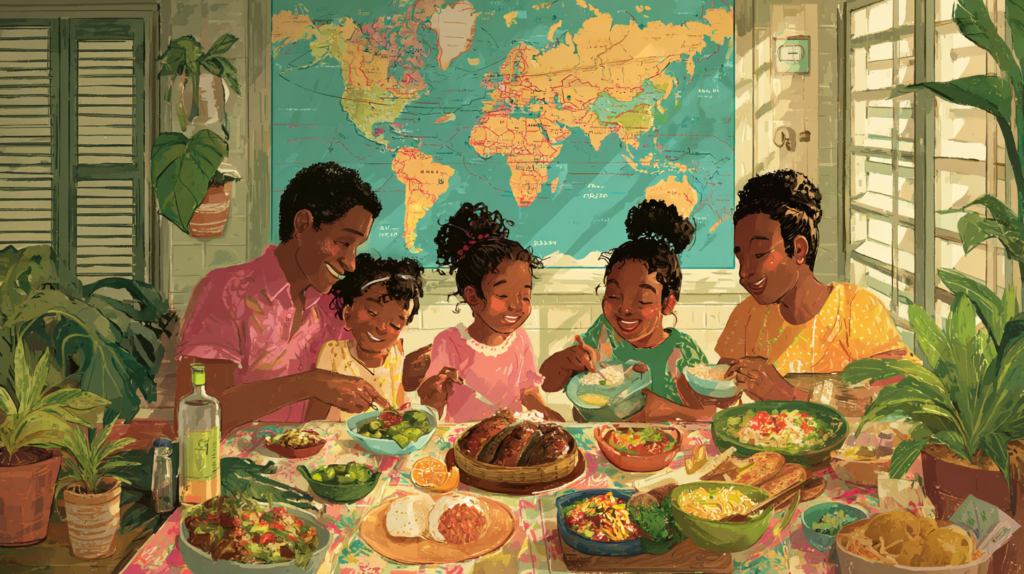
Let’s talk about what’s really happening when you cook a dish from another culture with your kids. On the surface, sure, you’re making dumplings or arepas or jerk-spiced sweet potatoes. But dig a little deeper and you’ll find you’re teaching history, geography, language, agriculture, economics, and social studies—all without a single worksheet in sight. This is what educators call “experiential learning,” and it’s one of the most effective ways humans actually retain information.
When your seven-year-old helps you fold Jamaican beef patties and you mention that the technique came from Cornish pasties brought over by British colonizers, then adapted with Scotch bonnet peppers and local spices? That’s a living history lesson. When your preschooler tastes coconut milk for the first time in a Puerto Rican tembleque and you show them where coconuts grow on a map? That’s geography that sticks. Food is the rare subject that engages all five senses simultaneously, which is why culinary experiences create such strong memories and cognitive connections.
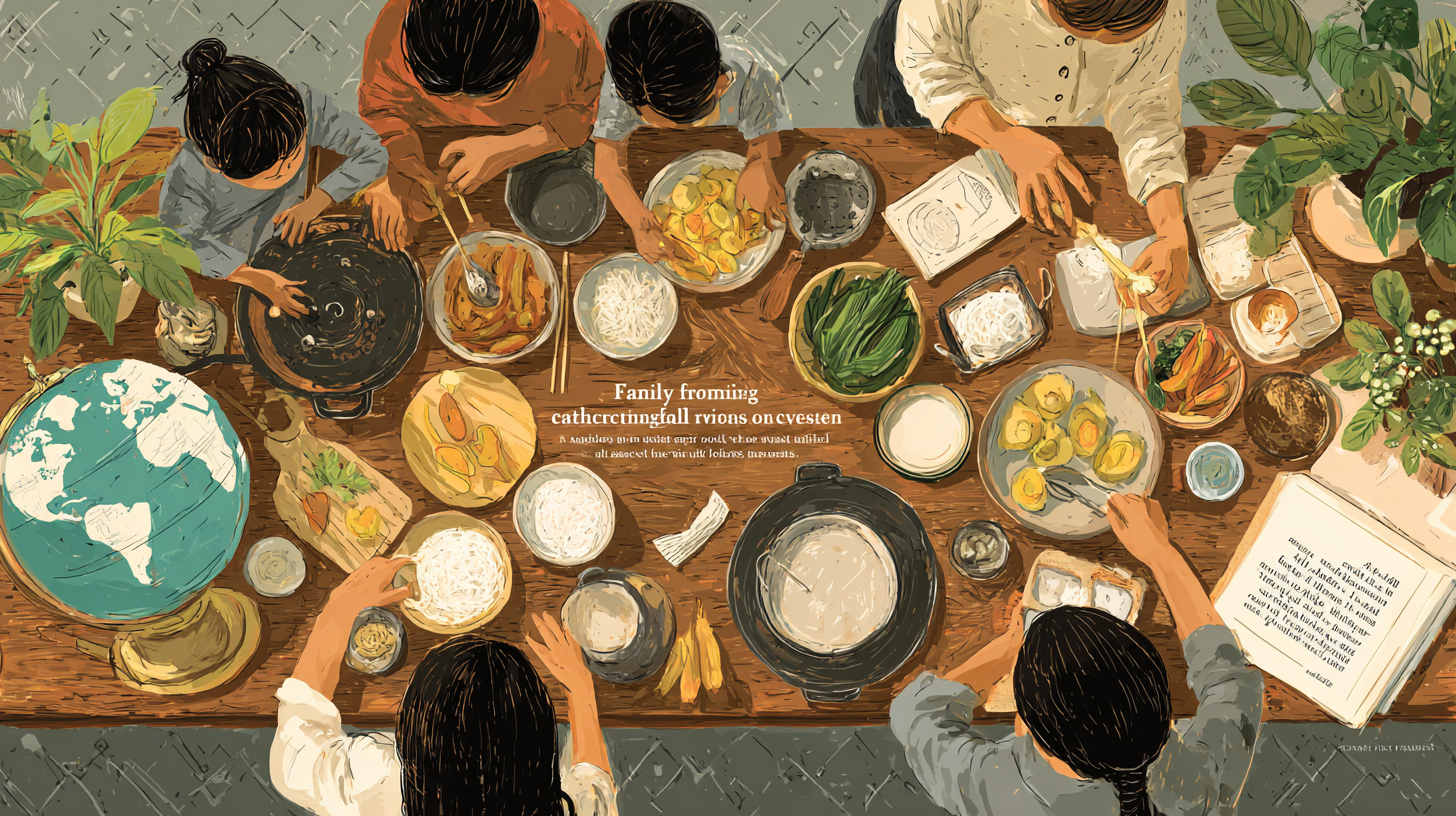
The academic world has caught up to what grandmothers have known for generations. Recent research in public health nutrition found that children who participate in cooking programs—especially those incorporating diverse cultural foods—show increased dietary diversity, better attitudes toward trying new foods, and improved cooking confidence. But here’s the kicker: those benefits extend to the whole family. Parents in these programs reported cooking more meals from scratch, feeling more connected to their own food heritage, and having richer dinner table conversations.
The culinary tourism industry, which has exploded over the past three years, tells us something important about what people crave. Food tourism is projected to grow at seventeen percent annually through 2034, making it one of the fastest-growing segments of the travel industry. Families aren’t just looking for vacation destinations anymore. They’re seeking authentic food experiences—cooking classes in local homes, market tours with resident guides, farm visits where kids can harvest ingredients. The desire to connect with culture through food has never been stronger, and you can tap into that same energy right in your own home.
The Truth About Picky Eating Nobody Wants to Hear
️ Picky Eater Myth Buster
Which statement do you believe about picky eating? Select one to reveal the research-backed truth:
The Research Says:
I’m about to say something that might sting a little: most picky eating isn’t about the food. It’s about fear of the unfamiliar, lack of context, and insufficient positive exposure to dietary variety early in life. Yes, genetics play a role—some children are genuinely more sensitive to bitter tastes. But research on infant and young child feeding shows that dietary diversity in the first two years of life is one of the strongest predictors of food acceptance later on.
Here’s what happens in many well-meaning homes: we introduce one “new” food at a time, in isolation, often steamed or boiled to mush, with no story or context or joy attached to it. Then we’re surprised when kids reject it. But when that same food is part of a narrative—when it has color, aroma, music, story, maybe even a little drama—acceptance rates skyrocket. Anthropologists studying food culture have documented this across societies: children are far more likely to eat unfamiliar foods when they’re embedded in positive social contexts and connected to people and stories they care about.
This is where cultural food exploration becomes a secret weapon. When you frame trying Trinidadian geera pumpkin as “eating like your friend Anaya’s family,” or Vietnamese pho as “the soup from that animated movie you loved,” you’re not tricking kids. You’re giving them what their brains actually need: context, connection, and meaning. The food isn’t scary or weird anymore. It’s part of a story they’re already invested in. And just like that, the battle is over before it started.
How to Turn Your Kitchen Into a Cultural Classroom Without Losing Your Mind
Let me be blunt: you do not need to be an expert in global cuisines to do this well. You don’t need a well-stocked spice cabinet or specialty ingredients or even particularly refined cooking skills. What you need is curiosity, a willingness to learn alongside your kids, and the understanding that “authentic” is less important than “engaged.” Some of the best family food adventures I’ve witnessed have involved semi-homemade shortcuts, ingredient substitutions, and recipes that would make traditional cooks weep—but the kids were invested, the conversations were rich, and everyone left the table feeling more connected.
Start with what you already have. If your family loves tacos, branch out to explore regional variations—Baja fish tacos, Mexico City al pastor, Yucatecan cochinita pibil. Each variation tells a different story about geography, available ingredients, and cultural influence. If your kids devour spaghetti, introduce them to Asian noodle dishes and talk about how noodles traveled the Silk Road. The goal isn’t to become a culinary anthropologist. It’s to create a framework where food becomes a vehicle for curiosity.
Your Family’s Cuisine Adventure Planner
Track how many cultures you’ve explored this month! Tap the + buttons to log your adventures.
Total Adventures This Month: 0
Here’s a framework that actually works: pick one cuisine per month. Spend the first week doing research together—watch a kid-friendly documentary, read picture books set in that country, listen to music from that region while you cook or do homework. Week two, visit a grocery store or market that specializes in those ingredients, if you can. Let your kids touch, smell, ask questions. Week three, cook a simple dish together. And week four, if you’re feeling ambitious, visit a restaurant that serves that cuisine and compare what you made at home to what the professionals do.
This monthly rhythm prevents overwhelm while building genuine knowledge. By the end of the year, your family will have explored twelve different food cultures with enough depth that the experiences stick. You’re not tourism-hopping through cuisines at random. You’re building real understanding, dish by dish, story by story. And here’s what surprised me most when my own family started doing this: the kids started making connections on their own. “Wait, Mom, didn’t we use coconut milk when we made that Jamaican curry? Is that why it’s in this Thai soup too?” Those moments—when they start seeing the threads that connect disparate cuisines—are pure magic.
Parent Tip: If you’re exploring Caribbean flavors with babies or toddlers, the Caribbean Baby Food Recipe Book offers over 75 island-inspired recipes designed for little ones. Think coconut rice and red peas adapted for six-month-olds, or geera pumpkin puree that introduces warm spices safely. It’s a beautiful way to start building that flavor foundation early.
Restaurant Adventures: More Than Just Eating Out
Let’s talk about something most parenting blogs won’t touch: restaurants as cultural education hubs. There’s this pervasive anxiety that taking kids to “ethnic” restaurants is risky—they won’t like anything, they’ll be disruptive, it’ll be expensive and wasted. But here’s what the research on culinary tourism and family leisure actually shows: well-prepared restaurant visits can be some of the most powerful cultural learning experiences children have, precisely because they’re outside the home and involve real people from those cultures.
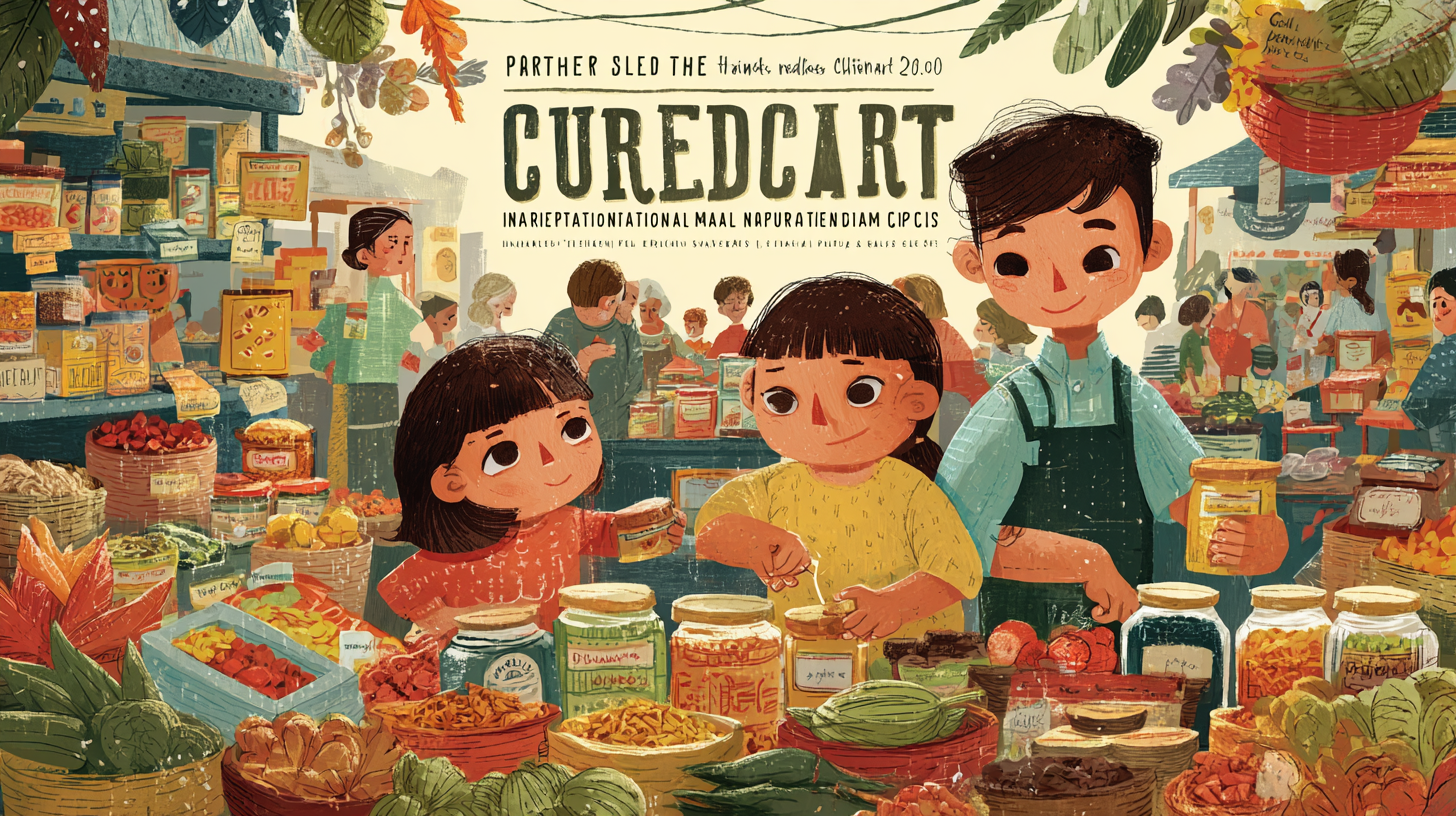
The key phrase there is “well-prepared.” You can’t just drag hungry, unprepared kids to an unfamiliar restaurant at six p.m. on a Tuesday and expect enlightenment. But if you spend ten minutes beforehand looking at the menu online, talking about what you’ll order, maybe watching a short video about the cuisine, and setting clear expectations? Different story entirely. Suddenly the restaurant becomes a field trip with learning objectives instead of a stressful dinner you’ll regret.
When you do visit, engage with staff if the context feels appropriate. Ask questions: “What dish reminds you of home?” “What do kids in your country typically eat for breakfast?” “Can you teach us how to pronounce this correctly?” Most restaurant owners and servers are thrilled when families show genuine interest in their food culture. Those brief conversations—hearing someone speak with pride about their grandmother’s recipe or explain why a certain spice matters—give kids something textbooks never can: direct human connection to the culture they’re exploring.
Make it a tradition to try one new restaurant per month that serves a cuisine your family has never experienced. Keep a journal or photo album of your adventures. Let kids rate dishes, write down new words they learned, draw pictures of their favorite parts. This documentation serves two purposes: it reinforces learning through reflection, and it creates a tangible record of your family’s growing cultural competence. Years from now, your kids will flip through that journal and remember not just what they ate, but who they were becoming in the process.
The Hidden Curriculum: What Food Actually Teaches
Beyond the Plate: Hidden Lessons in Every Meal
Click each card to reveal the surprising lessons food exploration teaches your children:
Geography
Tap to discover
Every ingredient has a home. When kids trace rice to Thailand, cocoa to Ghana, or plantains to the Caribbean, they’re building mental maps that no quiz can replicate. Food makes geography personal and memorable.
Empathy
Tap to discover
Food humanizes the unfamiliar. Research shows children who engage with diverse cuisines develop greater openness to people from different backgrounds. Sharing a meal is sharing humanity.
History
Tap to discover
Every dish tells a story. Trade routes, colonization, migration, innovation—food carries the full weight of human history. Kids learn historical concepts through flavors that persist across centuries.
Resilience
Tap to discover
Trying unfamiliar foods builds courage. Each new taste is a tiny act of bravery. Over time, these small steps compound into genuine confidence with novelty and change.
Sustainability
Tap to discover
Food connects to the planet. Conversations about where ingredients come from, how they’re grown, and why seasons matter plant the seeds of environmental awareness.
Creativity
Tap to discover
Cooking is applied creativity. Experimenting with flavors, adapting recipes, and presenting dishes beautifully all engage artistic thinking and problem-solving skills.
When cultural anthropologists study food practices across societies, they consistently find that food does more than nourish bodies. It marks identity, signals belonging, conveys status, mediates relationships, and transmits values across generations. In other words, every time you sit down to a meal, you’re participating in one of humanity’s oldest and most complex social rituals. And when you expose your children to food from cultures beyond your own, you’re teaching them to read those rituals—to see the invisible structures that shape how people live, love, and connect.
This is where the magic really lives. Your kids aren’t just learning that people in Japan eat with chopsticks or that injera is eaten with hands in Ethiopia. They’re learning that there are multiple valid ways to approach any human problem, including the deeply practical problem of getting food from plate to mouth. They’re learning that difference isn’t deficiency. They’re learning to be comfortable in unfamiliar contexts. And these lessons transfer far beyond the dinner table.
Studies on multicultural experience and cognition have found that people with more exposure to diverse cultural practices—including food—score higher on measures of creativity, complex thinking, and cognitive flexibility. They’re better at seeing problems from multiple angles and generating novel solutions. Why? Because their brains have been trained, through repeated exposure, to understand that there’s rarely one “right” way to do anything. The Korean way, the Nigerian way, the Peruvian way—all are valid, all are logical within their own contexts, all have something to teach.
When Food Becomes a Bridge Instead of a Barrier
There’s a conversation we need to have about cultural appropriation versus cultural appreciation, because it comes up every single time someone outside a culture starts cooking its food. Here’s my take, shaped by being Caribbean and watching my own food culture get both celebrated and commodified: context and respect are everything. When you cook Haitian griot with your kids and you talk about Haiti’s history, its resilience, its contributions to world culture—and maybe you support a Haitian-owned business or donate to a Haitian cause—that’s appreciation. When you throw “jerk” seasoning on everything because it’s trendy and you can’t name a single Jamaican artist or historical figure? That veers toward appropriation.
The difference is engagement depth. Appreciation involves learning, respect, reciprocity, and acknowledgment. It’s being willing to sit with the uncomfortable parts of history—the colonization, the exploitation, the ongoing inequities—while still celebrating the beauty and richness of the culture. It’s teaching your kids that Thai food is delicious AND that Thailand has a complex political situation we should care about. It’s making sure that your “around the world” food adventures include voices and perspectives from those cultures, not just recipes ripped from Pinterest.
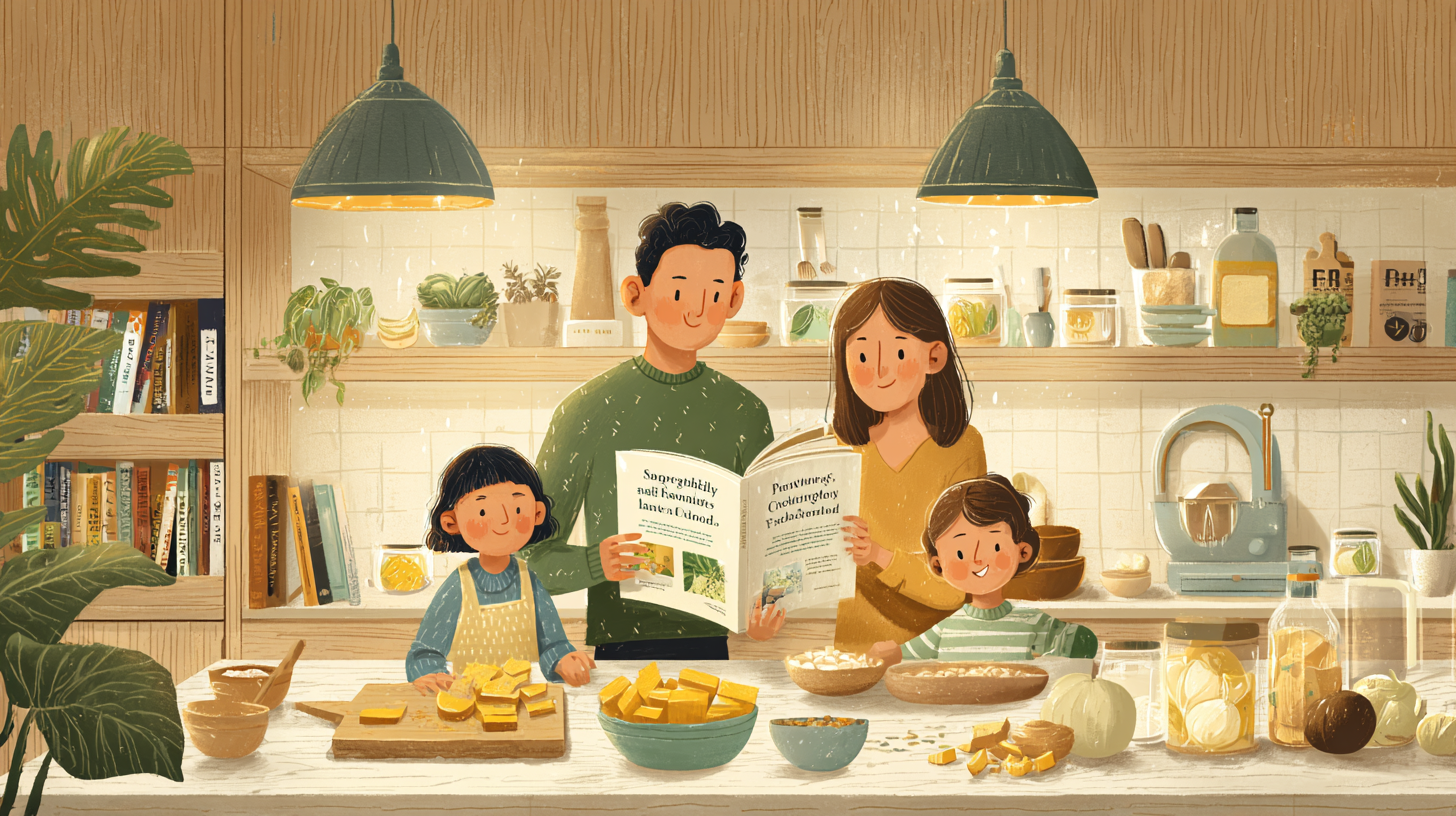
This is why I’m such a big advocate for pairing food experiences with books, documentaries, music, and if possible, direct relationships with people from those cultures. When your child’s exposure to Indian food includes their classmate Priya’s mom teaching them to make samosas, or listening to Priya talk about Diwali traditions, the food becomes part of a real human relationship instead of cultural tourism. Those connections—messy, authentic, reciprocal—are what transform cuisine exploration from consumption into genuine cultural education.
Programs that pair cooking education with cultural competency training show remarkable outcomes. Participants—both kids and adults—report feeling more comfortable in diverse settings, more curious about people different from themselves, and more critical of stereotypes. Food, it turns out, is one of the most effective tools we have for breaking down the walls of “us versus them” thinking. It’s hard to fear or dismiss someone whose food you’ve lovingly prepared and enjoyed. The act of cooking their cuisine with care and attention is itself a form of respect, a bodily acknowledgment that their culture has value.
The Challenges Nobody Warns You About (And How to Handle Them)
Let’s get real about the obstacles, because pretending they don’t exist helps no one. First: access and affordability. Not everyone lives near international markets or has the budget for specialty ingredients. This is a real equity issue in culinary education. If your local grocery store stocks exactly zero international ingredients and you can’t afford to order online, your options for authentic cuisine exploration are genuinely limited. The research on dietary diversity in under-resourced communities makes this painfully clear—families want to expose children to varied foods, but systemic barriers get in the way.
My advice here: start with what’s achievable and don’t let perfect be the enemy of good. Many global cuisines have been adapted by immigrant communities to use locally available ingredients. Chinese-American food isn’t “authentic” Chinese food, but it tells its own important story about adaptation, resilience, and fusion. Caribbean communities in the UK cook with ingredients wildly different from what’s available in the islands, and those adaptations are legitimate and valuable. So if you’re making “Thai-inspired” food with whatever vegetables your store stocks and bottled sauce from the international aisle, you’re still doing meaningful cultural exploration. Just be honest about the adaptations and use them as teaching moments about food access and food justice.
Second challenge: time. Cultural food exploration done well is time-intensive—the research, the shopping, the cooking, the conversation. This is a huge barrier for families already stretched thin. My honest answer here is that you have to decide what you’re willing to trade for this experience. Can you sacrifice some screen time to read picture books about Morocco before making tagine? Can you involve kids in the actual cooking so it’s quality time instead of just meal prep? Can you do a simpler version that’s still educational?
Your Family’s Cultural Food Journey
Check off each milestone as you build your family’s culinary adventure practice. Tap each item when completed!
Pick one culture to explore this month as a family
Read books, watch videos, and learn together about the culture
Visit a specialty store or international aisle with your kids
Make a dish from that culture as a family
Enjoy an authentic meal at a restaurant serving that cuisine
Journal, photograph, or discuss what you learned
Cook a dish for friends/family or share your experience
Begin the journey again with a new culture
Milestones Completed: 0/8
Third challenge: managing expectations and avoiding shame. Not every food adventure will be a hit. Your kids might hate the dumplings you spent two hours making. They might refuse to even try the curry you were so excited about. This is where you have to separate the activity from the outcome. The goal isn’t that they love every single dish. The goal is exposure, curiosity, and conversation. If they try one bite and politely say “not for me,” that’s success. If they spend the whole cooking process asking questions and learning but don’t eat much of the final product, that’s still success.
Health and nutrition present another layer of complexity. Not all celebrated cultural foods align neatly with public health recommendations, especially in restaurant portions or heavily processed forms. Ethiopian injera is a beautiful, ancient fermented flatbread, but it’s also very high in carbohydrates. Filipino lechon is a centerpiece of celebration and family bonding, but it’s also deep-fried pork. You don’t have to pretend otherwise or skip these foods entirely. You just have to frame them honestly: this is celebration food, feast food, special occasion food. Most cultures have both everyday sustenance dishes and festive splurge dishes, and teaching kids to understand that distinction is valuable nutrition education in itself.
Looking for healthier starting points? The Caribbean Baby Food Recipe Book includes nutrient-dense, whole-food recipes like sweet potato and callaloo rundown and coconut rice with red peas—traditional flavors adapted for optimal infant and toddler nutrition. These dishes teach cultural appreciation while supporting healthy growth from the start.
From Your Kitchen Table to the Rest of Their Lives
Here’s what keeps me up at night in the best possible way: we’re raising the generation that will inherit a hyper-connected, increasingly diverse, climate-challenged world. The kids at your kitchen table right now will work on international teams, navigate multicultural relationships, make decisions about global supply chains and environmental justice and cross-cultural conflict. The skills they need—cognitive flexibility, cultural humility, comfort with ambiguity, genuine curiosity about difference—these aren’t optional extras. They’re survival skills.
And here’s the wild part: you can start building those skills tonight over dinner. You don’t need curriculum or lesson plans or expert credentials. You need to cook something unfamiliar with genuine curiosity, involve your kids in the process, tell the stories behind the food, and sit down together to share the meal and the experience. That’s it. That’s the whole formula. Everything else is just variations on that theme.
The research on early cultural exposure is unambiguous. Children who grow up with regular, positive experiences of cultural diversity—whether through food, friendships, travel, or media—develop stronger intercultural competence, which predicts everything from academic success to workplace performance to relationship satisfaction later in life. They’re better equipped to navigate the actual world they’ll inherit, which looks nothing like the monoculture many of us grew up in. Food is one of the most accessible and joyful ways to provide that exposure, starting from infancy and continuing through adolescence.
I think often about that moment with my daughter and the Thai basil chicken, how a picture book and a bowl of noodles cracked open her world just a little wider. That’s what we’re really doing here. We’re not just feeding bodies or even teaching nutrition or culture in the abstract. We’re showing our kids that the world is vast and varied and full of people whose lives look different from ours but whose fundamental humanity is exactly the same. We’re teaching them that different isn’t scary. That unfamiliar isn’t bad. That curiosity is a virtue and openness is a strength.
Your First Thirty Days: A Practical Action Plan
Find Your Family’s Starting Point
Answer these quick questions to get your personalized cuisine exploration starting plan:
How much time can you realistically dedicate per week?
What’s your kids’ current adventurousness with food?
What’s your access to international ingredients?
Your Custom Starting Strategy:
Regardless of your starting point, here’s a universal framework that works: Week One is research and excitement building. Pick your cuisine together as a family. Watch a ten-minute YouTube video about the country. Check out picture books from the library. Find the country on a map or globe. Listen to music from that region during dinner or homework time. The goal is gentle, repeated exposure to the idea that this culture exists and has cool stuff to offer.
Week Two is ingredient exploration. If you can visit an international market, do it. If not, spend time in your regular grocery store’s international aisle. Let kids pick out one ingredient they’ve never seen before. Read labels together. Google unfamiliar items. Buy what you need for your chosen recipe, plus maybe one or two “mystery” ingredients to research and experiment with later. The shopping itself is education.
Week Three is cooking together. Choose a recipe that’s achievable for your family’s skill level and your kids’ ages. Assign everyone a job—even toddlers can tear herbs or stir or arrange things on a plate. Play music from that culture while you cook. Talk about the ingredients, where they come from, why they matter. Take photos of the process. Make it an event, not just a meal.
Week Four is reflection and expansion. How did it go? What did people like or not like? What did you learn? Document the experience somehow—journal, scrapbook, video, whatever works for your family. Then decide: do you want to cook another dish from this same cuisine, or move on to a new culture next month? There’s no wrong answer. The rhythm itself is what matters, the consistent prioritization of cultural food exploration as a family value.
What Happens When This Becomes Who You Are
I want to close with a vision of what’s possible, because sometimes we get so caught up in the logistics and challenges that we forget why any of this matters. Imagine your child at fifteen, confidently ordering at a Vietnamese restaurant and making conversation with the server about regional differences in pho. Imagine them at twenty-five, volunteering for an international assignment at work because they’re genuinely curious about other cultures, not anxious about them. Imagine them at thirty-five, raising their own kids with the same openness and curiosity you modeled.
This is what we’re building toward. Not just kids who eat vegetables (though that’s nice too), but humans who move through the world with genuine cultural humility and intellectual curiosity. People who default to “I wonder” instead of “that’s weird.” People who understand that their way isn’t the only way, and that diversity makes everything—food, ideas, communities, workplaces—richer and more resilient. These are the outcomes that research on multicultural competence consistently predicts, and food is one of the most powerful, accessible tools we have for getting there.
Every family meal is a choice about what you’re teaching and who your kids are becoming. You can default to the same rotation of familiar foods and miss the opportunity entirely. Or you can lean into the discomfort and the mess and the occasional failures, knowing that on the other side of all that is a kid who sees the world as endlessly fascinating instead of vaguely threatening. A kid who greets difference with curiosity instead of fear. A kid who understands, in their bones and not just their heads, that humans everywhere are far more similar than different—and that the differences we do have make life infinitely more interesting.
Start small. Start tonight, if you can. Pick one cuisine that intrigues you or has some connection to your community or represents a place you’ve always wanted to visit. Do fifteen minutes of research with your kids. Find one simple recipe. Make a plan for next week. That’s all it takes to begin. The world is waiting at your kitchen table, ready to be explored one dish, one story, one bite at a time.
Ready to explore Caribbean flavors specifically? The Caribbean Baby Food Recipe Book features recipes from Jamaica, Trinidad, Guyana, Haiti, Cuba, Puerto Rico, and the Dominican Republic—each with cultural context, ingredient explanations, and family meal adaptations. Start building your family’s cultural food foundation with flavors that connect to the African diaspora, Indigenous traditions, and island resilience.
The magic isn’t in getting it perfect. The magic is in showing up, consistently and curiously, to explore the vast beautiful diversity of human food culture with the people you love most. That’s the real recipe. Everything else is just details.

Kelley's culinary creations are a fusion of her Caribbean roots and modern nutritional science, resulting in baby-friendly dishes that are both developmentally appropriate and bursting with flavor. Her expertise in oral motor development and texture progression ensures that every recipe supports your little one's feeding milestones while honoring cultural traditions.
Join Kelley on her flavorful journey as she shares treasured family recipes adapted for tiny taste buds, evidence-based feeding guidance, insightful parenting anecdotes, and the joy of celebrating food, culture, and motherhood. Get ready to immerse yourself in the captivating world of Kelley Black and unlock the vibrant flavors of the Caribbean for your growing baby, one nutritious bite at a time.
- The Feeding Revolution: Why Your Everyday Meals Are Changing the World - October 13, 2026
- Your Feeding Story Matters More Than The “Perfect” One Online - October 12, 2026
- Looking Forward: Stepping Into Your Confident Feeding Future - October 11, 2026