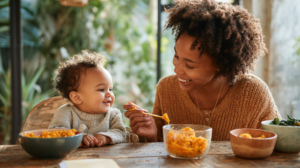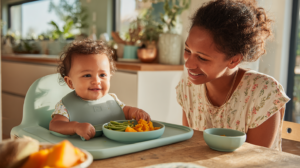
The Kitchen Memory Revolution: How Family Cooking Transforms Relationships (Not Just Dinner)
Quick Discovery: What’s Your Family Kitchen Reality?
Let me tell you something I learned the hard way. Three years ago, I was that parent rushing through meal prep like it was a race against time. Dinner had to be on the table by 6 PM sharp. The kitchen was MY domain. Kids? They were distractions. Mess? Absolutely not. Efficiency was everything.
Then one evening, my six-year-old asked if she could help make dinner. My first instinct was to say no—it would take twice as long, the kitchen would be a disaster, and honestly, I just wanted it done. But something made me pause. Maybe it was the hopeful look in her eyes. Maybe I was just too tired to argue. So I said yes.
What happened next changed everything. Sure, we got flour everywhere. Yes, dinner was 30 minutes late. And you know what? It was the best evening we’d had in months. She told me about school drama I never knew existed. We laughed. We created something together. And when we finally sat down to eat that slightly lopsided casserole, it tasted like pure joy.
That’s when I realized I’d been doing it all wrong. I wasn’t making memories. I was making meals.
The Science Behind Kitchen Connection
Here’s what researchers discovered in 2025 that completely flips the script on family cooking: it’s not about nutrition, meal planning, or even teaching kids to cook. A groundbreaking study involving 461 families found that shared cooking and dining practices directly enhance psychological flourishing—which basically means emotional resilience, life satisfaction, and the ability to thrive. The researchers measured something they called “interaction quality” and “participation frequency,” and families who scored high on both showed 39.3% better family functioning through flexibility, adaptability, and emotional regulation.
But here’s the kicker: the families who benefited most weren’t the ones with spotless kitchens or five-star meals. They were the ones who embraced the chaos, invited participation, and focused on connection over perfection.
Think about it like this: we spend so much energy trying to feed our families the “right” foods that we forget to feed the relationships. More than 80% of American families are now eating more meals together than before, but many still treat cooking as a solo mission rather than a shared experience. That’s a massive missed opportunity for connection.
Your Family Memory Calculator
The Mental Load Nobody Talks About
Let’s address the elephant in the kitchen: the mental load. A 2024 study revealed something many of us already felt in our bones—while mothers do more overall domestic labor than partners, the division of cognitive labor (the planning, anticipating, and monitoring) is even more disproportionate. This inequitable split correlates with depression, stress, burnout, and poorer relationship functioning.
So when I talk about “low-pressure family cooking,” I’m not just talking about lowering expectations for perfection. I’m talking about redistributing that invisible labor. When everyone participates in cooking, everyone shares the mental load. Your partner learns that milk doesn’t magically appear in the fridge. Your kids discover that dinner doesn’t spontaneously materialize at 6 PM.
But here’s where it gets interesting: the goal isn’t to add more burden—it’s to transform a chore into connection. One mother in a Copenhagen family cooking program said it perfectly: “We are a bit closer, right? And we got to know each other better—you know, you get to know each other when you do nice things together.”
Reframing the Mess
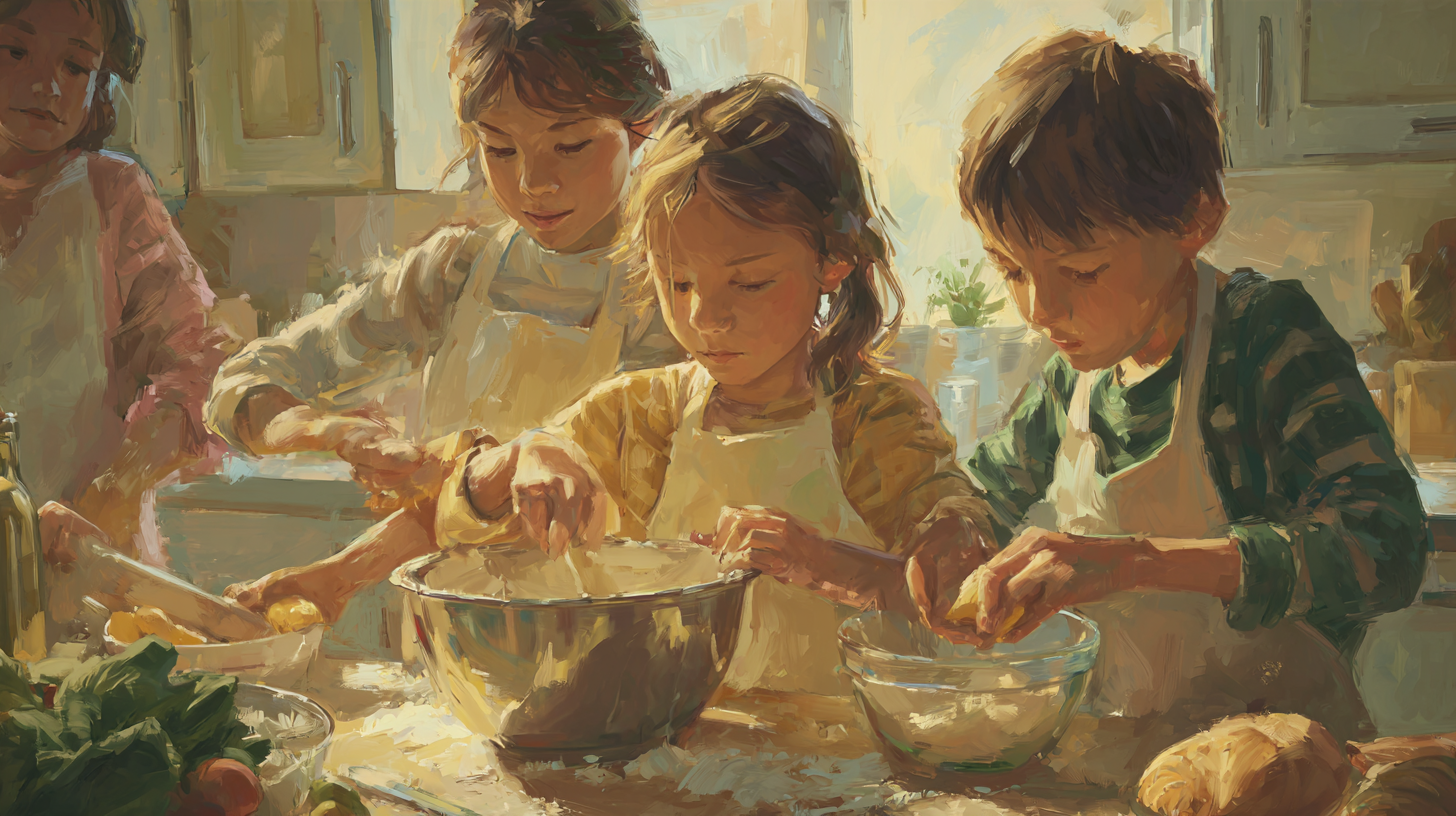
Here’s a shocking truth that changed my perspective completely: mess is not the enemy of family cooking. Mess is the evidence of participation. Every spilled ingredient, every sticky handprint, every dish in the sink represents a moment your child was learning, engaging, and connecting with you.
Research on age-appropriate cooking interventions shows that children as young as 2-3 can participate in cooking activities for 15-20 minutes with direct supervision. Ages 4-5 can extend to 20-30 minutes. Ages 6-8 can handle 30-45 minutes. And ages 9-12 can work for 45-60 minutes. Notice how none of these guidelines mention “mess-free” or “perfectly executed”? That’s because developmentally appropriate cooking inherently involves spills, mistakes, and learning through doing.
The Mess Management Mindset Shift
Simple Recipes That Invite Participation
The secret to stress-free family cooking isn’t complex meal planning or fancy techniques. It’s choosing recipes where participation matters more than precision. Think about the difference between a perfectly executed French omelet (high stress, low participation) versus building your own tacos (low stress, high participation).
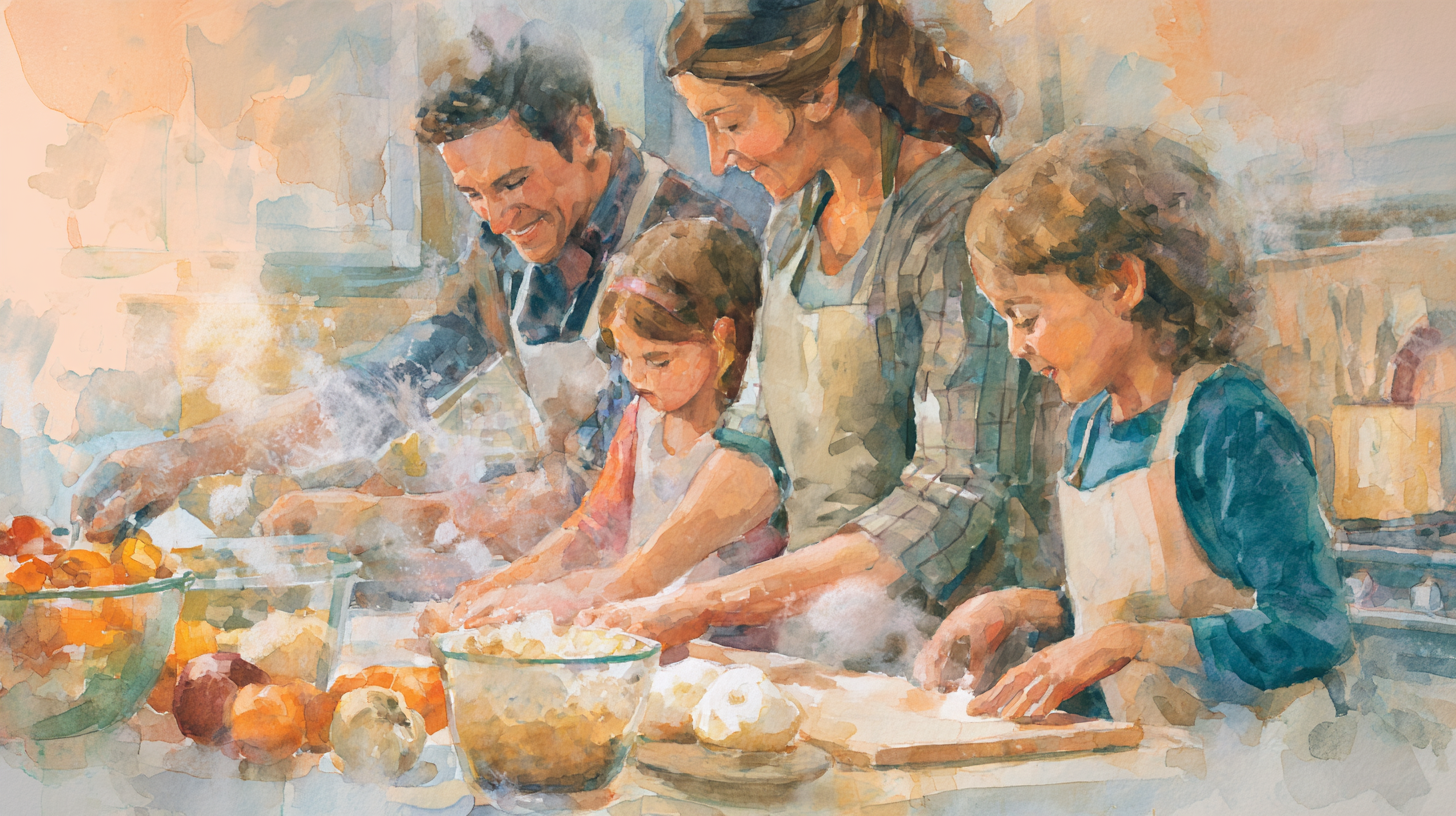
The Cooking with the Seasons for Health program in rural Washington demonstrated this beautifully. They used six sessions focused on parent-child dyads, incorporating food tasting, spotlight vegetables, interactive nutrition lessons, and child-focused cooking lessons. The key? Visual recipes with pictures where each page showed ingredients and step-by-step guidance, allowing even non-reading children to participate independently.
Here’s what works in real Caribbean kitchens and beyond:
One-Pot Wonders: Rice and peas, dhal, or simple stews let everyone contribute an ingredient. My daughter’s favorite is when she gets to add the coconut milk to our Caribbean-style Coconut Rice & Red Peas—that satisfying pour makes her feel like a master chef every time.
Build-Your-Own Meals: Taco night, loaded baked potatoes, or flatbread pizzas. Everyone assembles their own plate, and suddenly picky eating becomes creative expression. Sheet pan nachos are particularly magical because kids can see their exact contribution on the final product.
No-Cook Participation: Smoothies, salads, and sandwich stations require zero heat management, which means younger children can do almost everything independently. One brilliant parent created a smoothie station with pre-measured ingredient cups—her 4-year-old makes breakfast for the whole family now.
Dump-and-Stir Recipes: These are your secret weapon. Pre-measure ingredients into clear containers (kids love seeing what’s next), and let them do all the adding and mixing. Cornmeal porridge, muffins, and simple cakes work perfectly. If you’re introducing island flavors early, recipes like Cornmeal Porridge Dreams or Ti Pitimi Dous adapt beautifully for family cooking sessions.
✅ Your Low-Pressure Kitchen Readiness Check
Check the barriers you currently experience:
Managing Mistakes Without Breaking Down
Let’s talk about the dropped egg incident. In my old kitchen mindset, a dropped egg was a disaster—wasted food, mess to clean, time lost, frustration building. In my new kitchen mindset, a dropped egg is a teaching moment. And honestly? Sometimes it’s just funny.
The research backs this up in fascinating ways. Studies on children’s cooking programs found that when kids feel cooking competence increases, so does their wellbeing and movement competence. But here’s the crucial part: competence doesn’t come from never making mistakes. It comes from making mistakes in a supportive environment where failure is reframed as learning.
One cooking education specialist working with families recommends the “Oops! What’s Next?” approach. When something goes wrong (and it will), you simply say “Oops! What should we do next?” This simple phrase does three things: acknowledges the mistake without judgment, models problem-solving, and keeps the momentum going without dwelling on the error.
A father in the Tingbjerg Family Cooking Classes project shared that his biggest breakthrough came when he stopped trying to prevent mistakes and started celebrating recovery. His son knocked over a bowl of flour? They laughed, cleaned it together, and measured out more flour—this time with the bowl in the center of the counter. That recovery process taught more than a hundred perfect attempts ever could.
Creating Positive Memories That Last
Here’s what nobody tells you about family cooking memories: they’re not made in the big moments. They’re made in the tiny ones. The way your toddler’s tongue sticks out in concentration when stirring. The conversation that happens naturally when your teenager’s hands are busy chopping. The “remember when” stories that get told years later.
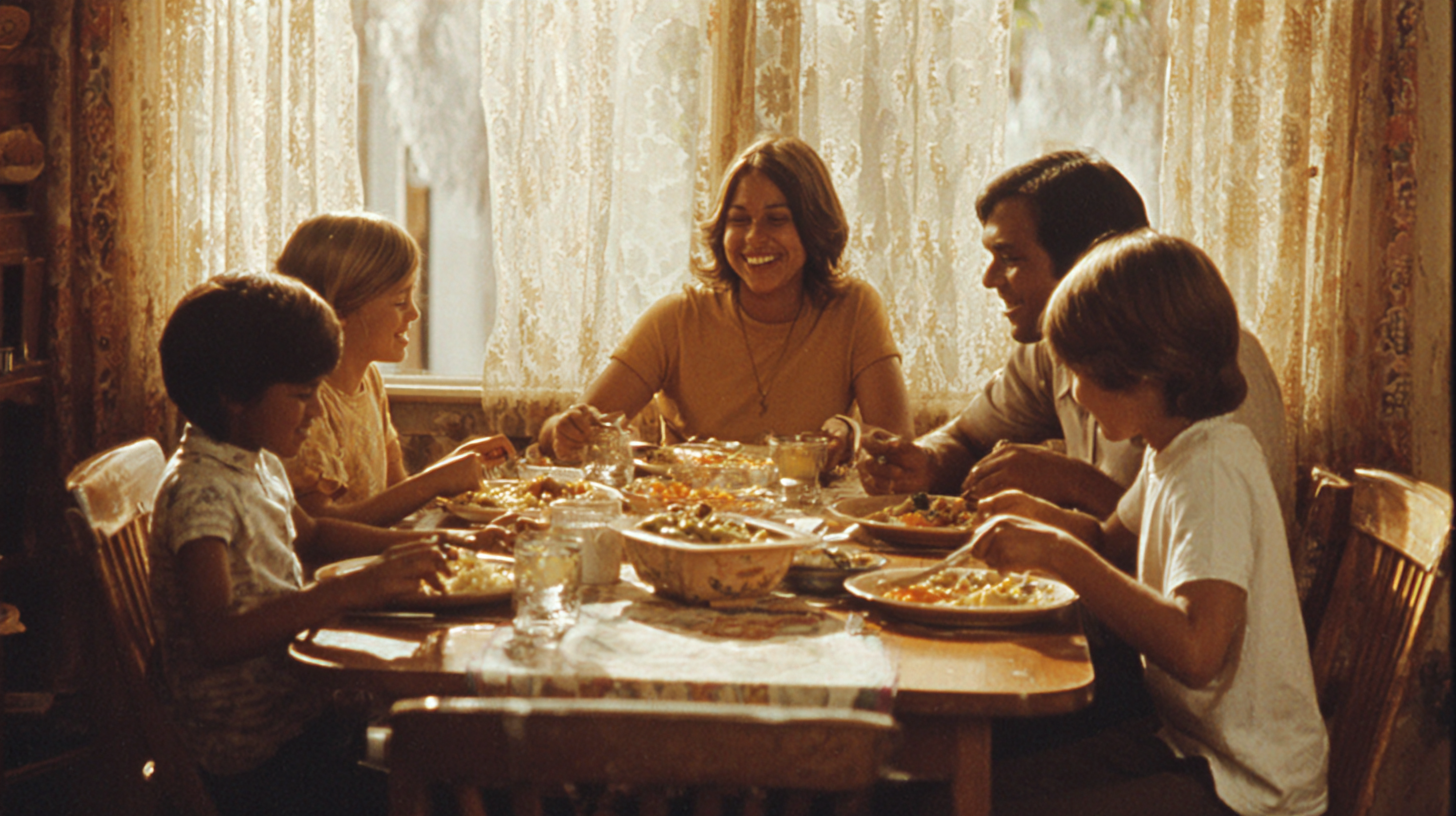
Research published in 2025 on family dynamics and cooking found that shared culinary practices enhance family well-being through three specific mechanisms: strengthening family cohesion (the “we-ness” of your family unit), promoting healthy behaviors together (creating shared values around food and health), and fostering psychological flourishing (building emotional resilience and life satisfaction).
But translating research into reality requires intentional memory-making strategies. Here’s what actually works:
Theme Night Rituals: Taco Tuesday or Pizza Friday aren’t just about reducing decision fatigue (though they definitely do that). They’re about creating predictable traditions your kids can anticipate and eventually take ownership of. One mother reported that her now-teenage son, who moved away for college, still FaceTimes the family every Friday during “his” pizza night.
Kitchen Soundtracks: Let kids develop playlists for cooking time. Music creates powerful memory anchors. Twenty years from now, hearing that song will transport them right back to your kitchen. My daughter’s current obsession is creating “stirring songs” versus “chopping songs”—I have no idea what makes them different, but she’s absolutely certain there’s a distinction.
Recipe Scrapbooks: Document your cooking adventures together with photos, sauce-stained recipe cards, and notes about who did what. Include the disasters alongside the triumphs. These imperfect, authentic records become family treasures. One family I know includes “tasting notes” where each person writes one word describing the dish—reading their 5-year-old’s evolution from “yucky” to “interesting” to “amazing” for various vegetables is pure gold.
Collaborative Menu Planning: Use a whiteboard or shared digital document where each family member contributes top meal choices. This approach was featured in multiple family cooking programs as a way to increase buy-in and reduce conflicts. When kids see their choice coming up, participation skyrockets. Bonus: they’re learning planning and anticipation skills without realizing it.
Cultural Connection Cooking: This is where Caribbean cooking traditions shine brilliantly. Teaching children to make dishes from your heritage—whether that’s rice and peas, roti, or mofongo—connects them to something larger than themselves. These recipes carry stories, history, and identity. When my friend introduces her children to traditional Caribbean flavors starting in babyhood, she’s not just feeding them; she’s giving them roots.
Your 4-Week Kitchen Transformation Journey
Click each step as you complete it!
The Time Truth
Let’s address the big objection head-on: “I don’t have time for this.” I hear you. Research shows that Americans spend an average of just 37 minutes daily on meal preparation. Parents with children spend more, but not much more. When you’re running on empty, the idea of inviting chaos into your already-rushed routine sounds impossible.
But here’s the perspective shift that changed everything for me: you’re going to spend that time cooking anyway. The question isn’t whether you have time—it’s how you want to spend the time you’re already using.
Cooking alone: 30 minutes of task completion. Cooking together: 45 minutes of relationship building. Both produce dinner. Only one produces memories and stronger family bonds. When researchers tracked families over time, they found that those who prioritized shared cooking time reported feeling less time-stressed overall, even though the actual cooking took longer. The emotional benefit of connection reduced the perceived time pressure in other areas of life.
Plus, there’s a long-term efficiency factor nobody talks about. Kids who regularly participate in cooking develop real skills. By age 8-10, many can prepare simple meals independently. By teenage years, they can handle full dinner preparation. That’s not just about future adulting skills—that’s about a 14-year-old who can actually help with meal prep instead of adding to your mental load.
When Participation Doesn’t Look Perfect
Social media has done a number on our expectations for family cooking. Scroll through Instagram, and you’ll see children in pristine white aprons, perfectly measured ingredients in matching bowls, and kitchens that look like photo shoots. A 2025 analysis of family meal trends on Instagram revealed hidden pressures behind these picture-perfect moments—the planning, staging, and emotional labor required to create that aesthetic often contradicts the joy and spontaneity that makes family cooking meaningful.
Real family cooking looks different. It looks like a 4-year-old who insists on cracking eggs even though you both know half the shell will end up in the bowl. It looks like a 10-year-old who measures flour with such concentration that time seems to stop. It looks like a teenager who won’t look at you directly but suddenly opens up about friendship drama while dicing onions.
The BRITE Box recipe kit study found that when parents received structured support for cooking with kids, they reported improved dietary diversity and positive impacts on family food-related behaviors. But the most interesting finding? The improvements had nothing to do with perfect execution. They came from consistent participation, even when that participation was messy, chaotic, or imperfect.
One mother in the study said something that stuck with me: “I learned to care less about how the kitchen looked and more about how my kids felt.” That shift in priority—from outcome to experience—is where the transformation happens.
Addressing the Safety Question
Let’s talk about the elephant in the kitchen: safety concerns. Research shows that parental worry about safety (boiling water, hotplates, large knives) is one of the top barriers to family cooking with children. These concerns are valid. But here’s what the evidence actually shows about age-appropriate cooking and safety.
Guidelines for designing age-appropriate cooking interventions, developed through multidisciplinary research, establish clear safety parameters for different ages. The key insight? Safety comes from appropriate task assignment and supervision, not from keeping kids out of the kitchen entirely.
Ages 2-3 can safely: wash vegetables in cold water, tear lettuce, snap green beans, stir cold ingredients, sprinkle toppings, and use cookie cutters. Ages 4-5 add: measuring with cups and spoons, pouring pre-measured liquids, mashing with a fork, kneading dough, and peeling bananas. Ages 6-8 incorporate: using a butter knife for soft foods, simple peeling with supervision, cracking eggs (into a separate bowl!), and using hand-crank tools. Ages 9+ can progress to: cutting with appropriate knives under supervision, stovetop cooking with oversight, and reading recipes independently.
Notice what’s missing from these guidelines? Preventing all mistakes. The goal isn’t perfection—it’s appropriate challenge within safe boundaries. That’s how competence and confidence develop together.
The Cultural Wisdom We’re Forgetting
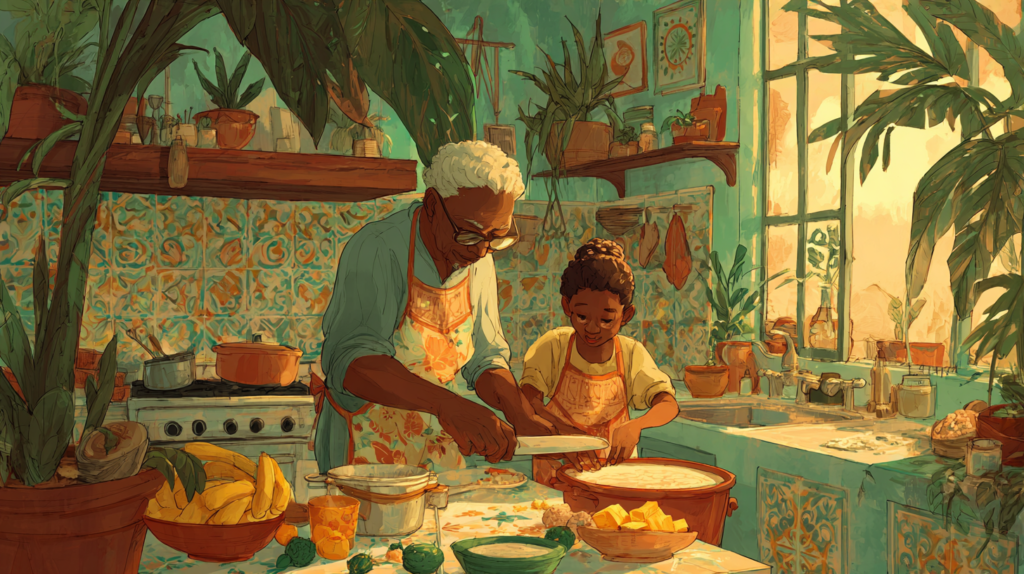
Here’s something beautiful happening in Caribbean kitchens that the rest of the world is slowly remembering: cooking has never been a solo activity. In traditional Caribbean homes, meal preparation is inherently communal. Grandmothers, mothers, aunts, and children all participate according to ability. There’s no concept of “keeping kids out of the kitchen”—the kitchen is where life happens.
This isn’t just cultural nostalgia; it’s wisdom worth reclaiming. When cooking is framed as a family activity rather than an individual task, everything shifts. The mental load distributes. Skills transfer naturally across generations. Food traditions preserve themselves through participation rather than instruction. Connection happens organically because hands are busy and guards are down.
Research on modern transference of domestic cooking skills found that modern Western culture has largely lost this intergenerational transmission. The result? Young adults who can’t cook, parents who feel overwhelmed by solo meal preparation, and families missing out on the bonding that happens naturally when everyone’s hands are in the pot.
But here’s the good news: you can reclaim this wisdom starting today. You don’t need multiple generations in your kitchen (though that’s wonderful if you have it). You just need to shift from “I’m cooking dinner” to “We’re making dinner together.” That simple pronoun change—from I to we—transforms the entire experience.
And if you’re wondering how to introduce authentic Caribbean flavors to your children from the very beginning of their food journey, starting with adapted versions of traditional recipes builds their palate and connection to heritage simultaneously. Recipes like Sweet Potato & Callaloo Rundown or Yellow Yam & Carrot Sunshine introduce complex flavors gently, setting the stage for lifetime appreciation of your food culture.
What Success Actually Looks Like
Let me paint you two pictures. In the first picture, dinner is on the table at exactly 6 PM. The kitchen is spotless. The meal is nutritionally balanced and beautifully presented. You did it all yourself while everyone else watched TV or did homework. You’re exhausted but accomplished.
In the second picture, dinner happens at 6:30 PM. There’s flour on the counter and a dish towel on the floor. The meal is slightly lopsided and one side is more cooked than the other. But your 7-year-old proudly announces to the family that she made the sauce. Your partner actually knows where the mixing bowls live now. Your teenager told you about something real while chopping vegetables. And when you sit down to eat, everyone’s already invested because they participated in creating it.
Which picture represents success? According to research on family well-being and cooking practices, it’s the second one. By every measure that matters—family cohesion, psychological flourishing, life satisfaction, emotional resilience—the messy, collaborative version wins.
Success in family cooking isn’t about the meal. It’s about moments like these, reported by actual families in cooking research studies:
“I think my mom and I have been closer than normal.” – Child, age 10
“We got to know each other better—you know, you get to know each other when you do nice things together.” – Parent
“Now he asks to help with dinner every night. I used to see that as inconvenient. Now I see it as precious.” – Parent
That’s what success looks like. Not perfect meals. Perfect moments.
Your Kitchen, Your Way, Starting Now
You don’t need a complete kitchen overhaul. You don’t need fancy tools or extensive meal plans. You definitely don’t need matching aprons or Pinterest-worthy setups.
You just need to invite someone in. Start this week. Choose one simple meal. Ask your child if they want to help. Say yes to the mess. Laugh at the mistakes. Notice the connection.
That’s it. That’s the revolution. Want more guidance on building food traditions that last? Explore Caribbean recipes designed for families to discover how simple, flavorful cooking can become your family’s foundation.
What Happens Next
Here’s the truth about family cooking that took me years to understand: you’re not just making dinner. You’re making who your children become.
Children who regularly participate in family cooking develop stronger emotional regulation skills. They build confidence through competence. They learn that mistakes aren’t failures—they’re part of the process. They experience teamwork, communication, and problem-solving in real-time. They understand that contributions matter, that their participation creates something meaningful.
And they remember. Oh, do they remember.
Twenty years from now, your children won’t recall whether dinner was on time or if the kitchen stayed clean. They won’t remember the exact nutritional breakdown of every meal. But they will remember the feeling of your kitchen—the safety, the laughter, the belonging. They’ll remember that they mattered enough to be included. They’ll remember that your family’s table was a place where they were valued, not just fed.
Those memories? They’re built one messy, imperfect, beautiful meal at a time.
The research couldn’t be clearer: families who cook together regularly show 39.3% higher emotional resilience and family functioning. They experience enhanced psychological flourishing and life satisfaction. Their children demonstrate better wellbeing and stronger social bonds.
But more than any statistic, here’s what I know from experience: three years after that first flour-covered evening with my daughter, cooking together is now our most treasured time. She’s nine now, and she can make scrambled eggs, mix salad dressing, and roll the best roti you’ve ever tasted. But more importantly, our kitchen has become where she tells me things. Where we dream together. Where we build memories that will outlast both of us.
That transformation didn’t require perfection. It required presence. It didn’t require expertise. It required invitation. It didn’t require more time. It required different time—time spent together instead of alone, building connection instead of just completing tasks.
Your kitchen holds that same potential. Not someday when you’re less busy or more organized or better prepared. Today. Right now. This evening.
So here’s my invitation to you: stop waiting for the perfect moment. Stop worrying about the mess. Stop stressing about efficiency. Instead, invite your people into your process. Lower the pressure. Raise the participation. Watch what happens when you transform cooking from a solo race against time into a shared journey toward connection.
Because at the end of the day—at the end of your life, really—nobody wishes they’d spent more time cooking perfect meals alone. They wish they’d spent more time creating imperfect memories together.
The magic is in the mess. The joy is in the journey. The bond is in the building.
Your kitchen is waiting. Your people are ready. The only question left is: are you?

Kelley's culinary creations are a fusion of her Caribbean roots and modern nutritional science, resulting in baby-friendly dishes that are both developmentally appropriate and bursting with flavor. Her expertise in oral motor development and texture progression ensures that every recipe supports your little one's feeding milestones while honoring cultural traditions.
Join Kelley on her flavorful journey as she shares treasured family recipes adapted for tiny taste buds, evidence-based feeding guidance, insightful parenting anecdotes, and the joy of celebrating food, culture, and motherhood. Get ready to immerse yourself in the captivating world of Kelley Black and unlock the vibrant flavors of the Caribbean for your growing baby, one nutritious bite at a time.
- The Feeding Revolution: Why Your Everyday Meals Are Changing the World - October 13, 2026
- Your Feeding Story Matters More Than The “Perfect” One Online - October 12, 2026
- Looking Forward: Stepping Into Your Confident Feeding Future - October 11, 2026