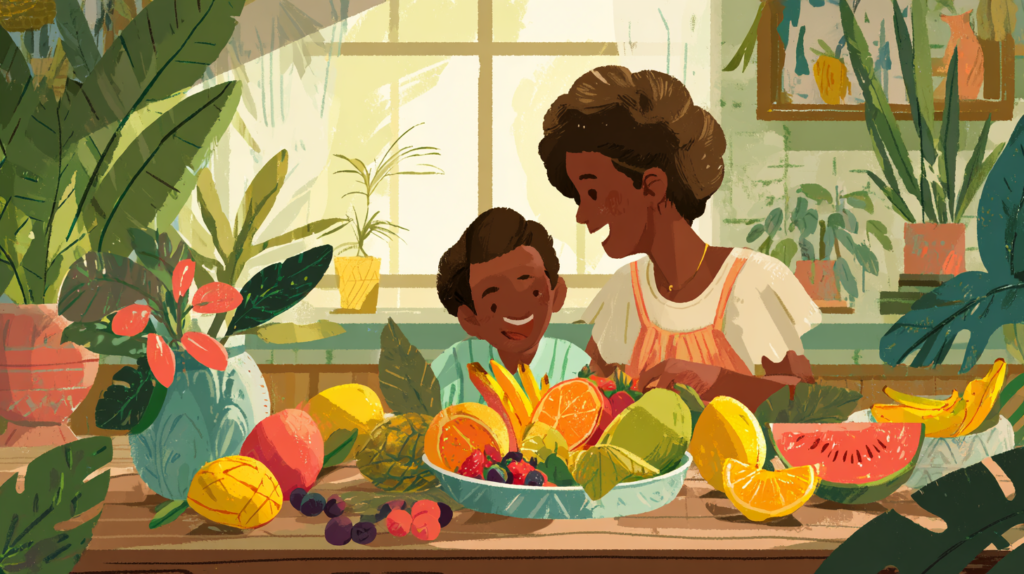
The Fruit Truth: Why Your Child’s Natural Sugar Intake Isn’t What You Think
Quick Fruit Quiz: What’s Your Parenting Fruit Philosophy?
Before we dive in, let’s see where you stand. Click the statement that best describes your current approach:
Here’s something I learned three years into parenting that completely changed how I approached my daughter’s snack plate: the panic over fruit sugar isn’t just misplaced—it’s actively working against our children’s health. And I discovered this the hard way, standing in my kitchen at 2 AM, reading nutrition labels by phone light after my pediatrician casually mentioned that my daughter wasn’t eating enough whole fruit.
The truth is, somewhere between diet culture’s “sugar is evil” messaging and juice companies’ clever marketing, parents like us got caught in a confusing middle ground. We’re bombarded with conflicting advice: fruit is nature’s candy (bad!), but also essential nutrition (good!). Juice counts as a serving (convenient!), but also rots teeth (terrifying!). No wonder 32% of children ages 1-5 aren’t eating fruit daily, according to 2021 CDC data, while 57% are drinking sugar-sweetened beverages regularly.
But here’s what changed everything for me, and what I’m about to share with you: the conversation we should be having about fruit isn’t about limiting it—it’s about understanding it. Because when you know the real difference between an apple and apple juice, between a single serving and an all-fruit diet, between summer berries and year-round imports, you stop second-guessing every snack decision.
This isn’t another lecture about what you’re doing wrong. This is the balanced, research-backed perspective you’ve been searching for—one that acknowledges both nutrition science and the reality of feeding actual children who have opinions about food.
The Sugar Conversation Nobody’s Having Right
Let me tell you about my neighbor, Maria. Smart woman, reads all the parenting blogs, follows the wellness influencers. Last month, she told me she’d started limiting her four-year-old son to one small piece of fruit per day because she’d read that “sugar is sugar” and fruit was basically nature’s candy bar. Meanwhile, she was serving him “healthier” packaged snacks with added sugars that made a mango look like a vitamin supplement.
This is the fundamental misunderstanding that’s creating unnecessary anxiety in kitchens across the country: the idea that natural fruit sugar operates the same way in your child’s body as processed, added sugar. And it absolutely does not.
When your child bites into an orange, they’re not just getting fructose. They’re getting a complete nutritional package: fiber that slows sugar absorption, vitamin C that supports immune function, potassium for healthy blood pressure, and antioxidants that protect developing cells. That fiber is particularly crucial—it’s the reason your child’s blood sugar doesn’t spike and crash after eating fruit the way it might after drinking juice or eating candy.
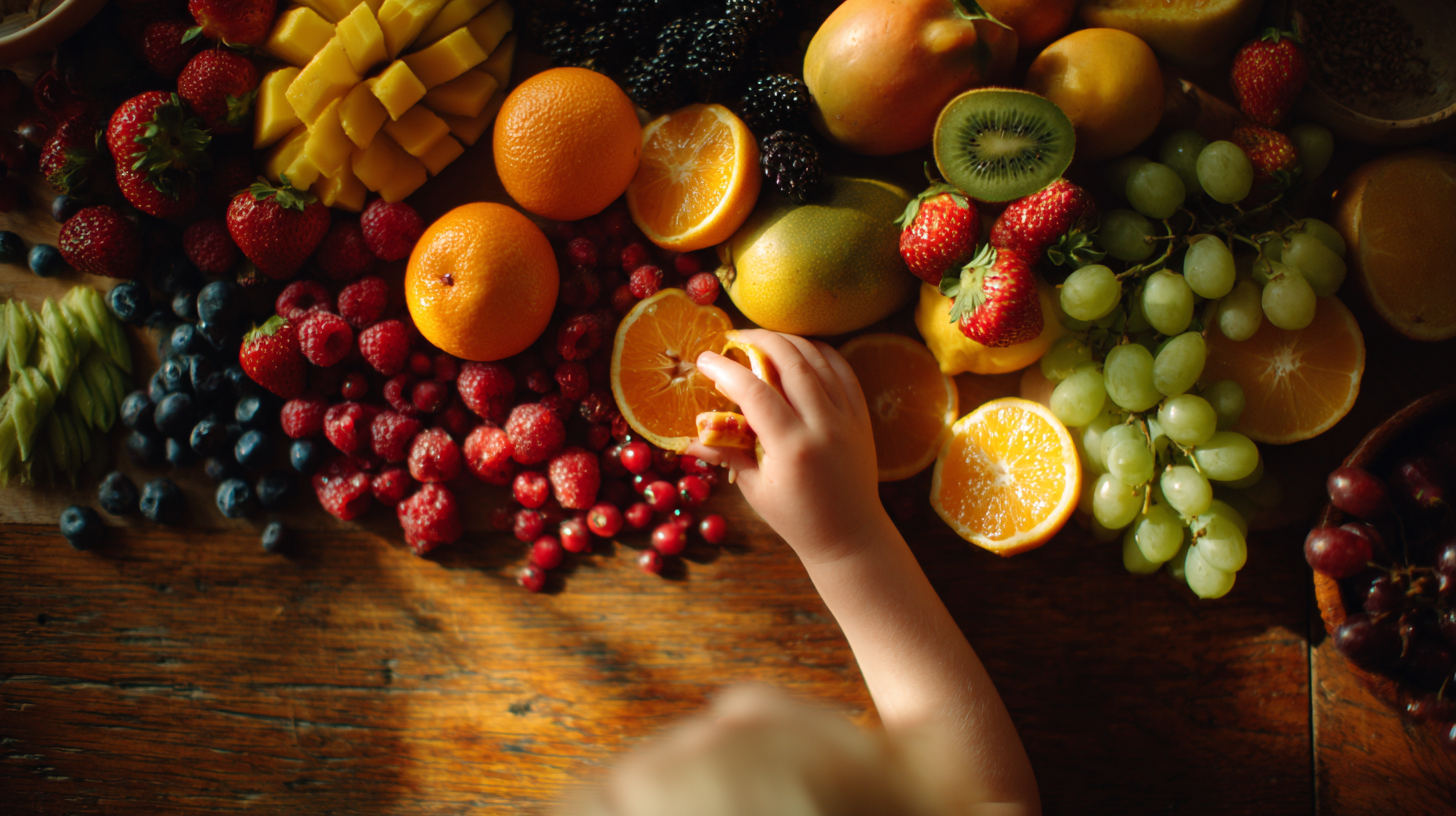
Research published in 2024 examining free sugars in children’s diets found that whole fruit consumption was associated with better overall diet quality, while added sugars—the kind in processed foods and beverages—were linked to poorer nutritional intake. The study emphasized that naturally occurring sugars in whole fruit shouldn’t be limited in the same way as added sugars, yet many parents are doing exactly that.
Expert nutritionists consistently emphasize this distinction. The natural sugars in whole fruits come packaged with essential nutrients and fiber that make them fundamentally different from processed sugars. When researchers looked at children’s diets globally, they found that less than 10% of children in some countries were meeting recommended fruit intake levels, not because they were eating too much, but because parents were unnecessarily restricting it.
Here’s what this means practically: you don’t need to count the grams of sugar in that apple. You don’t need to limit berries because they’re “high in sugar.” The American Academy of Pediatrics and nutritional guidelines worldwide don’t recommend limiting whole fruit consumption in children—they recommend increasing it. The only time you’d need to moderate fruit intake is in the extreme case of a child eating fruit to the exclusion of other food groups, which we’ll address later.
Myth-Busting Time: Click to Reveal the Truth
TRUTH: A medium apple has 19g of natural sugar plus 4g of fiber, vitamin C, and potassium. A candy bar has 20g+ of added sugar with zero fiber or nutrients. Your child’s body processes these completely differently. The fiber in fruit slows sugar absorption, preventing blood sugar spikes.
TRUTH: Studies show whole fruit consumption in children is actually associated with healthier body weight, not weight gain. The fiber creates satiety, and the nutritional density supports proper growth. Childhood obesity is linked to added sugars in processed foods, not whole fruit intake.
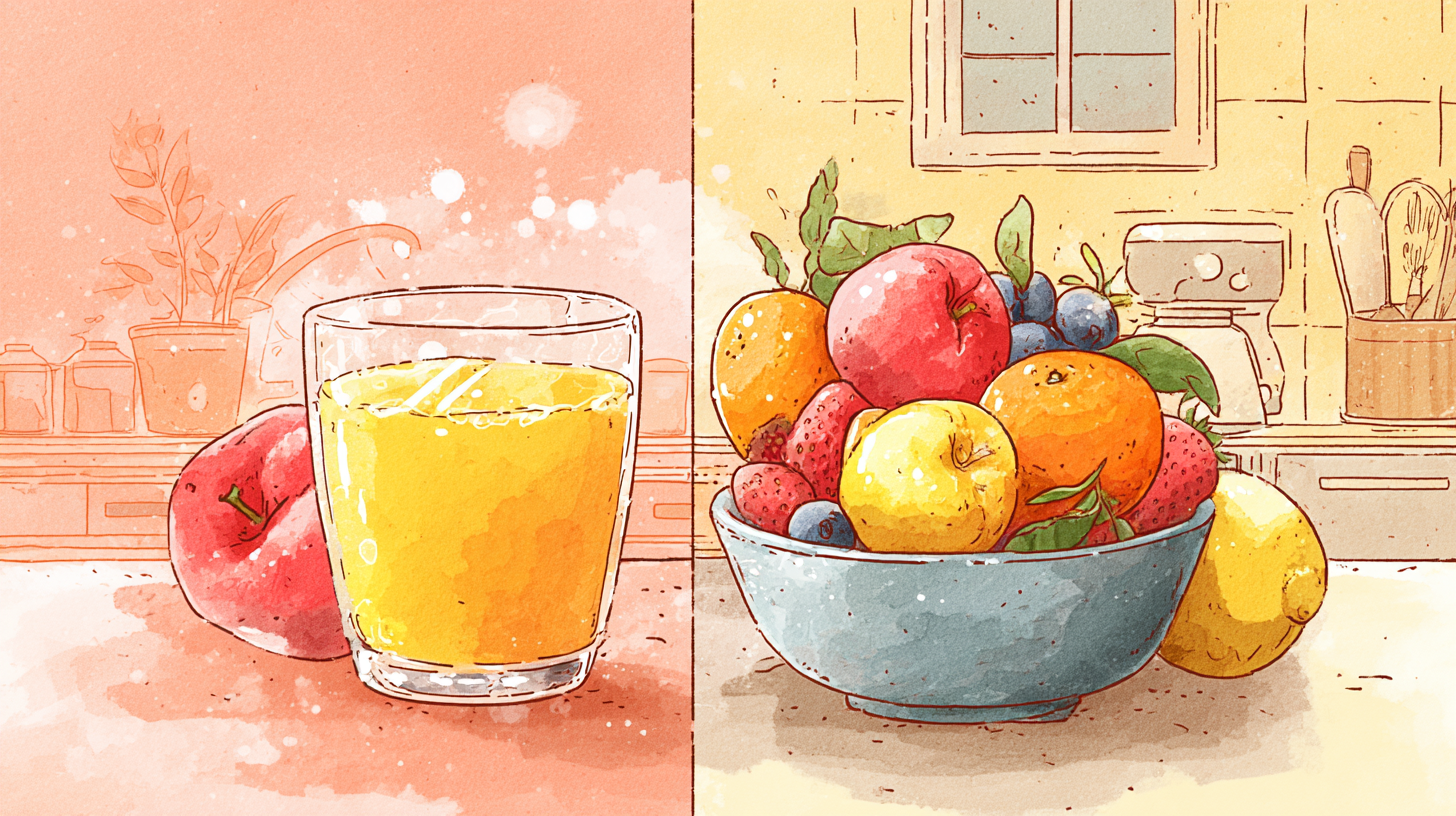
TRUTH: Recent research shows that replacing juice with whole fruit reduces sugar intake by 3.4-5.6g per day and adds 0.5-1.3g of fiber. When you juice a fruit, you remove the fiber that makes fruit beneficial. Four ounces of juice can contain the sugar of 3-4 whole fruits without any of the filling fiber.
The real villain in our children’s diets isn’t the banana in their lunchbox—it’s the 57% of young children drinking sugar-sweetened beverages regularly, according to 2021 data. It’s the processed snacks marketed as “healthy” that contain more added sugar than a serving of fruit. When we misdirect our concern toward whole fruit, we’re fighting the wrong battle entirely.
The Whole Fruit vs. Juice Showdown
I used to think I was doing the right thing by keeping a variety of 100% fruit juices in my fridge. Orange juice with breakfast, apple juice with lunch—it counts as fruit, right? My daughter was happy, I wasn’t fighting the “just one more bite” battle, and she was getting her fruit servings. Win-win. Or so I thought.
Then I learned what actually happens when you turn a fruit into juice, and why pediatric nutritionists are increasingly firm about limiting it. The transformation isn’t just physical—it’s metabolic.
When you eat an orange, the fiber creates a matrix that your digestive system has to work through. This slows down sugar absorption, keeps you feeling full, and allows your body to process the natural sugars gradually. When you drink orange juice, you’re getting the liquid sugar of multiple oranges delivered rapidly into your bloodstream, minus the fiber that would normally moderate that absorption. Your child’s body experiences this as a sugar load, not as the nutritious fruit it started as.
The American Academy of Pediatrics has become increasingly specific about juice limits for good reason: 4 ounces per day maximum for ages 1-3, 4-6 ounces for ages 4-6, and 8 ounces for ages 7-14. These aren’t arbitrary numbers—they’re based on research showing the effects of excess juice consumption on dental health, weight, and overall nutrition.
A groundbreaking 2025 study projected what would happen if early care and education programs replaced juice with whole fruit. The results were striking: children would consume 3.4-5.6 fewer grams of sugar per day and gain 0.5-1.3 more grams of fiber. Over time, this small daily difference compounds into significantly better nutritional outcomes.
Whole Fruit vs. Juice Calculator
Select your child’s age group to see personalized recommendations:
But here’s where I want to get real with you: I’m not suggesting you never give your child juice. I’m suggesting you understand what juice is—a treat, not a fruit serving. When my daughter asks for apple juice now, I’ll sometimes say yes, but I count it mentally in the same category as other sweet beverages, not as her daily fruit intake.
The practical shifts that worked for our family were surprisingly simple. Instead of juice boxes in the diaper bag, I started packing clementines (easy to peel, no mess, self-contained). Instead of juice with breakfast, we’d blend a smoothie with whole fruit, Greek yogurt, and a handful of spinach she couldn’t taste—getting fiber and protein along with the fruit. And yes, sometimes we still have juice, but it’s a conscious choice rather than a default.
If your child is accustomed to juice and you’re worried about the transition, start by diluting it—half juice, half water. Many children don’t even notice. Gradually increase the water ratio. Simultaneously, make whole fruit as convenient as juice: pre-cut melon in containers, berries washed and ready to grab, apple slices with a small container of nut butter for dipping. The key insight I learned is that convenience often trumps preference. When whole fruit is as easy to grab as juice, children will eat it.
How Much Fruit Is Actually Right?
After the third time someone told me their toddler would “only eat fruit” for dinner, I realized we’d swung from one extreme to another. We went from juice-as-fruit to fruit-as-unlimited, and parents were confused about where the actual middle ground lived.
The recommendations aren’t as complicated as they seem: children ages 2-3 need about 1 cup of fruit daily. Ages 4-8 need 1 to 1.5 cups. Older children and teens need 1.5 to 2 cups. A “cup” is more intuitive than it sounds—one medium apple, one large banana, or about 16 grapes. Eight large strawberries. Half a large grapefruit. One cup of cut melon pieces.
But these are guidelines, not rigid rules. Some days your child will eat more fruit, some days less. The goal is balance across the week, not perfection every single day. What concerns pediatric nutritionists isn’t a child who eats two bananas one day—it’s a pattern of only eating fruit while refusing proteins, vegetables, and whole grains.
I spoke with a pediatric dietitian who shared something that stuck with me: “Fruit problems are almost never about eating too much fruit. They’re about not eating enough of other things.” This reframed everything. The question isn’t whether your child ate three servings of fruit today—it’s whether they’re also getting adequate protein, healthy fats, whole grains, and vegetables.
Teaching portion awareness to children doesn’t mean restricting fruit—it means helping them understand what a balanced plate looks like. I started using the visual method: imagine your plate divided into quarters. One quarter is protein, one quarter is whole grains, and two quarters are fruits and vegetables combined. This gives children a concrete visual that doesn’t require measuring cups or mathematical thinking.
For parents of picky eaters who worry their child won’t eat enough fruit, the research offers reassurance: consistent exposure matters more than immediate acceptance. Children may need to see, touch, smell, and taste a new fruit 10-15 times before accepting it. This isn’t pickiness—it’s normal developmental food neophobia. Your job isn’t to force fruit consumption; it’s to continue offering it without pressure.
And for Caribbean families especially, fruit is deeply woven into our food culture. From papaya at breakfast to mango as an afternoon snack, fruit isn’t just nutrition—it’s tradition, comfort, and connection. When I make recipes from my Caribbean Baby Food Recipe Book, like the Papaya Banana Sunshine puree or the Mango Morning blend, I’m not just feeding my daughter—I’m passing down the flavors of home while ensuring proper nutrition. These recipes balance tropical fruits with other nutrient-dense ingredients like coconut, sweet potato, and whole grains.
The Rainbow Plate Revolution
Last summer, my daughter went through a phase where she’d only eat strawberries. Morning, noon, night—strawberries. As a parent, I was caught between relief (at least she’s eating fruit!) and concern (is this enough variety?). This is when I discovered what nutrition educators call the “Rainbow Plate” approach, and honestly, it changed not just what my daughter ate, but how she thought about food.
The concept is brilliantly simple: different colored fruits contain different nutrients. Red fruits (strawberries, watermelon, cherries) are high in lycopene and vitamin C. Orange and yellow fruits (mangoes, peaches, pineapple) deliver beta-carotene and vitamin A. Blue and purple fruits (blueberries, blackberries, plums) are packed with anthocyanins and antioxidants. Green fruits (kiwi, green grapes, honeydew) offer folate and potassium. White and brown fruits (bananas, pears) provide fiber and potassium.
When children eat across this color spectrum, they’re naturally consuming a broader range of vitamins, minerals, and protective compounds. A 2019 study on sensory-based food education found that programs teaching children to select fruits in a range of colors significantly improved both the quantity and variety of fruit consumption. Children weren’t just eating more fruit—they were excited about it.
Your Seasonal Fruit Guide
Click a season to discover the best fruits for your family right now:
Eating seasonally isn’t just trendy—it’s practical nutrition. Seasonal fruits are typically more affordable, fresher, and more nutrient-dense than out-of-season imports that traveled thousands of miles. When strawberries are in season locally, they’re not only cheaper but also sweeter and more nutritious than the ones shipped from across the world in winter.
In the Caribbean tradition, we’ve always eaten with the seasons—mango season in summer, soursop in fall, citrus in winter. This natural rotation ensures dietary diversity without having to overthink it. The Caribbean Baby Food Recipe Book features recipes that honor this seasonal approach, like the Guanabana Dreams (soursop) puree perfect for fall feeding, or the Mango Morning blend that celebrates summer abundance.
But beyond nutrition and cost, there’s something valuable about teaching children that food has seasons. It creates anticipation (mango season is coming!), gratitude (we get fresh berries right now!), and connection to natural cycles. My daughter now asks, “Is it strawberry time yet?” in a way that makes her understand food comes from somewhere real, not just the grocery store.
For families in regions with less dramatic seasonal variation, you can still create this diversity by rotating focus fruits monthly. January might be citrus month—oranges, grapefruits, clementines. February could be tropical month—pineapple, mango, papaya. This keeps your child’s palate engaged and ensures nutritional variety without requiring extensive meal planning.
When Fruit Becomes the Only Food
I need to talk about something that doesn’t get addressed enough: the growing number of toddlers and young children whose parents report they “only eat fruit.” This isn’t the same as eating a lot of fruit alongside other foods—this is fruit replacing meals, fruit as the answer to every food refusal, fruit as the entire diet.
Here’s the truth that made me uncomfortable at first: while whole fruit is nutritious, a fruit-only diet is dangerous for children. It’s a form of malnutrition, not wellness, despite how “natural” it sounds. Children on primarily fruitarian diets are at serious risk for protein deficiency, iron deficiency anemia, calcium deficiency, vitamin B12 deficiency, and inadequate healthy fats essential for brain development.
The research on fruitarianism—diets consisting primarily or exclusively of fruit—consistently shows severe nutritional risks. Growing children need complete proteins for muscle and tissue development. They need iron for cognitive function and energy. They need calcium for bone growth. They need omega-3 fatty acids for brain development. Fruit provides virtually none of these nutrients in adequate amounts.
I’m not talking about a child who eats fruit with every meal and snacks on berries. I’m talking about the child who refuses dinner but will eat three bananas. The toddler who lives on applesauce and watermelon. The preschooler whose parents have given up offering other foods because “at least they’re eating fruit.”
If this resonates uncomfortably, you’re not alone, and you’re not a bad parent. Feeding challenges with young children are extraordinarily common, and fruit often becomes the default because it’s one thing they’ll consistently accept. But it’s crucial to address this pattern with professional support—a pediatric dietitian can help create strategies to slowly expand accepted foods while ensuring nutritional adequacy in the meantime.
The key insight from feeding therapists is that restrictive eating patterns rarely resolve on their own. They require gentle, consistent intervention that respects the child’s autonomy while gradually expanding their accepted food repertoire. This might include family-style meals where all foods are available without pressure, cooking together to increase food familiarity, and separating the job of providing food from the job of eating it.
Making Peace with Fruit
What finally gave me peace about fruit in my daughter’s diet wasn’t more information—it was a shift in perspective. I stopped asking, “Is this too much fruit?” and started asking, “Is my child eating a variety of foods across all food groups?”
When I looked at our week as a whole rather than fixating on individual meals, I saw that yes, she ate fruit every day. But she also ate proteins, whole grains, vegetables, dairy, and healthy fats. The fruit wasn’t crowding out other nutrition—it was part of a varied diet. And suddenly, the anxiety disappeared.
This is the balanced perspective that gets lost in the noise: fruit is neither a dietary villain to be restricted nor a miracle food that can replace other nutrition. It’s one component of a healthy childhood diet, and most children aren’t eating enough of it, not too much.
✅ Your Balanced Fruit Checklist
Click each item as you implement it in your family’s routine:
The practical wisdom I wish someone had told me three years ago: keep cut fruit visible and accessible in clear containers at your child’s eye level in the fridge. This single change increased our fruit consumption more than any lecture or rule. When my daughter can see berries and melon right at her height, she chooses them.
Involve your children in fruit selection at the market or store. Let them pick one new fruit to try each shopping trip. Make it an adventure, not a chore. My daughter has discovered favorites this way that I never would have selected—dragon fruit, persimmons, kumquats. Her willingness to try new foods has expanded far beyond fruit because she feels ownership over these choices.
For Caribbean families wanting to introduce traditional tropical fruits, start young and start often. The flavors of mango, papaya, soursop, and guava aren’t just nutrition—they’re cultural connection. Recipes like the Zaboca (Avocado) and Green Fig Blend or the Chola Dominicana (zapote) puree from the Caribbean Baby Food Recipe Book make these introductions easy and developmentally appropriate for babies and toddlers.
And perhaps most importantly: model the behavior you want to see. Children who watch their parents eating and enjoying whole fruit are significantly more likely to do the same. Our food culture starts at home, at our own plates. When fruit is a natural part of adult eating, it becomes a natural part of childhood eating.
Your Next Right Step
If you take only one thing from this article, let it be this: the conversation about fruit in your child’s diet should be about abundance, not restriction. About variety, not limits. About understanding, not fear.
The magic isn’t in measuring every portion or tracking every gram of natural sugar. It’s in creating an environment where whole fruit is normal, accessible, and delicious. Where juice is occasional, not default. Where eating across the color spectrum happens naturally. Where your child learns that fruit is both nutritious and joyful—part of a balanced diet, part of cultural tradition, part of the simple pleasure of eating real food.
You don’t need perfect fruit consumption. You need consistent progress toward variety and balance. Some weeks you’ll nail it. Some weeks you’ll fall back on the familiar. That’s not failure—that’s normal family life. The goal isn’t perfection; it’s gentle, sustainable improvement over time.
Start small. If your child currently drinks juice daily, replace one serving this week with whole fruit. If you’ve been restricting fruit due to sugar concerns, give yourself permission to offer it freely as part of balanced meals. If you’re stuck in a fruit variety rut, add one new fruit to your next shopping trip. These small shifts compound over months and years into fundamentally different eating patterns.
And remember: every time you offer your child whole fruit without anxiety, without counting, without restriction—you’re not just feeding their body. You’re teaching them that food can be both nourishing and enjoyable, that health doesn’t require perfection, that eating is meant to be one of life’s simple pleasures, not a source of stress.
That’s the fruit truth I wish someone had told me from the beginning. The one that would have saved me years of unnecessary worry and given me back the simple joy of watching my daughter bite into a perfectly ripe mango, juice running down her chin, summer sunshine on her face. That moment isn’t complicated by sugar counts or portion anxiety. It’s just good food, good nutrition, and the uncomplicated pleasure of childhood.
And that, more than any nutritional guideline, is what I want for all our children.
If you’re looking for more practical ways to introduce nutritious, flavorful fruits and whole foods to your little ones using Caribbean-inspired recipes that balance tradition with modern nutrition science, explore the complete Caribbean Baby Food Recipe Book. You’ll find over 75 recipes featuring tropical fruits, wholesome vegetables, and nutrient-dense ingredients your baby will love—from first purees through toddler meals.

Kelley's culinary creations are a fusion of her Caribbean roots and modern nutritional science, resulting in baby-friendly dishes that are both developmentally appropriate and bursting with flavor. Her expertise in oral motor development and texture progression ensures that every recipe supports your little one's feeding milestones while honoring cultural traditions.
Join Kelley on her flavorful journey as she shares treasured family recipes adapted for tiny taste buds, evidence-based feeding guidance, insightful parenting anecdotes, and the joy of celebrating food, culture, and motherhood. Get ready to immerse yourself in the captivating world of Kelley Black and unlock the vibrant flavors of the Caribbean for your growing baby, one nutritious bite at a time.
- The Feeding Revolution: Why Your Everyday Meals Are Changing the World - October 13, 2026
- Your Feeding Story Matters More Than The “Perfect” One Online - October 12, 2026
- Looking Forward: Stepping Into Your Confident Feeding Future - October 11, 2026