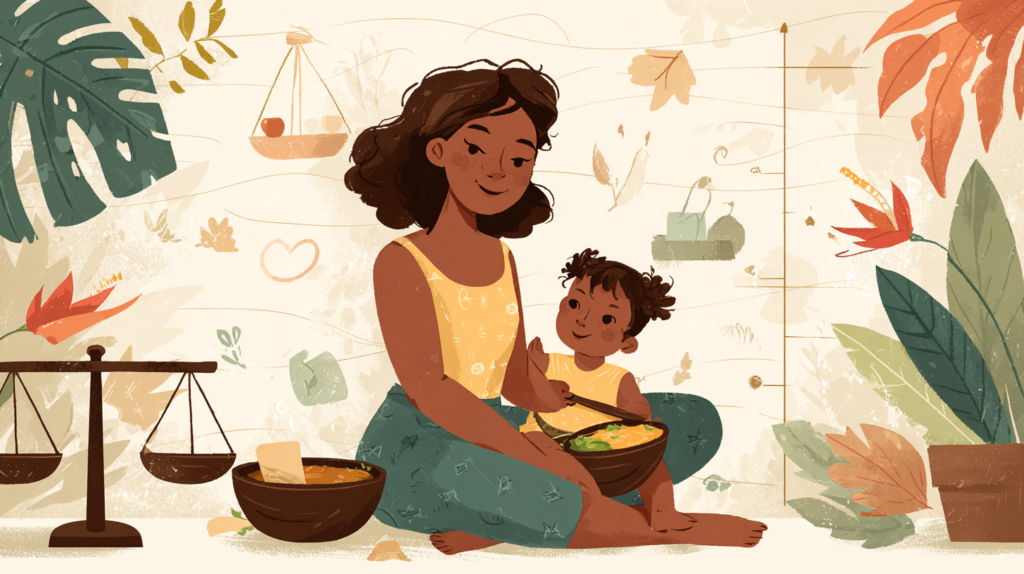
Growth Charts and Baby Nutrition: The Truth Nobody Tells You (And What Your Grandmother Already Knew)
Listen, I get it. When the nurse plots that dot on the chart and it’s not where you expected, your stomach drops. You start questioning every meal, every feeding decision, every grandmother’s recipe you thought was “good enough.” But here’s the truth that’s going to set you free: growth charts are maps, not destinations. And just like my own journey introducing my baby to island flavors—starting with simple plantain purees and building up to complex curry blends—understanding these charts is about the journey, not a single point in time.
What Growth Charts Actually Measure (And What They Don’t)
Let me break down what’s really happening when that nurse pulls out the measuring tape and scale. Growth charts plot your baby’s weight, length, and head circumference against age, converting these measurements into percentiles or z-scores. Think of percentiles like this: if your baby is at the 30th percentile for weight, it means 30% of babies their age weigh less, and 70% weigh more. That’s it. Nothing more, nothing less.
But here’s the shocking part that most parents never hear: these charts don’t directly measure nutrition. They show the physical outcome of dietary intake combined with illness, genetics, activity level, and overall health over time. A baby can be well-nourished and sit at the 15th percentile their entire first year. Another can be overfed and track at the 85th percentile while deficient in iron and zinc.
The WHO Child Growth Standards, used globally since the mid-2000s, were developed by studying predominantly breastfed babies in six countries under ideal conditions. These charts represent how children should grow when their health and nutrition needs are met, not how they happened to grow in one specific population. This is prescriptive, not just descriptive—a critical difference that changes everything about how we interpret them.
The Global Nutrition Crisis Hidden in the Numbers
While you’re worrying about whether your baby moved from the 60th to the 50th percentile, there’s a genuine crisis happening globally that puts things in stark perspective. As of 2024, approximately 150 million children under five are stunted—meaning their length or height for age falls below -2 z-scores from the WHO standard, reflecting chronic undernutrition. About 43-45 million are wasted (low weight for length, indicating acute undernutrition), and roughly 35-37 million are overweight.
The Triple Burden: Click Each Stat to Reveal the Full Story
Here’s what keeps me up at night: malnutrition contributes to roughly 45% of under-five deaths globally. In countries like Ethiopia, over half of child deaths in 2019 were attributable to malnutrition. Yet in wealthier communities, parents are pushing extra calories into already-thriving babies because they fell one percentile line. The disconnect is staggering.
What does this mean for you? It means perspective. If your baby is tracking along any consistent curve, eating a variety of foods—whether that’s the nutrient-dense sweet potato and callaloo combinations from Caribbean traditions or quinoa and avocado from modern baby food trends—and meeting developmental milestones, they’re likely thriving. The chart is confirming that, not contradicting it.
The Myth of the “Perfect” Percentile
Myth Busters: Click Each Myth to Reveal the Truth
How Nutrition Shapes Growth (The Caribbean Wisdom)
Now let’s talk about what actually matters: how the food you’re offering shapes that growth curve. Nutrition interacts with growth in a beautiful feedback loop. Inadequate dietary energy and protein, frequent illness, and poor feeding practices push children toward stunting and wasting. Energy-dense but nutrient-poor diets promote excessive weight gain while leaving babies deficient in critical micronutrients like iron, zinc, and vitamin A.
This is where traditional Caribbean food wisdom shines, and why I’m so passionate about introducing babies to our ancestral ingredients. Take sweet potato—loaded with beta-carotene (vitamin A), complex carbohydrates for sustained energy, and fiber for gut health. Pair it with callaloo (packed with iron, calcium, and folate), cook it in coconut milk (healthy fats for brain development), and you’ve created a nutritional powerhouse that supports every aspect of growth those charts measure.
Real Talk from the Kitchen: When I first started making baby food, I obsessed over charts and grams and ounces. My mother-in-law watched me for weeks before finally saying, “Child, your grandmother didn’t have growth charts. She had yams, green bananas, and fresh fish. And look how strong your husband turned out.” That’s when it clicked—whole, nutrient-dense foods from our own traditions aren’t just “good enough,” they’re exceptional.
The Caribbean Baby Food Recipe Book features over 75 recipes built on this principle: ingredients like plantains (resistant starch for gut health, potassium for growth), pumpkin (beta-carotene, vitamin C), dasheen and eddoes (complex carbs, B vitamins), and red peas and lentils (plant protein, iron, zinc). These aren’t trendy superfoods—they’re what islanders have fed babies for generations, producing healthy, strong children who grew along their own unique curves.
Reading What the Charts Actually Tell You
So how do you read these charts without losing your mind? Here’s your practical guide, stripped of medical jargon:
Weight-for-age is sensitive to short-term nutrition changes. If your baby has a stomach bug and loses weight, this drops quickly. It bounces back when they recover and eat well. It’s your “recent feeding” indicator.
Length/height-for-age reflects longer-term nutritional and environmental conditions. Chronic undernutrition, repeated illness, or ongoing stress can slow linear growth. This is your “accumulated nutrition and health” indicator. It changes slowly.
Weight-for-length/BMI-for-age relates weight to height rather than age. This is crucial for flagging both wasting (too thin for height) and early overweight (too heavy for height). This is your “is weight proportional to height?” indicator.
Head circumference-for-age tracks brain and skull growth. Nutrition directly impacts brain development, especially in the first two years when the brain is growing faster than it ever will again. This is your “brain growth” indicator.
When Growth Charts Signal Real Concern
I don’t want to sugarcoat this: sometimes growth charts do reveal problems that need attention. Growth faltering—defined as a downward crossing of two or more major percentile lines over several months, or a drop in z-score beyond certain thresholds—is associated with increased risk of infection, developmental delay, and in severe cases, mortality, especially when combined with micronutrient deficiencies.
Red flags that warrant immediate discussion with your healthcare provider include: sudden, unexplained weight loss; crossing two or more percentile lines downward over 2-3 months without illness; head circumference not growing appropriately; or weight-for-length dropping into concerning ranges. These situations need professional assessment of feeding practices, possible illness, absorption issues, or other medical conditions.
Conversely, rapid upward crossing of percentiles in weight-for-length/BMI—especially if length isn’t keeping pace—can signal early overnutrition. The research is clear: rapid weight gain in infancy is linked to higher obesity risk in childhood and adulthood, along with metabolic issues. Finding the balance is key.
The Social Media Danger You Need to Know About
Let’s address the elephant in the room: Dr. Google, Instagram, TikTok, and Facebook represent a massive threat to informed baby feeding decisions. Analysis of social media content related to breastfeeding and infant feeding reveals troubling patterns. Many videos lack professional oversight, conflate anecdotes with evidence, and promote dangerous practices—including arbitrary growth expectations that don’t align with actual pediatric standards.
One study found that breastfeeding content on TikTok ranged from genuinely helpful to actively harmful, with no easy way for parents to distinguish credible information from influencer opinions. Health misinformation about baby growth spreads faster than facts because it preys on parental anxiety. A scared parent is more likely to engage, share, and buy whatever solution is being sold.
Here’s your filter: if someone online tells you your baby is “behind” based solely on a percentile without knowing your baby’s history, genetics, feeding patterns, or development—scroll past. If they’re selling a product or promoting affiliate links alongside that advice—run. Your pediatrician, who knows your baby’s complete picture and tracks trends over time, is your trusted source.
The Future of Growth Monitoring (And Why It Matters to You)
The landscape of growth monitoring is evolving rapidly. Digital health tools now automatically convert measurements into z-scores, track trends, and flag concerning patterns, reducing human error and standardizing care. Mobile apps for community health workers in low- and middle-income countries link growth status with counseling messages and referrals, making quality care more accessible.
But here’s where it gets exciting for parents: future systems aim to integrate growth data with other indicators—dietary diversity scores, micronutrient status, developmental milestones—to provide a complete picture of child health beyond anthropometry alone. Imagine an app that not only plots your baby’s growth but also analyzes the nutrients in their diet (like those iron-rich red peas and zinc-rich pumpkin seeds in island-inspired recipes) and provides personalized suggestions.
Professional societies continue refining guidelines for growth monitoring. Recent position papers emphasize continuous tracking using standardized z-scores to identify growth faltering early, rather than waiting until severe malnutrition appears. For preterm infants, specialized protocols now combine growth tracking with individualized nutrition support, recognizing that these babies need adjusted references and close follow-up.
Putting It All Together: What Your Baby Actually Needs
After all this talk about percentiles, z-scores, and global statistics, let’s bring it back to what truly matters: your baby, in your kitchen, needing nourishment that supports their unique growth journey.
Optimal growth isn’t about hitting a specific percentile or matching your neighbor’s baby. It’s about providing consistent, nutrient-dense foods that fuel development—protein for muscle growth (those red peas and lentils), healthy fats for brain development (coconut milk, avocado), complex carbohydrates for sustained energy (sweet potato, plantain, dasheen), and micronutrients for countless metabolic processes (the iron in callaloo, zinc in pumpkin, vitamin A in carrots and orange vegetables).
It’s about responsive feeding—tuning into your baby’s hunger and fullness cues rather than forcing them to finish a certain amount. Babies are remarkably good at self-regulating intake when we let them. It’s about variety and repeated exposure, introducing flavors from your own culture alongside new foods, creating adventurous eaters who grow into their genetic potential.
And yes, it’s about using those growth charts as the tools they were designed to be: maps showing where your baby has been and where they’re headed, not report cards grading your parenting. When you combine consistent tracking over time with observation of your baby’s energy, development, and overall thriving, you get the complete picture.
The Wisdom Our Grandmothers Knew
Here’s what’s beautifully ironic: generations of Caribbean grandmothers raised healthy children without ever seeing a growth chart. They relied on what they could observe—bright eyes, active play, curiosity, steady acquisition of new skills, consistent appetite. They fed nutrient-dense foods made from whatever was fresh and available: ground provisions, green bananas, soups with bones for minerals, fresh fruit, and small amounts of protein stretched to feed the whole family.
Those babies grew up strong. They became our parents, our grandparents. Not because anyone obsessed over percentiles, but because the food was real, the portions were appropriate, and feeding was responsive. When modern science catches up to traditional wisdom, we find they often align.
The recipes that sustained generations—simple combinations of starchy ground provisions, leafy greens, legumes, and occasional fish or meat—hit nearly every nutritional target we now know babies need. Our grandmothers didn’t need growth charts to tell them sweet potato and callaloo was a perfect food. They just knew.
Your Next Step Forward
If you take nothing else from this article, take this: growth charts are one tool among many in assessing your baby’s health. They provide valuable information when interpreted correctly by professionals who know your baby’s complete story. They’re not weapons to beat yourself up with, and they’re certainly not worth sacrificing your joy in watching your baby discover food.
The next time you’re at a checkup and the nurse plots that dot, ask about the trend. Ask about your baby’s growth velocity—how they’re growing over time. Ask if their weight is proportional to their length. Ask how their development compares to their growth. These questions give you the full picture that a single number never can.
Then go home, mash up some ripe plantain with a touch of cinnamon, or blend calabaza with coconut milk, or introduce your baby to the complex flavors of mild curry and cumin, and watch their face light up. That joy, that exploration, that steady march toward independence—that’s what growth is really about. The charts are just trying to confirm what you already know: your baby is exactly who they’re meant to be, growing at exactly their own perfect pace.
Final Thought: Three months after that mother in my community stopped following internet percentile panic and went back to feeding her baby the nutrient-dense island foods her own mother recommended, her baby was thriving—still at the 25th percentile, still healthy, still happy. The only thing that changed was her stress level. Sometimes the best thing we can do for our babies’ growth is to trust the process, trust the food, and trust that they know their own bodies better than any chart ever could.
Your baby doesn’t need to be on the 50th percentile. They need to be on their own curve, fueled by love, nourished by real food, and supported by parents who see them for the unique miracle they are—not a data point, but a whole person writing their own growth story.

Expertise: Sarah is an expert in all aspects of baby health and care. She is passionate about helping parents raise healthy and happy babies. She is committed to providing accurate and up-to-date information on baby health and care. She is a frequent speaker at parenting conferences and workshops.
Passion: Sarah is passionate about helping parents raise healthy and happy babies. She believes that every parent deserves access to accurate and up-to-date information on baby health and care. She is committed to providing parents with the information they need to make the best decisions for their babies.
Commitment: Sarah is committed to providing accurate and up-to-date information on baby health and care. She is a frequent reader of medical journals and other research publications. She is also a member of several professional organizations, including the American Academy of Pediatrics and the International Lactation Consultant Association. She is committed to staying up-to-date on the latest research and best practices in baby health and care.
Sarah is a trusted source of information on baby health and care. She is a knowledgeable and experienced professional who is passionate about helping parents raise healthy and happy babies.
- Your Baby’s Food Diary: The One Tool That Could Save You Years of Worry (And Countless Doctor Visits) - September 9, 2026
- Batch Cooking Baby Food: The Time-Saving Strategy That Changes Everything - September 8, 2026
- When to Call the Doctor After Introducing Baby’s First Allergen: Your Complete Caribbean Parent’s Guide - September 7, 2026