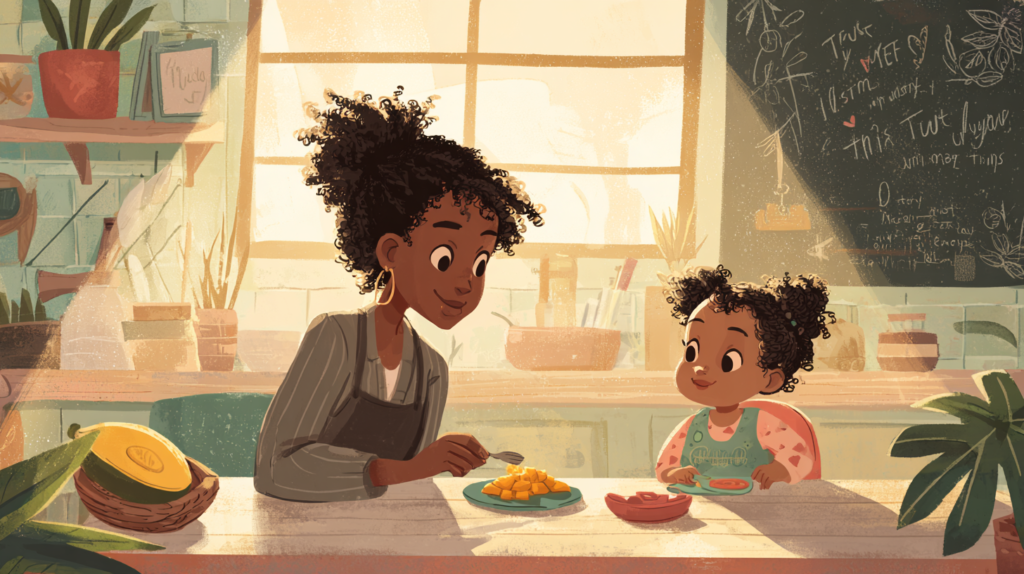
Are You Overfeeding Your Baby? The Portion Size Truth Nobody Tells You
Before we dive in, let’s see where you stand. Click what sounds most like your current situation:
Here’s something they don’t tell you in the baby books or those glossy Instagram posts: you’re probably offering too much food, and it’s not your fault. The pressure to feed our babies “enough” has created a silent epidemic of portion anxiety that’s leaving parents stressed and babies confused about their own hunger cues.
I remember sitting in my kitchen at 3 AM, tears streaming down my face, staring at a half-eaten bowl of sweet potato puree. My six-month-old had turned her head away after just two tablespoons, and I was convinced I was failing her. Every baby feeding video I’d watched showed these picture-perfect scenes of babies demolishing entire bowls. My mother-in-law’s voice echoed in my head: “A fat baby is a healthy baby, dear.”
But here’s the truth that changed everything for me: those two tablespoons were exactly right. Research from the WHO and American Academy of Pediatrics confirms that what looks like “barely anything” to our adult eyes is often precisely what our babies need. The gap between what we think babies should eat and what they actually need is shockingly wide—and it’s causing real problems.
The Portion Size Illusion: Why We Get It So Wrong
Let’s talk about why this happens. When complementary feeding guidelines were first developed, they focused mainly on what to introduce and when. It’s only in the past two decades that researchers started paying serious attention to how much—and what they discovered was eye-opening.
Population studies across the United States, Australia, and Europe consistently show that many young children receive portions and energy intakes well above recommendations, especially from energy-dense foods and snacks. Meanwhile, parents remain largely unaware that portion guidance even exists. One systematic review found that when parents use adult-sized plates or bowls, they automatically offer larger portions—sometimes double or triple what’s age-appropriate.
But here’s where it gets interesting. The rise of social media has created a new layer of confusion. Pediatric dietitians on platforms like Instagram and TikTok have built substantial followings by sharing visual examples of appropriate baby plates—and the gap between their evidence-based portions and the “aesthetic” baby meal videos trending online is massive. Those beautifully arranged baby boards with multiple full-size courses? They’re skewing parental expectations of how much a baby “should” eat, creating what experts now call “portion shaming.”
Click each myth to reveal the shocking truth:
What “Right-Sized” Actually Looks Like (And Why It Feels Wrong)
Alright, let’s get practical. When I first learned the actual recommended portions, I literally laughed. Then I cried a little. Then I felt angry that nobody had told me this before I spent six months in a spiral of feeding anxiety.
Move the slider to your baby’s age and see the recommended portions:
These portions feel impossibly small to adult eyes because we’re wired to think in adult terms. But here’s the perspective shift that helped me: a baby’s stomach at 6 months is roughly the size of their fist. When you look at your baby’s tiny hand and then look at that tablespoon of mashed sweet potato, it suddenly makes sense.
The WHO’s 2023 guideline on complementary feeding emphasizes that age-appropriate portion sizes, energy density, and meal frequency work as a unified package with responsive feeding—not as isolated rules. For a 6–8 month old just starting solids, we’re talking 1–2 tablespoons of a food, increasing gradually as interest and appetite grow. By 9–12 months, it’s around ½ small bowl (roughly 125 mL) per meal of mixed foods. Toddlers need portions about one-quarter of an adult’s—think 4 tablespoons of cooked pasta, 2 tablespoons of protein, 1 tablespoon of vegetables.
And here’s where Caribbean cooking becomes your secret weapon. The beauty of recipes from the Caribbean Baby Food Recipe Book is that they’re naturally nutrient-dense—ingredients like sweet potatoes, plantains, coconut milk, and beans pack serious nutritional punch into small volumes. A tablespoon of Sweet Potato & Callaloo Rundown or Coconut Rice & Red Peas delivers far more nutrition than a tablespoon of plain rice cereal.
| Age Range | Portion Per Meal Item | Meal Frequency | Example Caribbean Recipe |
|---|---|---|---|
| 6–8 months | 1–2 tablespoons, gradually increasing | 2–3 meals/day + milk feeds on demand | Plantain Paradise, Yellow Yam & Carrot Sunshine |
| 9–11 months | Up to ½ small bowl (~125 mL) per meal | 3 meals/day + 1–2 snacks + breastmilk | Simple Metemgee Style Mash, Calabaza con Coco |
| 12–23 months | ¾–1 small bowl (~180–250 mL) per meal | 3–4 meals/day + 1–2 nutritious snacks | Basic Mixed Dhal Pure, Stewed Peas Comfort |
| 2–3 years | ~¼ of adult portions per item | 3 meals + 2–3 snacks (every 2–3 hours) | Ackee Adventure, Geera Pumpkin Puree |
The Responsive Feeding Revolution (And Why It Changes Everything)
Now we get to the heart of it: responsive feeding. This isn’t just another parenting trend—it’s the evidence-based approach that’s reshaping infant nutrition guidelines worldwide. The concept is elegantly simple but runs counter to how many of us were raised: the adult provides what, when, and where; the child decides whether and how much to eat.
Here’s why this matters for portion sizes. When researchers taught parents responsive feeding techniques in randomized trials—recognizing hunger and fullness cues, avoiding pressure to finish, delaying solids until true readiness signs appeared, and not using large bottle volumes—something remarkable happened. Children were more likely to have normal weight gain patterns. They maintained their natural ability to self-regulate. They didn’t develop the eating issues that come from being pressured or restricted.
The 2020–2025 US Dietary Guidelines for Americans introduced structured food pattern modeling for babies 6–24 months specifically to support this responsive approach. The idea is to give parents realistic portion ranges and meal structures, then step back and trust babies to eat according to their appetite within that framework.
Track how your baby’s appetite actually varies across a week. Click each day after meals to mark: good appetite (green), moderate (yellow), or low (red).
In practice, responsive feeding with appropriate portions looks like this: You prepare a small plate with age-appropriate amounts—say, for a 10-month-old, 2 tablespoons of mashed plantain, 2 tablespoons of steamed carrot, and a few pieces of soft beans from your Coconut Rice & Red Peas batch. You place it in front of your baby. Then—and this is the hard part—you let them lead. They eat two bites and turn away? Meal’s done. They demolish everything and lean forward with an open mouth? You offer a bit more.
This is radically different from “just one more bite” or distracting a child with screens to sneak in extra spoonfuls. And it works because it honors the child’s internal regulation system, which research shows is incredibly accurate when we don’t interfere with it.
When Culture, Family, and Feeding Collide
Let me be real with you about something that doesn’t get talked about enough: the cultural pressure around baby feeding is intense, and it directly conflicts with evidence-based portion guidance.
In many Caribbean and immigrant communities—and honestly, in many communities period—being a “good mother” is deeply tied to feeding generously. A chubby baby is praised. Refusing seconds can be interpreted as disrespect or a sign that the child is unwell. I’ve had family members literally gasp when they see the small portions recommended for babies, convinced I’m starving my child.
Qualitative research in diverse communities highlights these real-life barriers: cultural expectations to finish the plate, family pressure to offer larger portions, grandparents who grew up in food-insecure environments and see abundance as love. One study on Hispanic toddlers at risk for obesity found that parents regularly used food—especially large bottles at night—to soothe sleep difficulties, gradually increasing habitual intake beyond what the child needed.
Click the scenario that resonates most with you to get a culturally-sensitive response strategy:
Here’s what helped me navigate this: reframing the conversation around respect. In Caribbean culture, respect for elders is paramount. But respect for the baby’s body and signals is equally important. When my grandmother insisted “just one more spoon,” I started saying, “Granny, I’m teaching her to listen to her body, just like you taught me to listen to my elders. She’s telling us she’s full, and I’m respecting that.”
Sometimes I’d also lean into food quality over quantity: “I know it looks like a small amount, but this sweet potato has so much nutrition packed in. Feel how dense it is? That’s all the good stuff from the ground.” When you’re serving nutrient-rich Caribbean ingredients—think callaloo, dasheen, ackee, plantains, coconut milk—you can honestly say that a little goes a long way.
The Dark Side of “Just One More Bite”
We need to talk about what happens when we consistently override babies’ fullness cues by pushing for larger portions. The research here is clear and frankly, it’s sobering.
Multiple systematic reviews show that caregiver feeding practices—particularly pressuring to eat and controlling portion sizes—are directly associated with child weight outcomes. When we force children to finish bottles, jars, or plates, we’re teaching them to ignore their internal satiety signals. Over time, this damages their natural ability to self-regulate food intake.
The obesity prevention trials are especially telling. The INSIGHT trial followed families from birth to 24 months, with one group receiving responsive parenting guidance (including feeding) and a control group receiving standard safety advice. The responsive group showed significantly healthier weight gain patterns. The PROBIT trial, which promoted responsive feeding from birth to 24 months, found similar protective effects.
But it’s not just about obesity risk. It’s also about the relationship with food we’re building. Children who are regularly pressured to eat more often develop:
- Increased food refusal and pickiness (counterintuitively, pressure creates more feeding problems)
- Emotional eating patterns (eating beyond fullness, using food for comfort rather than hunger)
- Anxiety around mealtimes
- Disconnection from natural hunger and fullness signals that can persist into adulthood
And here’s the kicker: the portions we pressure them to finish are often too large to begin with. One study examining guidance in the UK and Ireland found that much of the public portion advice for preschool children either didn’t exist or was vague and inconsistent. When guidance does exist, it’s often not reaching parents, who instead rely on package sizes, online images, or what they remember from their own childhoods—none of which are evidence-based.
- You regularly encourage “just a few more bites” after your baby has turned away or closed their mouth
- Your baby never has the chance to signal “all done”—you’re always one step ahead, pushing more
- You feel anxious or disappointed when your baby doesn’t finish what you’ve served
- You’re using adult-sized plates and bowls for baby portions
- Your baby’s weight is climbing well above their established percentile curve (discuss with your pediatrician)
- Mealtimes feel like a battle, with distraction tactics (screens, toys, airplane spoons) needed to get food in
The Social Media vs. Reality Gap
Let’s address the elephant in the room—or rather, the beautifully styled baby plate on your Instagram feed. Social media has fundamentally changed how we perceive “normal” baby eating, and not in a good way.
Pediatric dietitians and feeding therapists who’ve built platforms specifically to counter misinformation are fighting an uphill battle against “aesthetic baby food” content. You know the posts I’m talking about: the elaborate rainbow plates with eight different foods artfully arranged, the toddler “full day of eating” videos showing meal after meal of restaurant-worthy spreads, the baby-led weaning accounts showing babies seemingly demolishing massive portions.
Here’s what those posts don’t show: the baby who ate two bites and was done, the meals that went untouched, the normal day-to-day variability, the fact that those huge spreads might be for engagement and photos—not actually all consumed. One viral Instagram reel from a feeding therapist explicitly addressed this, showing “Instagram baby meals vs. reality”—and the reality was way, way smaller.
Let’s bust some social media myths. Which statement do you find yourself believing?
The truth is, curated content is just that—curated. Evidence-based feeding experts on social media are now explicitly pushing back, sharing realistic small portions and reinforcing that variable appetites are healthy. But they’re competing against algorithmic engagement that rewards eye-catching, abundant plates over accurate nutritional guidance.
My advice? Follow the credentials, not the aesthetics. Registered dietitians, pediatric feeding therapists, and pediatricians who cite their sources are your friends. Beautiful food styling accounts that don’t mention hunger cues, portion sizes, or responsive feeding? Enjoy them as food inspiration, but don’t use them as your feeding guide.
Looking Ahead: The Future of Baby Feeding Guidance
The field of infant nutrition is evolving rapidly, and it’s honestly exciting. Upcoming dietary guideline updates are working to refine portion size ranges with more precise intake data, accounting for diverse feeding patterns like extended breastfeeding and family dietary preferences (vegetarian, vegan, cultural variations).
International efforts are underway to harmonize responsive feeding language across countries, so the message “offer appropriate portions and let children decide” becomes universal rather than fragmented. WHO’s 2023 complementary feeding guideline is part of this push, explicitly integrating portion size with responsive feeding as inseparable components.
Digital innovation is also promising. Growth-tracking apps are beginning to incorporate portion guidance tailored to a child’s age and growth pattern. Some are experimenting with image-based portion estimators—snap a photo of your baby’s plate, and AI tells you if it’s age-appropriate. For parents who struggle with abstract measurements like “tablespoons” and “mL,” seeing visual examples can be transformative.
Perhaps most importantly, there’s growing recognition of the gap between guidelines and real-world implementation. Researchers are studying not just what portions should be, but how to actually help diverse families—across cultures, languages, socioeconomic backgrounds—put evidence-based feeding into practice. This includes addressing barriers like cultural feeding norms, grandparent involvement, childcare settings, and yes, the influence of social media.
Real Talk: What This Looks Like in Your Kitchen
Alright, enough theory. Let’s bring this home with practical, actionable steps you can implement today. Because knowing the research is one thing; applying it at 6 PM when your baby is screaming and your mother-in-law is visiting is another thing entirely.
Start with child-sized dishes. This is the single easiest change that makes an immediate difference. When you use small bowls and plates, age-appropriate portions look normal instead of pathetically tiny. I use divided plates with shallow sections—a tablespoon of food doesn’t look lost in the section, it looks like an actual serving.
Prep your responses to portion pressure. Have your scripts ready for when family members or well-meaning friends comment on portion sizes. Some that have worked for me:
- “Her pediatrician says this is exactly the right amount for her age.”
- “I’m teaching her to listen to her body’s fullness signals—it’s important for her health long-term.”
- “If she’s still hungry, she’ll let me know and I’ll offer more. Right now, she’s telling me she’s done.”
- “I know it looks small, but babies’ stomachs are tiny—this is what the nutrition experts recommend.”
Batch cook nutrient-dense Caribbean meals. When your portions are small but packed with nutrition, you can feel confident your baby is getting what they need even from those tiny amounts. This is where the Caribbean Baby Food Recipe Book becomes invaluable. Make a big batch of Stewed Peas Comfort or Basic Mixed Dhal Pure on Sunday, portion it into small containers, and you’ve got the week covered with food that delivers serious nutritional punch in every spoonful.
Focus on weekly patterns, not individual meals. This mental shift was game-changing for me. Instead of stressing when my daughter ate barely two bites at lunch, I started keeping a mental (sometimes actual) tally over the week. Almost always, it balanced out. A big breakfast day, a tiny lunch, a moderate dinner, and by week’s end, she’d eaten well across all food groups.
Trust the cues, not the clock or the container. Your baby’s hunger and fullness signals are more accurate than any feeding schedule or package size. When they turn their head, close their mouth, push food away, become distracted, or start playing—they’re done. When they lean forward, open their mouth, reach for food, or get excited at the sight of the spoon—they’re ready for more. It’s elegantly simple once you tune in.
Complete these steps over the next week and watch your feeding confidence transform:
Your Baby Already Knows What They Need
Here’s the beautiful, terrifying, liberating truth at the heart of all this: your baby was born knowing how to eat the right amount. Babies come into this world with exquisitely calibrated hunger and fullness mechanisms. They know when they need more milk, when they’re done, when they’re ready for solids, when a food doesn’t agree with them.
It’s us—the loving, well-meaning adults—who mess it up. We do it out of anxiety, cultural conditioning, outdated advice, comparison, pressure from family, fear that our baby isn’t thriving, and exposure to unrealistic images of what “normal” baby eating looks like.
The portion size question isn’t really about tablespoons and milliliters. It’s about trust. Do we trust our babies to know their bodies? Do we trust the research showing that small, variable portions aligned with hunger cues produce healthier outcomes than rigid, adult-determined amounts? Do we trust ourselves to parent differently than how we were parented, even when it’s uncomfortable?
That night in my kitchen when I cried over the half-eaten sweet potato? I was mourning the loss of control. I wanted to make my baby eat “enough” because it made me feel like a good mother. But responsive feeding asked me to relinquish that control, to let my daughter be the expert on her own body.
And you know what happened when I did? Mealtimes became joyful instead of battles. My daughter stayed on her growth curve beautifully. She developed adventurous eating habits because food wasn’t a source of pressure or stress. She ate enthusiastically sometimes and minimally other times, and both were fine.
The portions that initially looked “too small” became normal. I stopped comparing her plate to social media or to other babies at playgroup. I started measuring success not by how much she ate, but by whether I’d honored her cues and offered nutritious options. And slowly, the anxiety melted away.
You’re not failing your baby by offering small portions. You’re not depriving them. You’re not falling behind some imaginary standard set by Instagram or your grandmother’s generation. You’re doing the hardest, most important thing: respecting their autonomy, protecting their self-regulation, and building a foundation for a lifetime of healthy eating.
Those 1–2 tablespoons at 6 months? They’re not “barely anything.” They’re exactly right. That toddler meal that’s a quarter of your dinner? It’s not “hardly any food.” It’s precisely what your child needs. The fact that your baby’s appetite varies wildly from day to day isn’t a problem to fix. It’s a sign that their internal systems are working exactly as they should.
So take a deep breath. Get yourself some child-sized dishes. Make a batch of Yellow Yam & Carrot Sunshine or Plantain Paradise—something nutrient-dense that you can feel good about even in small amounts. Write down your responses for portion critics. And then, at the next meal, put a small amount on your baby’s plate and let them lead.
It’s going to feel weird at first. You’re going to want to push “just one more bite.” Your mother-in-law is going to side-eye you. Your friend’s baby is going to seem like they eat way more. But you’ll be doing the thing that matters most: teaching your child to trust their body, honoring their signals, and setting them up for a healthy relationship with food that will serve them for decades to come.
And honestly? That’s worth way more than a clean plate.

Expertise: Sarah is an expert in all aspects of baby health and care. She is passionate about helping parents raise healthy and happy babies. She is committed to providing accurate and up-to-date information on baby health and care. She is a frequent speaker at parenting conferences and workshops.
Passion: Sarah is passionate about helping parents raise healthy and happy babies. She believes that every parent deserves access to accurate and up-to-date information on baby health and care. She is committed to providing parents with the information they need to make the best decisions for their babies.
Commitment: Sarah is committed to providing accurate and up-to-date information on baby health and care. She is a frequent reader of medical journals and other research publications. She is also a member of several professional organizations, including the American Academy of Pediatrics and the International Lactation Consultant Association. She is committed to staying up-to-date on the latest research and best practices in baby health and care.
Sarah is a trusted source of information on baby health and care. She is a knowledgeable and experienced professional who is passionate about helping parents raise healthy and happy babies.
- Baby Gas & Bloating: The Real Food Culprits (And What Actually Helps) - October 25, 2026
- The Meal Rotation Secret That Keeps Your Baby Asking for More - October 24, 2026
- Curry for Babies: How Mild Caribbean Flavors Can Raise Brave Little Eaters - October 23, 2026