 Skip to content
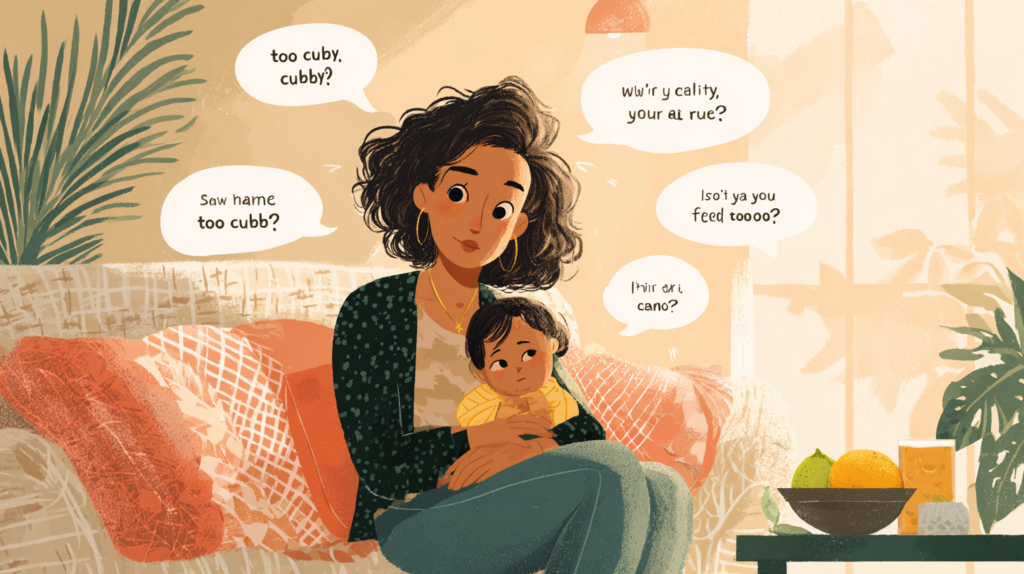
The Comment That Shattered My Confidence: When Someone Called My Baby “Too Chubby”
Before We Begin: How Do Comments About Your Baby’s Size Make You Feel?
Click all that apply—let’s acknowledge what you’re carrying:
Three words. That’s all it took.
“She’s getting chunky.”
My mother-in-law said it with a laugh, pinching my six-month-old daughter’s thigh rolls at a family gathering. Everyone chuckled. Someone made a joke about “michelin baby” and “baby sumo wrestler.” I smiled—because what else do you do when you’re surrounded by people who think they’re being harmless?—but inside, something cracked.
That night, I couldn’t sleep. I found myself Googling “is my baby too fat?” at 2 AM, scrolling through growth charts, comparing my daughter’s percentiles to strangers’ babies online. I started second-guessing every feeding. Was I overfeeding her? Should I cut back on breastfeeding sessions? Was I ruining her health before she could even sit up on her own?
Here’s what I wish someone had told me then: Those comments weren’t really about my baby. They were about generations of weight stigma, confusion about infant health, and the impossible standards we place on parents—especially mothers—to produce “perfect” children. And they were doing real damage to my mental health.
If you’ve ever felt your stomach drop when someone commented on your baby’s size, this is for you. Because the truth is, “chubby baby” comments are never just about the baby. They’re about parental anxiety, cultural body shame, and the silent fear that we’re somehow failing at the most important job we’ll ever have.
Why These Comments Hit Differently (And Why They Matter More Than You Think)
Let’s talk about what’s really happening when someone comments on your baby’s body. Research shows that 76% of parents regularly engage in “self-fat talk” in front of their children, and over half make negative comments about other people’s weight. We’re swimming in a culture where body commentary is so normalized that people don’t even realize they’re doing it—even to infants who can’t understand words yet.
But here’s the shocking part: these comments start shaping outcomes earlier than anyone imagined. Studies confirm that children as young as three years old already show negative attitudes toward larger bodies, directly reflecting the cultural weight stigma they’ve absorbed. And where does that absorption begin? In their homes, from the adults around them, including the casual remarks made about their own baby bodies.
When your aunt says your baby is “getting so big” with a worried tone, or your pediatrician warns about “rapid weight gain” while your baby is happily thriving, what’s really being communicated? That a baby’s body—a body designed to grow, change, and store energy for massive developmental leaps—is being judged by adult beauty standards and obesity fears.
One mother described it perfectly in a recent online parenting forum: “Someone telling me my baby was ‘chunky’ made me feel like I was doing something wrong. Like I was a bad mom who couldn’t even feed her child correctly. It wasn’t about my baby at all—it was about my worth as a parent.”
And that’s exactly the problem. These comments trigger deep-seated fears about being judged, about somehow harming our children, about not measuring up. Research on parental mental health shows that mothers who perceive their child as underweight report more pressure-to-eat feeding practices, while those who perceive overweight tend to become restrictive—both responses driven by anxiety, not the child’s actual needs.
The Science Behind Your Gut Reaction
There’s a reason why a seemingly innocent comment about your baby’s rolls can send you into a spiral. Your brain is wired to protect your child, and when someone suggests—even indirectly—that something might be “wrong” with your baby’s body, it triggers a threat response.
But here’s what the research actually tells us: Infant weight gain follows wildly different patterns, and what looks “chubby” at six months often redistributes by 18 months as babies become mobile. Pediatric nutrition experts emphasize that baby fat serves critical developmental functions—it fuels brain growth, supports immune function, and provides energy reserves for the enormous work of learning to crawl, walk, and explore.
Yet parents—bombarded with contradictory messages—receive praise from older generations who see a bigger baby as “thriving,” while simultaneously being warned by health providers about future obesity risk. This cultural whiplash creates impossible tension. One longitudinal study tracking parental feeding practices found that weight-related anxiety in parents directly predicted more controlling feeding behaviors, which ironically can interfere with children’s natural hunger and fullness cues.
The impact extends beyond feeding. Recent research published in 2024 revealed that parental internalized weight stigma is associated with more self-critical weight talk and restrictive health-related feeding practices. In other words, when we carry shame about weight—our own or societal shame about body size in general—we unconsciously pass that shame to our children through how we feed them and talk about bodies.
Weight-based teasing and criticism, even in early childhood, are strongly linked to later body dissatisfaction, low self-esteem, depressive symptoms, and disordered eating. A 2023 study on body shame in children ages 7-12 found that parental attention to children’s appearance was a key factor in developing body shame—more influential than parental body dissatisfaction itself. The message? It’s not our silent worries that harm kids; it’s the comments we make out loud.
Myth or Truth? Test Your Knowledge
What’s Really Being Said (Translation Guide for Common Comments)
Let me translate what people actually mean when they make these comments—because it’s rarely about your baby:
“Wow, she’s getting so big!” = I’m uncomfortable with my own relationship with food and bodies, and I’ve been taught to comment on physical appearance as a form of small talk.
“Are you sure you should feed him that much?” = I’m projecting my own food anxiety and diet culture beliefs onto your infant, who is perfectly capable of self-regulating if you let him.
“She’s going to be a big girl!” = I’ve absorbed cultural fat-phobia and genuinely believe I’m warning you about a future problem, not realizing I’m creating a present one.
“He’s so chunky—must be a good eater!” = I think I’m complimenting your parenting, but I’m actually reinforcing the idea that a child’s worth and your parenting competence are visible in body size.
Understanding this translation helps because it reveals the truth: these comments are almost never about your baby’s actual health. They’re about the speaker’s own baggage, cultural conditioning, and discomfort with bodies that don’t fit narrow “acceptable” ranges.
A body image coach who works with parents shared this insight: “When someone immediately says ‘you’re not fat!’ after a child expresses body concerns, it sends the message that being fat is horrible. We want to counter that mindset.” The same principle applies to baby comments. When we react with defensiveness or reassurance that focuses on size, we reinforce that size matters—when what we should be reinforcing is that all bodies are worthy of respect.
The Script Library: What to Actually Say When It Happens
Here’s where we get practical. You need responses ready because freezing or fake-laughing while dying inside helps no one. These scripts are designed to protect your baby, set boundaries, and preserve your mental health—all without starting World War III at the dinner table.
️ Get Your Personalized Response Script
Choose the scenario you’re facing:
For the laugh-it-off relative: “We’re focusing on [baby’s name]’s development and health, not her size. Her pediatrician is happy with her growth.” Then immediately redirect: “Did you see how she’s started reaching for her toys?”
For the concern-troller: “I appreciate that you care, but we’ve got this covered with our healthcare team. What we really need is for people not to comment on her body.” Firm, clear, done.
For feeding police: “We’re practicing responsive feeding—following her cues rather than restricting. Research shows this supports healthy self-regulation.” (This works because you’re citing “research,” which often stops amateur pediatricians in their tracks.)
For the repeat offender: “I need to be direct: we don’t discuss body size around our baby. It’s important to us that she grows up without body shame. Can I count on you to support us in this?” This recruits them as an ally rather than making them a villain, which increases cooperation.
For your own parents or in-laws: “I know things were different when you were raising babies, but we’re choosing not to comment on children’s bodies. It means a lot to us, and we’d love your support.” Acknowledging generational differences without invalidating their experience helps.
One Caribbean grandmother I know uses this brilliant approach: “You know how back home we always said a chubby baby is a blessed baby? Well, now we know that all healthy babies are blessed, no matter their size. We’re just grateful she’s thriving.” It honors cultural history while gently correcting the messaging.
And here’s the powerful part about having these responses ready: they’re not just for others. They’re for you. Every time you set a boundary, every time you redirect a comment, every time you refuse to engage with body-shaming talk about your baby, you’re protecting your own mental health too. You’re practicing the belief that your worth as a parent isn’t measured in your baby’s percentiles.
Boundary-Setting Strength Assessment
How would you respond in this situation?
The Hidden Damage (And Why Your Mental Health Matters Most)
Let’s talk about what happens to you—the parent—when these comments keep coming. Because while everyone’s focused on the baby, your mental health is quietly taking hit after hit.
Studies on body image during pregnancy and postpartum reveal that approximately 1 in 10 mothers experience significant body dissatisfaction after birth, with higher rates among those who had higher pre-pregnancy BMI. This dissatisfaction doesn’t exist in a vacuum—it extends into how mothers perceive and talk about their baby’s body. When you’re already struggling with how your own body changed, comments about your baby’s size can feel like a referendum on your adequacy.
Research on young mothers and mothers experiencing vulnerability shows that parenting stress, depression, and anxiety intersect heavily with weight-related worries. One study participant described: “Every time someone commented on my baby being ‘big,’ I heard it as ‘you’re overfeeding’ or ‘you can’t do this right.’ I started obsessively tracking every ounce, every feeding time. I couldn’t enjoy nursing anymore—it became this source of anxiety.”
The mental load is real: You’re already monitoring wake windows, tracking dirty diapers, watching developmental milestones, managing your own postpartum recovery, potentially returning to work, maintaining relationships, and trying to remember if you brushed your teeth today. Adding “defend my baby’s body from commentary” to that list isn’t just exhausting—it’s often the thing that pushes mental health over the edge.
And here’s what makes it even harder: the isolation. Unlike other parenting challenges you might discuss openly in your mom group, feeling hurt by body comments about your baby can feel shameful to admit. You worry you’re being “too sensitive” or “making a big deal out of nothing.” But a 2024 study on family-based weight stigma found that both maternal and paternal critical comments about weight were significantly associated with increased psychological distress in young people—meaning the impact is real, measurable, and lasting.
Is Weight Stigma Affecting Your Family? Take This Assessment
Check all statements that feel true for you:
Building Your Shield (Practical Mental Health Protection Strategies)
You cannot control what comes out of other people’s mouths. But you can absolutely control how you protect yourself and your baby from the fallout. Here’s your action plan:
1. Limit exposure strategically. Social media is a minefield of body comparison. A 2022 analysis found that a large share of obesity-related posts includes fat-shaming messages, even within supposedly supportive body-positivity spaces. Curate your feed ruthlessly: unfollow accounts that trigger size anxiety, mute family members who can’t stop commenting, and actively seek out weight-neutral parenting content. Your mental health is worth more than staying up-to-date on your second cousin’s opinions.
2. Find your people. Connect with communities—online or in person—that embrace diverse baby bodies and practice responsive feeding. These might be breastfeeding support groups, intuitive feeding communities, or body-positive parenting forums. When you’re surrounded by people who celebrate thriving babies of all sizes and challenge diet culture, individual comments lose their power.
3. Talk to someone who gets it. If comments about your baby’s body are fueling obsessive weighing, restrictive feeding, anxiety, depression, or persistent guilt, please talk to a therapist, your pediatrician, or a lactation consultant who’s trained in weight-neutral care. Perinatal mental health is increasingly recognizing that body image distress—both about our own bodies and our children’s—deserves clinical attention and support.
4. Practice the redirect. Have three go-to topics that you can immediately pivot to when someone comments on your baby’s body: “Speaking of development, she just started babbling!” or “Hey, have you tried that new Caribbean restaurant downtown?” or “How’s your garden doing?” The goal is to make body talk a conversational dead-end while other topics flourish.
5. Create a family food philosophy. This is especially powerful if you’re raising children with Caribbean heritage or other cultures where food is love and feeding is community. You might say: “In our home, we honor our food traditions by introducing diverse flavors and ingredients, trusting our baby to eat according to her needs, and celebrating nourishment without judgment.” When you have a clear, articulated philosophy, random comments bounce off more easily.
One mother shared: “I started keeping a list on my phone of every milestone and adorable thing my baby did. When someone made a comment about her size, I’d literally look at that list to remind myself of all the ways she’s thriving that have nothing to do with weight. It sounds simple, but it worked.”
Teaching Them What You Wish You’d Learned
Here’s the beautiful opportunity hidden in this awful situation: every time you shut down a body-shaming comment, every time you redirect from appearance to ability, every time you model that bodies are worthy of respect regardless of size—you’re teaching your child something that previous generations never learned.
The research is clear: children’s body image is shaped more by what parents say than by parents’ silent body dissatisfaction. That means you have incredible power here. You get to decide what your child internalizes about bodies, food, and worth.
Start now, even while they’re babies:
Use neutral body language. “Your body is getting so strong! Look at you rolling over!” instead of “Look how big you’re getting!”
Celebrate what bodies do, not how they look. “Those legs help you kick and play!” rather than “You have such cute chubby legs!”
Avoid all food morality. Never “good food” vs. “bad food,” never “you were so good, you ate all your vegetables.” Food is food. Some foods fuel certain activities better than others. That’s it.
Model food joy from diverse cultures. If you’re introducing your baby to Caribbean flavors, talk about how plantains provide energy for crawling adventures, how mangoes are sweet and delicious, how coconut milk makes foods creamy and satisfying. Connect food to pleasure, culture, and function—never to body size.
Correct body talk immediately. When a relative says “Is she getting thin?” or “He’s so chunky!” you say calmly: “We don’t talk about people’s bodies that way. We notice what they can do.” Then model it: “Look at how well she’s sitting up now!”
One parent described their approach perfectly: “When my son was starting solids, I introduced him to traditional foods from my Jamaican heritage—sweet potato, callaloo, ackee. I wanted him to experience those flavors as normal, everyday foods that connect him to family, not as ‘ethnic’ or ‘healthy’ foods. And I wanted him to learn that eating is about nourishment, tradition, and joy—never about controlling his body.”
This is generational healing work. This is breaking cycles. This is hard and exhausting and so, so worth it.
When the Comments Come From Inside Your Head
Sometimes the harshest critic isn’t your mother-in-law or the judgmental stranger at the grocery store. Sometimes it’s the voice inside your own head, the one that whispers: “Are you feeding them too much? Are you not feeding them enough? Is their body wrong? Are you failing?”
That voice is carrying decades of cultural conditioning, personal experiences with body shame, diet culture messaging, and the impossible weight of modern parenting anxiety. It’s not your fault that voice exists. But you can learn to talk back to it.
Here’s what helps:
Acknowledge the thought without accepting it as truth. “I’m having the thought that my baby is too big” is different from “My baby is too big.” One is a thought (influenced by bias and fear); the other is a statement of fact. Research on cognitive defusion shows that simply noticing thoughts as thoughts, rather than facts, reduces their emotional impact.
Ask: Whose voice is this really? Often, our inner critic sounds suspiciously like someone from our past—a parent who was always dieting, a coach who emphasized appearance, a culture that praised thinness. When you identify the source, you can choose whether that voice deserves authority over your parenting.
Counter with facts. “My baby’s pediatrician says she’s healthy and growing well. That is the only opinion that matters medically. Everything else is cultural noise.”
Practice self-compassion. Research shows that self-compassion—treating yourself with the kindness you’d offer a good friend—is protective against anxiety and depression. When the critical voice gets loud, ask: “What would I say to my best friend if she told me she was worried about this?”
❤️ Self-Compassion Practice: Draw Your Daily Reminder
Click below to draw a compassion card—a gentle reminder just for you:
The Conversation I Wish I’d Had (And the One You Can Have Now)
If I could go back to that family gathering where my mother-in-law first called my daughter “chunky,” here’s what I wish I’d said:
“I appreciate that you care about [baby’s name], but I need to ask you not to comment on her body. Research shows that even indirect messages about size can shape how children see themselves and how parents feed their kids. Her pediatrician is monitoring her growth, and what she needs from us is love, attention, and trust in her body’s wisdom—not judgment about her size. Can I count on your support in this?”
Would it have been awkward? Absolutely. Would it have prevented months of anxiety, midnight Googling, and feeding stress? Probably.
Here’s the truth that took me too long to learn: Setting boundaries feels uncomfortable in the moment, but the long-term discomfort of silence is so much worse. Every time you don’t speak up, you’re reinforcing—to yourself and your child—that body commentary is acceptable, that your parenting is up for public review, that your baby’s worth is tied to fitting into acceptable size ranges.
You don’t have to be perfect at this. You don’t have to have the ideal response every time. But you do have to start somewhere.
Maybe it’s sending a group text to family before the next gathering: “Quick ask: we’re working on raising [baby’s name] with a healthy body image, so we’re asking everyone to avoid commenting on her size, weight, or body. Thanks for understanding!”
Maybe it’s practicing responses in the mirror until they feel natural enough to actually say.
Maybe it’s simply deciding that the next time someone makes a comment, you won’t laugh it off—you’ll pause, you’ll breathe, and you’ll say: “We’re not doing that in our family.”
Moving Forward With Your Whole Heart
My daughter is three now. She has no memory of her grandmother’s “chunky” comment, but I remember my response to it—or lack thereof—with crystal clarity. I remember the months of anxiety. I remember weighing her obsessively. I remember the shame spiral every time she wanted to nurse.
What I wish someone had told me then is this: Your baby’s body is not a report card on your parenting. Your baby’s percentile is not a measure of your worth. Your baby’s rolls, or lack thereof, say absolutely nothing about your competence, your love, or your commitment to their wellbeing.
What matters is that you’re showing up, that you’re feeding them with love and attention to their cues, that you’re protecting them from body shame in a culture drowning in it, and that you’re doing the hard work of interrupting generational patterns.
When you redirect a comment about your baby’s body, you’re not being oversensitive—you’re being protective. When you set boundaries with family about body talk, you’re not being difficult—you’re being deliberate. When you refuse to engage in size comparisons and weight anxiety, you’re not being naive—you’re being revolutionary.
Because in a culture that teaches us from birth that our bodies are always too much or never enough, that our worth is measured in inches and pounds, that food is a moral test and hunger is something to be controlled—choosing to raise a child who believes their body is good, capable, and trustworthy is an act of rebellion.
It’s also an act of healing. For them, yes. But also for you.
Every time you shut down a shaming comment, you’re rewriting the script that maybe you inherited, that told you your body was something to be managed, controlled, perfected. Every time you model body respect, you’re teaching yourself—right alongside your baby—that bodies of all sizes deserve dignity.
This journey isn’t easy. Some days you’ll handle comments beautifully. Other days you’ll freeze, or laugh along, or lie awake at night wishing you’d said something different. That’s okay. You’re learning. You’re unlearning. You’re breaking cycles while simultaneously being exhausted from broken sleep and touched-out from constant physical demands.
Give yourself the same grace you’re learning to extend to your baby: Your worth is not measured by your performance. Your effort counts. Your intentions matter. You are enough, exactly as you are.
And so is your baby.
When you tuck them in tonight, look at their perfect, growing, changing body—the body that came from yours, that you’ve nourished and cared for, that’s doing exactly what it’s supposed to be doing—and know this: You’re doing a good job. Not because of their size, but despite a culture that tries to make size matter. You’re raising them in a world that weaponizes bodies, and you’re choosing to make your home a place where bodies are safe.
That’s everything.
So the next time someone makes a comment about your baby being “too chubby,” “too thin,” “so big,” or “getting chunky”—take a breath. Remember that their words are about their baggage, not your baby’s health. Choose your response with intention, whether it’s a gentle redirect or a firm boundary. And then let it go, secure in the knowledge that what you’re building in your home—body trust, food joy, unconditional love—is more powerful than any offhand comment could ever be.
Your baby doesn’t need perfect percentiles or ideal curves. They need you—messy, learning, imperfect, fierce-hearted you—showing them that their body is not a problem to be solved, but a miracle to be celebrated.
And that is exactly what you’re doing.

Expertise: Sarah is an expert in all aspects of baby health and care. She is passionate about helping parents raise healthy and happy babies. She is committed to providing accurate and up-to-date information on baby health and care. She is a frequent speaker at parenting conferences and workshops.
Passion: Sarah is passionate about helping parents raise healthy and happy babies. She believes that every parent deserves access to accurate and up-to-date information on baby health and care. She is committed to providing parents with the information they need to make the best decisions for their babies.
Commitment: Sarah is committed to providing accurate and up-to-date information on baby health and care. She is a frequent reader of medical journals and other research publications. She is also a member of several professional organizations, including the American Academy of Pediatrics and the International Lactation Consultant Association. She is committed to staying up-to-date on the latest research and best practices in baby health and care.
Sarah is a trusted source of information on baby health and care. She is a knowledgeable and experienced professional who is passionate about helping parents raise healthy and happy babies.
- Pigeon Peas for Baby: The Caribbean Protein Secret Your Grandmother Knew (But Never Told You Why) - September 11, 2026
- 11 Month Old Feeding: The Almost-Toddler Revolution Happening in Your Kitchen Right Now - September 10, 2026
- Your Baby’s Food Diary: The One Tool That Could Save You Years of Worry (And Countless Doctor Visits) - September 9, 2026


