When Your Baby Turns Dinner Into a Science Experiment: The Hidden Truth About Food Play That No One’s Telling You
Choose Your Mealtime Reality:
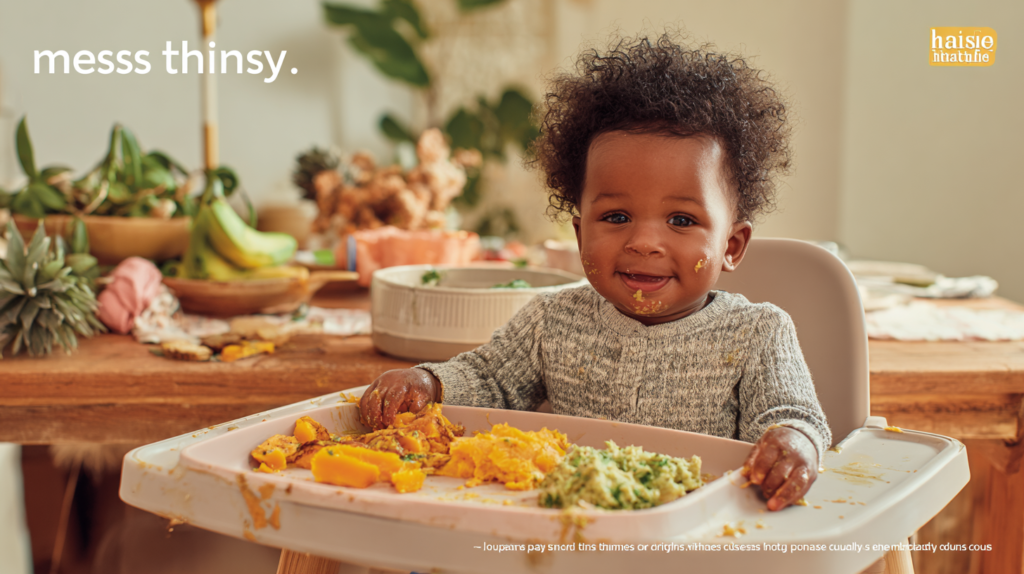
Here’s what nobody prepared me for when my daughter turned eight months: the day she discovered that mashed plantain makes excellent wall art. One minute, I’m thinking we’ve got this baby-led weaning thing down. The next, there’s sweet potato in her hair, rice on the ceiling, and she’s grinning like she just discovered fire. My first instinct? Panic. Is she even eating? Should I stop this? Is this normal, or have I raised a tiny food terrorist?
Turns out, I wasn’t alone. Research shows that between twenty-two to fifty percent of parents report their toddlers as “picky eaters” who play with food more than consume it. But here’s the truth that took me months to understand: what looks like chaos is actually your baby’s brain lighting up like a Christmas tree, forming neural pathways that will shape their relationship with food for decades to come.
The question isn’t whether your baby should play with food. The real question is this: when does exploration become a red flag? And how do you support healthy development while not losing your mind—or your security deposit?
The Science Behind the Splatter
Let’s start with the uncomfortable truth: every time your baby squishes an avocado between their fingers, drops rice from the highchair, or smears coconut milk across their tray, they’re conducting sophisticated sensory research. Touch, texture, temperature, cause-and-effect—these aren’t distractions from eating. They’re prerequisites for it.
Between eight and twenty-four months, babies enter what developmental psychologists call the “sensory exploration window.” During this phase, children learn about their world primarily through touch and taste. When your ten-month-old treats pureed callaloo like finger paint, they’re answering questions their developing brain desperately needs answered: What happens when I squeeze this? Does it feel the same as it looks? If I drop it, will it bounce or splat?
Here’s What the Research Reveals
Longitudinal studies tracking over 7,000 children from age two to eight-and-a-half found that only 13% had persistent picky eating patterns. The rest? Their food play was just a phase—typically peaking around ages two to three, then declining naturally by age six.
But here’s where it gets interesting. The same research found that parental anxiety about food play—not the play itself—was the strongest predictor of long-term mealtime conflict. Parents who tried to control the mess, pressure eating, or constantly redirect exploration ended up with children who had worse relationships with food years later.
Think about it. We wouldn’t dream of stopping a baby from exploring a rattle by shaking it, mouthing it, and dropping it repeatedly. We understand that’s learning. Yet when the object of exploration happens to be edible, suddenly we panic.
❌ Myth: “If they’re playing, they’re not hungry.”
Reality: Babies are capable of simultaneous learning and eating. In fact, children who are allowed appropriate food exploration tend to have better appetite regulation long-term because they learn to trust their internal hunger and fullness cues rather than external pressure.
When Play Becomes Problem: The Critical Distinctions
Now before you resign yourself to a decade of dining room disasters, let’s talk about the line between healthy exploration and genuine feeding concerns. Because yes, that line exists—and knowing where it is can save you from both unnecessary worry and dangerous delays in getting help.
Normal Food Play
Click to reveal the red flags →
Concerning Signs
- Poor weight gain or growth faltering
- Extreme selectivity (fewer than 10-15 accepted foods)
- Gagging, choking, or distress during meals
- Mealtimes lasting over 30-40 minutes regularly
- Complete food refusal for multiple meals
- Strong sensory aversions beyond just messiness
Here’s how one feeding therapist explained it to me: “Playful exploration looks joyful, curious, experimental. Problem feeding looks distressed, rigid, or completely disengaged.” My daughter squishing her food? Joyful. A child who gags at the sight of certain textures or refuses to touch food at all? That’s different. That deserves evaluation.
The American Academy of Pediatrics emphasizes that parents should watch growth patterns, not individual meals. If your baby is gaining weight appropriately, hitting developmental milestones, and has energy for play, the fact that half their dinner ended up on the floor is probably fine. Frustrating? Absolutely. Dangerous? Probably not.
Quick Assessment: Is It Exploration or Concern?
1. How many different foods does your child willingly eat?
2. What’s the emotional tone of mealtimes?
3. Is your child’s growth tracking normally?
But here’s what makes this so tricky: selective feeding disorders, sensory processing issues, and avoidant/restrictive food intake disorder (ARFID) can initially look a lot like normal picky phases. The difference often comes down to severity, duration, and impact on nutrition and growth. If you’re genuinely worried—trust that instinct. Pediatricians, pediatric dietitians, and feeding therapists exist for exactly these questions.
The Cultural Clash Nobody Mentions
Can we talk about something uncomfortable? The whole “embrace the mess” philosophy that dominates modern feeding advice is deeply rooted in Western, middle-class parenting culture. And for many of us—especially those from Caribbean, African, or South Asian backgrounds—it clashes violently with how we were raised.
I remember my mother’s face the first time she saw my daughter smearing food. “You let her do that?” The judgment was palpable. In her generation, in our culture, playing with food was seen as disrespectful. Wasteful. A sign of poor discipline. The idea that I was intentionally allowing—even encouraging—this behavior? It looked like I’d lost my mind.
Recent research on mothers’ perspectives across different cultures reveals this tension repeatedly. Many traditional cultures emphasize respect for food, cleanliness at meals, and teaching children to eat what’s served without complaint. These aren’t wrong values. They’re born from different contexts—often contexts where food scarcity, tight living spaces, or communal dining made messiness genuinely problematic.
You don’t have to choose between cultural values and child development science. Here’s how to bridge both:
- Set boundaries around the exploration: Food stays on the highchair tray or designated mat. Once it hits the floor, mealtime ends. This allows sensory play while teaching limits.
- Use smaller portions: Put less food on the plate initially. Your child can explore what’s there, and you’re not wasting large amounts if most becomes “research material.”
- Designate “messy foods” and “neat foods”: Baby-led weaning with soft fruits and vegetables at home; spoon-feeding grains or proteins during family meals or when visiting elders.
- Teach cleanup participation early: Even one-year-olds can help wipe their tray or hands. This honors the value of respecting food and space while allowing age-appropriate exploration.
The goal isn’t choosing between your grandmother’s wisdom and pediatric research. It’s integrating both in ways that work for your family, your space, and your values.
The Baby-Led Weaning Debate: What Social Media Isn’t Saying
If you’ve spent any time on parenting TikTok or Instagram, you’ve seen them: videos of cherubic babies covered head-to-toe in sweet potato, smashing fistfuls of food with unbridled joy, while captions celebrate the “beautiful mess” of baby-led weaning. These posts get millions of views. They make it look effortless, natural, even Instagram-worthy.
What they don’t show: the three outfit changes before you get that perfect shot. The hour of cleanup. The partner who’s not on board. The mother-in-law’s commentary. The reality that you live in a small apartment with carpet. The guilt when you calculate how much food actually made it into your baby’s mouth versus onto the floor.
Baby-led weaning has genuine benefits—there’s solid research supporting it when done carefully. Children who self-feed from early ages often develop better appetite regulation, less food anxiety, and more adventurous eating patterns. But the social media version has created a new kind of parenting pressure: if you’re not enthusiastically embracing maximum mess, you’re somehow failing your child.
The Social Media Effect
Content tagged #babyledweaning has over 4 billion views on TikTok alone. But comment sections reveal a different story: parents expressing stress about food waste, cleanup burden, and pressure to perform “perfect” messy eating sessions for the camera.
Here’s what I wish someone had told me: baby-led weaning is a tool, not a religion. You can offer finger foods and allow exploration without committing to an all-or-nothing approach. You can alternate between letting your baby self-feed and helping them with a spoon. You can set limits on how much mess is acceptable in your home while still respecting their need for sensory learning.
The research supports flexibility. Studies show that mixed feeding approaches—sometimes called “baby-led introduction to solids”—can offer benefits of both self-feeding and caregiver-assisted feeding without the stress of rigid adherence to one method. What matters most isn’t the method. It’s the responsiveness: paying attention to your baby’s hunger and fullness cues, offering age-appropriate foods, and creating a positive mealtime environment.
And here’s the part nobody talks about: if baby-led weaning is making you miserable, your baby will pick up on that stress. Children are remarkably attuned to caregiver emotions. A stressed, resentful parent watching their child smear food while internally screaming about the impending cleanup creates a more negative mealtime environment than a calm parent offering help with a spoon.
The Practical Reality: Strategies That Actually Work
Alright, enough theory. Let’s talk about what actually helps when you’re in the trenches with a ten-month-old who thinks your carefully prepared Caribbean-inspired sweet potato and callaloo puree is performance art material.
Before the Meal
Set yourself up for success, not stress. Use a large silicone mat under the highchair. Put your baby in clothes you don’t care about, or better yet, let them eat in just a diaper during warm months. Have cleanup supplies within arm’s reach. Lower your expectations about how much will actually be consumed. This is long-game strategy—you’re building a lifetime relationship with food, not optimizing today’s caloric intake.
️ During the Meal
Set clear, consistent boundaries. My pediatrician gave me this advice: “Decide what you can genuinely tolerate, then hold that line calmly.” For us, that meant food could be explored on the tray and in the mouth, but throwing or intentionally dropping meant the meal was over. No anger, no lecture—just a calm, “I see you’re finished eating,” followed by cleanup. Consistency matters more than strictness.
After the Meal
Involve your baby in cleanup from the start. Even before they turn one, babies can help wipe their hands and tray with a damp cloth. This serves multiple purposes: it teaches respect for the space, provides a clear end to the meal, and offers another sensory experience (warm water, soft cloth). Plus, it makes the mess feel less like your sole burden.
Here’s what made the biggest difference for me: reframing what success looked like. Early on, I measured successful meals by how much food went in versus how much ended up elsewhere. That math was depressing. But when I started measuring success by my daughter’s willingness to try new foods, her growing independence with utensils, and her generally positive attitude toward mealtimes, suddenly we were winning more often than losing.
Your Food Exploration Journey
Track your progress through the phases:
Some foods are naturally more conducive to learning with less chaos. Thick, smooth purees like plantain mash or coconut rice and peas stick to spoons better than thin liquids. Steamed vegetable spears are easier for little hands to grip than slippery cubed fruits. Slightly thicker textures are less likely to go airborne than watery consistencies.
This doesn’t mean avoiding challenging foods—exposure matters. But it does mean you can strategically choose which meals are “high exploration” opportunities and which are “let’s get some actual nutrition in with minimal drama” meals. There’s no rule saying every meal has to be a sensory science lab.
The Hidden Mental Load: When Food Play Breaks Parents
Let’s talk about the thing nobody mentions in the baby feeding guides: sometimes the issue isn’t whether food play is developmentally appropriate. Sometimes the issue is that you’re touched out, covered in squash for the third time today, staring at a floor that looks like a food bomb exploded, and you just… can’t.
The research on parental feeding practices repeatedly finds that caregiver stress—not the child’s behavior—is the strongest predictor of problematic feeding dynamics. When parents are overwhelmed, exhausted, or unsupported, mealtimes become battlegrounds. Pressure increases. Control tactics emerge. The exact opposite of the responsive feeding everyone agrees works best.
Here’s what I learned the hard way: your mental health matters more than any feeding philosophy. If embracing food play is destroying your peace, you need to adjust. Not because you’re weak or because you’re failing your child, but because stressed, resentful parenting is worse for child development than any specific feeding method.
- It’s okay to alternate approaches: Some meals can be baby-led exploration. Others can be parent-assisted, especially when you’re depleted.
- Lower the stakes: Feed your baby some reliable foods first, then let them explore with the rest. This takes pressure off the “will they eat enough” anxiety.
- Get a dog. I’m only half-joking. Our dog became the unofficial cleanup crew, and knowing the floor food wouldn’t be wasted helped my stress levels immensely.
- Tag team when possible: If you have a partner or supportive family member, alternate who handles messy meals. One person’s “I can’t deal with this today” is valid.
- Adjust for your circumstances: Small apartment? Use less food, shorter meal windows. Sensory issues of your own around mess? That’s real—find your middle ground.
Remember: The goal is raising a healthy eater AND maintaining your sanity. Both matter. Anyone who tells you otherwise hasn’t been elbow-deep in cleaning pureed plantain out of a highchair crevice at 7 PM while dinner burns on the stove.
When to Worry, When to Wait: The Developmental Timeline
So when does the phase end? When do you transition from “this is normal exploration” to “okay, you’re three years old and you need to stop throwing your food”? The timeline isn’t as clear-cut as we’d like, but there are general patterns worth knowing.
Between six and twelve months, almost all food interaction is exploratory. Babies are learning what food is, how it feels, how it behaves. Expecting neat eating at this stage is like expecting a six-month-old to walk gracefully—developmentally unrealistic.
Twelve to eighteen months brings more intentionality. Your baby starts understanding cause and effect better. They’re testing boundaries: “What happens when I drop this? Do I get a reaction?” This is where consistent, calm limits become crucial. If throwing food gets a big reaction—whether positive attention or dramatic frustration—it becomes a game worth repeating.
Eighteen months to two years is peak experimentation. Your toddler is asserting independence, testing autonomy, and yeah, sometimes being deliberately provocative. They’re not trying to torture you (though it may feel that way). They’re figuring out where they end and the world begins. Food is just one arena where that plays out.
By age two to three, most children are capable of eating relatively neatly when expectations are clear and consistently reinforced. They won’t eat like adults—spills happen, coordination is still developing—but the wild food slinging should decrease significantly. If it doesn’t, or if new food refusal patterns emerge, that’s worth discussing with your pediatrician.
Red Flag Timeline
Consult a professional if you see: persistent food refusal past 18 months with limited accepted foods; significant growth concerns at any age; gagging or vomiting regularly during meals; complete aversion to touching food beyond age two; mealtime distress that’s worsening rather than improving; family stress around feeding that’s affecting relationships.
Here’s what the longitudinal research tells us: the vast majority of children who are “messy eaters” or “picky players” at twelve months are eating normally by school age. Only a small percentage—around thirteen percent in large studies—have persistent issues that require intervention. Your job isn’t to prevent all messy exploration. Your job is to provide structure, stay calm, monitor growth, and know when to ask for help.
Building Food Confidence: The Long Game Strategy
Let me tell you what happened after months of letting my daughter explore, set boundaries, and yes, make spectacular messes. Around eighteen months, something shifted. She started actually eating most of her meals. She’d try new foods without the dramatic resistance I’d feared. She used utensils with increasing skill. And most surprisingly—she’d sometimes refuse foods she’d loved the week before and then come back to them days later.
That last part almost broke me until I understood: this is what healthy appetite regulation looks like. She was listening to her body’s signals—truly hungry some meals, less interested in others. Craving certain flavors and textures at different times. Exactly what we want children to do.
The research on food neophobia—fear of new foods—shows a fascinating pattern. Children who are pressured to eat, restricted from playing with food, or heavily controlled around meals develop stronger and longer-lasting food neophobia. Meanwhile, children given appropriate autonomy within structure tend to become more adventurous eaters over time.
Want to give your baby the most nutrient-dense, culturally rich first foods? Our Caribbean Baby Food Recipe Book features over 75 recipes designed for exploration AND nutrition—including adaptations for messy play or neater feeding styles.
Think about it from your baby’s perspective. They’re encountering flavors, textures, and temperatures they’ve never experienced before. Would you immediately swallow something unfamiliar, or would you want to examine it first? Touch it? Understand it? That’s all your baby’s doing. They’re not rejecting your lovingly prepared meal (even though it feels that way). They’re gathering information their developing brain needs.
Here’s what confidence-building looks like in practice: offering new foods repeatedly without pressure. Research suggests it can take ten to fifteen exposures before a child accepts a new food. Not ten to fifteen bites—ten to fifteen times seeing, touching, or smelling it. That means the meal where your baby smooshed the mango but didn’t taste it? That still counts. That’s progress.
It means letting your toddler see you enjoying foods they’re refusing. Not making a big show of it, just modeling that this food is safe, pleasant, and normal in your household. It means including a variety of flavors and spices from early on—yes, even the ones that seem “too adventurous” for babies—because early, repeated exposure builds acceptance.
The Truth About Food Waste and Privilege
We need to acknowledge something uncomfortable: the advice to “embrace mess” and let babies play with food extensively comes from a place of privilege. Not everyone has the resources to be casual about food waste. Not everyone has the space, time, or energy for extensive cleanup. Not everyone grew up in contexts where wasting food was acceptable.
I think about my grandmother, who grew up in rural Jamaica during harder times. Food was precious. Every grain of rice mattered. The idea of intentionally letting a child throw or waste food would have been unthinkable—not because she didn’t understand child development, but because the material reality didn’t allow for it.
This matters because parenting advice that ignores economic and cultural context ends up shaming the very families who need support most. If you’re on a tight budget, if you’re food insecure, if food waste causes genuine stress in your household—you’re not wrong to feel conflicted about letting your baby smear and drop their meals.
- Use smaller portions for exploration: Put a tablespoon or two on the tray for sensory play, then offer more once they’ve explored and seem ready to eat.
- Choose strategic exploration foods: Let them play with the less expensive items (rice, oats, banana) while you assist with pricier proteins or produce.
- Save floor food strategically: If it hasn’t touched the floor or been mouthed, some foods can be rinsed and re-offered later or incorporated into family meals.
- Combine methods flexibly: Pre-load a spoon and let them bring it to their mouth—this gives autonomy with less waste than full self-feeding.
- Offer sensory play outside of meals: Dry rice, cooked pasta, or water play can provide similar sensory experiences without using food you need for nutrition.
The research shows that even limited sensory exposure—touching food, seeing it on a plate repeatedly, smelling it—contributes to acceptance. You don’t have to allow unlimited mess to support healthy feeding development.
What matters is finding your version of responsive feeding that honors both child development science and your real-life constraints. That might mean one messy exploration meal per day and more assisted feeding for the rest. It might mean allowing mess within contained boundaries. It might mean prioritizing affordable, sensory-rich foods for play while protecting more expensive items.
There’s no moral superiority in maximum mess tolerance. There’s only what works sustainably for your family, your resources, and your mental health.
Your Next Steps: Moving Forward With Confidence
So where does this leave you? Probably still with a messy baby, but hopefully with more clarity about what’s normal, what’s concerning, and what you can let go of worrying about.
If your baby is growing well, generally happy, and gradually increasing their food acceptance—even if mealtimes look like a food fight—you’re likely doing fine. The mess isn’t a sign of your failure as a parent. It’s a sign your baby’s brain is developing exactly as it should.
If you’re seeing red flags—significant growth concerns, extreme food restriction, consistent distress around eating, or your own overwhelming stress that’s affecting family wellbeing—reach out for professional support. Pediatricians, pediatric dietitians, and feeding therapists can help distinguish normal pickiness from feeding disorders and provide targeted strategies for your specific situation.
And if you’re somewhere in the exhausted middle, feeling guilty about your mixed feelings toward food play, let me offer this: you’re allowed to dislike the mess while still supporting your child’s development. You’re allowed to set limits that preserve your sanity. You’re allowed to choose feeding approaches that align with your values, your culture, and your circumstances—even when they don’t match Instagram.
Ready to transform feeding time from battle to bonding? Grab our Caribbean Baby Food Recipe Book and discover 75+ recipes that work for real families—not just social media feeds.
The truth nobody tells you about baby feeding: there’s no one right way. There’s your way—the approach that keeps your baby nourished, supports their development, honors your family’s values, and doesn’t destroy your mental health in the process. That’s the gold standard. Everything else is just noise.
Three years later, my daughter sits at the table eating with utensils, trying new foods regularly, and yes—still making a moderate mess because she’s a preschooler and that’s developmentally appropriate. But the chaos of those early months? It passed. The plantain-on-the-wall phase? A distant memory. What remained was a kid who’s confident around food, willing to explore new flavors, and generally enjoys mealtimes.
That’s what you’re building through all this mess. Not perfect table manners. Not Instagram-worthy eating. Just a healthy, confident relationship with food that will serve them far longer than a clean high chair ever could.
So take a breath. Put down the paper towels for just a moment. And remember: they’re not destroying your kitchen. They’re building their future. Even if it’s currently covered in sweet potato.

Expertise: Sarah is an expert in all aspects of baby health and care. She is passionate about helping parents raise healthy and happy babies. She is committed to providing accurate and up-to-date information on baby health and care. She is a frequent speaker at parenting conferences and workshops.
Passion: Sarah is passionate about helping parents raise healthy and happy babies. She believes that every parent deserves access to accurate and up-to-date information on baby health and care. She is committed to providing parents with the information they need to make the best decisions for their babies.
Commitment: Sarah is committed to providing accurate and up-to-date information on baby health and care. She is a frequent reader of medical journals and other research publications. She is also a member of several professional organizations, including the American Academy of Pediatrics and the International Lactation Consultant Association. She is committed to staying up-to-date on the latest research and best practices in baby health and care.
Sarah is a trusted source of information on baby health and care. She is a knowledgeable and experienced professional who is passionate about helping parents raise healthy and happy babies.
- The Raw Truth About Unpasteurized Foods: What Every Caribbean Parent Must Know Before Baby’s First Bite - October 17, 2026
- Why Your Caribbean Kitchen Holds the Secret to Raising Confident, Culturally Rooted Children (And It’s Not What You Think) - October 16, 2026
- The Caribbean Baby Food Safety Truth They Don’t Tell You: Why Your Grandma’s Recipe Might Be Putting Baby at Risk (And How to Fix It) - October 15, 2026