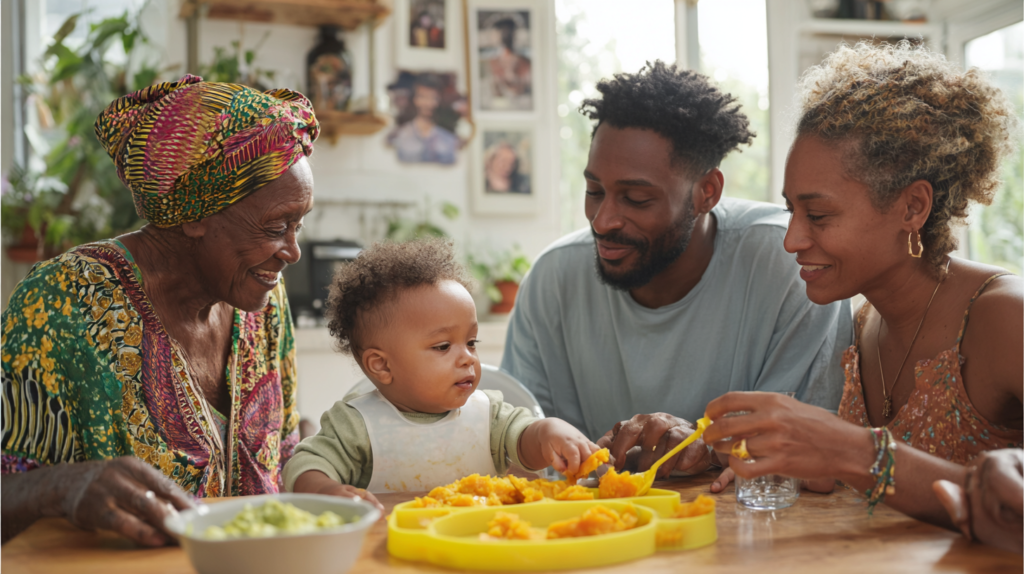
When Grandma Says “Just a Little Taste Won’t Hurt” – Navigating the Solids Battlefield Without Losing Your Mind (or Your Mother-in-Law)
Before We Dive In: What’s YOUR Feeding Tension Point?
Click the situation that makes your heart race faster than a baby reaching for your hot coffee:
Here’s something nobody warns you about when you’re pregnant and dreaming of peaceful family dinners: the moment you introduce solids to your baby, you’re not just navigating what goes into that tiny mouth—you’re stepping into a minefield of generational beliefs, cultural traditions, and deeply held convictions about what makes a “healthy” baby.
Last week, a friend texted me at midnight. Her message? “MIL gave baby custard at 7 months. I said no dairy yet. Now she’s not speaking to me. Send help.” This wasn’t just about custard. It was about respect, boundaries, trust, and two generations of women who both desperately want what’s best for the same child but can’t agree on what “best” actually means.
The stakes feel impossibly high because they are. Research shows that grandparents—especially maternal grandmothers—are now major childcare providers worldwide and wield enormous influence over infant feeding patterns. Studies from India reveal that households where grandmothers have correct infant and young-child feeding knowledge are two to four times more likely to follow recommended breastfeeding and complementary feeding practices. When grandparents are on board, babies thrive. When they’re not, parents face an exhausting daily negotiation over every meal, every snack, every bite.
But here’s the truth most parenting articles skip: your grandmother isn’t trying to undermine you. She kept children alive and thriving in her time. She has battle scars from her own feeding journey. And now, watching you parent, she’s caught between wanting to support you and feeling like everything she did is being dismissed as wrong or outdated. The conflict isn’t really about baby-led weaning versus purees, or sweet potato at six months versus rice cereal at four. It’s about love, legacy, and the impossible weight of wanting to do right by the newest, most vulnerable member of the family.
Why This Feeding Clash Cuts So Deep (And It’s Not About the Mashed Banana)
Let’s go back a generation—or two, or three, depending on your family. Many of our grandmothers raised babies in an era when formula companies handed out free samples in hospitals, when rice cereal at six weeks was standard pediatric advice, when a chubby baby was the ultimate sign of good mothering, and when the phrase “failure to thrive” was whispered with genuine fear. In parts of the Caribbean and across many cultures, food scarcity was a living memory. Feeding your child well wasn’t just nutrition—it was survival, pride, and proof that you were a capable mother.
Fast-forward to today. Current public health guidance says exclusive breastfeeding (or formula) until around six months, then introduce complementary foods with emphasis on iron-rich options, responsive feeding, and letting baby explore textures. No honey before one year. No cow’s milk as a main drink before one year. Watch for choking hazards. Introduce allergens early. Oh, and consider baby-led weaning, where baby self-feeds from the start instead of being spoon-fed purees.
To many grandparents, this sounds like a foreign language—or worse, like a judgment on everything they did. One qualitative study found that mothers frequently turn to family members and online sources for feeding advice more than healthcare providers, which means the information gap between generations gets filled not with evidence but with emotion, anecdote, and whoever has the loudest voice at the dinner table.
The Numbers Behind the Dinner Table Drama
Families where grandmothers have accurate infant feeding knowledge are 2-4 times more likely to follow recommended practices for breastfeeding initiation, colostrum feeding, and appropriate timing of complementary foods.
Across multiple studies, grandparents routinely provide meals and snacks when caring for young children, meaning their beliefs directly shape what babies eat—not just occasionally, but consistently.
Many grandparents introduce extra fluids (water, teas) or solids earlier than current guidelines recommend, sometimes before 6 months, based on their own generational norms and cultural practices.
Research shows grandparents frequently offer high-sugar, high-fat foods as expressions of affection, viewing indulgent feeding as part of their special role—which can conflict with parents’ dietary limits.
Cultural memories run deep. In many Caribbean households, a hearty bowl of cornmeal porridge or a rich stew signals care and nourishment. Recipes like Cornmeal Porridge Dreams or Sweet Potato & Callaloo Rundown bridge generations because they honor traditional ingredients—coconut milk, callaloo, sweet potato, plantain—while adapting them to modern baby-feeding safety. But when grandma wants to add sugar to the porridge or offer it at four months instead of six, the bridge starts to crack.
The Baby-Led Weaning Explosion (And Why It’s Driving Grandparents Wild)
If you’ve spent any time in parenting groups online, you’ve seen the fierce debates: baby-led weaning (BLW) versus traditional spoon-feeding. BLW advocates say letting babies self-feed from the start promotes independence, better motor skills, and healthier relationships with food. Traditional feeders argue that purees are safer, easier, and help ensure babies actually consume enough nutrients.
The Shocking Truth About BLW vs. Spoon-Feeding
Most parents don’t know this research finding—click to reveal what the science actually says:
But here’s what makes BLW particularly explosive in multi-generational households: it looks terrifying if you’ve never seen it before. Baby gagging on a piece of steamed broccoli. Food smeared everywhere. A six-month-old “playing” with a spear of roasted sweet potato instead of eating. To a grandmother whose role was to ensure every bite went into baby’s mouth, this looks like chaos, waste, and danger—not modern best practice.
Social media hasn’t helped. Stories of grandparents defying BLW rules go viral: “MIL mashed up all the food when I left the room.” “Grandma spoon-fed baby behind my back.” “She said I’m starving my child by ‘just letting him play with food.'” Online communities validate parents’ frustration, but they also amplify the conflict, turning what could be a private family discussion into a public judgment of who’s the “better” caregiver.
The Real Flashpoints: Where Disagreements Actually Happen
️ Can You Spot the Peaceful Response?
Test your conflict-navigation skills with these real scenarios:
Scenario 1: The 4-Month Rice Cereal Push
Grandma insists: “I gave all my babies cereal at 4 months and they turned out fine. Your baby is hungry—look at him watching us eat!”
Scenario 2: The Unauthorized Treat
You walk in to find grandma giving your 8-month-old a cookie. “Just a tiny taste! He loved it!”
Scenario 3: The “Baby Needs More!” Pressure
After every meal, grandma says baby didn’t eat enough and tries to add more spoonfuls. Baby turns away. She persists.
Each of these scenarios is a real moment reported in studies and social media discussions about grandparent feeding conflicts. The pattern is always the same: different beliefs about what babies need, combined with high emotional stakes, plus unclear communication equals explosion.
But notice what the “peaceful” responses have in common: they validate the grandparent’s underlying emotion (worry, love, desire to help), they explain the reasoning behind your approach without lecturing, and they offer a concrete alternative that gives grandma a valued role. You’re not dismissing her—you’re redirecting her immense caregiving energy toward actions you can both feel good about.
What the Research Shows: Grandparents as Allies or Obstacles?
Let’s be honest about what the studies actually find. Grandparent involvement in infant feeding is a double-edged sword. On one hand, when grandmothers have accurate, updated knowledge, they’re powerful forces for good. They provide crucial support, share labor-intensive food preparation tasks, offer emotional reassurance to anxious new mothers, and model healthy eating behaviors.
A 2020 meta-synthesis on grandmothers’ knowledge, attitudes, and practices related to breastfeeding found that many grandmothers want to support their daughters and daughters-in-law but feel confused or even hurt by changing recommendations. They see advice they followed being labeled “dangerous,” and they interpret requests to “do it differently” as personal criticism. The result? Some become defensive, some withdraw, and some—in a misguided attempt to prove their way works—override parents’ instructions when left alone with baby.
On the other hand, grandparents who feed according to outdated beliefs can inadvertently increase risks. Early introduction of solids (before four months) is linked to increased infection and allergy risk. Pressuring babies to finish bottles or plates overrides natural satiety cues and is associated with higher weight gain and childhood obesity risk. Offering high-sugar, high-salt, or low-nutrient “treat” foods regularly shapes taste preferences in ways that can last years.
A 2023 narrative review on grandparents’ influence on children’s dietary health found that, across cultures, grandparents tend to offer larger portions, more energy-dense foods, and more indulgent feeding styles than parents. This isn’t malicious—it’s cultural. For many grandparents, especially those who experienced food insecurity, providing abundant food is the ultimate expression of love and security. Telling them “less is more” or “baby will eat when hungry” runs counter to deeply ingrained beliefs about what good caregiving looks like.
✅ Building Your Peace Plan: Track Your Wins
Small steps create big change. Click each milestone as you accomplish it:
The Cultural Layer: Why Caribbean and Multicultural Families Face Extra Pressure
If you’re raising a baby in a Caribbean household or a multicultural family, you’re navigating an additional layer of complexity: food isn’t just nutrition—it’s identity, heritage, and connection to ancestors. When grandma wants baby to taste her famous callaloo or a spoonful of her carefully prepared stew, she’s not just offering food. She’s offering belonging.
This makes conflict especially painful. Saying “no” to traditional foods or preparation methods can feel, to an elder, like rejection of culture itself. Many Caribbean grandmothers take enormous pride in their cooking and in passing down recipes that survived colonization, migration, and economic hardship. When a daughter or daughter-in-law says “too much salt” or “baby isn’t ready for that yet,” it can land as “your food isn’t good enough” or “our culture isn’t safe for my child.”
The good news? Cultural foods and modern baby feeding guidelines are absolutely compatible. Traditional Caribbean ingredients—plantains, sweet potatoes, pumpkin, coconut milk, yams, beans, and tropical fruits—are nutritional powerhouses perfect for babies. Recipes like Yellow Yam & Carrot Sunshine, Plantain Paradise, or Coconut Rice & Red Peas honor the flavors and ingredients grandmothers know by heart while adjusting preparation (lower salt, age-appropriate textures, safe spices) to meet current safety standards.
The key is framing: “We’re not rejecting your food, Grandma—we’re adapting it for baby’s development stage. Can you teach me how you make your callaloo, and we can figure out together how to make a baby-safe version? I want baby to grow up loving these flavors the way I do.” This approach preserves pride, honors knowledge, and creates collaboration instead of confrontation.
Scripts, Strategies, and Survival Tools for Real-Life Moments
Theory is lovely, but what do you actually say when you’re standing in the kitchen, exhausted, and grandma is hovering with a spoon full of sugary porridge aimed at your six-month-old’s mouth? Here are field-tested scripts and strategies from parents, researchers, and family therapists who’ve navigated these exact waters:
When grandma questions your timing:
“I know it seems like baby is ready earlier—I thought so too! But our pediatrician explained that baby’s gut and kidneys are still developing until around six months, and starting solids too early can actually increase infection risk. Waiting a few more weeks gives baby’s system time to be ready. I promise we’ll start soon, and I’d love your help when we do.”
When grandma criticizes baby-led weaning:
“I can see why this looks messy and scary—it did to me at first too! The research shows babies actually have a really strong gag reflex that protects them, and learning to self-feed helps develop fine motor skills. How about this: when you’re watching baby, you can offer some of these pre-loaded spoons and these safe finger foods we’ve prepared? That way baby still practices self-feeding but you’re involved and can feel confident.”
When grandma sneaks unauthorized foods:
“I know you love treating baby—and trust me, baby will love treats from you when the time is right. Right now we’re being careful about sugar and salt because it can shape taste preferences for life. I don’t want to be the fun-police! How about we make a list together of ‘Grandma’s special foods’ that are safe now, and another list of treats we can introduce together when baby is older? That way you get to be the special treat-giver without me worrying.”
When grandma insists baby needs more food:
“You raised healthy kids, so I totally understand why you’re worried about portions. Here’s what’s wild—babies this age need way less than we think, and their stomachs are tiny. Pediatrician showed me that [baby’s name]’s growth curve is perfect, so even though the amounts look small to us, it’s exactly what baby needs. If you’re nervous, we can check weight together at the next appointment—I think seeing those numbers will reassure you.”
When cultural foods are the sticking point:
“I want baby to grow up loving our family foods! But some ingredients need to wait until baby’s system is ready—like honey before one year, or high-salt foods while kidneys are developing. Can we cook together and adapt your recipes? Like, I’d love to learn your plantain recipe and figure out how to prepare it baby-safe. That way baby gets the real flavors but in a way that’s developmentally appropriate. You know these recipes better than anyone—I need your expertise to make this work.”
️ Your Family Peace Potential Calculator
Rate these factors honestly to see how likely you are to find common ground:
Communication Quality
Mutual Respect
Flexibility
Involvement Level
When Conflict Becomes Crisis: Knowing When to Draw Hard Lines
Most feeding disagreements can be resolved with patience, communication, and compromise. But some situations require firm boundaries—not for control, but for safety. If grandparent feeding behaviors pose genuine risk to baby’s health, you have to act, even if it damages the relationship temporarily.
Hard-line situations include: repeatedly giving honey before one year (botulism risk), offering choking-hazard foods (whole grapes, nuts, popcorn) to babies under appropriate age, force-feeding or pressuring baby to eat past satiety signals, or deliberately undermining medical advice for a baby with specific health conditions (allergies, reflux, failure to thrive).
In these cases, the script shifts: “I know we disagree on this, and I respect your experience. But this is a non-negotiable safety issue based on current medical evidence. If you can’t honor this boundary, we’ll need to rethink care arrangements until baby is older and the risk has passed. This isn’t about trust or control—it’s about keeping baby safe, which I know we both want.”
It’s a hard conversation. It might mean reducing unsupervised time with grandparents, which brings its own guilt and logistical challenges. But chronic boundary violations—especially around food and safety—erode trust faster than almost anything else in family relationships. Better one difficult conversation now than months of resentment, anxiety, and secret non-compliance that ultimately blows up into a larger rift.
Some families find success with written feeding plans: a simple one-page document listing approved foods, portion guidance, foods to avoid, and emergency contacts. It removes ambiguity, provides something concrete grandparents can reference, and creates accountability. Frame it as a tool, not an insult: “I made this for everyone who helps with baby—the babysitter will use it too. It just makes sure baby gets consistent care no matter who’s feeding.”
The Long Game: Teaching Respect Through Food
Here’s a perspective that might ease the weight of these daily conflicts: how you navigate feeding disagreements with grandparents is teaching your child enormous lessons about respect, boundaries, communication, and cultural negotiation that will serve them for decades.
Children who grow up watching adults disagree respectfully, explain reasoning, compromise, and honor each other’s expertise learn that conflict doesn’t have to mean rejection. They learn that you can love someone and still set boundaries with them. They learn that “different” doesn’t mean “wrong,” and that traditions can be adapted without being abandoned.
Conversely, children who grow up in households with chronic tension around food—where parents and grandparents undermine each other, speak badly about each other’s approaches, or use food as a control battlefield—absorb anxiety around eating. They learn that food is about power, not nourishment. They internalize that love comes with conditions and manipulation.
That’s not to guilt you into accepting feeding practices you’re uncomfortable with—absolutely not. But it is to remind you that your goal isn’t to “win” the feeding debate. Your goal is to create an environment where your child feels safe, nourished, loved by multiple generations, and connected to their heritage—while also meeting modern health standards. That’s a both/and situation, not either/or.
Practical tip: involve grandparents in feeding milestones. Invite them to be present (in person or video call) for baby’s first taste of solids. Let them see baby’s reaction to a traditional food you’ve adapted together. Share photos of baby enjoying foods grandma taught you to make. Frame updates as celebrations, not reports: “Look what baby did today with the recipe you taught me!” This builds shared investment and joy, which is the actual point of family meals anyway.
Moving Forward: Building Bridges One Meal at a Time
Nobody warns you that starting solids means starting negotiations. That the simple act of offering your baby a spoonful of mashed sweet potato will become tangled up in your relationship with your mother, your mother-in-law, your own childhood, your partner’s childhood, and generations of beliefs about what “good feeding” looks like.
But here’s what I’ve learned from watching families navigate this successfully: the ones who come through with relationships intact are the ones who lead with curiosity instead of judgment. They ask: “What did you do when you were feeding babies? What were you told? What worked for you?” They listen. They validate. And then they gently, persistently, lovingly add: “Here’s what we’re learning now. Here’s why we’re doing it differently. And here’s how you can be part of it.”
Grandparents who feel respected, included, and valued are far more likely to come around to new approaches—especially when they see them working. Grandparents who feel dismissed, criticized, or shut out often dig in harder, because now it’s not about feeding methods—it’s about their worth, their legacy, and whether they still have a place in this family.
Start small. Pick one area where you can defer to grandparent wisdom (maybe they prep the vegetables, or they teach you how to properly cook plantain, or they hold baby during feeding while you manage the spoon). Pick one area that’s non-negotiable for you (maybe no honey, or waiting until six months, or no added salt). Clearly communicate both. Celebrate progress, even tiny bits. “Thank you for respecting our timing on starting solids—it means so much that you’re supporting us even though you did it differently.”
And when you’re totally exhausted, when you’ve had the same conversation for the fifteenth time, when grandma gave baby that cookie despite everything you’ve said, take a breath and remember: she’s not trying to hurt your baby. She’s trying to love your baby the way she knows how. Your job is to help her learn a new language of love—one that honors both where she’s been and where you’re going.
Food is family. Food is culture. Food is love made visible. When you start solids with your baby, you’re not just introducing nutrition—you’re negotiating what kind of family you’re building and what values you’re passing down. Make it a table where everyone has a seat, where different generations can learn from each other, and where the baby in the high chair, oblivious to all the drama, just gets to experience being deeply, abundantly loved by everyone around them.
That’s the meal worth fighting for. And with patience, clear communication, and recipes that bridge old and new—like the 75+ Caribbean-inspired baby food recipes that adapt traditional island flavors to modern safety guidelines—you can create exactly that. One spoonful, one conversation, one small compromise at a time.
Your Kitchen, Your Rules, Your Peace
At the end of this messy, beautiful, exhausting, joy-filled journey of starting solids with your baby while managing family dynamics, here’s what matters most: you are the parent. You get to make the final call. Not because you’re smarter or more knowledgeable than your mother or mother-in-law, but because this is your child, your household, your responsibility.
But “your rules” doesn’t have to mean “my way or the highway.” It can mean “here are our family feeding guidelines, developed with our pediatrician, informed by current research, and adapted to honor our cultural foods and family traditions.” It can mean “we value your experience and we’re asking you to trust our decisions, even when they’re different from what you did.”
The families who navigate this successfully aren’t the ones with the most compliant grandparents or the most lenient parents. They’re the ones who keep talking, keep explaining, keep inviting grandparents into the process rather than shutting them out of it. They’re the ones who see grandparents as potential allies in raising healthy kids, not adversaries to be managed.
Because here’s the secret nobody tells you: in five years, the specifics of whether baby started solids at five months or six months won’t matter nearly as much as whether your mother and mother-in-law still feel like valued members of your family. Whether they feel confident caring for your growing child. Whether the kitchen is a place of warmth and connection, or a battlefield of unspoken resentment.
You’re not just feeding a baby. You’re feeding relationships. Choose your battles wisely, communicate clearly and kindly, hold your boundaries with love, and offer grace—both to the grandparents learning to trust your parenting and to yourself as you learn to parent under their watchful, well-meaning, sometimes maddening gaze.
The rice cereal debate will pass. The baby-led weaning controversy will fade. But the family bonds you’re building or breaking right now—those will shape your child’s sense of belonging and security for decades to come. Feed those bonds as carefully as you feed that baby. They both need the same ingredients: patience, consistency, love, and the willingness to try again tomorrow when today didn’t go as planned.
Now go make peace over a bowl of perfectly mashed plantain. Or sweet potato. Or whatever food becomes your family’s bridge between generations. You’ve got this.

Expertise: Sarah is an expert in all aspects of baby health and care. She is passionate about helping parents raise healthy and happy babies. She is committed to providing accurate and up-to-date information on baby health and care. She is a frequent speaker at parenting conferences and workshops.
Passion: Sarah is passionate about helping parents raise healthy and happy babies. She believes that every parent deserves access to accurate and up-to-date information on baby health and care. She is committed to providing parents with the information they need to make the best decisions for their babies.
Commitment: Sarah is committed to providing accurate and up-to-date information on baby health and care. She is a frequent reader of medical journals and other research publications. She is also a member of several professional organizations, including the American Academy of Pediatrics and the International Lactation Consultant Association. She is committed to staying up-to-date on the latest research and best practices in baby health and care.
Sarah is a trusted source of information on baby health and care. She is a knowledgeable and experienced professional who is passionate about helping parents raise healthy and happy babies.
- The Clean Plate Club Myth: Why Making Your Baby Finish Every Bite Could Backfire - October 20, 2026
- The Protein Truth Nobody Tells You: What Your Baby Really Needs Between 6-12 Months - October 19, 2026
- Raw Vegetables for Baby: When Are They Safe? - October 18, 2026