The One Seat at Your Table That Changes Everything
I’ll never forget the first time we pulled that highchair up to our dinner table—not off to the side where I could shovel mashed bananas into my baby’s mouth while my own food went cold, but right there, smack in the middle of the action. My mother-in-law looked at me like I’d lost my mind. “The baby’s going to be at the table? With us? During the actual meal?”
But here’s what nobody tells you about those early feeding days: your baby isn’t just learning to eat. They’re learning how to be human. And according to recent research from 2024, over 80% of American families are now prioritizing shared family meals more than ever before, with powerful evidence showing that including babies from the very start creates benefits that ripple through childhood and beyond. The families who include their littlest members at the table from day one? Their children show better emotional regulation, more adventurous eating habits, and stronger family bonds years down the line.
The truth is, family meals aren’t just about nutrition—they’re about connection, conversation, and creating tiny humans who know what it means to belong. Yet somewhere between the baby food commercials and the feeding schedules, we’ve forgotten that the most powerful feeding tool we have isn’t in any jar or pouch. It’s already sitting at your table.
Why Your Baby Belongs at the Table (Yes, Even at Six Months)
Let me paint you a picture that’s probably happening in homes right now: It’s 6 PM. One parent is speed-eating dinner at the counter while the other spoon-feeds the baby in a separate room. The TV is on. Nobody’s talking. Everyone’s just trying to survive until bedtime. Sound familiar?
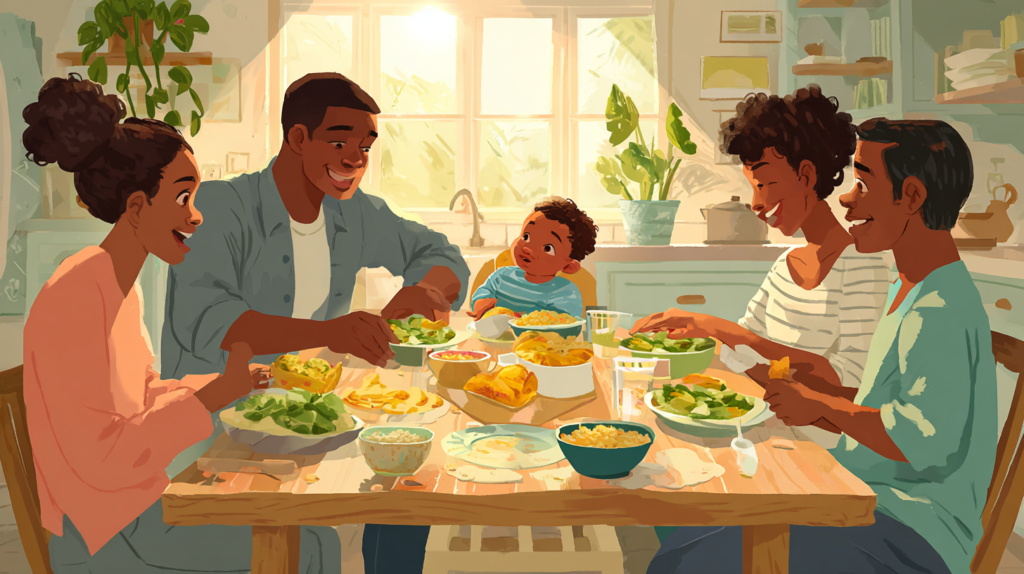
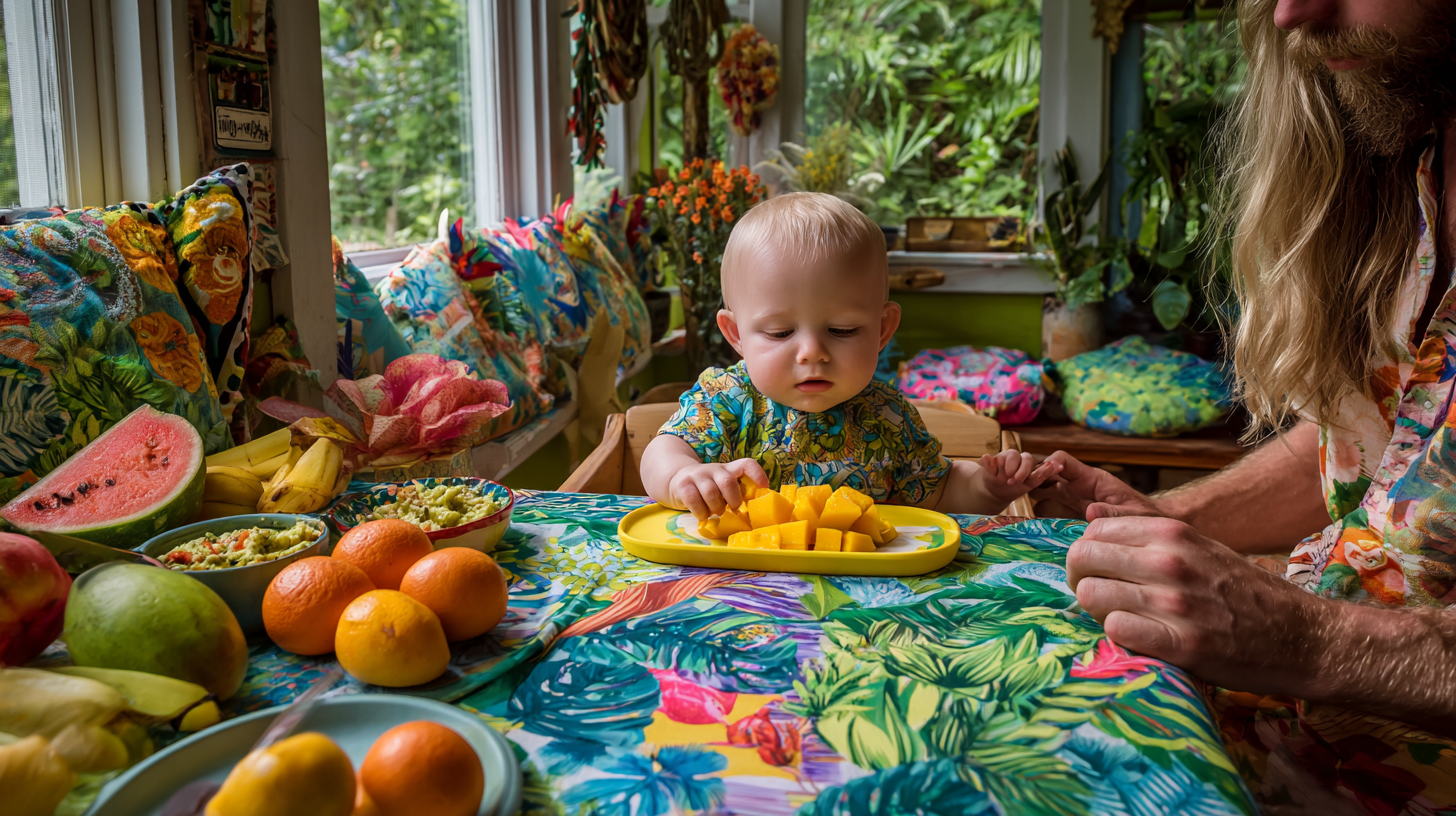
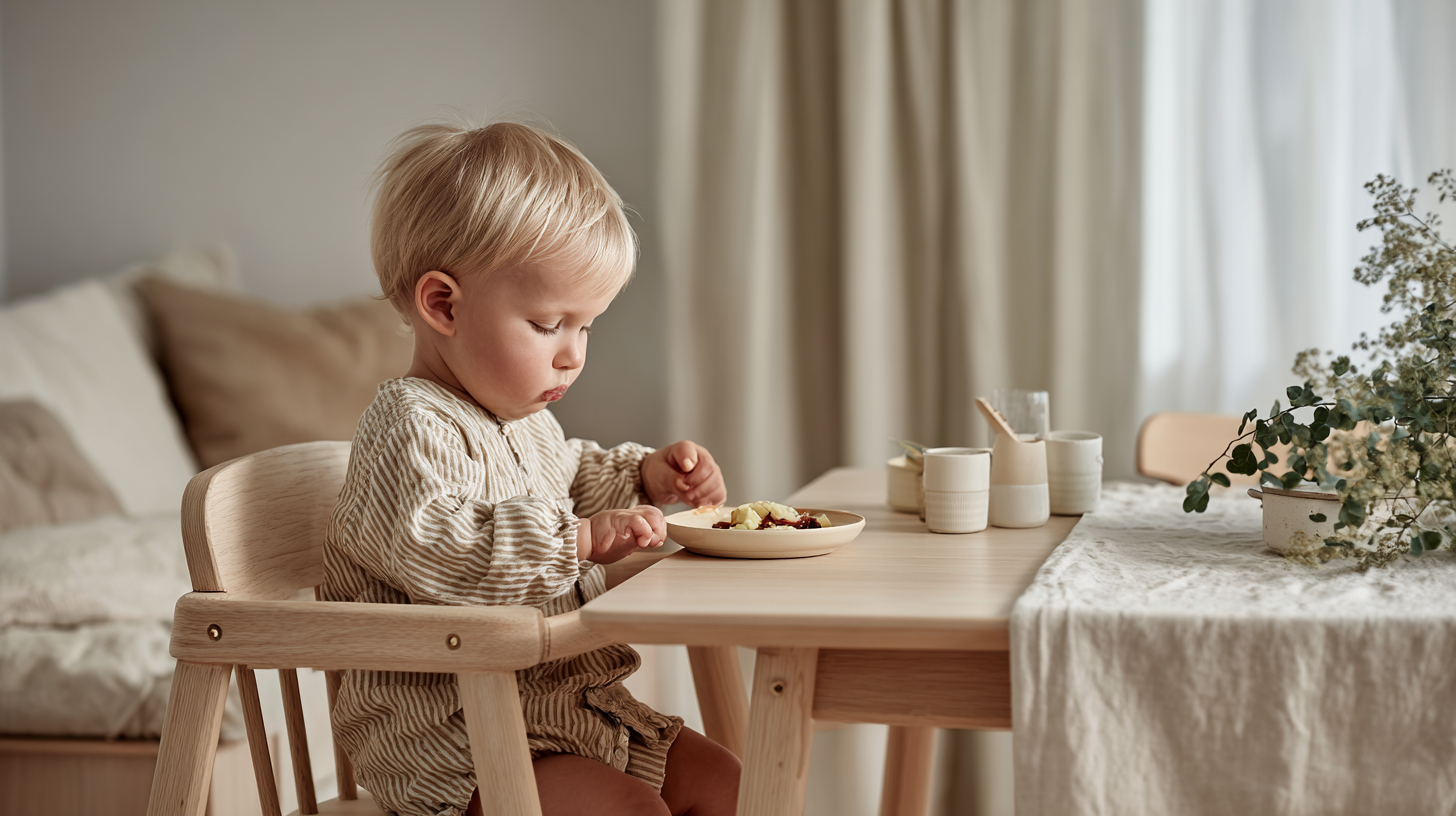
Now contrast that with this: Your whole family gathered around the table. Your six-month-old in their highchair, little fists grabbing at soft pieces of ripe mango and perfectly cooked sweet potato. They’re watching you take bites, mimicking your chewing motions, squealing when their older sibling makes them laugh. This isn’t some Instagram-perfect fantasy—this is family-style eating, and the research is overwhelming about its benefits.
A comprehensive 2020 study published in Food & Nutrition Research found that shared family meals are directly associated with positive parental feeding practices, including encouraging variety, teaching portions, creating a healthy eating environment, and modeling healthy eating behaviors. When babies join the family table from the start, they’re exposed to diverse foods, natural conversation rhythms, and the social cues that make eating a communal experience rather than a solitary task.
Here’s what’s happening in your baby’s brain during these shared meals: They’re observing facial expressions, learning turn-taking, understanding that food brings people together, and building associations between eating and positive emotions. The FMI Foundation’s 2024 Family Meals Movement data revealed that 62% of families credit shared meals with fostering emotional connectedness, and 41-42% see them as opportunities for healthier, more balanced nutrition. When babies participate from six months onward, they internalize these patterns early.
But the benefits go deeper than just nutrition and social skills. Family meals provide structure and predictability, which are essential for babies’ developing sense of security. When mealtimes happen at roughly the same time each day, with the same people, in the same place, babies learn what to expect. This routine becomes an anchor in their day—a time when the whole family pauses, comes together, and focuses on nourishment and connection.
The Science Behind the Social-Emotional Magic
Let’s talk about what’s actually happening when your baby watches you take a bite of food, sees your face light up, and hears you say, “Mmm, this is delicious.” They’re not just learning that food tastes good—they’re learning a complex web of social and emotional cues that will shape their relationship with food for years to come.
Research on parental feeding practices shows that modeling is one of the most powerful tools parents have. When babies observe family members eating a variety of foods with enjoyment, they’re far more likely to try those foods themselves. A 2023 study analyzing barriers to healthy family dinners found that children whose parents modeled positive eating behaviors showed significantly better diet quality and were less likely to become picky eaters.
But modeling goes beyond just showing your baby what to eat. It’s about demonstrating how to eat—using utensils, taking reasonable bites, chewing thoroughly, and participating in mealtime conversation. Babies are natural mimics, and they’ll try to copy everything you do. When they see everyone at the table using forks and spoons, they’ll want to try too. When they hear laughter and engaged conversation, they’ll babble along, developing the pre-language skills that eventually become actual words.
The emotional climate of family meals matters enormously. A 2024 analysis found that 49% of children and adolescents report having daily family meals, with higher rates among younger children and two-parent households. These regular shared meals create emotional wellbeing, reduced stress, and higher life satisfaction. For babies and toddlers specifically, the emotional warmth and security of family mealtimes lay the groundwork for healthy emotional development.
Consider this: when your baby tries a new food and makes a face, and everyone at the table laughs warmly and encourages them to try again, they’re learning that it’s okay to be uncertain, that new experiences are safe, and that their family will support them through challenges. Conversely, when meals are stressful, rushed, or focused solely on getting food into the baby’s mouth, these negative associations can create feeding difficulties that last for years.
What’s Your Family Meal Personality?
Tap the scenario that best describes your current mealtime reality:
Adapting Your Meals: The Caribbean Approach to Family-Style Feeding
Now, here’s where it gets practical. You’re not going to make separate meals for your baby—that’s the whole point. But you’re also not going to serve your six-month-old jerk chicken with scotch bonnet pepper. So how do you bridge that gap?
The secret is in the preparation. When I started making family meals that everyone could share, I turned to the flavors of my Caribbean heritage—bold, nourishing ingredients like sweet potatoes, plantains, coconut milk, beans, and fresh vegetables that are naturally baby-friendly when prepared appropriately. The key is cooking these ingredients without added salt, sugar, or heavy spices, then adapting them for each family member at the table.
Let’s take a classic example: coconut rice and peas. For the family version, you’d cook kidney beans with coconut milk, scallions, garlic, and thyme. For baby, you’d set aside a portion of the beans and rice before adding salt, then mash or serve as finger foods depending on their developmental stage. Same meal, same table, slightly different preparations. This approach is beautifully outlined in resources like the Caribbean Baby Food Recipe Book, which features over 75 recipes that can easily transition from baby food to family meals.
Real parents are doing this every day. One Reddit discussion from November 2024 featured parents sharing tips on adapting meals for babies and toddlers simultaneously. One parent described cooking a base of seasoned ground meat, then removing baby’s portion before adding salt and spicy seasonings. Another explained how they’d roast vegetables with olive oil for the family, setting aside plain steamed portions for their seven-month-old. The thread was full of practical wisdom: soft-cooked pasta, shredded rotisserie chicken, mashed avocado, steamed broccoli, and cubed sweet potato all became family meal staples that required minimal adaptation.
The beauty of Caribbean cuisine is that many traditional dishes are already built on whole, nutrient-dense ingredients that babies can safely explore. Dishes like callaloo (leafy greens cooked until soft), mashed plantains, yellow yam, dasheen, and cassava are naturally perfect for baby-led weaning or puree approaches. When you cook recipes like Sweet Potato & Callaloo Rundown or Yellow Yam & Carrot Sunshine, you’re giving your baby authentic cultural flavors while creating meals the whole family enjoys.
Conversation, Connection, and the Lost Art of Talking at the Table
Here’s something that surprised me: it’s not just about what you eat together—it’s about what you say together. The 2024 FMI Foundation report noted that 62% of families identify conversation and connectedness as the primary benefit of shared meals. But what does that look like when one of your diners is still babbling in proto-language?
It looks like narrating what you’re doing. “Mama’s taking a bite of sweet potato. Mmm, it’s so good! Do you want to try?” It looks like engaging siblings in conversation while baby listens and absorbs the rhythm of back-and-forth dialogue. It looks like pausing to make eye contact with your baby, smiling, and giving them space to “respond” with coos and gestures.
This kind of interaction is language development in action. Babies who are included in family mealtime conversations hear significantly more words and more complex sentence structures than babies who are fed separately. They learn the social rules of conversation—waiting for pauses, making eye contact, taking turns. These skills form the foundation for literacy, social competence, and emotional intelligence.
But let’s be real: the conversation doesn’t always flow naturally when you’re worried about your baby choking, gagging, or throwing food on the floor. This is where realistic expectations come in. Your baby will make a mess. They will gag occasionally as they learn to manage food in their mouths (gagging is actually a protective reflex, different from choking). They will grab your fork, knock over cups, and create chaos. And that’s okay. That’s part of the learning process.
The goal isn’t perfection—it’s presence. It’s showing up at the table together, day after day, building the habit of shared meals that will carry your family through childhood, adolescence, and beyond. According to research on family meals among parents, these regular shared meals are associated with better nutritional wellbeing, social connection, and emotional health for every family member, not just the children.
Real Talk: The Challenges Nobody Mentions
Let me be honest with you about the challenges, because they’re significant. A 2023 study on barriers to healthy family dinners identified time constraints, mismatched schedules, meal planning difficulties, picky eaters, and competing demands as the biggest obstacles families face. For families with babies and young children, these barriers are amplified.
Single parents and working parents face unique challenges. When you’re juggling multiple jobs, childcare logistics, and the basic demands of survival, the idea of a peaceful family dinner can feel laughably out of reach. The research acknowledges this: families facing economic stress, single-parent households, and homes where parents work evening shifts have significantly lower rates of shared meals.
Then there’s the mental load. Planning meals that accommodate a baby, a picky toddler, and two adults with different dietary preferences requires cognitive energy that many parents simply don’t have at the end of a long day. The pressure of social media doesn’t help—scroll through Instagram and you’ll see perfectly curated family meals with matching plates, fresh flowers, and babies eating avocado toast without a single splatter. A 2025 study on social media representations of family meals found that these idealized portrayals create unrealistic expectations and increase parental stress.
Here’s what I want you to hear: your family meals don’t need to be Instagram-worthy. They don’t need to involve seven different vegetables, cloth napkins, or any specific aesthetic. Family meals can be scrambled eggs and toast. They can be leftovers heated in the microwave. They can be takeout eaten straight from the container. What matters is that you’re together, you’re present, and you’re making it work in whatever way works for your family.
Your Family Meal Readiness Checklist
Tap each milestone as you achieve it—see your progress build!
Setting Realistic Expectations (Because Instagram Is Lying to You)
Let’s establish some ground truth about what including your baby at the family table actually looks like. First meal? Probably a disaster. Baby will grab the tablecloth, knock over water, and fling food across the room while older siblings complain about the mess. This is normal. This is expected. This is part of the process.
Developmental milestones matter here. At six months, when most babies are ready to start solids, they’re working on hand-eye coordination, learning to bring objects to their mouths, and figuring out how to move food from the front to the back of their mouths for swallowing. This is a complex motor skill that takes practice. Expect gagging (which is protective), expect mess, and expect that very little food will actually be consumed in the early weeks. Babies under twelve months are still getting the majority of their nutrition from breast milk or formula—solid foods are primarily about exploration and skill-building.
By eight to ten months, babies start developing the pincer grasp, which allows them to pick up smaller pieces of food. This is when they can start managing more textures and participating more actively in self-feeding. By twelve months, many babies can handle soft table foods and are ready to join more fully in family meals, though they’ll still need foods cut appropriately to prevent choking.
The research supports gradual inclusion rather than perfection. Studies on positive parenting approaches emphasize responsive feeding—paying attention to your baby’s hunger and fullness cues, offering a variety of foods without pressure, and creating a positive emotional environment around meals. This is the opposite of the rigid feeding schedules or force-feeding approaches that characterized earlier generations of parenting.
Here are some realistic expectations for different stages:
6-8 months: Baby mostly plays with food, explores textures, and observes family members eating. They may gum soft pieces or suck on food more than actually swallowing it. This is normal and good—they’re learning.
8-10 months: Baby starts consuming more food, developing preferences, and actively participating in self-feeding. Meals are still messy, but there’s more intentional eating happening. They’re watching your every move and trying to imitate.
10-12 months: Baby is eating a more substantial amount of solid food and may start using utensils (clumsily). They’re developing opinions about what they like and dislike. Family meals become more interactive as baby can engage more actively in the social aspects.
12+ months: Toddlers can handle most family foods with appropriate modifications (cutting, mashing, avoiding high-risk choking hazards). They’re full participants in family meals, with all the opinions, mess, and joy that entails.
The Practical Playbook: Making It Work in Your Real Life
Enough theory—let’s talk logistics. How do you actually make family meals happen when you have a baby, possibly other kids, two working parents, and approximately seventeen minutes of free time per day?
Start with one meal. You don’t need to overhaul breakfast, lunch, and dinner overnight. Pick one meal—for most families, dinner works best—and commit to making that a together meal. Even if it’s only fifteen minutes, even if half the food ends up on the floor, you’re building the habit.
Prep ahead strategically. Sunday meal prep isn’t just for fitness influencers—it’s survival for busy parents. Cook a big batch of beans, roast a pan of vegetables, prepare some grains. Store them in the fridge in separate containers. During the week, you can quickly assemble plates that work for everyone: baby gets plain mashed beans and soft roasted carrots, toddler gets beans with a little seasoning, adults get beans with full spices and hot sauce. Same ingredients, different preparations, one cooking session.
Use the “family meal bonus” approach. This is where Caribbean cooking shines. Make dishes like Coconut Rice & Red Peas, Stewed Peas Comfort, or Yellow Yam & Carrot Sunshine that naturally adapt across ages. The Caribbean Baby Food Recipe Book includes “Family Meal Bonus” recipes alongside baby versions—recipes like Guyanese Cook-Up Rice, Trini Baigan Choka, and Dominican Mangú that the whole family can enjoy with simple modifications.
Embrace simple meals. Rotisserie chicken pulled into shreds. Scrambled eggs with avocado. Pasta with olive oil and steamed broccoli. Toast with mashed beans. These aren’t fancy, but they’re nourishing, quick, and appropriate for all ages. Don’t let perfect be the enemy of good.
Create a no-device zone. The FMI Foundation’s #FoodNotPhones campaign emphasizes reducing digital distractions during meals. Put phones in another room. Turn off the TV. Make eye contact. This is hard—I know, because I’ve failed at it many times—but it’s worth the effort. The quality of family connection during meals drops dramatically when screens are involved.
Let baby self-feed. This is messy and requires supervision, but it’s crucial for developing motor skills and autonomy. Put a mat under the highchair, dress baby in clothes you don’t care about, and let them explore. Offer pre-loaded spoons if you want to speed things along, but resist the urge to take over completely.
Include cultural foods from the start. If your family eats curry, plantains, spicy stews, or other flavorful dishes, your baby can too—with modifications. The earlier babies are exposed to diverse flavors, the more likely they are to accept them long-term. This is particularly important for maintaining cultural food traditions. Recipes like Baigan Choka Smooth, Calabaza con Coco, and Plantain Paradise introduce authentic Caribbean flavors in baby-safe forms.
Flip to Discover: Hidden Benefits of Family Meals
Tap each card to reveal a surprising benefit you might not know about:
When Things Go Wrong (And They Will)
Let’s troubleshoot the common problems, because they’re going to happen and you need to know you’re not alone.
Baby refuses everything. This is normal and developmental, especially around 18-24 months. Don’t make separate meals. Continue offering family foods without pressure. Research shows it can take 10-15 exposures before a child accepts a new food. Keep serving it without forcing.
Meals take forever. Set a reasonable time limit—20-30 minutes—and then end the meal calmly. Babies and toddlers have short attention spans. When they start playing more than eating, they’re done.
Sibling disruption. Older kids may act out when baby joins the table. Involve them in helping—let them choose a vegetable, help set the table, or “teach” baby how to eat. This creates investment and reduces resentment.
Schedule chaos. Not every meal will be together, and that’s okay. Aim for consistency where possible—maybe weeknight dinners are hit-or-miss, but Sunday breakfast is sacred. Find what works for your family’s reality.
Gagging and choking fears. Learn the difference between gagging (normal, protective reflex where baby coughs and clears food) and choking (silent, requires intervention). Take an infant CPR class. Avoid high-risk foods like whole grapes, hot dogs, and hard raw vegetables. Supervise every bite.
Cultural pressure. Grandparents, in-laws, and well-meaning relatives may criticize your approach, especially if it differs from how they fed their children. Stay confident in the research and your choices. You can respectfully explain your approach or simply change the subject.
The Long Game: Why These Early Meals Matter Forever
Here’s what keeps me going on the hard days: the research on long-term outcomes. Children who grow up with regular family meals have better academic performance, lower rates of substance abuse, reduced risk of eating disorders, and stronger family relationships through adolescence and into adulthood. These benefits persist even after controlling for other family characteristics.
Think about what you’re actually teaching when you pull that highchair up to the table. You’re teaching your baby that they belong. That their presence matters. That meals are about more than just consuming calories—they’re about connection, culture, and community. You’re teaching them to try new things, to observe and learn from others, to participate in a ritual that humans have practiced for thousands of years.
You’re also building a foundation for cultural transmission. When you serve your baby foods from your heritage—whether that’s Caribbean dishes like callaloo, ackee, plantain, or coconut-based recipes—you’re connecting them to their roots. You’re saying, “This is who we are. This is where we come from. This matters.” Those early taste experiences shape preferences that last a lifetime.
The social-emotional benefits compound over time. A baby who learns to read facial expressions and social cues during meals becomes a toddler who can navigate social situations with greater ease. That toddler becomes a school-age child who can sit through a meal, engage in conversation, and handle new foods without anxiety. That child becomes a teenager who still wants to eat dinner with the family—and research shows that’s increasingly rare and increasingly valuable.
According to 2024 data, 49% of children report daily family meals, but this rate drops significantly in adolescence. The families who establish family meal routines early, when children are babies, are far more likely to maintain them through the challenging teenage years. Those continued family meals during adolescence are associated with dramatically better outcomes across mental health, academic achievement, and risk behavior.
Your Table, Your Rules, Your Family
Let me tell you what happened with that first meal when we pulled the highchair up to the table. My baby grabbed a piece of ripe mango, squeezed it until juice ran down her arm, gummed it for approximately thirty seconds, then flung it across the room where it hit the wall with a satisfying splat. My mother-in-law sighed heavily. My older child laughed so hard milk came out of his nose. My partner and I locked eyes and tried not to crack up.
It was messy. It was chaotic. It was absolutely nothing like the peaceful family dinners I’d imagined. And it was perfect. Because my baby was there, with us, learning what it means to share a meal. She was watching her brother eat green beans and trying them herself. She was hearing us talk about our days, absorbing the rhythm of conversation. She was building memories in her tiny developing brain—memories of belonging, of warmth, of family.
Five years later, that same child now sets the table without being asked. She tries new foods with curiosity rather than suspicion. She tells elaborate stories during dinner about her kindergarten adventures. And on the really good nights, when everyone’s together and the food is good and the conversation flows easily, I catch her eye and remember that first mango-flinging meal. We’re building something here. Something that will outlast the mess and the chaos and the challenging phases.
You don’t need the perfect recipes or the ideal setup or the pristine dining room. You don’t need to do it the way your parents did it, or the way the parenting books say, or the way it looks on social media. You just need to show up, pull that highchair close, and create space for your baby at your table. Everything else will follow.
The magic isn’t in the meal—it’s in the moment. It’s in the eye contact and the laughter and the teaching and the learning that happens when you stop treating your baby’s feeding as a separate event and start including them in the daily ritual that makes us human. So tonight, when you sit down to eat, look at that empty space at your table. Your baby belongs there. Not someday, not when they’re older, not when it’s more convenient. Now. Today. This meal.
Because the truth is, you’re not just feeding your baby. You’re raising a person who knows what it means to be part of something bigger than themselves. And that starts at your table, with your family, with this meal right now. Pull that chair close. The rest will figure itself out.

Kelley's culinary creations are a fusion of her Caribbean roots and modern nutritional science, resulting in baby-friendly dishes that are both developmentally appropriate and bursting with flavor. Her expertise in oral motor development and texture progression ensures that every recipe supports your little one's feeding milestones while honoring cultural traditions.
Join Kelley on her flavorful journey as she shares treasured family recipes adapted for tiny taste buds, evidence-based feeding guidance, insightful parenting anecdotes, and the joy of celebrating food, culture, and motherhood. Get ready to immerse yourself in the captivating world of Kelley Black and unlock the vibrant flavors of the Caribbean for your growing baby, one nutritious bite at a time.
- The Feeding Revolution: Why Your Everyday Meals Are Changing the World - October 13, 2026
- Your Feeding Story Matters More Than The “Perfect” One Online - October 12, 2026
- Looking Forward: Stepping Into Your Confident Feeding Future - October 11, 2026