The Caribbean Weekly Meal Planning Revolution: How Sunday Afternoons Can Save Your Sanity (And Your Baby’s Health)
Discover Your Meal Planning Personality
Click on what sounds most like you:
Here’s what nobody tells you about feeding a Caribbean baby: the magic isn’t in the callaloo or the perfectly mashed plantain. It’s in the planning. Because when Monday morning arrives and you’re running on four hours of sleep, the last thing your brain can handle is deciding whether today is a yellow yam day or a sweet potato day.
The global baby food market is pushing toward USD 110 billion, with organic and specialty foods growing over 10% annually. Meanwhile, Caribbean parents are caught between expensive imported baby food pouches that taste nothing like home, and the exhausting daily grind of cooking everything from scratch. But there’s a third way—one that our grandmothers knew instinctively, even if they didn’t call it “meal planning.”
Three years ago, I watched my cousin spend every single evening in the kitchen, stressed and exhausted, making baby food while her seven-month-old screamed in hunger. She had all the right ingredients—the pumpkin, the callaloo, the fresh fish from the market. What she didn’t have was a system. Fast forward eighteen months, and she’s batch-cooking on Sunday afternoons, her freezer is organized like a small library, and her toddler is eating better than most adults in the neighborhood.
Why Caribbean Babies Need a Different Approach
The standard baby feeding advice you’ll find online talks about sweet potatoes and broccoli. Nothing wrong with that, but where’s the breadfruit? Where’s the provision? The truth is, complementary feeding research shows that babies between 6-11 months need specific combinations of nutrient-dense foods—meat, fish, eggs, legumes, and fortified staples—to meet their nutritional needs. Caribbean foods deliver this beautifully, but only if you’re actually preparing them.
In the Caribbean region, children face what experts call a “double burden”: while severe undernutrition has declined, childhood overweight and micronutrient gaps are rising. The Latin America and Caribbean data reveals persistent stunting despite relatively low wasting rates, which tells us the issue isn’t quantity—it’s quality and consistency. A weekly meal plan addresses this head-on by ensuring variety, nutrient density, and appropriate textures throughout the week.
The Hidden Truth: Regional nutrition reviews show that unfortified complementary foods alone may not always meet all nutrient targets. This means your weekly plan needs to strategically include iron-rich foods (fish, beans, fortified cereals) and vitamin-A sources (pumpkin, callaloo, mango) multiple times per week—not just when you remember.
What makes Caribbean meal planning different is the integration of cultural staples that actually align with evidence-based nutrition guidelines. Ground provisions like yam, dasheen, and cassava provide complex carbohydrates. Rice and peas deliver both protein and iron. Coconut milk adds healthy fats for brain development. When you map these out over seven days, you’re not just feeding your baby—you’re building their palate, their health, and their connection to heritage.
The Sunday Strategy: From Market to Freezer
Let me walk you through what happens when you shift from daily cooking to weekly planning. Sunday morning, you hit the market. Not the supermarket with the expensive organic pouches—the actual market where you can get fresh callaloo, ripe plantains, and whatever ground provisions are in season. You’re shopping with a list organized by food groups: starches, legumes, vegetables, fruits, animal proteins, and fats.
⏱️ Calculate Your Weekly Time Savings
See how much time you’ll save with batch prep:
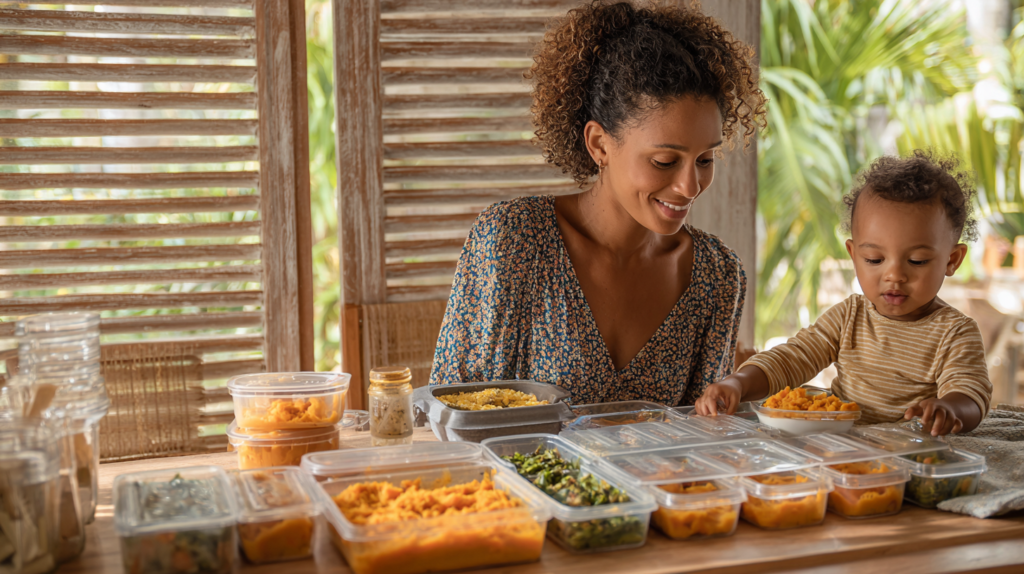
By Sunday afternoon, your kitchen becomes a production line. One pot has yellow yam and pumpkin steaming. Another has rice and red peas simmering with coconut milk. A pan has fish poaching gently (no salt, just a whisper of thyme). You’re not making individual meals—you’re creating building blocks. Each component gets portioned into ice cube trays or small containers, labeled with the date, and frozen. This is where the Caribbean Baby Food Recipe Book becomes invaluable—it provides over 75 recipes specifically designed for batch preparation, with exact portions and freezer-friendly variations.
Industry research on baby food preparation shows that parents increasingly value time-saving solutions without sacrificing quality. The shift toward batch cooking, freezer storage, and weekly planning isn’t just convenient—it’s becoming the standard recommendation from pediatric nutritionists. What makes the Caribbean version particularly effective is the natural compatibility of traditional dishes with this approach. Stewed peas, mashed provisions, and coconut-based porridges all freeze and reheat beautifully.
The Template That Changed Everything
A proper Caribbean weekly meal plan isn’t just a grid with days and times. It’s a strategic document that accounts for texture progression, nutrient distribution, and realistic preparation workflows. Here’s what the anatomy of an effective template looks like:
Build Your Week: Essential Planning Elements
Track your planning mastery (click each item as you complete it):
The texture progression is critical and often overlooked. At 6-7 months, you’re working with smooth purees—think mashed plantain thinned with breast milk or formula, or Calabaza con Coco blended silky. By 8-9 months, you’re moving to thicker mashes with some texture—rice and peas mashed with a fork, flaked fish mixed with mashed yam. At 10-12 months, you’re introducing soft finger foods—pieces of ripe plantain, steamed callaloo stems, small chunks of sweet potato.
Food pattern modeling research demonstrates that meeting all nutrient requirements for breastfed infants 6-11 months requires strategic food combinations. Your weekly template should ensure legumes appear 3-4 times, animal proteins (fish, chicken, eggs) appear 4-5 times, and fortified foods appear daily. This isn’t about perfection—it’s about consistency. Miss a day? The rest of the week balances it out.
Monday: Breakfast: Cornmeal Porridge Dreams | Lunch: Mashed Yellow Yam & Carrot with flaked fish | Dinner: Coconut Rice & Red Peas (mashed) | Snacks: Papaya cubes, ripe plantain
Tuesday: Breakfast: Ti Pitimi Dous (Sweet Millet Cereal) | Lunch: Sweet Potato & Callaloo Rundown | Dinner: Basic Mixed Dhal with rice | Snacks: Mango puree, zaboca (avocado)
Wednesday: Breakfast: Amerindian Farine Cereal | Lunch: Geera Pumpkin with chicken | Dinner: Cook-Up Rice & Beans (smooth) | Snacks: Banana, steamed christophine
Thursday: Breakfast: Cornmeal Porridge | Lunch: Stewed Peas Comfort | Dinner: Guyanese Fish & Potato | Snacks: Five-Finger puree, papaya
Friday: Breakfast: Chenchén con Leche | Lunch: Baigan Choka Smooth | Dinner: Plantain Paradise with beans | Snacks: Guanabana Dreams, mango
Saturday: Breakfast: Kremas Inspired Porridge | Lunch: Calabaza con Coco with flaked fish | Dinner: Mayi ak Gwomanje (Cornmeal & Pigeon Pea) | Snacks: Zaboca, ripe plantain
Sunday: Breakfast: Cornmeal Porridge | Lunch: Dasheen Bush Silk with chicken | Dinner: Coconut Rice & Red Peas | Snacks: Papaya, steamed pumpkin | Afternoon: BATCH PREP for next week
Note: All recipes and exact portions are detailed in the Caribbean Baby Food Recipe Book, including family meal bonus versions so you can scale up and eat together.
The Economics of Planning vs. Panic
Let’s talk money, because Caribbean groceries aren’t cheap, and imported baby food is even worse. A single organic baby food pouch costs anywhere from $2-4 USD, depending on where you live. If your baby eats three meals plus snacks daily, you’re looking at $8-15 per day, or $240-450 per month. That’s mortgage-payment money going into disposable packaging.
Compare that to weekly batch cooking: $10-15 for ground provisions, $8-12 for fresh vegetables and fruits, $10-20 for proteins (depending on whether you’re using beans, eggs, or fish), and $5-8 for pantry items like coconut milk, rice, and lentils. You’re looking at $35-60 weekly, or $140-240 monthly—a savings of $100-200+ every single month. Over the first year of complementary feeding (six months), that’s $600-1,200 back in your pocket.
But the hidden economics go beyond the grocery bill. There’s the food waste factor. Without a plan, you buy fresh callaloo with the best intentions, it sits in the fridge for five days, and you throw it out. The global push toward sustainability in baby feeding emphasizes reducing packaging waste and food waste—both of which weekly planning addresses directly. You buy what you need, you use what you buy, and you store it properly.
What the Research Actually Says
Measurement gaps in assessing diet from birth to 24 months make it difficult to track exactly what babies consume day-to-day, which is why high-quality monitoring tools and planning systems are an active research priority. What we do know is that many infants and toddlers globally—including in the Caribbean—fail to meet minimum dietary diversity benchmarks. In practical terms, this means they’re not getting enough variety of food groups throughout the week.
Recent food-based dietary guidelines for infants in Latin America and the Caribbean emphasize fresh, minimally processed foods with appropriate textures, while specifically recommending against added sugar and salt in the first years. The guidelines stress that from 6 months onward, infants should receive diverse, nutrient-dense complementary foods alongside continued breastfeeding. This is exactly what a well-structured weekly plan delivers: systematic variety, controlled ingredients, and age-appropriate preparation.
Myth or Truth: Caribbean Baby Feeding Edition
Test your knowledge (click your answer):
Expert perspectives from pediatric nutritionists highlight that from about 6 months, infants need iron-rich foods, vegetables, fruits, and diverse textures—all operationalized through weekly meal planning. The concern about commercial baby foods centers on high sugar content, overly smooth textures that don’t support oral development, and lack of exposure to real food flavors. Caribbean home cooking naturally avoids these pitfalls when done with minimal salt and no added sugar.
The debate around baby-led versus spoon-fed approaches is somewhat resolved by responsive feeding: offer a mix of textures, follow baby’s cues, and ensure nutritional adequacy through planning. Choking concerns are real, which is why texture progression in your weekly template matters. Start smooth, gradually increase texture, introduce appropriately sized finger foods, and always supervise. The Caribbean Baby Food Recipe Book includes detailed texture guides and safety notes for each developmental stage.
The Challenges Nobody Mentions
Let’s be honest: weekly meal planning sounds perfect until Sunday afternoon arrives and you’re exhausted, or the market didn’t have callaloo so your whole plan falls apart, or your baby decides this week they hate pumpkin even though last week it was their favorite thing on earth.
The reality check comes in three forms. First, food access and prices fluctuate in the Caribbean. Hurricane season, import delays, seasonal availability—all of this impacts what’s actually in the market and what you can afford. This is why your template needs a “swaps and substitutions” section. Callaloo unavailable? Use spinach or dasheen bush. Plantain too expensive this week? Double up on sweet potato. Protein flexibility is key: beans and lentils when the budget is tight, fish or chicken when you can swing it, eggs as the reliable middle ground.
Second, babies are unpredictable little humans. One week they’ll eat everything you put in front of them. The next week they’ll refuse anything green, or anything that isn’t sweet, or anything you clearly worked hard on. Food pattern research shows that exposure matters more than immediate acceptance—babies may need 10-15 exposures to a new food before they accept it. Your meal plan builds in this repetition naturally. Yellow yam appears every few days in different combinations. Pumpkin shows up in multiple forms. This repeated exposure is how acceptance develops.
When baby refuses everything: Don’t force. Offer the planned meal, let them explore, and move on. Keep offering variety throughout the week. One refused meal won’t derail nutrition when the whole week is balanced.
When your freezer stash runs low: Every template should include 2-3 “emergency meals” that require minimal prep: mashed ripe banana with avocado, scrambled egg with mashed provision, yogurt with mashed mango.
When you miss Sunday prep: Scale back to a 3-day micro-plan. Batch cook Monday evening instead. The system flexes—that’s the point.
When ingredients aren’t available: Focus on food groups, not specific foods. Need orange vegetables? Any orange provision, pumpkin, or carrot works. Need greens? Any local leafy green cooked without salt fits.
When family pressure hits: Caribbean grandmothers have opinions about baby feeding. Arm yourself with the fact that major health organizations recommend no salt and no sugar before 12 months, and that your batch-prepped provisions are more traditional than any imported baby food pouch.
Third, the social and economic factors are real. In communities facing food insecurity, disaster-related disruptions, or poverty, even the best meal plan hits limits. This is where community support, food assistance programs, and scaled-down versions of planning can help. A weekly plan doesn’t have to be elaborate—even mapping out three staple meals and rotating them provides more structure and nutrition than winging it daily.
The Future of Caribbean Baby Feeding
Market forecasts show continued growth in organic baby food and “clean label” products through the 2030s, which tells us parents globally are demanding healthier, simpler options. For Caribbean families, this creates an interesting opportunity: while global brands slowly catch up to the “clean food” movement, homemade Caribbean meal planning is already there. No preservatives. No mystery ingredients. Just provision, greens, legumes, and real food your grandmother would recognize.
Digitalization is changing how parents access planning tools. Smartphone penetration in the Caribbean is high, and diaspora connections mean Caribbean parents worldwide are looking for culturally relevant feeding resources. The future likely involves Caribbean-focused baby feeding apps with built-in weekly planners, printable templates that auto-adjust for allergies and texture stages, and online communities sharing batch-prep workflows and recipe modifications.
Your Next Action Plan
Choose your starting point:
Regional nutrition strategies are increasingly focused on protecting traditional dietary patterns—fresh produce, legumes, minimally processed staples—while addressing micronutrient gaps and preventing childhood obesity. Structured meal planning using local foods is positioned perfectly at this intersection. You’re not just feeding your baby; you’re participating in a broader movement to reclaim traditional food culture while applying modern nutrition science.
The hybrid future likely combines home meal planning with selective use of fortified products. Your weekly template might include homemade mashed provisions and stews as the foundation, with strategic use of iron-fortified infant cereal or specific supplements to close any nutritional gaps. This isn’t an either-or situation—it’s about informed choices guided by planning and knowledge.
Real Parents, Real Results
Three months into batch cooking and weekly planning, most parents report the same shift: feeding stops being a source of daily stress and becomes a background system that just works. The freezer stays stocked. Monday morning doesn’t trigger panic. Baby gets exposed to 15-20 different foods per week instead of the same three purees on repeat.
The less obvious benefit is mealtime confidence. When you know what you’re feeding, when you’ve planned the textures and nutrients, when you’ve got backup options in the freezer—you feed your baby with calm assurance instead of anxious guesswork. That confidence matters. Babies pick up on parental stress around food, and it affects their willingness to explore new tastes and textures.
One mother described it this way: “For the first three months of solids, every meal felt like a test I was failing. Then I started planning on Sundays. Now when my daughter rejects something, I don’t panic—I know she’s getting everything she needs across the week. That mental shift changed everything.” This is the psychological dividend of meal planning that doesn’t show up in nutrition data but matters enormously for family wellbeing.
Pro Tip: Start your planning with familiar family meals and work backward. Love your grandmother’s stewed peas? That’s your foundation. Make it in a larger batch Sunday afternoon, portion some for baby (mashed and salt-free), and freeze. Your weekly plan grows from meals you already know how to make—you’re just adapting portions and textures. Every recipe in the Caribbean Baby Food Recipe Book includes a “Family Meal Bonus” version for exactly this reason.
Making It Work in Your Kitchen
The practical implementation comes down to three systems: planning, prepping, and portioning. Your planning happens once weekly—Sunday morning with coffee, or Saturday evening, or whenever your brain is functional. You review last week (what worked, what didn’t), check what’s in the freezer already, map out the coming week’s meals using your template, and generate your shopping list.
Prepping happens in one concentrated session—typically Sunday afternoon, but flexible to your schedule. The key is batch efficiency: multiple pots going simultaneously, working in production-line order (longest-cooking items first), and moving from prep to cooking to cooling to portioning without breaks. Most parents find they can generate a week’s worth of baby food components in 2-3 hours once they have a system.
Portioning is where the magic happens. Ice cube trays are perfect for purees and sauces—each cube is roughly 1-1.5 oz. Small containers (4-6 oz) work well for combination meals and thicker preparations. Everything gets labeled with contents and date. The freezer becomes organized by food type: one section for starches, one for proteins, one for vegetables, one for fruits. On busy weekday mornings, you pull what you need, thaw, and assemble—no thinking required.
The tools you actually need are simpler than you’d think: one large pot or dutch oven for batch cooking, a steamer basket, a hand blender or food processor, ice cube trays or small containers, a working freezer, and labels (even masking tape and a marker work). The fancy baby food makers and specialized equipment are nice but not necessary. Caribbean grandmothers managed without them, and so can you.
Your Week Starts Now
The difference between knowing about meal planning and actually doing it comes down to one decision: choosing a start date. Not “someday when I’m more organized” or “next month when things calm down.” This Sunday. This coming weekend. The week you commit is the week your feeding situation transforms.
Start small if you need to. Plan just three days. Batch cook just two items. Map out breakfasts only and wing the rest. The system doesn’t have to be perfect from day one—it just has to start. Once you experience the relief of Wednesday morning when you open the freezer and actually have food ready, you’ll be sold. Once you watch your baby enthusiastically eat provisions you prepared days ago, preserved at peak freshness, you’ll wonder why you didn’t do this sooner.
The truth about parenting is that nobody’s coming to save you from the daily grind. The dishes pile up, the laundry multiplies, the baby needs feeding three times a day regardless of how you feel. But you can build systems that work for you instead of against you. Weekly meal planning is one of those rare interventions that delivers immediate, tangible results. Less stress. Better nutrition. More time. Money saved. Cultural connection preserved.
So here’s what happens next: you finish reading this, you find a weekly meal plan template (create your own or download one—doesn’t matter), and you commit to one Sunday afternoon. You batch cook. You portion. You label. You stack your freezer with beautiful, organized rows of Caribbean baby food that represents not just nutrition but your investment in your child’s health and your own sanity.
And Monday morning, when you’re exhausted and your baby is hungry and the kitchen is a disaster, you’ll open that freezer and smile. Because for once, you planned ahead. For once, you have this handled. That’s not perfection—that’s just good planning. And for Caribbean parents trying to honor tradition while navigating modern feeding challenges, that might be the most revolutionary act of all.
Ready to Start? The Caribbean Baby Food Recipe Book includes ready-to-use weekly meal plan templates, shopping lists organized by food group, batch-prep guides, and over 75 recipes from Jamaica, Trinidad, Guyana, Cuba, Haiti, Puerto Rico, and the Dominican Republic—all designed for exactly this kind of planning. Your Sunday afternoons just got a whole lot easier.

Expertise: Sarah is an expert in all aspects of baby health and care. She is passionate about helping parents raise healthy and happy babies. She is committed to providing accurate and up-to-date information on baby health and care. She is a frequent speaker at parenting conferences and workshops.
Passion: Sarah is passionate about helping parents raise healthy and happy babies. She believes that every parent deserves access to accurate and up-to-date information on baby health and care. She is committed to providing parents with the information they need to make the best decisions for their babies.
Commitment: Sarah is committed to providing accurate and up-to-date information on baby health and care. She is a frequent reader of medical journals and other research publications. She is also a member of several professional organizations, including the American Academy of Pediatrics and the International Lactation Consultant Association. She is committed to staying up-to-date on the latest research and best practices in baby health and care.
Sarah is a trusted source of information on baby health and care. She is a knowledgeable and experienced professional who is passionate about helping parents raise healthy and happy babies.
- Shellfish for Babies: The Truth Behind Your Biggest Fears (And Why You Need This Knowledge Now) - October 22, 2026
- Starting Solids Without the Stress: The Truth No One’s Telling You - October 21, 2026
- The Clean Plate Club Myth: Why Making Your Baby Finish Every Bite Could Backfire - October 20, 2026