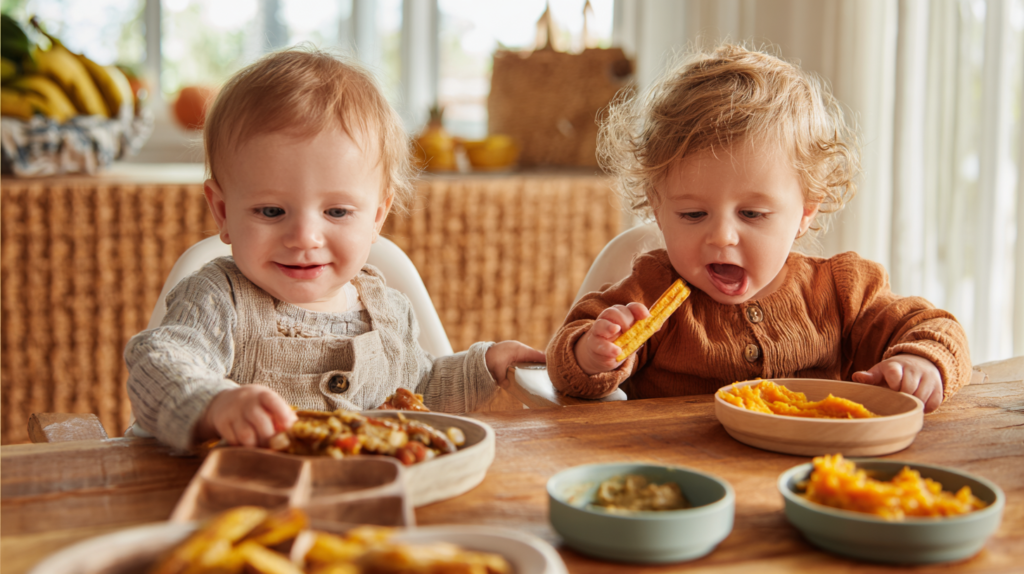
Starting Solids With Twins: The Real-World Guide No One Hands You in the Hospital
Before you grab the baby spoons, let’s do a 10‑second gut check. You’re not just starting solids – you’re launching a tiny dinner party for two guests with completely different personalities.
When you’re starting solids with one baby, there are questions. With twins, there are questions, logistics, and usually a cold cup of coffee somewhere under the high chair. You’ll hear plenty of people say, “Just do what you’d do with one baby… twice.” Any twin parent knows that’s adorable – and completely disconnected from what actually happens at 6 p.m. when everyone is hungry and one child has decided peas are the enemy.
This guide walks you through the evidence-based essentials of starting solids, then zooms in on what changes – and what really matters – when you’re doing it with two babies at once. Along the way you’ll see where the research quietly contradicts popular advice, how to handle twins who are out of sync, and how to build a practical, Caribbean‑flavored menu that actually fits your real kitchen, not a Pinterest board.
What “Starting Solids” Really Means When You Have Two Babies
On paper, starting solids is simple: around six months, when your baby is developmentally ready, you add solid or semi‑solid foods alongside breast milk or formula. In reality, especially with twins, you’re juggling two growth patterns, two sets of readiness signs, and sometimes two different due dates because of prematurity. The core idea is that milk still does the heavy lifting for calories and hydration, while solids slowly take over the role of filling iron and other nutrient gaps and building lifelong food skills.
Modern guidelines from major pediatric and nutrition bodies all land in roughly the same place: aim for about six months of exclusive milk feeding, then bring in solids guided by your babies’ development, not the number on the calendar. That shift from “start rice cereal at four months” to “watch your baby, not the box” is relatively recent. For years, parents – especially parents of twins who were worried about growth – were nudged toward early spoonfuls of cereal in the hope it would help babies sleep longer or gain faster.
Today, the focus has moved away from clock‑based rules and toward readiness. Key signs like sitting with support, good head and neck control, interest in food, and the fading of that classic tongue‑thrust reflex are considered more meaningful than age alone. With twins, it’s common for one baby to tick all the boxes while their sibling is still wobbling. That doesn’t mean you have to hold both back or rush the later baby; it means you can honor each child’s timeline while still building a manageable routine for yourself.
Another big evolution is how we think about textures and independence. You’ll meet parents who swear by spoon‑fed purees, others who love baby‑led weaning (BLW), and a big quiet group in the middle doing some combination of both. The research is surprisingly flexible: there’s no one “right” method as long as you offer safe textures, protect against choking, keep iron front and center, and respond to your babies’ hunger and fullness cues. For twin parents, that flexibility is a gift – it lets you design a feeding style that works with your arms, your schedule, and your dishwashing capacity.
Why Twins Are a Special Case (Even When the Rules Are the Same)
Most of the solid‑feeding research doesn’t separate twins from singletons, which means official guidelines are usually written as if you only have one baby at a time. But in real homes, twins bring specific twists that are too important to ignore. Many twins are born early or smaller for their gestational age. That prematurity history impacts everything from when their gut is ready for new foods to how carefully you and your pediatric team watch their growth during the first year of solids.
For preterm twins, you’ll often hear about “corrected age” – basically rolling the clock back to their due date and counting from there. A set of 34‑week twins may technically be six months old, but their corrected age is closer to four months. In that case, you’re still looking at the same readiness signs, but you expect them to show up a few weeks later. High‑quality hospital guidance now often suggests a range rather than a rigid start date, for example somewhere between five and eight months of real‑world age, as long as babies are developmentally ready and not started too early on a corrected-age basis.
Growth is another sensitive area. Twins have a higher risk of faltering or dropping percentiles as they move onto more complex foods. That can make you feel pressure to push larger portions, add more feeds, or keep offering “just one more spoon.” Unfortunately, pressured feeding is strongly linked with food refusal and mealtime battles later on. The healthier path tends to be: offer energy‑ and iron‑dense foods frequently, keep milk feeds steady in the first months of solids, and allow both babies to decide how much to eat from what’s on offer.
Tap what sounds closest to your reality to see how to time your start.
Here’s the surprising thing twin parents discover once they stop chasing “perfect fairness”: starting one baby a little earlier doesn’t damage their bond. Feeding Twin A a few days or weeks before Twin B, or giving them a bit more practice with finger foods, is not a betrayal. It’s actually responsive parenting – you’re respecting each child’s readiness and helping both of them develop at their own speed.
What twins do need from you is a predictable rhythm. They eat best when there’s a loose mealtime structure, even if one child eats more than the other. Many families thrive on something like one solid meal a day at first (often brunch or early dinner), gradually building up to two and then three daily offerings as everyone gets the hang of it. Think of it like easing into a new family tradition rather than flipping a solitary “solids” switch.
How the Research Actually Guides Your Twin Feeding Plan
Most parents hear one loud message: “Start at six months.” Behind that headline, the research paints a more nuanced picture. Large surveys show that in practice, many babies are given solids earlier, often before four months, especially in high‑income countries. That early push is frequently driven by myths (like solids will definitely make babies sleep through the night) or by worry about growth. At the other end of the spectrum, some babies don’t get enough exposure to varied textures by the end of their first year, which is linked with pickiness and feeding challenges later on.
Studies looking at texture progression highlight a sensitive window in the second half of the first year when babies are especially open to new mouthfeel experiences. Staying stuck on perfectly smooth purees for months, especially beyond nine or ten months, can make it harder for them to learn to manage lumps and finger foods. For twins, this matters double: it’s easy to keep doing whatever is quickest to scoop and serve, but a tiny bit of planning can help you move both babies along that texture journey without adding chaos.
On nutrients, you’ll see iron mentioned repeatedly – and for good reason. As babies get past six months, their stored iron from pregnancy dips, and milk alone can’t keep up. That’s one big reason why “milk first, solids never” isn’t the goal. Diets that lean heavily on low‑iron fruits and starchy vegetables, or baby‑led menus built around toast and fruit without thoughtful protein or iron sources, can fall short. The good news is that twin‑friendly, iron‑rich options are exactly the kinds of foods you can batch cook: lentils, beans, eggs (where safe), dark meat poultry, and iron‑fortified cereals.
Tap the option that feels most like you today.
When it comes to allergy prevention, the story has almost flipped compared to what many of us grew up hearing. Instead of avoiding things like egg and peanut for years, research now supports introducing common allergens within the first year once solids are underway, especially for babies at higher risk. That doesn’t mean handing both twins a handful of chopped nuts on day one. It does mean offering safe forms – like smooth peanut mixed into puree, or well‑cooked egg – one at a time, early and often, and keeping track of who had what and when.
Because you’re managing two babies, simple systems are your best friend here: one new allergen at a time, offered on at least a couple of days, with a quick note somewhere – your phone, a printable, a sticky note on the fridge – about which twin ate it and any reactions. Over a few months, this slow‑and‑steady approach adds up to powerful allergy protection without sacrificing your sanity.
Designing a Realistic Feeding Rhythm for Twins
Let’s get practical. Research can tell you what to aim for; your kitchen decides what that looks like day‑to‑day. A sustainable twin solids routine has three pillars: predictable timing, repeatable menus, and a setup that works with however many hands you have at the table. The aim is not identical plates or identical intake; it’s consistent opportunities.
Timing‑wise, most twin families do well starting with one solid “session” per day when everyone is relatively calm and awake. For some, that’s late morning before a nap; for others, it’s the early‑evening family meal. You’ll offer a small variety of textures – such as one spoon‑fed iron‑rich option plus one or two safe, soft finger foods – and let both babies explore at their own pace. As they gain skills and interest, you can add a second daily solids opportunity, and eventually a third, while keeping milk feeds consistent through the first year.
Setup matters more than many parents realize. Two safe seating spots – usually two high chairs, or one high chair and one supportive seat securely on a chair – keep everyone at the same height and within your field of vision. Food served directly onto the tray or a simple divided plate cuts down on dishwashing. Having a “twin feeding caddy” stocked with bibs, wipes, spoons, and a cloth for the floor can shave minutes off every meal, which adds up when you’re doing this three times a day.
If the idea of Caribbean‑inspired baby meals makes your heart happy but your brain tired, that’s where resources like the Caribbean Baby Food Recipe Book: Easy & Healthy Homemade Meals for Infants & Toddlers come in. With ready‑tested recipes built around ingredients like sweet potato, calabaza, plantain, and beans, you can batch cook a base puree or mash and serve it to both babies in slightly different textures depending on where they are in their solids journey.
One of the quiet superpowers of a Caribbean‑leaning twin menu is how naturally it covers the nutrients your babies need. Dishes based on pumpkin and coconut milk, beans and rice, or plantain with a little meat or lentils offer iron, healthy fats, and slowly absorbed carbs in one go. When you prep once and freeze in small portions, you’re building your own twin‑specific “baby food aisle” right inside your freezer – only with far more flavor and control over salt and sugar.
Handling Twin Differences Without Losing Your Mind
Every twin parent hits this moment: one baby eats everything and lunges for seconds, the other inspects every crumb like a tiny customs officer and then flings it overboard. It’s easy to panic and start labelling them: “the good eater” and “the fussy one.” The trouble is, those labels can stick – for you, for extended family, and eventually for the children themselves.
Under the surface, small and temporary differences in appetite or willingness to explore food are usually normal. One twin might be more sensitive to texture, another more cautious around unfamiliar things in general, and yet another still catching up on oral‑motor skills if they had a more complicated medical history. The goal is to respond to their current behavior without assuming it’s their permanent identity.
Practically, that means offering the same core meal to both babies, with small adjustments for skill level. The more hesitant twin might get the beans from “Cook‑Up Rice Beans Smooth” blended with a bit more liquid, while the more enthusiastic twin gets a thicker mash or a few soft grain clumps to explore with their fingers. On another day, you might serve “Papaya Banana Sunshine” as a spoon feed for one and as a thicker spoon‑scoop with soft chunks for the other – same flavor, different challenge level.
What’s stressing you most about starting solids with your twins right now?
One thing that helps is thinking in weeks, not days. Your goal is not that every single feeding is perfectly “even,” but that over the course of a week, both babies are offered a variety of textures and nutrients. If one twin barely touched breakfast but devoured dinner, that’s still a win. You can gently nudge the more hesitant twin forward by keeping pressure low (“take your time, this is here if you want it”) and giving them repeated exposure to the same safe foods without turning it into a power struggle.
For families with Caribbean roots, there’s often outside pressure in both directions: older relatives may expect babies to eat more, sooner, and with more seasoning; newer social‑media influences may insist on minimalist plates and impossibly neat high chairs. Remember that traditional Caribbean baby wisdom includes a lot of gold: flexible use of local produce, slow introduction of spices, and family‑style cooking where babies share in the main meal once it’s adapted to be safe. Your job is not to please every voice; it’s to blend that inherited wisdom with up‑to‑date safety guidance in a way that feels respectful and doable.
Myths, Social Media Pressure, and the Reality of Your Kitchen
Spend ten minutes scrolling through feeding influencers and you might think your twins need 100 different foods before their first birthday, three‑course tasting menus, and color‑coordinated suction plates. Behind the scenes, even some of those creators are exhausted and quietly cutting corners. Evidence‑based guidance is far kinder: your babies don’t need fancy; they need consistent exposure to nutritious foods in forms they can handle.
One persistent myth is that homemade baby food must always be steamed separately, puréed alone, and never overlap with adult meals. If you grew up in a Caribbean household, you know that’s not how our grandparents did it. They made one pot – think sweet potato with callaloo, a gently seasoned pumpkin stew, or a basic dhal – and then pulled out a baby portion before adding extra salt, heat, or frying. That approach still works beautifully. A dish like “Sweet Potato Callaloo Rundown” can become a silky mash for your twins while the rest of the pot turns into your dinner.
Another modern pressure is the idea that purees and baby‑led solids are in competition. In practice, many twin parents create their own hybrid. On one tray you might have a soft strip of boiled plantain or “Plantain Paradise” for grabbing, and on a spoon you’ve got a smoother blend of the same dish for the twin who isn’t yet confident with chunks. This combo strategy lines up well with research: it gives you the nutritional insurance of spoon‑fed dishes plus the skill‑building and autonomy of self‑feeding, all using the same basic ingredients.
When your brain feels fried, remember you don’t have to invent every recipe from scratch. A curated collection like the Caribbean Baby Food Recipe Book: Easy & Healthy Homemade Meals for Infants & Toddlers does the heavy lifting of creating balanced Caribbean‑inspired meals. You focus on defrosting, tasting, and serving; your twins still get adventurous, nutrient‑dense food that reflects your roots.
Building a Twin‑Proof, Caribbean‑Flavored Solids Toolkit
Let’s pull this together into a toolkit you can actually use between nap cycles. Think of it as your “twin solids starter pack” – a mix of routines, recipes, and mindset shifts that keep things sustainable.
Start with a short list of batch‑friendly dishes that hit key nutrients and can flex across ages. For iron and protein, something like “Basic Mixed Dhal Pure” made with lentils and light seasoning can be served smooth to younger or more hesitant twins and thicker or over very soft rice to more advanced eaters. For bright vitamin‑rich options, recipes like “Papaya Banana Sunshine,” “Green Papaya Pleasure,” or “Batata y Manzana White Sweet Potato Apple” offer gentle sweetness and familiar fruit‑plus‑veggie blends.
Next, layer in regional staples that carry both flavor and cultural comfort. Dishes built around calabaza pumpkin, dasheen, malanga, cornmeal porridge, or coconut milk give your twins a taste of home from their very first bites. They also tend to freeze well in small cubes or portions. You can line a tray with silicone molds, pour in a batch of something like “Cornmeal Porridge Dreams” with coconut milk and a hint of cinnamon, freeze it, and pop out portions into a bag – twin‑ready breakfasts with almost no morning thought required.
Finally, anchor this food toolkit in realistic systems: a simple weekly rotation, a shared ingredient list, and maybe one afternoon every week or two where you cook just one or two large pots for the babies. Many parents use that time to test a new flavor from a resource like the Caribbean cookbook, then cycle it into their regular meals once they know how their twins react. Over time, you’re no longer asking “what should I cook?” every day; you’re just pulling from your own small, well‑tested library of recipes that your family already enjoys.
If you want those library shelves stocked quickly, the Caribbean Baby Food Recipe Book: Easy & Healthy Homemade Meals for Infants & Toddlers can be your shortcut. With more than 75 recipes mapped by age and ingredient – from Amerindian farine cereal and millet porridges to plantain‑based mains and gentle bean dishes – you can skip the trial‑and‑error phase and go straight to cooking.
The Takeaway Your Future Self Will Thank You For
Years from now, you probably won’t remember exactly which day your twins tried mango or whether they hit 80 or 20 foods before their first birthday. What will stay with you are the moments: the look on Twin A’s face the first time they tasted coconut milk, the determined way Twin B practiced picking up soft cubes of pumpkin until they finally nailed it, the evenings when everyone was messy, tired, and somehow still laughing around the table.
Starting solids with twins isn’t about achieving a flawless feeding record. It’s about building a small, everyday ritual that supports their growth, respects their individual pace, and keeps you – the grown‑up holding the spoons and wiping the floor – as sane and supported as possible. When you lean on evidence rather than myths, honor corrected age and readiness signs, and keep your menu simple but nutrient‑dense, you’re already doing more than enough.
Choose the word that hits closest to your heart right now.
If you’re ready to turn this guide into actual meals – the kind that smell like home and still tick all the nutrition boxes – let your next step be simple: cook one new dish this week. Maybe it’s a calabaza‑and‑coconut puree, a sweet potato mash with callaloo, or a gentle lentil dhal from the Caribbean Baby Food Recipe Book: Easy & Healthy Homemade Meals for Infants & Toddlers. Serve it to both babies in whatever texture matches their stage, take a deep breath, and remember: you don’t have to do solids perfectly – you just have to keep showing up to the table with them.

Expertise: Sarah is an expert in all aspects of baby health and care. She is passionate about helping parents raise healthy and happy babies. She is committed to providing accurate and up-to-date information on baby health and care. She is a frequent speaker at parenting conferences and workshops.
Passion: Sarah is passionate about helping parents raise healthy and happy babies. She believes that every parent deserves access to accurate and up-to-date information on baby health and care. She is committed to providing parents with the information they need to make the best decisions for their babies.
Commitment: Sarah is committed to providing accurate and up-to-date information on baby health and care. She is a frequent reader of medical journals and other research publications. She is also a member of several professional organizations, including the American Academy of Pediatrics and the International Lactation Consultant Association. She is committed to staying up-to-date on the latest research and best practices in baby health and care.
Sarah is a trusted source of information on baby health and care. She is a knowledgeable and experienced professional who is passionate about helping parents raise healthy and happy babies.
- The Peanut Butter Revolution: Why Everything Your Parents Told You About Baby Food Allergies Was Wrong - October 13, 2026
- 15-Minute Baby Meals That’ll Make You Question Everything You Thought You Knew About Infant Feeding - October 12, 2026
- When Your Baby’s Tummy Rebels: Mastering Reflux While Starting Solids - October 11, 2026