How Much Should Baby Eat When Starting Solids? The Truth That Changes Everything
Here’s what nobody tells you: You’re about to feed your baby their first taste of real food, armed with measuring spoons and gram scales, obsessively Googling “6 month old refuses solids” at 2 AM. But here’s the thing—the question itself is backwards. The truth? For the first few months, it’s not about “how much.” It’s about something completely different, and understanding this will save you months of stress.
Quick Reality Check: What’s YOUR Starting Solids Belief?
Click the statement that sounds most like what you’ve been told or believe:
Fixed portions = success
More solids = less bottles
Clean plate = good parent
Learning > eating
Your Result:
I remember the first time my niece tried solids—six months old, sitting in her high chair, and my sister had prepared exactly two tablespoons of perfectly smooth sweet potato, weighed and measured like she was in a chemistry lab. The baby took one tiny taste, made a face, and promptly smooshed the rest into her hair. My sister looked at me, panicked: “She barely ate anything. Is that normal?”
Yes. It’s completely normal. And if someone had told her that before the moment happened, she would have relaxed and enjoyed watching her daughter explore new textures instead of spiraling into worry.
What we’re dealing with here isn’t just about food. It’s about a shift in our entire relationship with feeding. For six months, success meant finishing the bottle or draining the breast. Measurable. Quantifiable. But now? Now we’re entering the world of complementary feeding, where “how much” takes a back seat to “how often,” “what kind,” and most importantly, “is baby learning to eat?”
The Number Everyone Gets Wrong (And What Actually Matters)
Walk into any parenting group, scroll through any feeding forum, and you’ll see the same question a hundred times: “How many ounces should my 7-month-old eat at each meal?” Parents are desperate for a number—a target to hit that proves they’re doing it right.
But here’s the uncomfortable truth: the World Health Organization, CDC, American Academy of Pediatrics, and every other major health body have deliberately not set gram-based or ounce-based portion targets for babies starting solids. Instead, they focus on meal frequency, dietary diversity, and developmental readiness. Why? Because babies are wildly different. A baby who’s exclusively breastfed and eating solids twice a day at seven months may take just a few teaspoons per meal and be thriving. Another baby the same age on formula might polish off several tablespoons and still want more milk afterward.
Research Reality: Studies comparing baby-led weaning and traditional spoon-feeding found that at 6-9 months, spoon-fed babies averaged about 285 calories per day from solids, while BLW babies took in around 120 calories—but both groups met their total nutritional needs because BLW infants drank more milk. By 10-12 months, energy intake from solids converged. Translation? There’s no single “right” amount.
What the guidelines do emphasize is this: around 6 months, offer solids once or twice a day, with small amounts (think 1-2 tablespoons per food at first), and gradually increase frequency to 2-3 meals by 8 months and 3-4 meals by 9-12 months. Breast milk or formula remains the primary nutrition source until close to a year old. For most babies, that means continuing 4-6 milk feeds per day (roughly 24-32 oz of formula or frequent breastfeeds) well into the second half of the first year.
Here’s what that looks like in practice, not theory: when my cousin started her son on solids at six months, she offered him mashed Batata y Manzana (white sweet potato and apple)—one of those beautifully simple Caribbean-inspired purees that combine starchy comfort with a touch of natural sweetness. The first day, he ate maybe half a tablespoon. The next day, closer to two tablespoons. A week later, he was taking a few tablespoons of two different foods at a sitting. She never forced a number—she watched his cues, offered variety, and trusted the process.
Portion Reality Calculator: Where Does YOUR Baby Actually Land?
Select your baby’s age to see realistic portion ranges (not rigid targets!):
Just starting
Building momentum
Transition phase
Age Range:
Typical Milk Intake:
Solid Food Pattern:
Approximate Portions:
Remember:
Why “Just a Few Bites” Is Actually Perfect Progress
There’s a moment that happens in almost every household around week two or three of starting solids. Baby has been tasting foods, maybe swallowing a little, maybe just gumming and spitting. Then suddenly, they refuse. They turn their head. They clamp their mouth shut. Parents panic.
What’s happening isn’t failure—it’s learning. Babies are born with an extrusion reflex (tongue thrust) that gradually fades between 4 and 6 months. Even after it’s gone, the motor skill of moving food from the front of the mouth to the back, forming a bolus, and swallowing it is brand new. Add to that the sensory overload of new textures, temperatures, and flavors, and you’ve got a baby who’s working incredibly hard during every “meal.”
In the early weeks, the goal isn’t volume. It’s exposure. Researchers in infant feeding development note that it can take 10 to 15 exposures to a new food before a baby accepts it, and even then, “acceptance” might just mean they taste it without gagging or crying. This is why responsive feeding—where caregivers decide what, when, and where food is offered, and babies decide whether and how much to eat—is the gold standard in modern feeding guidance.
Think of it this way: if you were learning to eat for the first time, would you want someone measuring your success by the ounce? Or would you want someone celebrating the fact that you managed to pick up a piece of soft mango, bring it to your mouth, gum it, and maybe swallow a tiny bit? That’s the win. That’s progress.
Island Wisdom: Start Where Your Roots Are
In many Caribbean households, babies’ first foods aren’t bland rice cereal from a box—they’re the same foods the family eats, just prepared differently. Soft green fig (banana), mashed calabaza (pumpkin) with a hint of coconut milk, or smooth cornmeal porridge. These aren’t just nutritious; they’re culturally meaningful. Baby learns early that food is about family, flavor, and tradition—not just hitting a calorie target. If you want to explore dozens of these nutrient-dense, flavor-forward recipes designed for babies 6 months and up, the Caribbean Baby Food Recipe Book walks you through everything from first purees to 12+ month family-style meals.
The Meal Frequency Formula Nobody Talks About
Here’s where things get practical. The WHO and other global health bodies emphasize minimum meal frequency as a core indicator of adequate complementary feeding. For breastfed babies aged 6-8 months, that minimum is 2 solid or semi-solid meals per day. For 9-23 months, it’s 3-4 meals plus 1-2 nutritious snacks as needed, with continued breastfeeding or formula.
But what does “a meal” actually mean for a 7-month-old? It’s not a three-course dinner. It might be:
- A few tablespoons of mashed sweet potato with a tiny pinch of thyme (island-style, no salt)
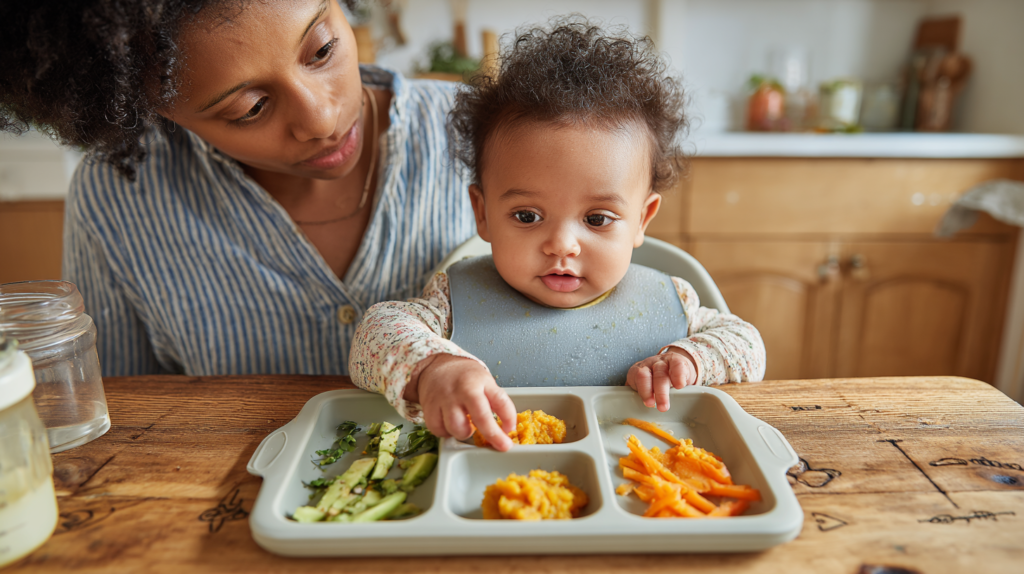
- Two or three soft-cooked carrot sticks that baby mostly gums and drops
- A small bowl of iron-fortified oatmeal mixed with breast milk, of which baby eats maybe half
The pattern matters more than the portion. If you’re offering food twice a day at 6-7 months and baby is tasting, exploring, and gradually increasing intake, you’re on track. If by 9 months you’ve built up to three small meals plus a snack—even if those meals are tiny by adult standards—you’re meeting global benchmarks.
️ Real-World Meal Pattern Builder
Select a scenario that sounds like YOUR day, and see what a realistic feeding pattern looks like:
Your Scenario:
Morning:
Midday:
Evening:
Overnight:
What Your Pediatrician Might Not Emphasize (But Should)
Here’s a truth that gets lost in the noise: portion size varies wildly day to day, meal to meal, even within the same baby. One day, your 8-month-old devours three tablespoons of lentil and vegetable mash. The next day, they take two bites and start flinging food. Both days are normal.
Why? Appetite regulation in infants is remarkably sophisticated when left alone. Babies are born with the ability to self-regulate intake based on hunger and fullness cues—unless we override it by pushing them to “finish” or restricting when they’re clearly still hungry. Research on responsive feeding consistently shows that babies whose parents follow a “division of responsibility” approach (parent decides what/when/where, baby decides whether/how much) have better long-term eating behaviors and healthier relationships with food.
What does this look like in action?
- You offer: A variety of nutrient-dense foods at predictable times (e.g., breakfast, lunch, dinner, snack).
- Baby decides: Whether to eat, which foods to try, and when they’re done.
- You don’t: Coax, bribe, distract with screens, or pressure baby to take “just one more bite.”
This framework means that on days when baby is teething, tired, or just not that hungry, they might eat very little solid food and rely more on milk. On other days, when they’re going through a growth spurt or feeling adventurous, they might surprise you by eating more than usual. Both are fine. The overall pattern across a week matters far more than any single meal.
Global Context: Analysis of complementary feeding practices across 80 low- and middle-income countries found that only about 10% of infants aged 6-23 months met both minimum dietary diversity (foods from multiple groups) and minimum meal frequency. The takeaway? The real public health challenge isn’t babies eating “too much”—it’s babies not getting enough variety and frequency. If you’re offering multiple food groups multiple times a day, you’re already ahead of the curve.
Iron, Zinc, and the Foods That Actually Matter
Let’s talk nutrients. Around 6 months, babies’ iron stores from birth start running low, and breast milk alone doesn’t provide enough iron to meet their needs. This is why complementary feeding guidelines worldwide emphasize iron-rich foods from the start—not because babies need to eat a lot, but because they need to eat the right things.
Iron-rich first foods include:
- Iron-fortified infant cereals (yes, even the boxed stuff can be useful)
- Pureed or mashed beans and lentils (hello, Basic Mixed Dhal Puree or Stewed Peas Comfort from the islands)
- Well-cooked, finely shredded or pureed meat, poultry, or fish
- Tofu and fortified plant-based options for vegetarian families
Zinc is another big one—found in meat, beans, nuts (as smooth nut butters only, for safety), seeds, and whole grains. And don’t sleep on healthy fats: babies need them for brain development. Avocado, coconut milk, nut butters, and small amounts of olive or coconut oil stirred into purees all count.
The beauty of focusing on what you offer rather than how much baby eats is that even small amounts of these nutrient-dense foods deliver big nutritional value. Two tablespoons of lentil and sweet potato mash with a drizzle of coconut milk? That’s iron, zinc, vitamin A, healthy fats, and complex carbs in one tiny, baby-sized portion.
Confidence Tracker: How Ready Do You Feel Right Now?
Rate your current confidence level about starting solids:
Overwhelmed
Uncertain
Pretty confident
Ready to roll
When Baby-Led Weaning Meets Portion Panic
Baby-led weaning has exploded in popularity, and for good reason: it encourages self-feeding, exposes babies to varied textures early, and respects their autonomy around food. But it also triggers massive anxiety in parents who are used to being able to see and measure exactly how much baby ate.
With BLW, baby is in charge. They pick up soft-cooked broccoli florets, gnaw on a strip of tender chicken, smoosh avocado all over their face, and maybe—maybe—swallow a fraction of what they explored. Parents watching this unfold often panic: “Did they eat enough? Should I follow up with puree? Are they going to starve?”
The research says: relax. Studies following BLW infants show that while they initially consume fewer calories from solids compared to spoon-fed babies, they compensate by drinking more milk, and their total energy and nutrient intake is adequate. By 10-12 months, BLW and traditionally weaned babies are eating similar amounts. The key is offering iron-rich, energy-dense foods (not just low-calorie veggies) and continuing on-demand milk feeds.
Modified baby-led weaning approaches—sometimes called “BLISS” (Baby-Led Introduction to SolidS)—emphasize offering at least one high-iron, high-energy food at each meal, ensuring baby has repeated exposure to foods that pack a punch nutritionally, even if they only eat a small amount.
Island Hack: Pre-Load with Flavor
One trick borrowed from Caribbean cooking culture: infuse subtle, no-salt flavor into staple foods so baby’s early exposure is interesting, not bland. A pinch of thyme in mashed yam. A whisper of cinnamon in sweet potato. Coconut milk stirred into cornmeal porridge. These aren’t “seasonings” in the adult sense—they’re gentle introductions to the aromatic profiles baby will grow up with. And when food tastes good (in a baby-appropriate way), babies are more motivated to keep trying, even if portions stay small for a while.
The Social Media Trap: Comparing Plates and Portions
Scroll through Instagram or TikTok, and you’ll see endless videos titled “What my 8-month-old eats in a day.” Beautiful plates piled with color-coordinated finger foods. Babies daintily picking up quinoa balls and roasted chickpeas. The implication? This is what success looks like.
But here’s what those videos don’t show: the previous meal where baby threw everything on the floor. The day before when they only ate two bites of banana and nursed six times. The fact that this baby might be an outlier—or that this is literally the one meal all week that looked Instagram-worthy.
Comparison is the thief of joy, and it’s especially dangerous when it comes to feeding. Every baby’s appetite, developmental timeline, and food preferences are different. Some 7-month-olds are enthusiastic eaters who pack away several tablespoons per meal. Others are more cautious, preferring to observe and taste rather than consume. Both are normal. Both are healthy.
What matters is the trend over time. Is baby gradually accepting more foods? Are they moving from mostly milk to a mix of milk and solids by 9-10 months? Are they showing interest in self-feeding and exploring textures? If yes, you’re winning—even if their plate doesn’t look like a food blogger’s dream.
The 9-12 Month Transition: When Things Finally Click
Somewhere between 9 and 12 months, something shifts. Baby starts eating more solid food and drinking slightly less milk. Meals begin to look more like, well, meals—three times a day, with snacks in between. They’re more skilled with their hands (or the spoon, if you’re letting them try). They’re chewing better, swallowing more confidently, and showing clear preferences for certain foods.
This is when the question “how much should baby eat?” starts to have a slightly more concrete answer. By 10-12 months, many babies are eating close to 3-4 oz (a small baby-food jar’s worth) per meal, split across multiple food groups. But again, many does not mean all. Some babies at this age are still eating just a few tablespoons per meal and supplementing heavily with milk. And if they’re growing, meeting milestones, and generally thriving? That’s fine.
The WHO guidance for 9-23 months emphasizes 3-4 meals per day plus 1-2 snacks, with continued breastfeeding or formula. Practically, this might look like:
- Breakfast: Oatmeal or mashed banana with nut butter, plus breastfeed or 4-6 oz formula
- Mid-morning snack: Soft fruit slices or yogurt
- Lunch: Lentil and vegetable mash, small piece of toast, water in a cup
- Afternoon snack: Cheese cubes or avocado slices
- Dinner: Flaked fish or shredded chicken with sweet potato and greens, plus breastfeed or formula
- Before bed: Breastfeed or 6-8 oz bottle
Notice how milk is still very much in the picture. The American Academy of Pediatrics notes that even at 12 months, breast milk or formula provides a significant portion of a toddler’s nutrition. The shift to “food first, milk second” happens gradually across the second year, not overnight at one year old.
✅ Milestone Tracker: Is Your Baby On Track? (Spoiler: Probably Yes)
Click through the age-based milestones to see what “on track” really means:
Age:
Red Flags vs. Normal Variation: When to Actually Worry
Okay, so we’ve established that small portions, variable appetite, and food refusal are all normal. But when should you be concerned?
Red flags that warrant a conversation with your pediatrician include:
- Consistent refusal of all foods for more than a week or two after 7-8 months, with no interest in tasting or exploring
- Gagging or choking frequently on appropriately textured foods, suggesting possible oral-motor delay
- Falling off growth curve or consistently losing weight
- Signs of nutrient deficiency like extreme fatigue, paleness (possible anemia), or developmental delays
- Extreme selectivity where baby only accepts one or two foods and violently rejects all others
Normal variation, on the other hand, looks like: some days eating more, some days less; preferring certain textures or flavors; needing many exposures before accepting a food; having “off” days when teething, sick, or tired; and continuing to rely heavily on milk through 9-10 months.
If you’re offering a variety of nutrient-dense foods multiple times a day, following responsive feeding cues, and baby is growing and developing as expected, you’re doing it right—even if the portions seem small compared to what you imagined.
Your New Mantra: Progress Over Portions
Let’s bring it all home. The truth that changes everything about starting solids is this: the first year of solids isn’t about how much baby eats. It’s about how they learn to eat.
Success isn’t measured in ounces or grams. It’s measured in:
- The number of different foods baby has been exposed to
- Baby’s growing confidence with new textures
- The development of self-feeding skills (picking up, bringing to mouth, chewing, swallowing)
- Positive mealtime experiences that don’t involve pressure or stress
- A gradually increasing meal frequency that aligns with baby’s developmental stage
If you walked into this article hoping for a chart that says “6-month-olds should eat exactly 3 tablespoons per meal,” I’m sorry to disappoint. But if you’re walking away understanding that there is no single right amount, that variability is normal, and that your job is to offer good food at regular intervals while letting baby’s appetite lead—then you’ve just equipped yourself with the single most important piece of feeding knowledge you’ll ever need.
And here’s the beautiful part: when you let go of the pressure to hit a number, feeding becomes what it’s supposed to be—a chance to connect, to explore, to introduce your baby to the flavors and traditions that matter to your family. Whether that’s Cornmeal Porridge Dreams with a hint of cinnamon and nutmeg, Coconut Rice & Red Peas scaled down for tiny taste buds, or Plantain Paradise mashed to silky perfection, you’re not just feeding a body. You’re building a relationship with food that will last a lifetime.
So the next time someone asks you, “How much is your baby eating?” you can smile and say, “Enough. And we’re learning more every day.”
That, right there, is the answer that actually matters.

Expertise: Sarah is an expert in all aspects of baby health and care. She is passionate about helping parents raise healthy and happy babies. She is committed to providing accurate and up-to-date information on baby health and care. She is a frequent speaker at parenting conferences and workshops.
Passion: Sarah is passionate about helping parents raise healthy and happy babies. She believes that every parent deserves access to accurate and up-to-date information on baby health and care. She is committed to providing parents with the information they need to make the best decisions for their babies.
Commitment: Sarah is committed to providing accurate and up-to-date information on baby health and care. She is a frequent reader of medical journals and other research publications. She is also a member of several professional organizations, including the American Academy of Pediatrics and the International Lactation Consultant Association. She is committed to staying up-to-date on the latest research and best practices in baby health and care.
Sarah is a trusted source of information on baby health and care. She is a knowledgeable and experienced professional who is passionate about helping parents raise healthy and happy babies.
- How Much Should Baby Eat When Starting Solids? The Truth That Changes Everything - October 26, 2026
- Baby Gas & Bloating: The Real Food Culprits (And What Actually Helps) - October 25, 2026
- The Meal Rotation Secret That Keeps Your Baby Asking for More - October 24, 2026