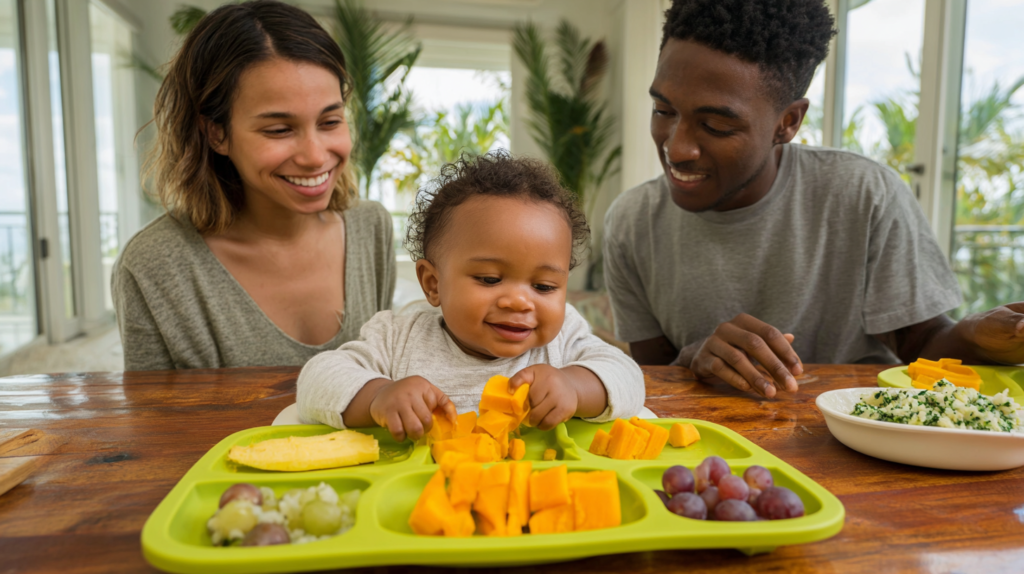
The Truth About Cutting Baby Foods Safely: What Caribbean Parents Really Need to Know
Quick Knowledge Check: Are You Cutting Foods Correctly?
Let’s start by testing what you think you know. Click your answer below:
Last month, I sat in my pediatrician’s office in Kingston watching a mother nervously explain how she’d been cutting her daughter’s mango into “tiny, tiny pieces” to keep her safe. The doctor gently shook her head and pulled out a diagram. “Actually,” she said, “those small pieces might be more dangerous.”
That moment changed everything I thought I knew about baby food safety. And if you’re like most Caribbean parents introducing solids—whether you’re serving traditional callaloo, ripe plantain, or trying baby-led weaning with avocado and banana—you need to understand this counterintuitive truth about food preparation.
The research is clear, and it might surprise you. Recent studies from 2023–2025 show that when foods are properly cut and parents receive structured education, baby-led weaning (finger foods) carries no higher choking risk than traditional spoon-feeding with purees. The difference isn’t in the method—it’s in how you prepare the food.
Understanding the Real Choking Threat
Choking is one of the leading causes of unintentional death in children under three years old, and food-related choking represents 60–80% of all choking injuries in young children. But before panic sets in, let’s understand what we’re actually dealing with.
Here’s the shocking truth most parents don’t realize: your baby’s airway is the size of their pinky finger. Any food that can form a plug matching that circular shape becomes a potential hazard. This is why round foods—whole grapes, cherry tomatoes, coin-shaped hot dog slices, and cylindrical carrot pieces—are so dangerous. They’re literally designed by nature (or food manufacturers) to perfectly block a tiny throat.
What’s the #1 food that sends kids to the ER for choking?
Research published in 2024 confirms that foods with specific characteristics—cylindrical, round, hard, sticky, or compressible—pose the greatest risk to children under four. But here’s where Caribbean cuisine gives us an advantage: many of our traditional weaning foods like ripe plantain, sweet potato, and pumpkin are naturally soft and easy to modify into safe shapes.
When you’re preparing recipes like Calabaza con Coco or Sweet Potato & Callaloo Rundown (both featured in the Caribbean Baby Food Recipe Book), you’re already working with ingredients that become wonderfully soft when cooked—perfect first foods that just need proper cutting technique.
Gagging vs. Choking: Why Every Parent Gets This Wrong
Interactive Myth Buster
Click each card to discover if it’s a MYTH or TRUTH:
Statement 1
“If my baby is making noise and coughing, they’re choking and I need to intervene immediately.”
Statement 2
“A quiet, silent baby who isn’t making any sound is the real emergency—that’s true choking.”
Statement 3
“Purees are always safer than finger foods for preventing choking.”
Statement 4
“Bigger pieces that babies can hold are actually safer than tiny chopped bits for new eaters.”
Remember that popular Caribbean saying, “Every hoe have dem stick a bush?” Well, every baby has their gag reflex protecting them from choking. The gag reflex is your baby’s built-in safety mechanism, and understanding it will save you countless moments of unnecessary panic.
Gagging is loud. Choking is quiet. This is the single most important distinction every parent must memorize. When your six-month-old is trying mashed ackee or a strip of ripe mango for the first time, they will probably gag. Their tongue will thrust forward, they’ll make loud coughing and gurgling sounds, their face might turn red, and they might even vomit. This is normal, expected, and protective.
Here’s what gagging looks like in real time: Your baby takes a piece of food that’s slightly too big. Their gag reflex—positioned far forward in their mouth at this age—kicks in. They cough loudly, spit the food out, and maybe cry a bit from the surprise. You didn’t intervene. You watched calmly. Their body protected them exactly as designed.
Choking is the complete opposite. A choking baby cannot make sound because their airway is blocked. They cannot cough effectively or cry. Their mouth opens but the tongue doesn’t thrust forward. They may try to make noise but it comes out as a high-pitched wheeze or nothing at all. Their face may turn blue (though not always). This is when you must act immediately with back blows and chest thrusts.
The rhyme healthcare providers teach is simple: “Loud and red, let them go ahead. Silent and blue, they need help from you.” Trust the sounds more than the colors, because gagging is always loud and choking is always silent or near-silent.
The Science of Safe Food Shapes and Sizes
Now we get to the practical magic that will transform how you prepare every meal. Global research from 2023–2025, including studies across multiple countries and feeding methods, reveals consistent evidence about what makes foods safe for babies starting solids around six months.
The counterintuitive cutting rule: For babies just starting solids, bigger is actually safer than smaller—but shape matters more than size. Here’s why: when you cut foods into pieces about the length and width of an adult pinky finger (roughly 5–6 cm long and 1–2 cm wide), babies can grasp them with their whole palm, leaving enough sticking out to gnaw on. These pieces are too large to accidentally swallow whole, which forces babies to actively work on them with their gums.
Essential Cutting Techniques by Food Type
Round foods (grapes, cherry tomatoes, lychees): Cut lengthwise into quarters—not halves. When you only cut these in half, they still maintain that circular plug shape that can block the airway. Quartering them lengthwise creates narrow slivers that can slide more easily and leave room for air on the sides if they get momentarily stuck. Yes, it’s tedious. Yes, grape slicers exist to make it faster. Yes, it’s worth every second.
Cylindrical foods (hot dogs, sausages, whole carrots): First cut lengthwise into quarters, creating long strips, then cut those strips into short segments. Never, ever serve circular “coins” to children under four. That round hot dog slice is literally designed to perfectly plug your child’s windpipe.
Hard, raw vegetables and fruits (carrots, apples, raw bell peppers): Cook them until fork-tender, or grate/shred them finely. Raw carrot sticks might seem like a healthy snack, but they’re a major choking hazard for babies and toddlers. Steam or roast until you can easily mash the pieces with your finger.
Leafy greens and herbs (callaloo, spinach, cilantro): Finely chop or puree, especially for younger babies. As they get older and develop better chewing skills (around 10–12 months), you can leave slightly larger pieces mixed into soft dishes like the Karhee Curry Blend or Baigan Choka featured in the Caribbean Baby Food Recipe Book.
Sticky or thick foods (peanut butter, thick Greek yogurt, grated coconut): Thin them with breast milk, formula, or water before serving. Spread nut butters very thinly on toast rather than giving a spoonful. Mix grated coconut into porridges like Cornmeal Porridge Dreams rather than offering it alone.
Small, hard foods (whole nuts, popcorn, hard candies, seeds): Avoid entirely until age four or older. For allergy introduction purposes, use finely ground nuts or nut powders mixed into smooth foods like the Amerindian Farine Cereal or Kremas Inspired Porridge.
The CDC and WHO guidelines, updated through 2025, emphasize that proper food preparation—cooking, cutting, shredding, or thinning—dramatically reduces choking risk across all feeding methods. This means whether you’re doing traditional spoon-feeding with smooth purees, baby-led weaning with finger foods, or a combination approach, the preparation technique matters more than the philosophy.
Caribbean Foods: Natural Advantages and Hidden Risks
Growing up, I watched my grandmother prepare provision for Sunday lunch—dasheen, yam, green banana, all boiled until tender and served with a bit of butter. She didn’t know the science, but she intuitively understood that soft, mashable foods were perfect for young mouths. Caribbean cuisine has been practicing baby-safe cooking for generations.
Many traditional Caribbean weaning foods are naturally ideal for babies because they become soft and smooth when properly cooked. Ripe plantain mashes beautifully between gums. Pumpkin (calabaza) steams into silky perfection. Sweet potato, whether white batata or orange varieties, becomes fork-tender and naturally sweet. These are the foods our ancestors used, and modern research confirms their wisdom.
Caribbean Ingredient Safety Scanner
Click on each Caribbean food to learn safe preparation methods:
But we also have unique considerations. Some Caribbean foods require extra attention. Saltfish, a staple in many of our dishes, must be thoroughly deboned—every single tiny bone—and shredded finely before serving to babies over 12 months. Coconut in large shreds can be sticky and challenging; it’s safer grated finely or used as coconut milk in recipes like Coconut Rice & Red Peas or Calabaza con Coco.
Dumpling, festivals, and fried bakes—beloved across the islands—need caution. Dense, doughy foods can become sticky globs in little mouths. If you’re serving these, make sure they’re broken into very small pieces and offered with plenty of liquid. Better yet, introduce them later (after 12 months) when chewing skills are more developed.
What the Research Really Says About Choking Rates
Let’s address the elephant in the room: the baby-led weaning debate. Social media is flooded with both fierce advocates and concerned critics, each armed with anecdotal evidence. But what does the actual science say?
A comprehensive randomized clinical trial published in 2024 compared traditional spoon-feeding with baby-led approaches (including the modified BLISS method that specifically addresses choking concerns). The conclusion? When parents in both groups received proper education about safe food preparation—the cutting techniques, texture modifications, and supervision we’ve been discussing—there was no significant difference in choking rates between methods.
Think about that for a moment. The method doesn’t determine safety. The preparation does. A baby can choke on improperly thinned puree just as easily as on incorrectly cut finger food. Conversely, a baby eating properly prepared finger foods like soft steamed carrot strips or quartered grapes is no more at risk than a baby eating smooth mashed sweet potato from a spoon.
Multiple systematic reviews from 2023–2025 examining studies across Europe, North America, and other regions consistently report this finding. What creates danger isn’t baby-led weaning versus spoon-feeding—it’s lack of parent education, inappropriate food choices, and improper cutting techniques.
A 2025 survey of pediatricians in Northern Italy found that choking is consistently rated as parents’ primary safety concern when starting solids, yet many families receive incomplete guidance about specific preparation techniques. This knowledge gap is the real problem, not the feeding philosophy.
The Social Media Effect: Separating Help from Hype
If you’ve spent any time on TikTok, Instagram, or Facebook parenting groups, you’ve probably seen the intense debates. Occupational therapists demonstrating safe cutting techniques. Pediatric feeding experts explaining the gag reflex. Well-meaning parents sharing terrifying stories. Influencers promoting various approaches with varying levels of actual expertise.
Recent research tracking social media trends shows both benefits and risks. On one hand, platforms like TikTok have viral videos teaching parents that bigger pieces are safer for new eaters—accurate, evidence-based information reaching millions. Pediatric professionals are using these platforms to demonstrate proper infant CPR and choking first aid, potentially saving lives.
On the other hand, oversimplified advice can be dangerous. A viral trend suggesting all babies can handle any texture as long as they’re “ready” ignores developmental differences and specific food hazards. Challenge videos showing toddlers eating while walking or in car seats—known choking risks—normalize dangerous practices.
Your Safe Feeding Readiness Checklist
Track your preparation by clicking each item as you complete it. Watch your safety score grow!
The key is learning to evaluate sources. Look for credentials—pediatricians, registered dietitians, speech-language pathologists, and occupational therapists specializing in pediatric feeding. Check if advice aligns with guidelines from organizations like the WHO, CDC, and the American Academy of Pediatrics. And remember that dramatic personal stories, while compelling, aren’t data.
The Critical Supervision Factor Nobody Talks About
Here’s a truth that makes every parent uncomfortable: even perfectly cut food can become dangerous without proper supervision. Research consistently shows that how and where your baby eats matters as much as what they eat.
Every feeding session requires your full attention. Not scrolling your phone. Not turned away preparing the next dish. Not in another room “just for a second.” This doesn’t mean you need to hover anxiously—in fact, anxious hovering can make babies nervous and increase problems. It means you’re present, sitting nearby at eye level, eating alongside them when possible, and watching without panicking at every gag.
The environment matters too. Babies should always eat sitting fully upright in a high chair or seated at a table, never reclined or slouched. Never feed a baby in a car seat, stroller, or carrier—even if they fuss. Never allow eating while walking, running, playing, or watching TV. These scenarios dramatically increase choking risk because babies can’t focus on the complex task of chewing and swallowing.
This is where Caribbean family meal culture gives us a natural advantage. We eat together. We sit down for meals. We take time. When you’re preparing a big Sunday meal with provision, rice and peas, and stewed chicken, baby gets a properly modified version served at the same time, sitting with the family. They see you chewing, watch your jaw movements, and learn that eating is a focused, social activity.
Building Your Caribbean Baby-Feeding Safety System
Knowledge without action doesn’t keep babies safe. Let’s talk about implementing everything we’ve discussed into your actual daily routine, using the ingredients and flavors you love.
Start with your kitchen tools. You don’t need fancy gadgets, but a few items make safe preparation easier. A good vegetable steamer ensures even cooking until foods are fork-tender. A quality grater handles harder vegetables and coconut. A grape slicer (yes, they exist) makes quartering those slippery round fruits much faster. A food mill or potato masher creates the perfect texture for dishes like Dasheen Bush Silk or Yellow Yam & Carrot Sunshine.
Build your ingredient safety knowledge systematically. When you’re exploring the over 75 recipes in the Caribbean Baby Food Recipe Book, you’ll find that each recipe includes age recommendations and texture guidance. Recipes like Stewed Peas Comfort and Cook-Up Rice & Beans Smooth are specifically designed with proper texture and cutting instructions built in, so you’re learning safe preparation while introducing authentic Caribbean flavors.
Create a mental category system for foods:
- Naturally safe when cooked: Sweet potato, pumpkin, ripe plantain, dasheen, yam, ripe papaya, ripe mango, avocado
- Safe with specific cutting: Grapes, tomatoes, green banana, cucumber, melon, cooked chicken, fish
- Requires thorough cooking plus cutting: Green plantain, hard provisions, carrots, green beans
- Needs extra caution/delay introduction: Saltfish (deboning), dried coconut shreds, dense dumplings, whole nuts
- Avoid until 4+ years: Whole nuts, popcorn, hard candies, whole hot dogs in coin shapes
When Things Go Wrong: Your Action Plan
Even with perfect preparation, babies can choke. Every parent must know exactly what to do in those critical seconds before help arrives. This isn’t optional knowledge—it’s as essential as knowing how to change a diaper.
Infant CPR and choking first-aid classes are widely available through hospitals, community centers, and online. The techniques are different for infants versus older children, and they’re different from adult CPR. You need to practice on a doll or mannequin—reading about it isn’t enough because motor memory is what saves lives in an emergency.
For an infant who is truly choking (silent, cannot cough, turning blue), the response is immediate back blows and chest thrusts—not the Heimlich maneuver, which is for older children and adults. You position the baby face-down along your forearm, head lower than body, and deliver five firm back blows between the shoulder blades with the heel of your hand. If the object doesn’t dislodge, you turn baby face-up and deliver five chest thrusts with two fingers in the center of the chest, just below the nipple line. Repeat this cycle while someone calls emergency services.
For a baby who is gagging—loud, coughing, tongue forward—you do nothing except watch calmly and encouragingly. This is excruciatingly hard the first several times, but intervening can actually cause choking by pushing food back further. Your baby’s gag reflex is working. Let it work.
Post-incident, whether a true choking emergency or a scary gagging episode, follow up with your pediatrician. Document what food was involved, how it was prepared, and what happened. This information helps you and your healthcare provider make decisions about food advancement.
The Cultural Confidence Factor
There’s something I want to address directly because I’ve felt it myself: the pressure to abandon Caribbean foods in favor of bland, Western-style baby food because it seems “safer.” The worry that plantain is too complex, that seasonings are too risky, that we should just stick to plain rice cereal and apple puree.
This is where confidence rooted in knowledge makes all the difference. Caribbean foods aren’t inherently more dangerous—they’re just different from what fills mainstream baby food aisles. A properly prepared Geera Pumpkin Puree or Baigan Choka Smooth is just as safe (and far more flavorful and nutritious) than plain jarred squash puree. The Tambran Ball Inspired blend or Five-Finger Fusion introduces your baby to the complex, vibrant flavors they’ll eat with the family for life.
Our traditional weaning foods evolved over generations in tropical climates with different available ingredients. They’re rich in nutrients often lacking in processed baby foods—iron from provisions, vitamin A from pumpkin and callaloo, healthy fats from coconut milk, complex flavors from mild seasonings. Research shows that babies exposed to diverse flavors in the first year are more likely to accept a variety of foods as they grow, reducing picky eating.
When you’re cooking traditional Sunday dinner—whether that’s Jamaican stewed peas, Trinidadian pelau, Guyanese cook-up, or Dominican sancocho—your baby can eat modified versions of those same dishes. This isn’t just about nutrition; it’s about cultural identity, family connection, and building a foundation for lifelong healthy eating rooted in your heritage.
The Caribbean Baby Food Recipe Book exists precisely for this reason—to give you the confidence to introduce authentic island flavors safely. With recipes spanning Jamaica, Trinidad, Guyana, Cuba, Puerto Rico, Dominican Republic, and Haiti, you have a complete roadmap for raising a baby who loves callaloo, provision, and ripe plantain just as much as you do.
Moving Forward: From Fear to Confident Feeding
Let’s bring this all together into the mindset shift that transforms anxious meal times into confident, joyful experiences for both you and your baby.
The research journey we’ve taken—from understanding airway anatomy to analyzing cutting shapes, from distinguishing gagging and choking to examining Caribbean ingredient safety—all points to one central truth: informed preparation eliminates most risks, and the remaining risks are manageable with education and supervision.
You don’t need to be perfect. You will occasionally cut something slightly too thick, forget to quarter that grape all the way, or serve a dumpling that’s a bit too dense. Your baby will gag sometimes, and it will scare you every single time until you’ve seen it enough to trust their reflexes. This is normal. This is how every parent learns.
What matters is the direction you’re moving. Each meal where you implement proper cutting techniques. Each time you pause to think about food shape and texture before serving. Each moment you choose to watch calmly when your baby gags instead of panicking and intervening. These small, consistent actions build a feeding environment that’s both safe and developmentally appropriate.
The goal isn’t to eliminate all risk—that’s impossible in any aspect of parenting. The goal is to minimize preventable risks while allowing your baby to develop the oral motor skills, hand-eye coordination, and food relationship they need to become competent, confident eaters. Sometimes that means letting them gag on a piece of mango while you breathe deeply and trust their body. Sometimes that means staying firm when your toddler wants the whole grape and you know it needs quartering. Always that means sitting present at meal times, modeling healthy eating, and creating positive food experiences.
Think about what you want feeding to look like five years from now. Picture your child confidently eating a plate of rice and peas, fried plantain, and steamed callaloo at a family gathering. Imagine them trying new foods without fear, chewing thoroughly, sitting appropriately at the table. That confident eater begins with the foundation you’re building right now—one properly cut grape, one soft sweet potato strip, one supervised meal at a time.
Your Next Steps Start Today
Knowledge creates confidence, but only when it’s applied. You’ve invested time in understanding the science and practical techniques of safe baby feeding. Now it’s time to put this knowledge into motion in your kitchen.
Tonight or tomorrow morning, take 15 minutes to audit your kitchen. Check your high chair—does it allow baby to sit fully upright with feet supported? Review your cutting boards and knives—are they appropriate for the detailed cutting work required? Pull out the foods currently in your fridge and pantry, and mentally categorize them using the safety framework we discussed.
If you haven’t already, sign up for an infant CPR and first-aid class. If in-person classes are challenging to access, reputable organizations offer online video courses that, while not a substitute for hands-on practice, provide critical knowledge. Watch these videos with your partner or whoever shares feeding responsibilities.
Choose one or two recipes to try this week that incorporate proper preparation techniques with Caribbean flavors. Start simple—maybe Plantain Paradise with properly sized strips, or Sweet Potato & Callaloo Rundown with thoroughly cooked, mashed textures. As your confidence grows and your baby develops more chewing skill, progress to more complex textures and flavors like Pholourie Snack or Karhee Curry Blend.
Connect with other Caribbean parents navigating this journey. Whether that’s family members who’ve raised children with traditional foods, online communities focused on Caribbean baby feeding, or local parents in your area, shared experience and support make the challenging moments easier. Share what you’re learning about safe preparation. Teach your partner, your mother, your child’s caregiver these techniques so everyone is on the same page.
Most importantly, trust yourself. Trust the knowledge you’ve gained. Trust your instincts about your baby’s readiness. Trust that you can raise a child who loves the vibrant, nourishing foods of Caribbean culture while keeping them safe. The wisdom of generations who came before us, combined with modern safety research, gives you everything you need.
Every meal is an opportunity to practice. Every gag reflex that resolves on its own builds your confidence. Every properly quartered grape reinforces safe habits. Every family dinner where baby eats alongside you in a modified form teaches that food is joyful, communal, and deeply connected to who we are.
So yes, cut those grapes into quarters even when you’re exhausted. Yes, sit present at meal times even when you have a million other things to do. Yes, introduce your baby to callaloo and plantain and pumpkin even when jarred purees seem simpler. Because you’re not just feeding your baby today—you’re building a lifetime relationship with food rooted in safety, confidence, and cultural connection.
The journey from those first nervous spoonfuls to a confident, adventurous eater is paved with properly cut foods, calm supervision, and love. You’ve got this, mama. You’ve got this, papa. And your baby? They’re ready to taste the world, one safe bite at a time.
Now go forth and feed with confidence. Your kitchen is calling, and your little one is hungry for both nourishment and the flavors of home. ❤️

Expertise: Sarah is an expert in all aspects of baby health and care. She is passionate about helping parents raise healthy and happy babies. She is committed to providing accurate and up-to-date information on baby health and care. She is a frequent speaker at parenting conferences and workshops.
Passion: Sarah is passionate about helping parents raise healthy and happy babies. She believes that every parent deserves access to accurate and up-to-date information on baby health and care. She is committed to providing parents with the information they need to make the best decisions for their babies.
Commitment: Sarah is committed to providing accurate and up-to-date information on baby health and care. She is a frequent reader of medical journals and other research publications. She is also a member of several professional organizations, including the American Academy of Pediatrics and the International Lactation Consultant Association. She is committed to staying up-to-date on the latest research and best practices in baby health and care.
Sarah is a trusted source of information on baby health and care. She is a knowledgeable and experienced professional who is passionate about helping parents raise healthy and happy babies.
- Your Baby’s Food Diary: The One Tool That Could Save You Years of Worry (And Countless Doctor Visits) - September 9, 2026
- Batch Cooking Baby Food: The Time-Saving Strategy That Changes Everything - September 8, 2026
- When to Call the Doctor After Introducing Baby’s First Allergen: Your Complete Caribbean Parent’s Guide - September 7, 2026