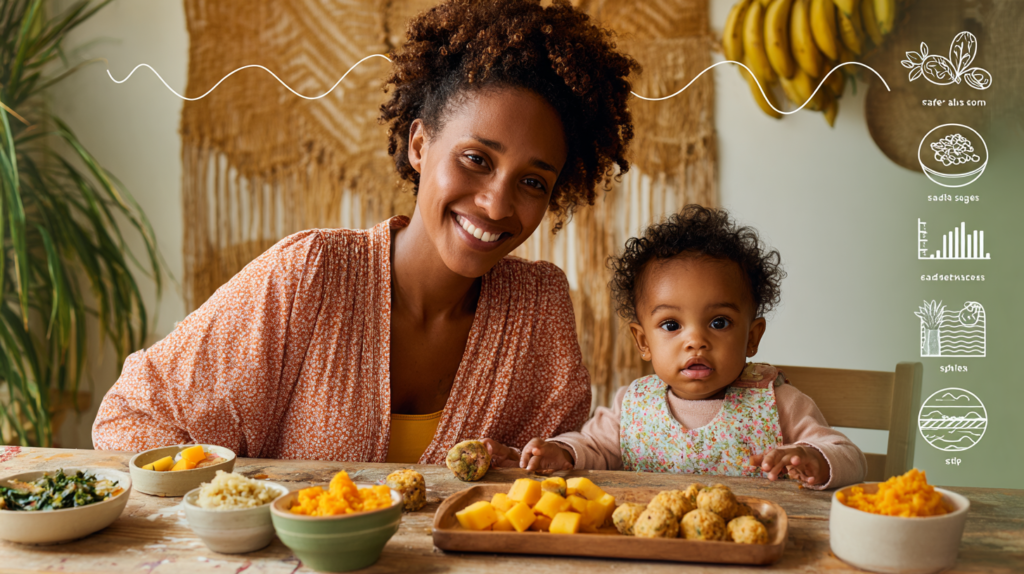
When Your Baby Only Eats One Food: The Science-Backed Path From Food Jail to Food Joy
Three months ago, my cousin called me in tears. Her 18-month-old would only eat white rice. Nothing else. Not the callaloo her grandmother lovingly prepared, not the sweet mango slices, not even the coconut cornmeal porridge that every island baby supposedly loves. Just plain white rice, three times a day, every single day.
Here’s what nobody tells you when your baby locks onto one food and refuses everything else: you’re not failing as a parent. In fact, research from sensory-based feeding interventions shows that food selectivity peaks naturally between ages 2-6 years, and babies who fixate on single foods are often simply navigating a completely normal developmental phase—not staging a tiny culinary rebellion against your best efforts.
But here’s the part that changed everything for my cousin—and will change everything for you: expanding your baby’s food repertoire isn’t about forcing, bribing, or hiding vegetables in smoothies. It’s about understanding the surprisingly simple science behind how children learn to accept new foods, and then applying strategies that work with your baby’s natural instincts instead of against them.
(Like my cousin’s rice situation)
(Limited but manageable)
(Suddenly stopped)
(Unpredictable acceptance)
The Shocking Truth About “Picky Eating” Nobody Shares
When pediatric feeding researchers analyzed thousands of selective eaters, they discovered something that contradicts everything you’ve been told by well-meaning relatives: babies who fixate on one food aren’t being stubborn or spoiled. They’re responding to a deeply rooted evolutionary survival mechanism called food neophobia—the fear of new foods that kept our ancestors alive by avoiding potentially poisonous plants.
But here’s where it gets interesting. A 2023 clinical trial involving preschool picky eaters found that when parents understood this biological reality and stopped using pressure tactics, children’s food acceptance improved dramatically within just six months. Not because the children suddenly became “better behaved,” but because removing pressure allowed their natural curiosity about food to re-emerge.
The research from the INSIGHT trial—one of the most comprehensive studies on infant feeding patterns—revealed that parents who used food to soothe or who pressured children to eat created a vicious cycle: the more pressure applied, the more the child restricted their food choices. It’s counterintuitive, but it’s backed by hard data collected from nearly 4,000 families.
Right now, your baby’s fixation on one food is actually their brain trying to establish safety and control in a world where everything is new and potentially threatening. Once you understand this, the path forward becomes crystal clear.
The Reality: This outdated advice can actually worsen food selectivity. Research from responsive feeding studies shows that children who experience extreme hunger develop MORE rigid food preferences, not fewer. The stress hormone cortisol interferes with their willingness to try new foods. Instead, maintain regular meal schedules with at least one “safe” food present so hunger doesn’t become a barrier to exploration.
The Reality: Sneaking foods breaks trust and prevents children from learning actual food acceptance. A meta-analysis of caregiver feeding interventions found that deceptive feeding strategies create long-term aversion and anxiety around meals. Children need to see, touch, smell, and gradually accept foods on their own terms—not discover them hidden after the fact. This is why sensory-based approaches that encourage exploration without deception show significantly better outcomes.
The Reality: Repeated exposure research from 2021 demonstrates that children typically need 8-15 neutral exposures to a new food before acceptance—and some children need even more. That’s not exposures where they taste it; that’s exposures where they simply see it on the table, tolerate it on their plate, or watch others eating it. One forced taste does nothing except create negative associations. Patience and repetition without pressure are the actual keys.
The Reality: While food selectivity can be developmental, left unaddressed with poor feeding practices, it often worsens. Studies tracking children over multiple years show that those whose parents responded with pressure, rewards, or giving up entirely maintained or intensified their selective eating into school age. The phase CAN pass—but only when you implement the right strategies that support gradual expansion rather than hoping time alone will fix it.
The Division of Responsibility: Your Secret Weapon
If you take away just one strategy from this entire article, make it this: the Ellyn Satter Division of Responsibility framework. Backed by decades of research and endorsed by feeding therapists worldwide, it’s deceptively simple but incredibly powerful.
Here’s how it works: You decide what foods are offered, when meals happen, and where eating takes place. Your baby decides whether to eat and how much. That’s it. No coaxing, no rewards, no “just one more bite.” You provide a structured food environment with regular meals and snacks, always including at least one food your baby accepts, and then you step back.
Why does this work when everything else fails? Because it removes the power struggle. Feeding problems escalate when meals become battlegrounds. Research on bidirectional associations between controlling feeding practices and food responsiveness shows that the more parents control what goes into a child’s mouth, the less the child trusts their own hunger and fullness cues—and the more they restrict their food choices as a way to reclaim autonomy.
When my cousin finally implemented this with her rice-obsessed toddler, she served family meals with rice plus two other foods. No pressure to try them. No comments about what was or wasn’t eaten. Within two weeks, her daughter touched a piece of steamed callaloo. By week three, she licked it. By month two, she was eating small amounts alongside her beloved rice. That’s the power of removing pressure and trusting the process.
If you’re looking to introduce more variety using island flavors your baby will actually enjoy, the Caribbean Baby Food Recipe Book offers over 75 recipes designed with this exact principle in mind—familiar bases like sweet potato, plantain, and coconut milk paired with new textures and flavors that encourage gradual exploration without overwhelming sensitive palates.
Tap each week to reveal your action steps. Small changes, massive results.
Goal: Establish routine and remove pressure
• Set consistent meal and snack times (3 meals, 2-3 snacks daily)
• Always serve one “safe” food at every eating occasion
• Stop commenting on what or how much baby eats
• Eat together as a family whenever possible
What to expect: Your baby may test boundaries or eat only safe foods. That’s normal. Your job is consistency, not immediate variety.
Goal: Non-eating food exposure
• Include one new food on the table at each meal (doesn’t need to touch baby’s plate)
• Narrate what you’re eating: “Mama’s having some mango. It’s orange and smooth.”
• Let baby touch, smell, or play with food outside of mealtimes
• Use food in sensory play (painting with mashed sweet potato, building with cucumber rounds)
What to expect: Baby may ignore new foods entirely. Success is exposure, not consumption. Keep it pressure-free and playful.
Goal: New food on baby’s actual plate
• Place tiny portions of 1-2 new foods on baby’s plate alongside safe food
• Model eating these foods yourself with enthusiasm (but don’t direct it at baby)
• Celebrate any interaction—touching, smelling, licking—without pressuring for bites
• Keep serving the same new foods repeatedly (remember: 8-15 exposures needed)
What to expect: Baby might push new foods away or ignore them. Some babies touch or lick. Both are progress. Stay neutral in your response.
Goal: Introduce foods similar to safe foods
• If baby eats white rice, try coconut rice or rice with tiny sweet potato pieces
• Modify textures gradually (if they eat purees, try soft lumps; if they eat one cracker brand, try a similar one)
• Review progress: Is baby tolerating new foods on the table? On the plate? Touching them?
• Continue the cycle: pressure-free exposure, modeling, patience
What to expect: Real eating of new foods might not happen yet—and that’s okay. You’re building neural pathways for acceptance that will pay off in months 2-3.
The Caribbean Advantage: Why Island Foods Are Perfect for Expansion
Here’s something beautiful about Caribbean cuisine that makes it uniquely suited for expanding a selective eater’s palate: the foods are naturally sweet, starchy, and comforting—exactly what cautious eaters gravitate toward—but they come in dozens of varieties with subtly different flavors and textures.
Think about it. If your baby accepts rice, you have a gateway to coconut rice, rice and peas, cook-up rice, and rice with tiny bits of sweet plantain. If they eat porridge, you can gradually explore cornmeal porridge, farine cereal, sweet millet cereal, and variations with cinnamon, nutmeg, or vanilla.
These aren’t radical departures that trigger fear responses. They’re gentle progressions that feel familiar enough to be safe but different enough to expand the palate. Sweet potatoes can lead to white batata, which can lead to malanga, then cassava. Mashed banana can progress to mashed ripe plantain, then to soft green fig.
This is exactly why foods like Plantain Paradise, Yellow Yam & Carrot Sunshine, and Coconut Rice & Red Peas from the Caribbean Baby Food Recipe Book work so well for transitioning selective eaters. They leverage familiar starchy bases while introducing new elements one tiny step at a time—the exact approach recommended by sensory-based feeding research.
Choose the statement that best matches your situation:
Seven Evidence-Based Strategies That Actually Work
Forget everything you’ve tried that failed. These strategies come directly from clinical trials, sensory feeding therapy protocols, and responsive feeding interventions that have helped thousands of families move beyond single-food fixation.
When Caribbean Flavors Meet Feeding Science
I’ll be straight with you: the reason I’m so passionate about Caribbean-inspired baby foods for selective eaters isn’t just cultural pride (though there’s plenty of that). It’s because island ingredients offer something that modern processed baby food completely misses—built-in flavor progression pathways.
When you start a baby on bland, single-ingredient purees and keep them there for months, you’re not protecting them. You’re actually making the eventual transition to family foods harder because the flavor gap becomes enormous. But Caribbean foods—with their natural sweetness from provisions like yam and sweet potato, gentle warming spices like cinnamon and nutmeg, and rich, comforting bases like coconut milk—they bridge that gap beautifully.
A baby eating Cornmeal Porridge Dreams with a hint of cinnamon is learning to accept spice in a non-threatening context. A baby eating Calabaza con Coco (pumpkin with coconut milk) is experiencing creamy, slightly sweet flavors that will make the transition to family curries and stews seamless. These aren’t just recipes—they’re stepping stones designed around how babies actually learn to eat.
Clinical trials on early flavor exposure consistently show that babies introduced to varied flavors between 6-12 months have fewer feeding difficulties later. But here’s what those studies don’t tell you: you don’t need 47 different exotic ingredients. You need smart progressions using a core set of versatile, naturally appealing foods. That’s exactly what Caribbean cuisine provides.
Recipes like Stewed Peas Comfort, Simple Metemgee Style Mash, and Sweet Potato & Callaloo Rundown from the Caribbean Baby Food Recipe Book aren’t just delicious—they’re strategically designed to use overlapping ingredients (coconut milk, thyme, sweet vegetables) so babies learn to recognize and accept core flavors across multiple dishes, which is precisely how acceptance builds.
⚠️ When to Seek Professional Help
Most single-food fixations resolve with patient, pressure-free strategies. However, consult a pediatrician or feeding therapist if:
- Baby’s diet consists of fewer than 10 foods and continues to narrow
- Growth has faltered or weight percentiles are dropping
- Baby shows extreme distress, gagging, or vomiting with most textures
- Feeding times consistently result in tantrums or family stress
- You notice signs of micronutrient deficiency (extreme fatigue, pale skin, constipation)
- Baby has gone more than 6 months without any dietary expansion despite implementing strategies
These may indicate avoidant/restrictive food intake disorder (ARFID) or sensory processing issues that require specialized intervention beyond home strategies.
Your Baby’s Food Future Starts Right Now
Remember my cousin? The one with the rice-only toddler? Six months later, her daughter now eats rice and peas, steamed callaloo, mashed plantain, small pieces of seasoned chicken, mango, and papaya. It didn’t happen overnight. There were setbacks. There were meals where only rice was eaten. But she trusted the process, removed the pressure, and kept showing up with variety on the table.
The breakthrough moment came when she stopped seeing her daughter’s selectivity as a problem to fix and started seeing it as a developmental phase to support. That mindset shift—backed by everything we know from responsive feeding research—changes everything.
Your baby isn’t broken. They’re not being difficult. They’re navigating a complex world where food represents not just nutrition but control, safety, and autonomy. When you approach expansion with patience, structure, and proven strategies, you’re not just adding foods to their diet. You’re teaching them that eating can be joyful, that their body signals matter, and that trying new things is safe.
Check off each milestone as you complete it. Watch your confidence—and your baby’s variety—grow.
You’re Doing This!
Every small step is progress. You’re not just expanding your baby’s diet—you’re building a foundation for a lifetime of healthy eating. Keep going!
✨ The Bottom Line
Expanding your baby’s diet from one food to many isn’t about tricks, bribes, or force. It’s about understanding the biology of food acceptance, respecting your baby’s autonomy, and implementing patient, research-backed strategies that work with their natural development instead of against it.
Structure your feeding environment. Remove pressure. Offer repeated exposure. Model joyful eating. Trust the timeline. And remember: every baby who now eats a varied diet started somewhere—often with a phase of eating just one or two foods. Your baby’s food story is still being written, and you’re exactly the right person to guide it.
The variety, the joy, the family meals where everyone eats together—it’s all ahead of you. You just needed the roadmap to get there. Now you have it.
If you’re ready to introduce Caribbean flavors strategically designed for gradual palate expansion, explore the full collection of 75+ recipes in the Caribbean Baby Food Recipe Book—every recipe includes family meal bonuses so everyone eats together, making expansion easier and more joyful.

Expertise: Sarah is an expert in all aspects of baby health and care. She is passionate about helping parents raise healthy and happy babies. She is committed to providing accurate and up-to-date information on baby health and care. She is a frequent speaker at parenting conferences and workshops.
Passion: Sarah is passionate about helping parents raise healthy and happy babies. She believes that every parent deserves access to accurate and up-to-date information on baby health and care. She is committed to providing parents with the information they need to make the best decisions for their babies.
Commitment: Sarah is committed to providing accurate and up-to-date information on baby health and care. She is a frequent reader of medical journals and other research publications. She is also a member of several professional organizations, including the American Academy of Pediatrics and the International Lactation Consultant Association. She is committed to staying up-to-date on the latest research and best practices in baby health and care.
Sarah is a trusted source of information on baby health and care. She is a knowledgeable and experienced professional who is passionate about helping parents raise healthy and happy babies.
- Your Baby’s Food Diary: The One Tool That Could Save You Years of Worry (And Countless Doctor Visits) - September 9, 2026
- Batch Cooking Baby Food: The Time-Saving Strategy That Changes Everything - September 8, 2026
- When to Call the Doctor After Introducing Baby’s First Allergen: Your Complete Caribbean Parent’s Guide - September 7, 2026