
When Love Meets the Dinner Table: Navigating Grandparent Feeding with Grace & Grit
Before We Begin: A Moment of Truth
Think back to your last family meal with grandparents. Which of these moments feels most familiar?
If you’ve ever stood in your mother’s kitchen, watching your child’s eyes light up at Grandma’s third offering of coconut drops, while your stomach twists with a mix of gratitude and frustration—you know this dance. The one where love, tradition, and modern parenting collide in the most ordinary, extraordinary moments of family life.
Here’s what nobody tells you when you become a parent: the hardest conversations aren’t always with your children. Sometimes they’re with the people who raised you, who see your baby’s face and remember yours, who express love the only way they know how—through food, abundance, and the unshakeable belief that a well-fed child is a loved child.
This article isn’t about choosing sides. It’s about building bridges. Because the truth is, both generations want the same thing: healthy, happy children who grow up knowing they’re cherished. The path to get there just looks different depending on which side of the generational divide you’re standing on.

The Numbers Behind the Napkins: Understanding Today’s Feeding Landscape
Let’s start with what the research actually tells us, because understanding the scope of this challenge helps us realize we’re not alone—and we’re not overreacting.
More than 7.5 million children in the United States currently live with grandparents, with approximately one-third in “skipped-generation” households where grandparents are the primary caregivers. But these numbers only tell part of the story. Across Caribbean communities and diaspora families worldwide, grandparent involvement in childcare and feeding is even more deeply woven into the cultural fabric. When you factor in regular childcare, occasional babysitting, and extended family meals, the reality is that grandparents influence up to 70% of feeding decisions in multigenerational households.
The research on feeding styles reveals striking differences: 40% of grandparents identify as using an “indulgent” feeding approach, compared to just 22% of parents. What does indulgent mean in practice? It means responding immediately to every snack request (64% of grandparents versus 35% of parents), offering an average of 2.75 snacks per caregiving session, and viewing treats—especially sweets and high-fat foods—as expressions of love and connection rather than nutritional concerns.
But here’s where it gets interesting: this isn’t about grandparents being irresponsible or parents being uptight. Studies comparing parent and grandparent feeding practices found that while parents prioritize structured mealtimes, portion control, and limiting treats, grandparents emphasize enjoyment, cultural food traditions, and the social-emotional aspects of eating. Both approaches have merit. Both come from love. The conflict emerges when these approaches collide without communication or compromise.
One particularly enlightening study from 2023 found that disagreements peak around three specific issues: the timing and frequency of treats, attitudes toward “finishing your plate,” and early introduction of solid foods or allergens. Holiday gatherings amplify these tensions, with 68% of parents reporting feeding-related conflicts during extended family celebrations. In Caribbean families specifically, debates often center on traditional dishes—how much coconut milk is too much, whether plantain is appropriate for young babies, when to introduce curry and spices, and whether “a little taste” of adult food is harmless or risky.
Interactive Stats Explorer
Choose a statistic to uncover what it really means for your family:
Where Tradition Meets Science: The Roots of Generational Conflict
To navigate these waters with grace, we need to understand why these conflicts arise in the first place. It’s not stubbornness. It’s not disrespect. It’s the collision of two valid worldviews, each shaped by its own historical moment.
Grandparents—particularly those who grew up in the Caribbean or immigrant communities—often experienced food insecurity, economic hardship, or periods when providing abundant food was a marker of success and parental competence. In many Caribbean cultures, the saying “belly full, heart happy” isn’t just a phrase—it’s a philosophy. A chubby baby was a healthy baby. Finishing your plate showed respect. Food was love made visible.
The feeding advice they received was also categorically different. Many were told to start solids at three or four months, to add sugar or honey to bottles to ensure babies ate well, to push children to eat everything served, and to view juice and soda as appropriate beverages for toddlers. This wasn’t negligence—it was the accepted medical guidance of their era.
Today’s parents navigate a completely different landscape. We’re told to exclusively breastfeed or formula-feed until six months, introduce allergens early and systematically, never force feeding, trust children’s hunger cues, limit added sugars until age two, and view food as nutrition first and tradition second. We have feeding therapists, food sensitivity testing, and Instagram accounts dedicated to baby-led weaning. The abundance of information can feel overwhelming—and to grandparents, it can feel like an implicit criticism of how they raised their own children.
In Caribbean families, there’s an additional layer: food is cultural identity. When you tell a Jamaican grandmother that you’re delaying introducing rice and peas, or ask a Trinidadian grandfather not to let baby taste the curry, you’re not just setting a feeding boundary—you’re potentially communicating (unintentionally) that their heritage isn’t good enough, safe enough, or valuable enough for this new generation.
Understanding this context doesn’t mean abandoning your boundaries. It means approaching conversations with curiosity rather than judgment, with collaboration rather than control. Because here’s the uncomfortable truth: unless you’re prepared to eliminate grandparent involvement entirely (which carries its own costs), you need to find a way to blend these worldviews.
My Own Journey: When Callaloo Met Conflict
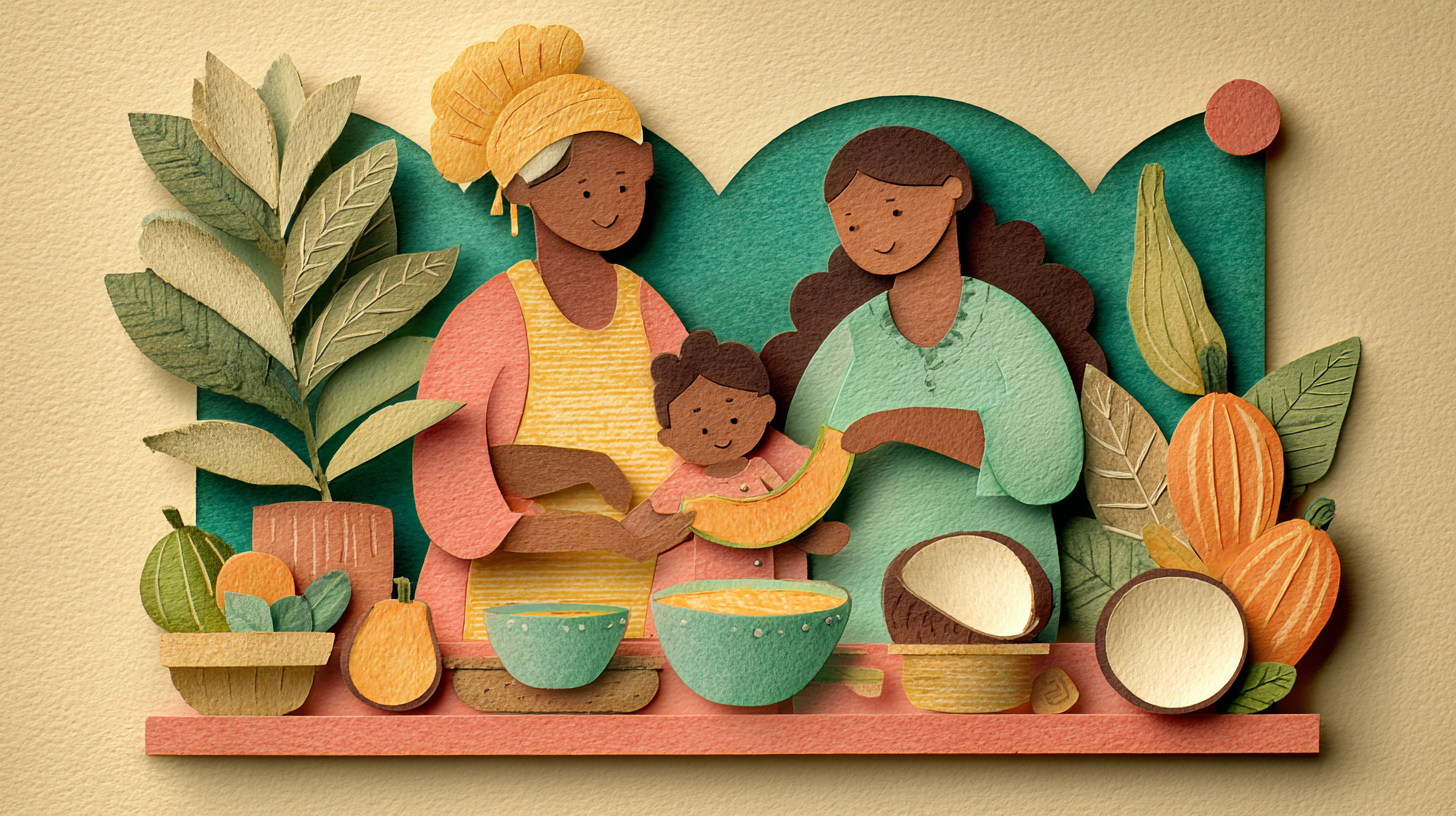
I need to tell you about the Great Callaloo Crisis of my daughter’s first year, because it taught me everything I now know about navigating these waters.
My mother—born in Trinidad, raised on her grandmother’s cast-iron pot cooking—arrived for her first extended visit when my daughter was seven months old. I’d been meticulously following baby-led weaning, introducing single ingredients, watching for reactions, documenting everything in my feeding journal like it was a scientific experiment. I was doing it “right.”
Then one afternoon, I walked into the kitchen to find my mother spooning a glorious, aromatic mixture into my daughter’s mouth. Callaloo. With coconut milk. And a hint of curry. And something that looked suspiciously like tiny pieces of saltfish.
I froze. Part of me wanted to snatch the bowl away. Part of me wanted to cry. Part of me—the part that remembered the taste of that dish from my own childhood—wanted to pull up a chair and join them.
Instead, I said: “Mom, we need to talk.”
What followed wasn’t easy. There were tears—from both of us. My mother felt judged, like I was saying her way of showing love was wrong. I felt dismissed, like my role as my daughter’s parent didn’t matter in the face of grandmotherly authority. We were both right. We were both wrong.
The breakthrough came when I stopped talking about what she couldn’t do and started asking questions. “Mom, why is callaloo important to you for her to try?” And she told me: because it connected four generations of women in our family. Because her grandmother had made it for her mother, who made it for her, and she needed to make it for my daughter. Because food wasn’t just nutrition—it was memory, identity, continuity.
So we compromised. We created what we called “tradition recipes”—modified versions of family dishes that honored their essence while meeting current safety guidelines. We found a Caribbean baby food recipe book that had baby-safe versions of classics like Callaloo Rundown (page 66), Coconut Rice and Red Peas (page 62), and Sweet Potato Plantain Mash. My mother adapted her recipes. I relaxed my rigid timeline. My daughter got the best of both worlds.
That conversation changed everything. Not just the feeding dynamics, but our entire relationship. Because once we stopped seeing each other as adversaries and started seeing each other as collaborative caregivers with the same goal, the path forward became clear.
✨ Reflection Moment: Your Story
Think about your own family feeding challenges. Select the statement that resonates most:
The Flashpoints: Common Conflicts and How to Navigate Them
Let’s get specific. Here are the most common feeding conflicts families face, based on both research and lived experience—along with diplomatic solutions that preserve relationships while protecting your child’s health.
Flashpoint #1: The Treat Parade
The Scenario: Every time grandparents visit or babysit, treats appear—ice cream, candy, sweetened juice, coconut drops, sugar cake. When you object, you hear: “It’s just a little treat!” or “One won’t hurt!” or the devastating: “You’re taking all the joy out of childhood.”
Why It Happens: For many grandparents, treats represent special occasions, love, and the luxury of indulgence they couldn’t always provide their own children. Denying treats feels like denying joy.
The Diplomatic Solution: Create a “Treat Framework” together. Acknowledge that treats have a place, then collaborate on what, when, and how much. Example: “You’re right that treats bring joy! Let’s plan one special grandparent treat each visit—what if you choose a fruit-based option like mango sorbet or papaya smoothie? That way she gets something special from you, and we’re building healthy taste preferences.”
The Script: “Mom, I love that you want to make special memories with treats. Can we create a tradition where your special treat is [specific healthy option]? That way, when she’s older and thinks of you, she’ll associate you with that specific thing—it becomes YOUR tradition together.”
Flashpoint #2: Clean Plate Club
The Scenario: Grandparents encourage (or pressure) your child to finish everything on their plate, even when baby shows fullness cues. You hear: “Just two more bites” or “You can’t waste food” or “You need to eat more to grow big and strong.”
Why It Happens: Many grandparents grew up in times of scarcity where wasting food was genuinely problematic. They equate eating everything with respect, gratitude, and good parenting.
The Diplomatic Solution: Educate about responsive feeding and offer alternative ways to show respect. Share that current pediatric guidance focuses on teaching children to recognize their own fullness cues—a skill that prevents overeating and obesity later in life.
The Script: “Dad, I know wasting food feels wrong—it does to me too. But our pediatrician explained that forcing kids to override their ‘I’m full’ signals actually teaches them to ignore their body, which can cause weight problems later. Can we teach gratitude differently—like having her help compost scraps or talking about where food comes from?”
Flashpoint #3: Traditional Foods Too Early
The Scenario: Grandparents want to introduce traditional dishes—curry, heavily seasoned rice, soups with adult ingredients—before you feel baby is ready. You hear: “We ate this young and turned out fine” or “You’re making feeding too complicated.”
Why It Happens: Traditional foods are identity. Delaying them can feel like rejection of culture, heritage, and family history.
The Diplomatic Solution: Embrace the spirit, modify the execution. Use resources like the Caribbean Baby Food Recipe Book to show that traditional flavors can be introduced in age-appropriate ways.
The Script: “Mom, I want her to grow up loving our foods! Can we introduce them in stages? Let’s start with the baby-safe version of your curry recipe (low sodium, mild spice, appropriate texture), and as she grows, we’ll gradually introduce the full-flavor version. That way she’s learning the tastes now, and you’re teaching her—just adapted for her age.”
Flashpoint #4: Undermining Meal Routines
The Scenario: You’ve established meal and snack times, but grandparents offer food constantly—crackers, fruit, juice—disrupting your child’s appetite for actual meals. You hear: “He said he was hungry!” or “What’s the harm?”
Why It Happens: Responding immediately to hunger requests feels nurturing and attentive. Scheduled feeding can seem rigid or cold to grandparents.
The Diplomatic Solution: Explain the developmental reason for meal timing: consistent schedules help children learn hunger and fullness cues, prevent grazing, and ensure adequate nutrition at mealtimes.
The Script: “I know it seems strict, but here’s what we’ve learned: when kids graze all day, they don’t develop proper hunger signals, and they don’t eat well at meals. Could we stick to our snack times (10am and 3pm), but you choose what healthy snacks to offer? That gives you special input while helping her learn to eat well at meals.”
Building Your Feeding Diplomacy Toolkit
Theory is helpful, but what you really need are practical tools you can implement tomorrow. Here’s your comprehensive toolkit for transforming feeding friction into family collaboration.
Tool #1: The Family Feeding Playbook
Create a one-page visual document that outlines your feeding approach. Include: approved foods, off-limits foods (with reasons), meal and snack timing, portion guidance, and how to respond to feeding challenges. Crucially, create this WITH grandparents, not FOR them. When they have input, they have ownership. Review it together every few months as baby’s needs change. Post it prominently in the kitchen, save a photo on phones, and refer to it as “our plan” not “my rules.”
Tool #2: Tradition Translation Sessions
Set aside time to cook together, translating beloved family recipes into baby-appropriate versions. Use the Caribbean Baby Food Recipe Book as your guide—it contains over 75 heritage recipes specifically adapted for babies 6+ months, including classics like Plantain Paradise, Sweet Potato Callaloo Rundown, Coconut Rice with Red Peas, Pumpkin Coconut Milk Mash, and Baigan Choka Smooth. Show grandparents that honoring tradition doesn’t mean serving identical preparation—it means introducing flavors, teaching techniques, and building food memories that connect generations.
Tool #3: The Unified Front Agreement
Establish this principle: disagreements happen privately, but in front of baby, all caregivers present a united front. If grandparent offers something you don’t want baby to have, you say: “Thanks, Mom, but not right now.” Later, privately: “Here’s why I said no, and here’s how we can handle similar situations going forward.” This prevents baby from learning to manipulate differences between caregivers while preserving everyone’s dignity.
Tool #4: The Three-Tier Boundary System
Not all feeding decisions carry equal weight. Create three categories:
- Non-Negotiables (Red Zone): True safety issues—allergens, choking hazards, food temperature, basic hygiene. These have no flexibility. Violation means loss of unsupervised feeding time.
- Strong Preferences (Yellow Zone): Things you care about but can occasionally flex on—exact portion sizes, specific vegetables, whether dessert happens after dinner or as afternoon snack. These can be grandparent’s choice sometimes.
- Flexible Territory (Green Zone): Things that truly don’t matter in the long run—which plate is used, whether bib matches outfit, food order, whether grandparent feeds or baby self-feeds. Let these go.
Communicating which zone each issue falls into prevents every feeding decision from feeling like a battle.
Tool #5: The Professional Authority Card
Sometimes, the message lands better from a neutral third party. Invite grandparents to join a pediatrician appointment specifically to discuss feeding. Prepare the doctor ahead of time about your concerns. Most pediatricians are skilled at presenting guidance in ways that honor grandparent experience while establishing current best practices. After the appointment, you’re all on the same team, following the same expert advice.
Tool #6: Gratitude Rituals
This is the secret ingredient everyone forgets: regularly acknowledge what’s working. “Mom, thank you for sticking to the snack schedule today—I noticed, and it really helps.” “Dad, the way you encouraged her to try new vegetables was perfect—you’re so good at making food fun.” Positive reinforcement works on grandparents just as it works on toddlers. What gets acknowledged gets repeated.
️ Tool Selection Guide
Based on your situation, which tool should you implement first? Select your primary challenge:
When Communication Breaks Down: Tough Love Strategies
Let’s address the elephant in the room: what do you do when grandparents repeatedly violate boundaries despite clear communication? When sneaking treats continues, when allergy protocols are ignored, when your feeding decisions are openly mocked or dismissed?
First, acknowledge that this is genuinely difficult. These aren’t strangers or acquaintances—these are people you love, who love your child, whose opinions matter to you. Setting hard boundaries with parents or in-laws activates guilt, fear of damaged relationships, and worry about depriving your child of grandparent relationships.
But here’s the truth you need to hear: consistently violated boundaries aren’t really boundaries—they’re suggestions. And when your child’s health, safety, or your authority as a parent is at stake, suggestions aren’t sufficient.
Progressive Consequence Framework:
Level 1 – Clear Restatement: “Mom, I’ve noticed [specific behavior] continuing despite our conversation. I need you to understand this isn’t negotiable. When [boundary violation happens], it [specific consequence—undermines my parenting, risks allergic reaction, confuses baby about food rules]. I need your commitment to follow our agreement.”
Level 2 – Supervised Feeding Only: “Because [boundary] hasn’t been respected, I’m not comfortable with unsupervised feeding time right now. You’re still absolutely welcome for visits and time together, but I need to be present during meals and snacks until we rebuild trust. This isn’t punishment—it’s protection.”
Level 3 – Reduced Contact: This is the last resort, reserved for situations where grandparent behavior genuinely endangers baby (allergen exposure, extreme overfeeding, completely undermining feeding therapy or medical protocols). “This is incredibly hard for me to say, but until you can respect these boundaries, we need to limit visits. I love you, baby loves you, but I cannot compromise on her safety/health. When you’re ready to commit to following our guidelines, I’m ready to welcome you back fully.”
These conversations are gut-wrenching. Many parents avoid them entirely, choosing to manage the ongoing tension rather than risk the confrontation. But consider the long-term costs: chronic stress, parental burnout, confused children receiving mixed messages about food and authority, potential health consequences, and resentment that erodes family relationships anyway.
The families who successfully navigate serious boundary violations share one characteristic: they’re willing to endure short-term discomfort for long-term relationship health. The period after setting firm boundaries is often tense, sometimes involving tears, angry calls, or temporary estrangement. But almost universally, when boundaries are maintained with love but without compromise, grandparents adjust. They realize the boundaries aren’t going away. They value the relationship more than the battle. And they learn new ways to express love that respect parental authority.
The Beautiful Side: When Grandparents Become Your Greatest Allies
It would be easy to conclude from all this discussion that grandparent involvement in feeding is inherently problematic. But that’s not the full story—not by a long shot.
When grandparents and parents successfully align their feeding approaches, the benefits are extraordinary. Children who grow up with engaged grandparents show stronger connections to cultural identity, more adventurous eating, richer food vocabulary, and deeper family bonds. Grandparents who feel trusted and respected become fierce advocates for healthy eating—often more effective than parents at encouraging vegetable consumption, introducing new foods, and modeling positive mealtime behavior.
Research shows that grandparent-grandchild cooking time specifically correlates with better dietary quality, increased fruit and vegetable consumption, and more positive attitudes toward family meals. The magic happens when grandparents aren’t fighting parental guidelines but collaborating within them—teaching family recipes in baby-appropriate ways, sharing food stories and traditions, and creating food memories that last lifetimes.
I’ve watched my own mother transform from the callaloo-sneaking grandmother to my daughter’s primary food culture educator. She’s the one who teaches the names of Caribbean vegetables at the market. She’s the one who tells stories about great-grandmother’s kitchen while stirring pumpkin coconut milk for baby. She’s the one who insisted we include sorrel and ginger in our holiday meal planning, then worked with me to create a baby-safe version my daughter could enjoy alongside the adults.
That transformation didn’t happen overnight, and it didn’t happen without uncomfortable conversations, tears, and boundary-setting. But the payoff? My daughter is growing up fluent in her food heritage, confident with Caribbean flavors, and connected to four generations of women through food. That’s invaluable.
For families looking to build this kind of collaborative feeding relationship, resources matter. The Caribbean Baby Food Recipe Book: Easy & Healthy Homemade Meals for Infants & Toddlers has become our shared language—grandparents can flip through and see that their heritage foods aren’t being rejected, just adapted. Recipes like Sweet Potato Callaloo Rundown (page 66), Coconut Rice with Red Peas (page 62), Plantain Paradise, and Pumpkin Coconut Milk Mash show that tradition and health aren’t opposites—they’re partners.
Envisioning Success
Imagine your ideal feeding relationship with grandparents. What does it look like? Select the vision that resonates most:
Looking Forward: The Long Game
Here’s something nobody tells you in the middle of these feeding conflicts: this phase is temporary, but the relationship dynamics you’re establishing right now will echo through decades.
Your baby will eventually eat adult foods, make their own food choices, and develop their own relationships with grandparents that don’t require your mediation. But the patterns you establish now—how you handle disagreements, whether you prioritize relationship or control, how you blend respect for elders with your parental authority—these patterns will shape family interactions long after anyone cares about baby food portions.
Ten years from now, your child won’t remember whether Grandma gave an extra cookie at 18 months. But they will remember whether family meals felt tense or joyful. They’ll internalize whether disagreements meant disconnection or whether different opinions could coexist with love. They’ll learn their relationship blueprint from watching how you and grandparents navigate difference.
This perspective doesn’t mean abandoning boundaries or accepting behavior that genuinely endangers your child. It means choosing your battles with wisdom, communicating with compassion even when frustrated, and always keeping the long view in mind.
Research on intergenerational family relationships consistently shows that families who successfully navigate early parenting disagreements—whether about feeding, discipline, or child-rearing philosophy—develop stronger, more resilient relationships that weather later challenges more effectively. The skill you’re developing right now—advocating for your child while honoring your elders, setting boundaries while maintaining connection—is one of life’s most valuable capabilities.
And here’s the beautiful twist: many parents report that as their children grow, grandparents who initially resisted feeding guidelines become the biggest advocates for those very same principles with future grandchildren. Once they see the outcomes—healthy kids with positive food relationships, family meals without conflict, children who appreciate both heritage and health—they become converts. Your patience now is teaching tomorrow’s grandparenting.
Your Action Plan: Next Steps
Reading about feeding diplomacy is valuable. Implementing it is transformative. Here’s your concrete action plan for the next 30 days:
Week 1 – Assessment and Communication:
- Schedule a conversation with grandparents specifically about feeding (don’t ambush this discussion during a visit)
- Complete your Family Feeding Playbook draft, including input from your partner
- Identify your personal Red/Yellow/Green zones
- Write down 2-3 specific behaviors you need to address and 2-3 things grandparents are doing well that you want to acknowledge
Week 2 – Collaborative Planning:
- Meet with grandparents to review the Feeding Playbook together—incorporate their input where possible
- Schedule a Tradition Translation cooking session
- If using resources like the Caribbean Baby Food Recipe Book, review it together and mark recipes grandparents are excited to try
- Establish the Unified Front Agreement
Week 3 – Implementation and Observation:
- Post the Feeding Playbook in visible location
- Allow grandparents to care for baby during mealtime while you observe (without micromanaging)
- Note what’s working and what needs clarification
- Practice your response scripts for common scenarios
Week 4 – Adjustment and Appreciation:
- Have a check-in conversation: “What’s working well? What feels challenging? What needs to change?”
- Adjust guidelines based on feedback where appropriate
- Explicitly acknowledge improvements and collaborative efforts
- Plan your next Tradition Translation session
This isn’t a magic fix—relationships are messy, and family dynamics rarely follow neat timelines. But families who invest this intentional effort almost universally report significant improvements in feeding harmony, reduced stress, and stronger grandparent-grandchild bonds.
Commitment Builder
What’s the ONE action you commit to taking this week? Choose your starting point:
The Table We’re Really Setting
We’ve talked about treats and boundaries, tradition and nutrition, conflict and compromise. But underneath all of this—beneath every feeding guideline and family disagreement—is something much more profound.
We’re not just teaching children how to eat. We’re teaching them how to belong. How to navigate difference. How to honor the past while creating the future. How to receive love even when it comes wrapped in ways we didn’t expect.
Every time you set a gentle boundary with a grandparent, you’re modeling for your child that love and limits can coexist. Every time you find creative compromise on traditional foods, you’re showing them that heritage and health aren’t enemies

Kelley's culinary creations are a fusion of her Caribbean roots and modern nutritional science, resulting in baby-friendly dishes that are both developmentally appropriate and bursting with flavor. Her expertise in oral motor development and texture progression ensures that every recipe supports your little one's feeding milestones while honoring cultural traditions.
Join Kelley on her flavorful journey as she shares treasured family recipes adapted for tiny taste buds, evidence-based feeding guidance, insightful parenting anecdotes, and the joy of celebrating food, culture, and motherhood. Get ready to immerse yourself in the captivating world of Kelley Black and unlock the vibrant flavors of the Caribbean for your growing baby, one nutritious bite at a time.
- When Love Meets the Dinner Table: Navigating Grandparent Feeding with Grace & Grit - September 16, 2026
- Co-Parenting Across Households: How to Keep Feeding Your Child Consistent (Even When Life Isn’t) - September 15, 2026
- Feeding and Your Relationship: How to Protect Your Partnership When Mealtimes Feel Like a War Zone - September 14, 2026