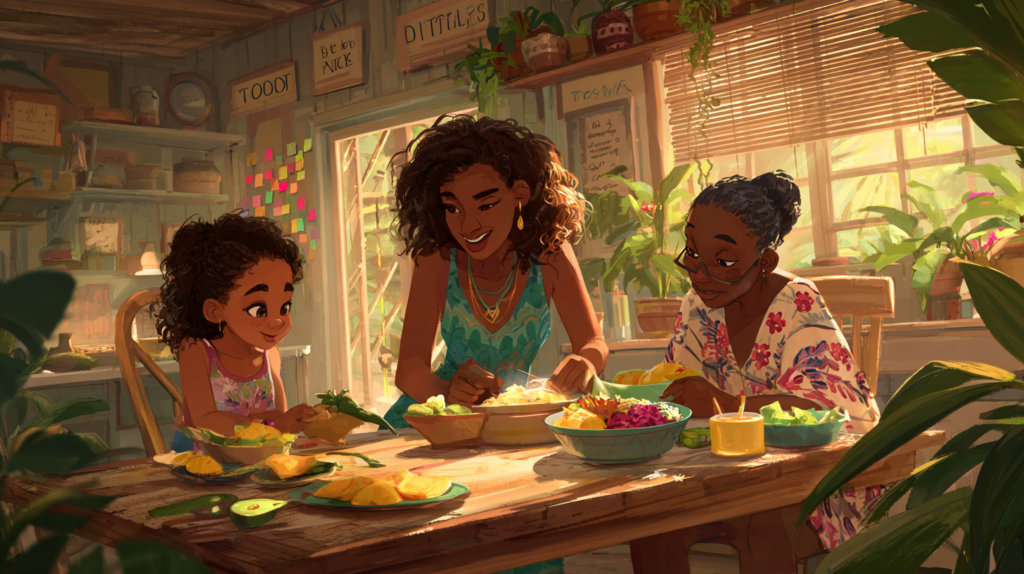
Your Feeding Legacy: What Values Are You Passing Down?
️ Tap to Reveal
What hidden food belief are you unknowingly passing to your child?
(Click or tap this card)
The Truth About Food Legacy
Every comment about “good” foods, every cleaned plate rule, every weight worry you voice becomes part of your child’s internal compass. You’re not just feeding them meals—you’re shaping how they’ll think about food for decades.
Here’s something that kept me awake one night after my daughter turned down her favorite mango slices: I realized she was watching me push vegetables around my plate while praising her for eating hers. I was teaching her that food rules apply differently to adults—that somewhere along the way, eating becomes complicated, stressful, a thing to control rather than enjoy.
That moment hit me like a ripe breadfruit falling from a tree. I was passing down the same anxious relationship with food that my grandmother passed to my mother, who passed it to me. The legacy wasn’t intentional, but it was real. And right then, I decided it would stop with me.
If you grew up hearing “clean your plate,” “sugar is poison,” or constant talk about diets and body size, you inherited a feeding legacy whether you wanted one or not. Research now shows that roughly 22% of children and adolescents globally display disordered eating behaviors, and parental feeding practices are one of the most significant modifiable risk factors. When parents diet, children are significantly more likely to diet too—and severe dieting in adolescence dramatically increases the risk of developing clinical eating disorders later in life.
But here’s the powerful truth that changed everything for me: you get to choose what you keep and what you release. You’re not trapped by what you inherited. Every single meal, every conversation about bodies, every food decision is an opportunity to consciously create a new legacy—one rooted in freedom, nourishment, and joy rather than fear, restriction, and shame.
The Invisible Inheritance: What We Don’t Realize We’re Teaching
A feeding legacy isn’t just about what you put on the plate. It’s the complete package of beliefs, emotions, rules, and rituals around food that travel from generation to generation, often without anyone noticing. It includes the explicit things—”No dessert unless you finish your vegetables”—and the subtle things—the way your face tightens when your child asks for a second helping, or how you casually mention you’re “being good” by skipping carbs.
Children are magnificent observers. They notice everything. When you sigh about your body in the mirror, label foods as “junk,” or celebrate weight loss, they’re downloading that information into their developing belief systems. Studies tracking children from early childhood into adolescence found that nonresponsive feeding practices—like high pressure to eat, excessive control, or ignoring children’s hunger and fullness cues—were prospectively associated with eating disorder symptoms and disordered eating behaviors years later.
Think about the messages that traveled to you. Maybe you learned that certain bodies are more valuable than others. Perhaps you absorbed the idea that hunger is something to ignore or override. You might have internalized that eating is about rules and willpower rather than nourishment and pleasure. These aren’t malicious teachings—most of our parents and grandparents genuinely believed they were helping us develop discipline or avoid health problems. But intention doesn’t change impact.
Here’s what shocked me when I started researching: about 35% of mothers and 17% of fathers engage in weight-control dieting, and parental dieting significantly increases the odds that children will also diet. Even more concerning, mothers with histories of eating disorders often describe intense anxiety about “passing it on,” feeling trapped between their own struggles and the desire to protect their children from the same pain.
The legacy also includes positive elements worth keeping. Maybe your family celebrated food as connection, gathered around the table for lively conversations, or honored traditional recipes that linked you to your culture and ancestors. Perhaps you learned that trying new flavors is an adventure, or that cooking for loved ones is an act of care. The work isn’t about rejecting everything—it’s about becoming conscious enough to choose.
The Research That Changes Everything
If you’re wondering whether this really matters, whether you can actually change generational patterns, the science is remarkably clear: you absolutely can, and it matters more than almost anything else you’ll do as a parent.
Large systematic reviews and meta-analyses consistently show that family feeding practices shape not just what children eat, but how they relate to food, their bodies, and themselves for life. Parental feeding behaviors—things like restriction, pressure to eat, using food as reward or punishment, and modeling diet behaviors—are among the strongest predictors of later eating disorder risk, body dissatisfaction, and problematic eating patterns.
But the flip side is equally powerful: responsive, attuned feeding practices protect children. When parents offer regular meals and snacks in a predictable structure while allowing children to listen to their own hunger and fullness cues, when they model balanced eating without moralizing food choices, when they create pleasant family mealtimes focused on connection rather than control, children develop healthier relationships with food and more stable emotional well-being.
What’s Your Default Feeding Response?
Choose the scenario that most closely matches your instinct:
The research on family meals alone is stunning. Multiple meta-analyses have found that more frequent family meals are associated with better diet quality, lower rates of obesity, reduced disordered eating, and better mental health outcomes in children and adolescents. One recent analysis noted that regular family meals are linked to lower rates of depression, anxiety, substance use, and eating disorders—not because of what’s being eaten, but because of the psychosocial benefits of connection, routine, and feeling valued.
What makes this even more relevant for cycle-breaking parents is the growing body of work on intergenerational transmission. Qualitative research with mothers who have eating disorders reveals the intense emotional complexity of trying to feed children differently than you feed yourself—the guilt, the hypervigilance, the fear of modeling harmful behaviors while simultaneously struggling with them. These mothers describe feeling like they’re “faking it” at mealtimes, performing food neutrality they don’t feel, desperately trying to shield their children from patterns they can’t quite escape themselves.
But here’s the hope embedded in that research: awareness is the first step. The very fact that you’re reading this, thinking critically about your feeding legacy, asking hard questions about what you want to keep and what you want to change—that itself is breaking the cycle. Your children don’t need perfection. They need your willingness to do things differently, to question inherited rules, to prioritize their relationship with food over outdated expectations.
Identifying What You Inherited
Before you can choose what to keep or release, you need to see what you’re carrying. This is the hardest part for many parents—getting honest about the food beliefs you absorbed, especially when they came from people you love who were doing their best with the information and resources they had.
Start by noticing your automatic thoughts around food. When your child asks for something sweet, what’s your immediate internal reaction? When they leave food on their plate, what story runs through your mind? When you’re packing their lunch or planning dinner, what invisible rules are you following? These automatic responses are clues to your inherited legacy.
Sort Your Food Values: Keep or Change?
Tap each value once to mark as KEEP (green), twice for CHANGE (red), three times to reset.
Your Sorting Results:
Common inherited beliefs include body-size hierarchy (smaller bodies are better, weight gain is failure), food morality (clean eating is virtuous, indulgence is weakness), external authority (ignore your body’s signals, follow the rules instead), scarcity mentality (eat it all now because it might not be available later), and performance eating (food is fuel for achievement, not pleasure).
Caribbean families often carry additional specific legacies—the importance of feeding children “properly” with traditional ground provisions, the belief that a chubby baby is a healthy baby, the practice of encouraging children to eat past fullness as a sign of good manners or gratitude, or the opposite: restriction of certain foods due to colonialism’s influence on what was considered “proper” or “civilized” eating.
Write down the food rules you remember from childhood. Not to judge your family, but to see them clearly. “Always eat breakfast.” “No snacking before meals.” “Vegetables first, then protein, then carbs.” “Don’t eat after 7 PM.” “Boys need bigger portions.” “Girls should watch their figures.” Some of these might be neutral or even helpful. Others might be rooted in diet culture, fear, or outdated nutritional science.

Notice what emotions come up when you imagine breaking these rules with your own children. If the thought of letting your child have dessert before dinner fills you with panic, that’s information. If you feel guilty when your toddler doesn’t finish their plantain, that’s a clue. Our emotional reactions often point directly to the deepest parts of our legacy—the beliefs we hold not just intellectually, but viscerally.
This detective work isn’t about blame. Your parents, grandparents, and ancestors were navigating their own contexts—poverty, food insecurity, beauty standards, health scares, cultural pressures. They passed down what they knew. Now you get to examine it, honor what serves your family, and release what doesn’t.
Choosing What to Keep: The Good Stuff Worth Protecting
Not everything you inherited needs to change. In fact, some of the most powerful, protective feeding practices might already be part of your family’s legacy—they’ve just been buried under layers of diet culture and anxiety.
Family meals, for instance, are worth their weight in gold. If you grew up gathering around the table regularly, hearing stories, sharing your day, and experiencing food as connection rather than transaction, that’s a legacy to treasure and continue. Research consistently shows that regular family meals—even just a few times a week—are associated with better nutrition, stronger family bonds, improved academic performance, and significantly lower risk of eating disorders and substance abuse.
Cultural food traditions are another treasure. The recipes that connect you to your heritage, the cooking techniques passed down through generations, the seasonal celebrations and special-occasion foods—these create identity, belonging, and food joy. When you make your grandmother’s coconut rice and peas or your father’s perfect ackee and saltfish, you’re giving your children roots and showing them that food is about culture, memory, and love, not just nutrients and rules.
If your family taught you that trying new foods is an adventure, that cooking is a creative act, that sharing food builds community, that seasonal produce tastes better, or that meals are worth taking time over—these are all values worth keeping. They align beautifully with evidence-based responsive feeding and intuitive eating principles while honoring your family’s wisdom.
The principle of offering structured meals and snacks is also worth keeping, though maybe not in the rigid way you experienced it. Children genuinely do better with predictable eating times—not because they need external control, but because routine helps them tune into their hunger patterns and trust that food will come regularly. The shift is from “you must eat at this time” to “food is reliably available at these times, and you decide how much your body needs.”
Even some rules that seem outdated might contain kernels of wisdom worth adapting. “Don’t waste food” can evolve from forcing plate-cleaning to teaching respect for resources, involving children in portion decisions, and saving leftovers. “Vegetables are important” can shift from “eat your vegetables or no dessert” to modeling enjoyment of vegetables, offering them in various preparations, and trusting that children will learn to eat them when they’re not framed as a punishment standing between them and pleasure.
The key is separating the principle from the method. Your family might have been right that certain values matter—nourishment, togetherness, gratitude, cultural connection—but wrong about the tactics for teaching them. You get to keep the values and update the approach.
Releasing What No Longer Serves: The Courageous Work of Letting Go
This is where the real cycle-breaking happens, and it’s harder than it sounds. Releasing inherited beliefs often feels like betraying the people who taught them to you, even when you intellectually know those beliefs are harmful.
Transform Your Food Rules
Select an old rule to see its new, evidence-based transformation:
The beliefs most worth releasing are those rooted in diet culture, weight stigma, and external control. “Clean your plate” teaches children to override their fullness cues, disconnecting them from their body’s wisdom and setting them up for overeating and guilt later in life. Research clearly shows that pressuring children to eat more than they want is associated with lower self-regulation and higher eating disorder risk.
“Earn your dessert” or using food as reward and punishment creates a hierarchy of foods that makes restricted items even more desirable while framing eating as a moral act rather than a biological one. Children who are restricted from certain foods often develop preoccupation with those foods and are more likely to overeat them when given access. The evidence supports offering all foods—including sweets and treats—as part of regular meals and snacks without moral judgment.
Body talk—commenting on your child’s size, praising weight loss, expressing concern about weight gain, comparing siblings’ bodies, or criticizing your own body in front of children—is another practice worth releasing entirely. Children whose parents engage in weight-focused talk are significantly more likely to diet, develop body dissatisfaction, and experience eating disorder symptoms. Your child’s body is not a problem to solve or a project to manage. It’s their home, and your job is to help them live in it peacefully.
The belief that you know better than your child how much they need to eat also needs examination. Obviously, you’re responsible for what foods are offered, when, and where—that’s your job as the parent. But the amount they eat? That’s their domain. Pushing food, restricting intake, or monitoring every bite teaches children that their hunger and fullness signals are unreliable, that eating is about pleasing others rather than nourishing themselves. Responsive feeding means trusting children to regulate their intake within the structure you provide.
For many Caribbean and immigrant families, there’s an additional layer: releasing the scarcity-driven patterns that made sense in contexts of genuine food insecurity or poverty but no longer serve in contexts of abundance. If your grandparents survived lean times by eating everything available and encouraging children to do the same, that was adaptive then. Now, if you have reliable food access, teaching children to eat past fullness “just in case” creates different problems. You can honor the wisdom of the past while adapting to present reality.
Letting go of these patterns can bring up grief. You might mourn the idea that your parents got it wrong, or feel guilty for not continuing what they worked so hard to teach you. That’s normal and okay. You can simultaneously honor their intentions and choose differently for your children. Both things can be true.
The Social Media Reality: What the Experts and Real Parents Are Saying
If you’ve spent any time on parenting corners of social media, you’ve probably encountered the growing community of “cycle-breaking” parents, pediatric dietitians, and anti-diet advocates who are fundamentally reshaping conversations about feeding children. This movement is particularly strong on platforms like Instagram and TikTok, where registered dietitians, therapists, and parents openly discuss healing their relationships with food while raising the next generation differently.
Common themes in this space include calling out harmful “food rules” passed down through generations, critiquing diet culture’s infiltration of pediatric health advice, modeling body respect and food neutrality, and sharing vulnerable stories about unlearning restriction and relearning to eat intuitively. These voices emphasize that you can provide structure and nutrition without control and fear, and that children are born with reliable hunger and fullness cues that diet culture tries to override.
The conversations aren’t without tension. Some parents worry that “food neutrality” means abandoning nutrition guidance entirely, or that honoring children’s autonomy means letting them eat unlimited candy. These concerns are usually addressed by clarifying the division of responsibility: parents decide what foods are offered, when, and where; children decide whether to eat and how much. This framework allows you to provide nutritious options, set appropriate boundaries (like offering sweets as part of meals rather than unlimited all-day access), and still respect children’s ability to self-regulate.
Expert voices in this space—including those trained in intuitive eating, Health At Every Size, and pediatric feeding—stress that the goal isn’t perfect eating, but a peaceful relationship with food. They point to research showing that restriction and control backfire, that food preoccupation often results from not allowing enough access, and that children who are trusted to listen to their bodies generally balance their intake over time without external pressure.
Real parents share both struggles and wins: the discomfort of watching a child eat “only” bread at dinner while trusting they’ll eat more variety tomorrow, the freedom of not battling over vegetables anymore, the emotional work of unpacking why their child asking for seconds triggers panic, and the joy of seeing children eat without anxiety or performance. These stories matter because they show that change is possible, messy, and worth it.
There’s also recognition that this work is harder for parents who are still actively struggling with disordered eating or diet mentality themselves. The advice often includes seeking professional support—therapy, dietitian guidance, or support groups—because you can’t fully pass down food peace if you haven’t found it yourself yet. And that’s okay. Healing alongside your children, even imperfectly, is still breaking the cycle.
Building Your New Legacy: Practical Steps for Conscious Food Parenting
Knowing what to release and what to keep is one thing. Actually implementing a new feeding legacy in your daily life is another. It requires intention, consistency, and a lot of grace for yourself when you slip back into old patterns—which you will, because change is hard and these beliefs run deep.
Your Cycle-Breaking Journey
Track your progress. Tap each milestone as you achieve it:
Start with language. The words you use about food and bodies shape how your children think. Eliminate moral language about eating—no more “being good” by eating salad or “being bad” with dessert. Remove judgment from food descriptions: instead of “junk food” or “unhealthy,” try “everyday foods” and “sometimes foods,” or better yet, just call them what they are: cookies, chips, fruit, rice. Stop commenting on your child’s body entirely, positively or negatively. “You’re so skinny!” and “You’re getting chubby” are equally harmful because both teach that body size is a source of value and scrutiny.
Implement the division of responsibility in feeding, developed by feeding expert Ellyn Satter and supported by decades of research. You decide what food is offered, when meals and snacks happen, and where eating takes place. Your child decides whether to eat from what you’ve offered and how much to eat. This framework respects both your role as the provider and your child’s autonomy as the eater. It eliminates battles because you’re not trying to control their intake—just providing opportunities to eat nourishing food regularly.
Make family meals a priority, even if it’s just breakfast on weekdays or Sunday dinner. The content matters far less than the connection. Put phones away, turn off screens, and focus on each other. Ask about everyone’s day, share stories, laugh together. Model eating a variety of foods without commentary about calories, portions, or your body. Show your children that meals are for nourishment and togetherness, not stress and surveillance.
If you’re working to introduce your child to Caribbean flavors and traditions, the Caribbean Baby Food Recipe Book offers over 75 island-inspired recipes designed for babies and toddlers 6 months and up. These recipes use familiar ingredients like sweet potatoes, plantains, coconut milk, and traditional spices to help you pass down positive food culture—the kind rooted in flavor, heritage, and joy rather than restriction. Introducing these foods early, in a pressure-free way, helps children develop a taste for their cultural cuisine while building food flexibility and openness.
Create neutral access to all foods within reasonable boundaries. This doesn’t mean unlimited candy all day—structure still matters. But it does mean including treats as part of regular meals and snacks, offering a variety of foods without hierarchy, and allowing your child to eat as much or as little as they want from what’s available. When sweets aren’t forbidden or put on a pedestal, they lose their power and children learn to self-regulate around them.
Address your own relationship with food and your body. This is the hardest and most important work. If you’re still dieting, counting calories, exercising to earn food, or criticizing your body, your children are learning those patterns regardless of what you say. Seek support if you need it—therapy, nutrition counseling from a non-diet dietitian, support groups, or books about intuitive eating and body acceptance. Healing yourself is part of breaking the cycle.
Normalize all body sizes and abilities. Read books with diverse characters, avoid making assumptions about health based on appearance, and actively challenge weight stigma when you encounter it. Teach your children that bodies are meant to be different, that health looks different for everyone, and that a person’s worth has nothing to do with their size, shape, or eating habits.
When you mess up—and you will—repair it. If you pressure your child to eat more, catch yourself and say, “Actually, you know your body. You can stop when you’re full.” If you make a negative comment about your body, come back later and say, “I said something unkind about my body earlier. That’s not okay, and I’m working on it.” Children don’t need perfect parents; they need parents who are willing to acknowledge mistakes and keep trying.
Navigating Pushback: When Family and Culture Clash With Your New Approach
One of the biggest challenges cycle-breaking parents face isn’t their own doubts—it’s the pushback from extended family, community members, and cultural expectations. When you choose to feed your children differently than you were fed, people notice. And they often have opinions.
Grandparents might insist on forcing more food, making comments about your child’s size, or sneaking restricted foods as “treats.” Well-meaning aunties might pressure you to put your child on a diet or criticize your permissive approach to sweets. Cultural community members might question whether you’re properly maintaining traditions or raising your child “soft” by not enforcing plate-cleaning.
This requires boundary-setting and sometimes difficult conversations. Start with education when possible: share research about responsive feeding, explain that forcing food teaches children to ignore their fullness cues, or clarify that body diversity is normal and healthy. Many older family members genuinely don’t know that the feeding advice they received is now considered harmful, and providing evidence-based information can shift their perspective.
When education doesn’t work, boundaries do. You might need to say, “I appreciate your concern, but we’re not commenting on the kids’ bodies in our family,” or “I know you were taught to make them clean their plates, but we do things differently now. Please respect our approach.” It’s uncomfortable, especially in cultures that emphasize respect for elders, but protecting your children’s relationship with food is worth the discomfort.
Find your people—other parents who are doing this work, online communities of cycle-breakers, therapists or dietitians who understand. You need support from people who won’t question your decision to offer dessert with dinner or let your child stop eating when they’re full. This work can feel lonely when you’re the only one in your family or community doing it, and connection with like-minded parents provides both validation and practical strategies.
Remember that you can honor cultural food traditions while releasing harmful feeding practices. Making your family’s traditional dishes is beautiful; forcing your child to eat them is not. Celebrating with special-occasion foods maintains connection; restricting everyday foods to prevent weight gain does not. You’re not rejecting your culture by feeding responsively—you’re adapting wisdom to current context and knowledge.
The Long Game: What Your New Legacy Will Look Like
Building a new feeding legacy is a long-term investment with results you won’t see for years, even decades. But the research and the stories of cycle-breaking parents who’ve gone before you paint a clear picture of what’s possible.
Build Your Family Food Culture
Choose a value to see how to implement it in daily life:
Children raised with responsive feeding and food neutrality are more likely to have stable relationships with food, to listen to their hunger and fullness cues throughout life, to enjoy a wide variety of foods without fear or guilt, and to have lower risk of disordered eating and eating disorders. They’re also more likely to have positive body image, to treat their bodies with respect rather than punishment, and to pass these same values to their own children someday.
Your child will remember family meals where they felt seen and heard, not monitored and judged. They’ll remember that food was about nourishment and culture and joy, not rules and restriction. They’ll grow up knowing that their body is trustworthy, that their hunger matters, that eating is a normal, peaceful part of life rather than a source of stress and shame.
They might not consciously realize what you’ve given them until they’re older—until they’re in college and notice that they don’t engage in the dorm-room diet talk, or until they’re adults and realize they don’t attach moral value to their food choices, or until they become parents themselves and naturally feed their own children with the ease and trust you modeled for them.
That’s when your legacy becomes clear: not in the individual meals, but in the fundamental relationship with food and body that underlies every eating experience for the rest of their lives. The freedom to eat when hungry, stop when full, enjoy treats without guilt, nourish their bodies without anxiety, and move through the world in whatever body they have without shame—that’s the inheritance worth giving.
For inspiration on how to bring cultural foods into this framework, the recipes in the Caribbean Baby Food Recipe Book—like Cornmeal Porridge Dreams, Coconut Rice & Red Peas, Sweet Potato & Callaloo Rundown, and Plantain Paradise—show you how to introduce traditional flavors early and often, creating positive associations with your heritage foods. When children grow up eating and enjoying cultural dishes without pressure or restriction, those foods become part of their identity and comfort rather than a battleground or a “should.”
Write Your Legacy, Starting Today
You don’t need to have it all figured out to start. You don’t need to be fully healed from your own food issues. You don’t need your entire family’s buy-in or a perfect plan. You just need to start where you are, with the very next meal, the very next conversation about food or bodies.
What will you do differently today? Maybe it’s pausing before you comment on your child’s appetite. Maybe it’s offering a cookie alongside lunch instead of making them earn it. Maybe it’s catching yourself before criticizing your body in the mirror and choosing silence instead. Maybe it’s cooking one of your grandmother’s recipes and telling your child the story behind it, connecting them to their heritage through food rather than food rules.
Every single choice is a thread in the legacy you’re weaving. Every time you honor your child’s fullness cue instead of pushing one more bite, you’re teaching them to trust themselves. Every time you speak neutrally about food instead of moralizing it, you’re giving them freedom. Every time you model eating with pleasure instead of guilt, you’re showing them that nourishment and joy can coexist.
The legacy you create won’t be perfect. You’ll slip back into old patterns sometimes. You’ll hear your mother’s critical voice come out of your mouth and cringe. You’ll have moments of panic when your child’s eating seems “off” and you’ll want to control it. That’s normal. What matters is that you notice, course-correct, and keep choosing differently.
Your feeding legacy is being written right now, in the ordinary moments of breakfast and snack time and family dinner. In the words you choose and the rules you release and the trust you extend. In your willingness to do the hard, uncomfortable work of questioning what you were taught and choosing something better for your children.
This is how cycles break: one meal, one conversation, one conscious choice at a time. Not perfectly, but persistently. Not because you have all the answers, but because you’re willing to ask better questions. Not because it’s easy, but because the alternative—passing down the same food anxiety and body shame you inherited—is harder.
Your children are watching, learning, absorbing. What they’re inheriting from you isn’t just recipes and food preferences. It’s an entire worldview about nourishment, pleasure, bodies, trust, and worthiness. That’s your feeding legacy. And you, right now, in this moment, get to decide what it will be.
The beautiful truth? You’re already doing it. By questioning, learning, and trying differently, you’ve already begun. The legacy you’re creating—rooted in freedom, respect, cultural connection, and trust—will ripple forward through generations you’ll never meet. And that, that is something worth passing down.

Kelley's culinary creations are a fusion of her Caribbean roots and modern nutritional science, resulting in baby-friendly dishes that are both developmentally appropriate and bursting with flavor. Her expertise in oral motor development and texture progression ensures that every recipe supports your little one's feeding milestones while honoring cultural traditions.
Join Kelley on her flavorful journey as she shares treasured family recipes adapted for tiny taste buds, evidence-based feeding guidance, insightful parenting anecdotes, and the joy of celebrating food, culture, and motherhood. Get ready to immerse yourself in the captivating world of Kelley Black and unlock the vibrant flavors of the Caribbean for your growing baby, one nutritious bite at a time.
- The Feeding Revolution: Why Your Everyday Meals Are Changing the World - October 13, 2026
- Your Feeding Story Matters More Than The “Perfect” One Online - October 12, 2026
- Looking Forward: Stepping Into Your Confident Feeding Future - October 11, 2026