When Your Baby Says “No Thanks” to the Spoon: The Truth Nobody Tells You About Starting Solids
️ What’s Your Baby’s Feeding Personality?
Click to discover your baby’s unique feeding style and get personalized insights!
Three weeks ago, I sat in my kitchen with a bowl of perfectly mashed sweet potato—the same Caribbean-inspired recipe that had been in my family for generations. My six-month-old looked at the approaching spoon like I was offering her a piece of moon rock. Head turned. Lips sealed tighter than a vault. And then came the hand—that tiny, surprisingly strong hand—swatting the spoon away with the force of someone who had made a life-altering decision.
If this sounds familiar, take a breath. Because what I’m about to share with you will flip everything you thought you knew about babies and spoons on its head. Here’s the truth that pediatricians, feeding therapists, and the latest research from 2022-2025 are finally acknowledging: your baby refusing the spoon isn’t a problem to fix—it’s a message to decode.
Between 40-60% of modern families now report using some form of baby-led or mixed feeding approach, and research shows this isn’t just a passing trend. Studies published in 2023 demonstrate that babies who are allowed to guide their own feeding journey—even when that means initially rejecting the spoon—often develop healthier relationships with food long-term. But here’s what gets lost in the social media noise: there’s a massive difference between responsive feeding (following your baby’s cues) and rigid feeding ideologies that leave parents confused and stressed.
The Shocking Science Behind Spoon Refusal
Let’s talk about what’s really happening in your baby’s brain and body when that spoon approaches. The Nordic Nutrition Recommendations 2023 and recent complementary feeding studies reveal something fascinating: babies are biologically wired to want control over what enters their mouths. This isn’t defiance—it’s development.
Around 6 months, infants experience a massive leap in their desire for autonomy. The same hands that have been exploring toys, faces, and everything within reach suddenly realize they can also control food. Traditional spoon-feeding asks babies to be passive recipients, but their developmental stage is screaming for active participation. When we understand this, spoon refusal transforms from a mealtime battle into a developmental milestone.
Here’s where it gets interesting: researchers tracking infant feeding behaviors discovered that babies who show early spoon refusal but are offered alternative self-feeding methods (like pre-loaded spoons or appropriately sized finger foods) actually develop better oral motor skills by 12 months compared to babies who are persistently spoon-fed against their cues. The key isn’t the utensil—it’s the autonomy.
Recent evidence from 2024 feeding studies shows that “responsive feeding”—the practice of reading and respecting your baby’s hunger, fullness, and preference cues—leads to better self-regulation and potentially reduced obesity risk later in childhood. Every time your baby turns away from the spoon, closes their mouth, or reaches for the food themselves, they’re communicating. The question is: are we listening?
What Your Baby Is Actually Telling You
Decode Your Baby’s Feeding Signals
Click on each signal to reveal what your baby might really be saying:
Head Turning & Mouth Clamping
✋ Hand Batting & Grabbing
Opening for Food But Refusing Spoon
Tongue Thrusting
Understanding these signals is game-changing because it shifts the entire dynamic. You’re no longer in a power struggle with a stubborn baby—you’re partnering with a communicative human who has preferences and developmental needs that deserve respect.
The American Academy of Pediatrics updated their 2023 infant feeding guidance to emphasize exactly this: “Using their hands and trying to use a spoon are important parts of how a baby learns to self-feed and regulate how much they eat.” Notice they said “trying to use”—not being spoon-fed passively. This distinction matters enormously.
The Mixed Method Revolution (And Why It Changes Everything)
Here’s what nobody tells you when you’re drowning in conflicting feeding advice: you don’t have to choose a camp. The latest randomized clinical trials from 2022 examining complementary feeding methods found that mixed approaches—combining responsive spoon-feeding with baby-led elements—achieved the highest adherence rates at 72%, compared to just 29% for strict baby-led weaning.
What does this look like in real life? Let me paint you a picture from my own kitchen yesterday. I had made a batch of coconut rice with red peas from my Caribbean Baby Food Recipe Book—soft, aromatic, and mashed to the perfect texture for little mouths. Instead of choosing between “spoon-feeding” or “baby-led weaning,” I did both.
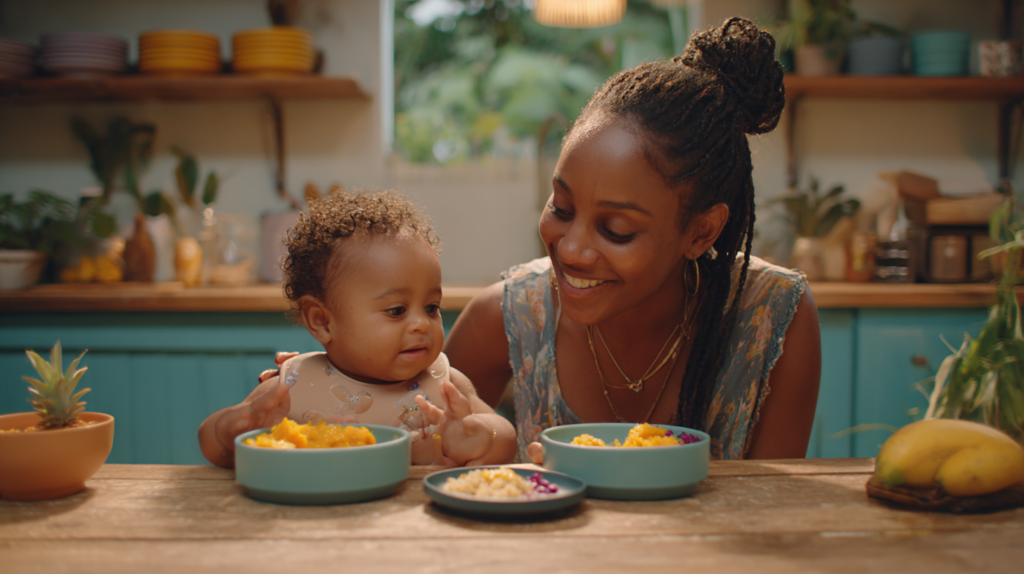
I placed small mounds of the rice mixture directly on her tray. She grabbed handfuls, squished them, brought some to her mouth. Meanwhile, I loaded a baby-safe spoon and placed it on her tray. She picked it up, waved it around, and eventually brought it to her mouth with my gentle hand-over-hand guidance. Some food made it in. Most ended up in her hair and the floor. And that was perfect.
This is what researchers call “baby-led feeding” (distinct from the more rigid “baby-led weaning”)—an approach that emerged in 2024-2025 literature emphasizing responsive, infant-paced feeding using whatever combination of methods works for your family. The focus isn’t on the tool or the texture—it’s on the relationship and the child’s autonomy within appropriate safety boundaries.
Your Personalized Feeding Strategy Builder
Based on current research, select all that apply to your situation:
Readiness Score:
The Pre-Loaded Spoon Method (Your Secret Weapon)
If someone had told me about pre-loaded spoons three weeks earlier, I would have saved myself so much frustration. This technique, validated in multiple 2023-2024 feeding studies, is brilliantly simple: you load the spoon with food and place it within baby’s reach or hand it directly to them. They control when and how it goes into their mouth. You’re facilitating, not forcing.
Gill Rapley, the pioneer behind baby-led weaning concepts, confirmed in a 2018 interview (still widely cited in current practice) that this method absolutely qualifies as responsive, baby-led feeding. “There’s often a perception that baby-led weaning means you never use spoons. That’s absolutely not the case. Babies can spoon feed themselves. They can be given a spoon preloaded with something like yogurt, and then they can manage it.”
The magic is in the control. Your baby decides the pace, the angle, whether they want it right now or in thirty seconds. This respects their autonomy while still ensuring nutrient-dense foods make it toward their mouth (even if the journey is indirect and messy).
Practical tips for pre-loaded spoon success:
Choose the right spoon: Short, chubby handles are easier for little fists to grip. Silicone or soft-tipped spoons are gentler on emerging teeth and delicate gums. Some parents swear by spoons with a slight curve that naturally angle toward baby’s mouth.
Start with sticky foods: Things that cling to the spoon reduce frustration. Think mashed avocado, thick yogurt (after appropriate age introduction), sweet potato mash, or pureed beans. The creamy malanga recipes or plantain paradise mash from Caribbean cooking traditions work beautifully here—they’re naturally sticky and loaded with nutrients.
Expect mess and embrace it: Neuroscience research shows that babies learn through multisensory experiences. The squishing, the smearing, the dropping—it’s all building neural pathways. Put down a splash mat, strip baby to a diaper if it’s warm enough, and let the learning happen.
Offer two spoons: Load one for baby, keep one for yourself. While they’re exploring their spoon, you can occasionally offer bites from yours—but always wait for them to open their mouth willingly. Never force entry. This is where a lot of traditional spoon-feeding goes wrong.
When Baby-Led Makes Sense (And When It Doesn’t)
Here’s What the Research Really Shows:
Baby-Led Works Best When: Your baby shows strong developmental readiness (sitting independently, excellent hand-eye coordination, high interest in food), you have time to supervise every bite closely, you’re comfortable with gagging (which is normal and protective), and you can ensure adequate iron-rich foods are offered since BLW babies sometimes consume less overall volume initially.
Mixed Method Is Better If: You’re nervous about choking risks (though research shows similar rates between methods with proper safety), your baby was premature or has developmental delays that might affect readiness, you have limited time for lengthy, messy meals, or you want the insurance of knowing specific amounts of key nutrients like iron are definitely getting in.
The Real Secret: You can switch between approaches meal to meal, day to day. Breakfast might be finger foods, lunch might include pre-loaded spoons with purees, dinner might be a combination. Babies are adaptable. Rigid adherence to one method is often more about adult ideology than infant need.
Recent observational studies tracking families over the first year of complementary feeding found something fascinating: the families who reported the least stress and the best infant growth outcomes weren’t the ones following a specific method perfectly—they were the flexible ones who adjusted based on their baby’s feedback each day.
Some days your baby might devour finger foods. Other days they might be teething and only want smooth, cool purees from a spoon. Both scenarios are valid. Both are responsive feeding when you’re following their lead rather than a predetermined script.
The Caribbean Advantage: Why Island Flavors Make Spoon Refusal Easier
I’m going to let you in on something that transformed my own feeding journey: traditional Caribbean foods are accidentally perfect for babies navigating spoon refusal. The textures, the natural flavors, the nutrient density—it’s like our grandmothers knew something modern baby food companies are still figuring out.
Take plantain, for example. When ripe and cooked, it’s naturally sweet, soft enough for gums but substantial enough to hold together for self-feeding. It’s loaded with potassium and vitamin A. You can mash it for spoon-feeding or cut it into thick strips for baby-led feeding. The same ingredient works both ways, which means less separate meal prep when you’re already exhausted.
Or consider the provision-based mashes—yam, sweet potato, dasheen, malanga. These root vegetables have a sticky, thick consistency that clings beautifully to pre-loaded spoons while also forming into moldable shapes for little hands. They’re iron-rich (critical for babies 6-12 months), energy-dense, and introduce complex flavors that research suggests may reduce picky eating later.
My Caribbean Baby Food Recipe Book includes over 75 recipes specifically designed for this dual-purpose feeding: every recipe can be served as a puree on a pre-loaded spoon OR formed into age-appropriate finger food shapes. Recipes like Sweet Potato & Callaloo Rundown, Coconut Rice & Red Peas, and Yellow Yam & Carrot Sunshine aren’t just delicious—they’re strategically textured to work with however your baby wants to eat that day.
The use of coconut milk in many Caribbean recipes adds healthy fats that support brain development while creating that creamy, smooth consistency babies often prefer when they DO accept spoon-feeding. The gentle introduction of herbs like thyme, bay leaf, and small amounts of ginger (age-appropriate, of course) builds adventurous palates without overwhelming sensitive taste buds.
Red Flags vs. Normal Variations
⚠️ When to Worry vs. When to Relax: The Expert Checklist
Click each scenario to see expert guidance:
Baby refuses spoon but eagerly grabs and mouths finger foods, shows steady weight gain
Baby refuses ALL foods (spoon and finger), shows distress at mealtimes, poor weight gain or weight loss
Baby gags frequently when trying solid foods but recovers quickly, continues eating
Baby refuses spoon, accepts finger foods but diet is very limited (only 2-3 accepted foods)
Baby coughs, chokes (true choking—silent, distress, inability to breathe), or turns blue during feeding
According to pediatric feeding specialists, only about 2.7-4.4% of children have true pediatric feeding disorders requiring clinical intervention. The vast majority of spoon refusal cases in otherwise healthy, thriving babies are developmental variations that resolve with responsive, flexible feeding approaches.
The key distinguishing factors: Is your baby growing adequately? Are they interested in SOME form of food, even if not the spoon? Can they tolerate a variety of textures even if they have preferences? Do mealtimes feel generally positive (even if messy) rather than distressing for baby?
If you answered yes to these questions, you’re almost certainly dealing with normal development, not pathology. Your job isn’t to force the spoon—it’s to continue offering variety, following your baby’s cues, and trusting the process.
The Next 72 Hours: Your Action Plan
If your baby refused the spoon this morning and you’re reading this feeling overwhelmed, here’s exactly what to do next. I’m breaking this down into practical, research-backed steps you can implement immediately.
Today (Next 4 hours): Observe without intervention. At the next meal or snack opportunity, simply watch. What does your baby reach for? Do they show interest in your food? Can they bring objects to their mouth with reasonable accuracy? Are they sitting supported? These observations tell you if your baby is developmentally ready for self-feeding approaches or if you might need to slow down and wait another week or two.
Tomorrow Morning: Set up for success. Choose ONE meal to try a new approach—breakfast is often ideal because babies are well-rested and more patient. Prepare a food with dual-texture potential. If you’re trying Caribbean flavors, something like mashed ripe plantain or sweet potato puree works perfectly. Place small amounts directly on the tray (about the size of your thumb). Load a baby-safe spoon and place it within reach. Have a second spoon ready for yourself but WAIT for baby to signal openness (leaning forward, opening mouth, reaching) before offering bites.
Days 2-3: Repeat and adjust. Try the mixed approach for at least two meals per day. Notice what your baby gravitates toward. Some babies prefer scooping foods themselves (thicker purees work well here—try recipes like Geera Pumpkin Puree or Basic Mixed Dhal from my recipe collection). Others love long, graspable pieces they can gnaw on. Many want both. Give them both. There’s no test to pass here.
By Day 3: Evaluate emotion, not consumption. Here’s the hard truth: in the first weeks of solids, nutrition still comes primarily from breast milk or formula. The goal of complementary feeding before 9-10 months is exposure, skill-building, and positive associations—not caloric intake. Ask yourself: Does my baby seem curious about food? Are they exploring textures? Do mealtimes feel relatively peaceful? If yes, you’re succeeding even if only three bites actually made it into their stomach.
Week 2 Forward: Expand variety systematically. This is where having a structured resource helps enormously. The beauty of comprehensive guides like the Caribbean Baby Food Recipe Book is the progression built in—recipes are organized by age and readiness, with clear guidance on texture modifications. You’re not inventing this from scratch every day.
Introduce iron-rich foods multiple times per week (critical for 6-12 month olds): think well-cooked beans, lentils, iron-fortified cereals, small amounts of meat or fish (when age-appropriate), and dark leafy greens like callaloo. Caribbean cuisine shines here because legumes and provision vegetables are staples, making it easier to meet iron needs without relying solely on commercial baby cereals.
The Conversation Nobody’s Having About Feeding Pressure
I need to pause here and talk about something that research is only beginning to quantify but that parents feel in their bones: the immense pressure around infant feeding. Social media has amplified this to an almost unbearable degree. There are “baby-led weaning” influencers suggesting that any spoon-feeding is controlling and harmful. There are traditional parenting voices insisting that self-feeding is dangerous and irresponsible. And you’re caught in the middle with a baby who just wants to eat (or not eat) without all this noise.
A 2024 study examining health professionals’ attitudes toward different feeding methods found significant disagreement even among experts, with many admitting they learned about baby-led approaches from social media rather than formal training. This means the “advice” you’re getting online—even from professionals—may be more opinion than evidence.
Here’s what we actually know from high-quality research: Responsive feeding—regardless of the specific method—supports healthy growth and eating behaviors. Pressuring children to eat (through force-feeding, distraction, or reward systems) is associated with worse outcomes including food refusal, pickiness, and potentially disordered eating patterns later. Allowing children appropriate autonomy within safe boundaries builds competence and confidence.
Notice what’s NOT in that list: a specific utensil. A particular texture timeline. A branded feeding method.
The real enemy isn’t spoons or self-feeding—it’s rigidity. It’s the idea that there’s one “right” way and deviation equals failure. It’s the pressure to perform feeding perfectly for an audience rather than responding to the actual baby in front of you.
Building the Caribbean Feeding Foundation
Let me bring this back to something tangible and cultural. When I dove deep into how my grandparents fed babies (back in Trinidad before baby food companies told us what to do), I discovered something profound: they didn’t have “methods.” They had common sense and adaptation.
Babies were offered what the family ate, modified for safety and developmental appropriateness. A thick stew might be mashed for a younger baby, offered in chunks for an older one. Babies sat with the family, watched, imitated, participated at their own pace. There was no performance anxiety because feeding was just life, not a milestone to document and compare.
This is the philosophy baked into Caribbean feeding traditions: food is communal, joyful, and flexible. The recipes I’ve collected and adapted for modern safety standards (proper temperatures, allergen introduction timing, choking hazard awareness) maintain this flexibility. Yellow Yam & Carrot Sunshine can be ultra-smooth for a nervous beginner or chunky with soft lumps for a more experienced eater—same base recipe, different treatment.
Stewed Peas Comfort can be pureed for spoon-feeding or the individual components (soft beans, provision pieces) can be offered as finger foods. Plantain Paradise works as a smooth blend or thick strips. You’re not making separate meals; you’re adapting one meal to meet your baby where they are today.
This approach also sets up flavor acceptance that benefits your child for life. Research increasingly shows that early flavor exposure (during the 6-12 month “flavor window”) influences long-term preferences. Babies exposed to diverse herbs, spices, and complex flavors tend to be less picky and more adventurous eaters in childhood.
Caribbean cuisine offers this naturally: the gentle warmth of cinnamon in porridges, the earthiness of cumin in provision mashes, the brightness of thyme in vegetable preparations. None of these overpower delicate palates, but they introduce the concept that food has personality and variety—a lesson that pays dividends when you’re trying to get a three-year-old to eat vegetables.
Your Baby’s Timeline Is The Only Timeline That Matters
We’ve covered a lot of ground, so let me distill this to the core truth: your baby’s feeding journey is uniquely theirs. Not their cousin’s, not the baby in your Instagram feed, not even their older sibling’s if you have one. Theirs.
Some babies take to spoons immediately. Others need weeks or months of self-feeding before they’ll tolerate being fed. Some want only smooth purees for a while; others dive straight into table foods. All of these paths can lead to the same destination: a competent, healthy eater who has a positive relationship with food.
The question isn’t “How do I get my baby to accept the spoon?” The question is “How do I support my baby’s feeding development in a way that respects their communication and builds their skills?” Sometimes that involves spoons. Sometimes it doesn’t. Often it’s a messy combination of both, changing week to week or meal to meal.
Trust the process. Trust your baby. And please, trust yourself. You know your child better than any feeding method inventor, any social media expert, any rigid guideline ever could. When you combine that intimate knowledge with evidence-based safety information and a flexible toolkit of approaches, you have everything you need.
The spoon refusal phase—however long it lasts—is temporary. The relationship you’re building with your child around food, around communication, around trust and autonomy? That’s permanent. Protect it fiercely, even when it means letting go of how you thought this “should” look.
The Gift Hidden in the Struggle
I’m going to leave you with a perspective shift that changed everything for me. That moment when my baby swatted away the spoon—the moment I started this article with—wasn’t rejection. It was her first real food opinion. Her first clear communication about how she wanted to experience this new world of eating.
I could have viewed it as a problem, a failure on my part, a challenge to overcome. Instead, I chose to see it as her becoming her own person, separate from me, with preferences and the courage to express them. Even at six months old, she was saying, “Not like this, Mama. I want to do this differently.” And my job—the beautiful, terrifying, humbling job of parenthood—was to hear her and adapt.
Every baby refusing the spoon is actually saying, “I’m ready to participate, not just receive. Teach me, but let me lead too.” What a profound invitation. What a privilege to witness. What a perfect opportunity to practice the balance of guidance and freedom that will define your entire parenting journey.
So yes, try the pre-loaded spoons. Embrace the mess of baby-led feeding. Explore the rich textures and flavors of Caribbean-inspired nutrition through resources that give you confidence and variety. But more than any technique, offer your baby what they really need: your patience, your trust, and your willingness to learn their unique language of hunger, fullness, readiness, and joy.
The spoon wars don’t have to be wars at all. They can be conversations. And in those conversations, in that daily practice of listening and responding, you’re feeding so much more than a body. You’re nourishing a relationship, building confidence, teaching respect, and creating the foundation for a lifetime of healthy, joyful eating.
Your baby said no to the spoon. Maybe the better question isn’t “how do I change their mind?” but “what are they asking for instead?” When you shift to that question, everything opens up. And in that openness, you might discover that the “problem” was actually the pathway all along.
Now go prepare that next meal with less worry and more wonder. Your baby is waiting to show you who they’re becoming, one messy, autonomous, perfectly imperfect bite at a time.

Expertise: Sarah is an expert in all aspects of baby health and care. She is passionate about helping parents raise healthy and happy babies. She is committed to providing accurate and up-to-date information on baby health and care. She is a frequent speaker at parenting conferences and workshops.
Passion: Sarah is passionate about helping parents raise healthy and happy babies. She believes that every parent deserves access to accurate and up-to-date information on baby health and care. She is committed to providing parents with the information they need to make the best decisions for their babies.
Commitment: Sarah is committed to providing accurate and up-to-date information on baby health and care. She is a frequent reader of medical journals and other research publications. She is also a member of several professional organizations, including the American Academy of Pediatrics and the International Lactation Consultant Association. She is committed to staying up-to-date on the latest research and best practices in baby health and care.
Sarah is a trusted source of information on baby health and care. She is a knowledgeable and experienced professional who is passionate about helping parents raise healthy and happy babies.