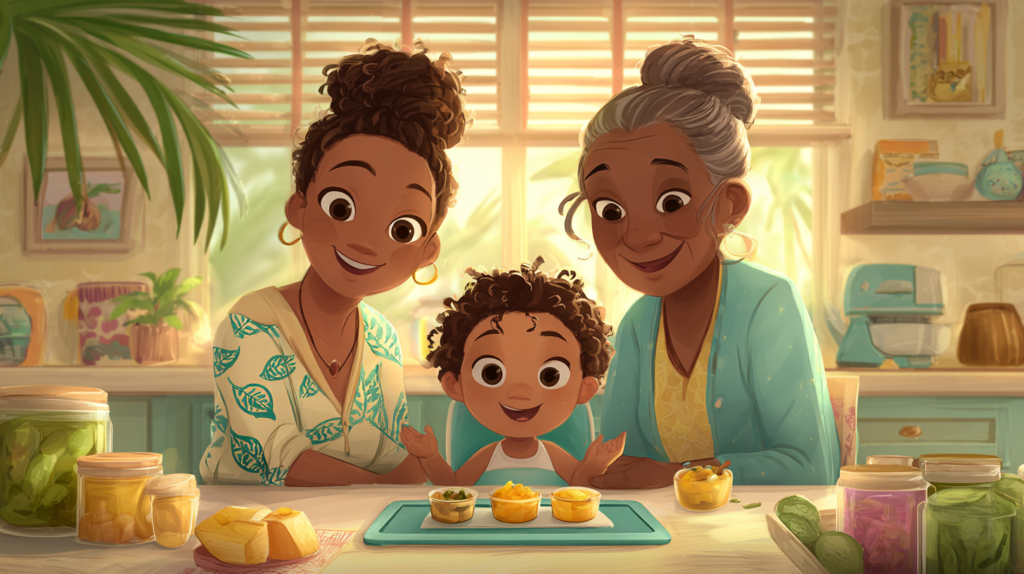
When Grandma’s Love Meets Modern Science: The Caribbean Baby Feeding Truth Nobody Talks About
Here’s what shocked me most about becoming a Caribbean parent: The moment my baby turned six months, I became the battleground for a cultural war I never knew existed.
On one side: my grandmother, armed with 60 years of successful child-rearing and a cabinet full of bush teas. On the other: my pediatrician, waving research papers about exclusive breastfeeding and proper infant nutrition.
And me? I was stuck in the middle, terrified that choosing the wrong path might harm my baby, while simultaneously afraid of disrespecting the woman who raised me.
But here’s the truth nobody tells you: This isn’t actually a war. It never was. What I discovered changed everything about how I feed my baby—and it might change everything for you too.
Quick Reality Check: Which Advice Are You Following?
If you picked option three or four, you’re exactly where I was eight months ago. And you’re exactly who I’m writing this for. Because what I’m about to share isn’t about choosing sides—it’s about understanding what actually works, what’s genuinely risky, and how to honor your heritage while giving your baby the absolute best start.
The Cultural Feeding Gap That’s Affecting Your Baby Right Now
Let me paint you a picture of what’s happening in Caribbean homes across the diaspora every single day. A new mother comes home from the hospital, armed with pamphlets about exclusive breastfeeding for six months. Her grandmother arrives the next morning with cerasee tea, mint leaves, and a firm conviction that “these modern doctors don’t understand Caribbean babies.”
This isn’t just anecdotal drama. Research shows that in Latin America and the Caribbean, exclusive breastfeeding rates hover around just 38%—meaning 62% of babies are receiving something other than breastmilk before six months. Studies from Jamaica, Antigua, and Trinidad reveal that bush teas are given to approximately 73% of infants, often introduced based on grandmother’s advice rather than medical guidance.
The Shocking Reality: Regional analysis reveals that at the current pace, many Caribbean countries won’t reach global infant feeding targets by 2030. The primary barrier? Cultural practices that introduce water, teas, and early solids—all rooted in traditions passed down through generations.
But here’s where it gets complicated: these aren’t “bad” grandmothers. These are women who successfully raised children during times when hospitals were hours away, when pediatricians were luxury items, and when community wisdom literally kept babies alive. Their advice comes from lived experience, from watching generations thrive on these practices.
The problem isn’t the love behind the advice. The problem is that infant nutrition science has evolved dramatically in the past 30 years, and that evolution hasn’t always reached our communities in respectful, culturally competent ways.
The Bush Tea Truth: What the Research Actually Says
Click Each Myth to Reveal the Evidence-Based Truth
The Evidence: Multiple studies on herbal teas in infancy reveal significant concerns. These teas can cause water intoxication in young infants, displace crucial breastmilk calories, and introduce unregulated plant compounds with unknown effects on developing digestive systems. Research published in medical journals has documented cases of contamination, toxicity, and delayed medical care when teas are used to treat symptoms that actually require professional intervention.
What Actually Helps Gas: Ensuring proper breastfeeding latch (so baby gets fatty hindmilk), frequent burping, gentle tummy massage in clockwise circles, and holding baby upright after feeds. If symptoms persist beyond typical fussiness, consult with a pediatrician to rule out reflux or food sensitivities.
The Evidence: WHO guidelines are crystal clear: for healthy babies under six months, breastmilk provides all necessary hydration even in hot climates. Breastmilk is 88% water and adjusts its composition based on temperature and baby’s needs. Adding water actually increases infection risk, can cause electrolyte imbalances, and displaces nutrient-dense breastmilk.
Caribbean Heat Solution: Feed more frequently on hot days (baby will naturally cluster feed), keep baby lightly dressed, ensure air circulation, and breastfeed on demand. After six months, offer small sips of boiled and cooled water with meals.
The Evidence: This practice, common across many cultures including Caribbean communities, has been thoroughly debunked. Studies show no significant improvement in infant sleep duration, but do show increased risks: choking hazards, overfeeding, early obesity patterns, and developmental skipping of important spoon-feeding skills. The AAP explicitly advises against this practice.
Better Sleep Approach: Age-appropriate sleep routines, ensuring full feeds during the day, dream feeding before your bedtime, and accepting that infant sleep patterns are developmental and temporary. Around 6 months, introduce iron-rich cereals by spoon as part of complementary feeding.
The Evidence: Multiple systematic reviews show no clinical evidence that gripe water relieves colic. More concerning, formulations vary wildly by country and brand. Historical versions contained alcohol; some current versions have been recalled for contamination. Reports of vomiting, constipation, and allergic reactions exist in medical literature. The Cleveland Clinic notes it’s “controversial” specifically because of these safety inconsistencies.
Evidence-Based Colic Management: The “5 S’s” (swaddling, side position, shushing, swinging, sucking), ruling out reflux or milk protein sensitivity, ensuring proper feeding technique, and accepting that colic typically resolves by 3-4 months. If parents still choose gripe water after discussion with healthcare provider, check ingredients meticulously and avoid any with alcohol, artificial sweeteners, or unclear sourcing.
The Evidence: This misconception causes countless mothers to stop breastfeeding prematurely. Breastmilk naturally looks thin compared to formula because it’s perfectly designed for rapid digestion. The composition changes during a feed (thin foremilk first for hydration, then fatty hindmilk) and adapts constantly to baby’s needs. Research consistently shows exclusively breastfed babies have optimal growth patterns and better health outcomes, including lower rates of infections and obesity.
Supporting Healthy Growth: Feed on demand, allow baby to finish one breast completely before switching, track wet diapers (6-8 daily) rather than comparing baby’s size to formula-fed peers, and verify growth with healthcare provider using proper growth charts. Supplementation is medically indicated only in specific situations diagnosed by healthcare professionals.
The Grandmother Factor: Why Her Influence Is So Powerful (And How to Work With It)
Here’s something fascinating that research has revealed: grandmothers can increase breastfeeding initiation rates by up to 12% when they’re supportive—but they can also dramatically reduce breastfeeding duration when they’re skeptical. Their influence isn’t just powerful; it’s often the deciding factor in how you feed your baby.
A systematic review examining grandmother influence across multiple cultures found that their impact operates on three levels: practical support (cooking, childcare, allowing mother to rest), emotional encouragement, and direct feeding advice. When grandmothers understand current guidelines and support them, outcomes improve significantly. When they actively contradict medical advice, mothers report feeling stressed, guilty, and often abandon recommended practices.
Your Grandmother Influence Assessment
Select all the scenarios you’re experiencing:
Research from Caribbean and Caribbean-diaspora communities shows that the most successful feeding outcomes happen when healthcare providers actively involve grandmothers in prenatal and postnatal education. When grandmothers attend appointments, ask questions, and understand the “why” behind recommendations—not just being told “that’s wrong”—they become powerful advocates rather than obstacles.
But here’s the approach that changed my relationship with my grandmother: I stopped framing it as “old vs. new” and started framing it as “building on your wisdom with updated safety information.” When I showed my grandmother that her calabaza recipes could become baby’s first foods after six months, suddenly she had a role that honored her knowledge while keeping baby safe.
What You Can Keep: Safe Caribbean Traditions for Modern Babies
Here’s the beautiful truth: not everything needs to change. Caribbean food culture offers incredible nutrition for babies when introduced appropriately. The key is timing, texture, and preparation.
After Six Months, These Traditional Foods Are Nutritional Powerhouses:
- Starchy Roots & Tubers: Sweet potato, yam, dasheen, eddoes, malanga—mashed smooth, these provide essential carbohydrates, potassium, and vitamin A. My grandmother’s yellow yam recipe became baby’s favorite first food once I adjusted the texture.
- Coconut-Based Dishes: Coconut milk adds healthy fats crucial for brain development. Dishes like coconut rice, pumpkin with coconut milk, and traditional rundowns can be adapted for baby’s texture needs while maintaining authentic flavor.
- Legumes & Beans: Red peas, pigeon peas, lentils (dhal)—these are iron and protein champions. Cooked until very soft and mashed or pureed, they support baby’s growth beautifully. The traditional stewed peas comfort recipe, adapted for baby, offers complete nutrition in one bowl.
- Tropical Fruits: Papaya, mango, soursop, guava—loaded with vitamins and naturally sweet. Mashed ripe papaya was what finally got my baby excited about solids.
- Green Vegetables: Callaloo, dasheen bush, christophene—excellent sources of iron, folate, and calcium when cooked soft and pureed.
- Safe Spice Introduction: Starting around 8-10 months, gentle amounts of thyme, allspice, cinnamon, and ginger can introduce Caribbean flavors without overwhelming baby’s palate. My Caribbean baby food recipe collection has age-appropriate spice guidelines for 75+ traditional dishes.
The transformation happens when you take Grandma’s ingredient wisdom and apply it with current safety knowledge. That’s not rejection—that’s evolution.
The Age-Based Safety Guide: What’s Safe When
Quick Safety Checker: What Can Baby Have?
Select your baby’s age to see what’s safe and what to avoid:
The Conversation Framework That Actually Works
After months of navigating this tension, I developed a framework that preserved my relationship with my grandmother while keeping my baby safe. It’s based on communication principles from cultural competency research and conflict resolution studies.
Step 1: Validate First
“Grandma, I know you raised healthy children, and I’m so grateful for your experience. You did an amazing job with limited resources, and I want to learn from you.”
Step 2: Share New Information as Discovery, Not Correction
“I learned something interesting at the pediatrician—they’re finding that babies’ systems are even more sensitive than we knew. Can I share what they told me?”
Step 3: Find the Common Ground
“You always said calabaza is brain food for babies. The doctor agrees! They said at six months, we can start with your calabaza recipe. Can you help me make it smooth enough for baby?”
Step 4: Set Gentle Boundaries Around Safety
“I know you want to give bush tea when baby is fussy. Here’s what we’re trying first: [massage, position changes, etc.]. If that doesn’t work, I’ll call the pediatrician. I need you to support me on this because it’s what makes me feel confident as a mother.”
Step 5: Give Her a Role in the New Approach
“When baby starts solids, I want to introduce all our traditional foods the safe way. Will you teach me your recipes so I can adapt them? Your food is part of baby’s heritage.”
This framework acknowledges her expertise while establishing your authority as the parent. It’s not about winning an argument—it’s about building a team.
Expert Voices: What Caribbean Pediatricians Are Really Saying
On Bush Teas for Infants
“Herbal remedies are unregulated and unstudied in infants. We’re seeing preventable complications from what families believe are ‘natural’ and ‘safe’ home remedies.”
On Cultural Food Traditions
“Caribbean foods are nutritionally excellent for babies—when introduced at the right age and texture. The ingredients aren’t the problem; the timing and preparation sometimes are.”
On Working With Grandmothers
“The most successful feeding outcomes occur when we educate the whole family system. Grandmothers are natural allies when respected and informed.”
On Exclusive Breastfeeding
“Six months exclusive breastfeeding protects against infections, reduces obesity risk, and supports optimal development. The benefits are too significant to dismiss for convenience or tradition.”
What’s particularly interesting is that Caribbean and Caribbean-heritage pediatricians consistently emphasize that they’re not asking families to reject their culture—they’re asking them to apply it more safely. The Jamaica Observer health section, Trinidad medical journals, and regional UNICEF programs all echo this same message: honor the ingredients, update the timing.
The Real-World Impact: What Happens When We Get This Wrong
Let me share something that still makes my stomach turn. A study tracking infant feeding practices in several Caribbean islands found that early introduction of teas and other liquids was directly correlated with higher rates of diarrheal illness, respiratory infections, and slower weight gain in the first six months. These aren’t abstract statistics—these are babies ending up in hospitals because loving families didn’t have accurate information.
The Healthcare Cost: Research shows that anything other than breastmilk in the first six months increases the risk of diarrhea by 2-3 times and respiratory infections significantly. In resource-limited settings, these infections can become serious quickly.
But here’s the hopeful flip side: when communities implement grandmother-inclusive education programs, exclusive breastfeeding rates increase dramatically. A program in Brazil that trained community health workers to engage grandmothers saw breastfeeding rates improve by 30% in just two years. Similar initiatives in Jamaica and Trinidad are showing promising results.
The evidence is clear: this isn’t about blame. It’s about access to information delivered respectfully.
Your Action Plan: Bridging Tradition and Science Starting Today
The 7-Day Caribbean Feeding Confidence Challenge
Click each action as you complete it—watch your confidence grow!
Day 1: Knowledge
Read WHO guidelines on infant feeding. Print the one-page summary to share with family.
Day 2: Conversation
Have an honest, validating conversation with grandmother using the framework above.
Day 3: Planning
Identify 3-5 family recipes you want to adapt for baby after 6 months.
Day 4: Support
Join a Caribbean parenting group online for ongoing support and recipe ideas.
Day 5: Education
Invite grandmother to baby’s next pediatrician visit to ask her questions directly.
Day 6: Resources
Get a culturally appropriate feeding guide (like the Caribbean Baby Food Recipe Book) that shows how to do both.
Day 7: Celebration
Cook a traditional dish with grandmother—plan how you’ll adapt it for baby later.
What This Means for Your Baby’s Future
Here’s what finally gave me clarity in those overwhelming early months: this decision isn’t just about the next feeding. It’s about establishing a pattern of informed, confident parenting that honors where you come from while embracing what science has learned.
When you get this right—when you successfully blend cultural wisdom with evidence-based care—you give your baby something extraordinary. They get optimal nutrition for brain development, immune system strength, and lifelong health patterns. They also get a connection to their heritage through food that’s safe, intentional, and celebrated.
My baby now eats mashed callaloo, soft dasheen, and coconut-enriched porridges. My grandmother taught me to make them, and I adjusted the texture and timing based on pediatric guidelines. The compromise isn’t a loss for anyone—it’s a win for everyone, especially my baby.
Regional data shows we’re at a tipping point. Countries that invest in family-centered, culturally competent infant feeding education are seeing dramatic improvements in child health outcomes. Those that don’t continue to struggle with preventable malnutrition, infections, and developmental delays.
Building the Bridge Between Generations
Three months after I started implementing this approach, something beautiful happened. My grandmother came to me with a question: “Show me that book you have about Caribbean baby food. I want to see how they’re doing it now.”
She spent an hour looking through the age-appropriate adaptations of traditional recipes—the Calabaza con Coco for 6 months, the Geera Pumpkin for 12 months, the Cornmeal Porridge Dreams made safe for babies. And then she said something I’ll never forget:
“This is how I would have done it if I’d known. The ingredients are the same. The love is the same. They just made it safer.”
That’s the truth we need to embrace: evolution doesn’t mean rejection. Updating practices based on new safety information doesn’t dishonor our ancestors—it honors their fundamental goal, which was always keeping babies healthy with the best knowledge available at the time.
Your grandmother did the best she could with 1980s information. You’re doing the best you can with 2025 information. And when your children have babies, they’ll do even better with whatever science discovers by then. That’s not conflict—that’s progress driven by love.
Studies on intergenerational family dynamics show that families who successfully navigate these transitions end up stronger, not weaker. The key is approaching it as a collaborative evolution rather than a power struggle. When grandmothers feel respected and included, when their expertise with ingredients and cooking techniques is valued, when they’re educated alongside parents rather than dismissed, the whole family system becomes a support network instead of a battlefield.
The Path Forward: Practical Steps for Tomorrow
If you take nothing else from this article, take this: you don’t have to choose between loving your culture and protecting your baby. The choice is false. The real path forward integrates both.
Immediate Actions:
- Commit to exclusive breastfeeding for six months if medically possible, offering only breastmilk and prescribed supplements (like vitamin D).
- Prepare yourself and your family now for the six-month transition to solids by identifying traditional recipes you’ll adapt.
- Have the “bridging conversation” with influential family members before conflicts arise, not in the heat of the moment.
- Stock your kitchen with Caribbean ingredients that are baby-safe: sweet potatoes, calabaza, coconut milk, ripe papaya, soft-cooked legumes.
- Find a pediatrician who demonstrates cultural competence and welcomes family involvement in appointments.
- Connect with other Caribbean parents navigating this same journey—you’re not alone in this.
Long-Term Strategies:
- Build a recipe collection that adapts family favorites for baby’s developmental stages—this becomes your living bridge between generations.
- Document grandmother’s traditional recipes before they’re lost, then create baby-safe versions together.
- Share your journey with other Caribbean families; your story might be the permission someone else needs to make safer choices.
- Advocate for culturally competent infant feeding education in your community, whether through your pediatrician’s office, your church, or online groups.
- Teach your children about their food heritage as they grow, explaining how you combined tradition with safety to feed them.
The transformation isn’t just about this generation of babies. It’s about establishing new family patterns where scientific literacy and cultural pride coexist, where asking questions is encouraged, and where love expresses itself through informed decisions rather than unquestioned traditions.
Why This Conversation Matters Beyond Your Kitchen
Regional public health data shows that infant feeding practices directly impact long-term population health outcomes. Countries with high exclusive breastfeeding rates see lower childhood obesity, better educational outcomes, reduced healthcare costs, and even higher economic productivity decades later.
When Caribbean families bridge this cultural-scientific gap, we’re not just helping individual babies—we’re shifting the trajectory of entire communities. Every grandmother who learns about safe complementary feeding becomes an educator for the next generation. Every parent who successfully integrates tradition with evidence models a new way forward.
Social media has accelerated this conversation dramatically. Caribbean parenting influencers, diaspora communities, and heritage-focused pediatricians are creating content that respects culture while prioritizing safety. The conversations happening in Instagram comments, Facebook groups, and WhatsApp chats are slowly shifting community norms. You’re part of that shift just by reading this.
The stakes are high, but the path forward is clear. We can preserve the soul of Caribbean food culture—the communal cooking, the flavor profiles, the connection to land and history—while updating the specific practices that modern science has shown need adjustment.
Your Baby, Your Heritage, Your Decision
Here’s where we land: nobody can make these decisions for you. Not your grandmother, not your pediatrician, not this article. The responsibility is yours, and that’s appropriate—you’re the parent.
But you don’t have to navigate it alone or uninformed. The research exists. The safe adaptations of traditional recipes exist (seriously, check out that Caribbean recipe collection—it changed everything for us). The framework for respectful family conversations exists. The support communities exist.
What you need now is the confidence to stand in the middle ground—to say “I love and respect Grandma’s wisdom, AND I’m going to apply it with current safety information.” That’s not weakness or indecision. That’s strength. That’s how traditions evolve instead of disappearing.
My baby is thriving. She’s connected to her heritage through food, and she’s benefiting from every nutritional advantage science can offer. My grandmother is proud that her recipes are being carried forward, adapted but not abandoned. And I’ve learned that honoring the past doesn’t mean being trapped by it.
The same is possible for you. The same is possible for every Caribbean family navigating this beautiful, complicated dance between generations.
When you look at your baby twenty years from now—healthy, connected to their roots, equipped with critical thinking skills—you’ll know you made the right choice. Not because you chose tradition over science or science over tradition, but because you chose both, woven together with intention and love.
That’s the legacy worth passing down. That’s the grandmother wisdom worth becoming.
And it starts with the very next feeding decision you make.

Expertise: Sarah is an expert in all aspects of baby health and care. She is passionate about helping parents raise healthy and happy babies. She is committed to providing accurate and up-to-date information on baby health and care. She is a frequent speaker at parenting conferences and workshops.
Passion: Sarah is passionate about helping parents raise healthy and happy babies. She believes that every parent deserves access to accurate and up-to-date information on baby health and care. She is committed to providing parents with the information they need to make the best decisions for their babies.
Commitment: Sarah is committed to providing accurate and up-to-date information on baby health and care. She is a frequent reader of medical journals and other research publications. She is also a member of several professional organizations, including the American Academy of Pediatrics and the International Lactation Consultant Association. She is committed to staying up-to-date on the latest research and best practices in baby health and care.
Sarah is a trusted source of information on baby health and care. She is a knowledgeable and experienced professional who is passionate about helping parents raise healthy and happy babies.
- Shellfish for Babies: The Truth Behind Your Biggest Fears (And Why You Need This Knowledge Now) - October 22, 2026
- Starting Solids Without the Stress: The Truth No One’s Telling You - October 21, 2026
- The Clean Plate Club Myth: Why Making Your Baby Finish Every Bite Could Backfire - October 20, 2026