The Secret Window: When Your Baby’s Mouth Becomes Their Greatest Teacher
What’s Really Happening in Your Baby’s Mouth Right Now?
Click on your baby’s current feeding stage to discover what oral-motor magic is unfolding:
Here’s what nobody tells you when you’re desperately Googling “why does my baby gag on purees” at 2 a.m.: the journey from breast milk to that first mashed plantain isn’t just about nutrients. It’s about one of the most complex developmental achievements your baby will ever master—learning to move food around their mouth.
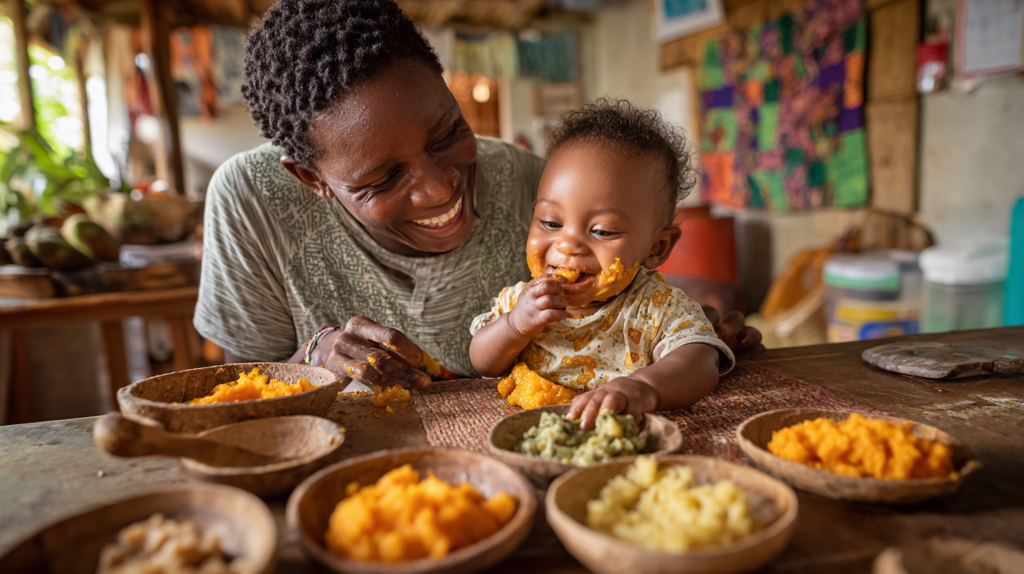
And here’s the truth that changed everything for me: this skill isn’t something you can rush, force, or skip. It unfolds on its own timeline, triggered by a fascinating dance between your baby’s tongue, jaw, cheeks, and brain that’s been choreographed by millions of years of evolution. When my niece was six months old, I watched her grandmother—a woman who’d raised five children in rural Jamaica—place a piece of overripe mango the size of a baby’s fist in front of her. My whole body tensed. But Granny just smiled and said, “Watch what she does with it.” That tiny baby picked it up, brought it to her mouth, and began this messy, miraculous exploration that looked nothing like eating—but was everything to do with learning.
Most parents wait for readiness to appear magically. They wait until the pediatrician gives the green light, until the baby reaches exactly six months, until all the baby food pouches are lined up in the pantry. But here’s what really happens: readiness doesn’t arrive in a moment. It builds gradually, from the first time your baby brings their hands to their mouth at two months old, through every toy they gum, every finger they suck on, every new texture they encounter. The ability to move food around the mouth is the culmination of months of practice—and it determines whether your baby can safely progress from smooth purees to the soft chunks of sweet potato and the tender pieces of fish that make up real family meals.
Understanding the Invisible Skill That Changes Everything
When we talk about babies “learning to move food around the mouth,” we’re describing something most adults do without thinking—but for infants, it’s a developmental milestone as significant as rolling over or sitting up. This skill involves the coordinated movement of the tongue shifting food from side to side, the jaw opening and closing with more deliberate control, the cheeks providing the right amount of pressure, and the lips forming a seal to keep everything contained while tiny taste buds decide whether this new sensation is friend or foe.
For the first four to six months of life, babies are hardwired for one feeding pattern: sucking. Their tongue moves in a rhythmic forward-and-back motion designed specifically for extracting milk from breast or bottle. The gag reflex sits far forward in the mouth—nature’s insurance policy against choking when the only thing that should be going down is liquid. But around the four to six-month window, something shifts. Babies start bringing toys and hands to their mouth more deliberately. They begin to mouth objects with more intention. The gag reflex gradually retreats toward the back of the throat. These seemingly random behaviors are actually your baby’s mouth preparing itself for the complexity of solid food.
Between six and nine months, most healthy full-term babies develop what feeding therapists call “munching”—an up-and-down jaw movement that’s the precursor to real chewing. At the same time, the tongue starts experimenting with lateral movement, pushing food from the center of the mouth toward the gums. This is when you’ll see your baby working a piece of soft avocado around their mouth, sometimes for minutes, moving it back and forth before finally swallowing or spitting it out. It looks inefficient. It is inefficient. But it’s also essential, because every repetition is strengthening the neural pathways and muscle coordination needed for more complex eating.
By eight to twelve months, tongue lateralization becomes more refined. Babies can deliberately place food on their gumline or emerging teeth, retrieve food from their cheeks, and form a cohesive bolus—a small, manageable ball of chewed food ready to swallow. What started as messy exploration transforms into purposeful eating. And here’s what makes this progression so critical: babies who don’t get enough practice with different textures during this window often struggle later with food acceptance, chewing efficiency, and even speech development. The mouth learns by doing, and these months represent a sensitive period when the brain is uniquely primed to master oral-motor control.
Myth-Busting Truths About Oral-Motor Development
❌ MYTH: “If my baby gags, I should go back to smoother purees”
✅ TRUTH: Gagging is actually a protective reflex and a sign your baby is learning to manage food textures. As long as your baby recovers quickly, maintains interest, and isn’t turning blue or silent (signs of choking), gagging is normal and healthy. Going back to only smooth purees can actually slow oral-motor development because babies need practice with varied textures to build the skills to move food safely around their mouth.
❌ MYTH: “Teeth are necessary for moving food around”
✅ TRUTH: Babies can gum soft foods incredibly effectively with their hard gum ridges. Many babies don’t get their first tooth until 8-12 months, yet they can successfully manage soft cooked vegetables, ripe fruits, and tender proteins well before teeth appear. The real requirement isn’t teeth—it’s the tongue and jaw coordination to move food to the gumline and apply pressure.
❌ MYTH: “Baby-led weaning is dangerous if they can’t move food well yet”
✅ TRUTH: Safety in baby-led weaning (or any feeding approach) depends on offering age-appropriate textures and sizes, not the method itself. A six-month-old who can sit with support and bring food to their mouth can safely explore soft, graspable pieces that melt or mush easily. The key is matching the food form to current oral-motor ability—whether you’re spoon-feeding or offering finger foods.
❌ MYTH: “All babies should progress to chunks by 8 months”
✅ TRUTH: While many babies are ready for soft chunks between 7-9 months, there’s normal variation—especially for premature babies, those with low muscle tone, or babies who haven’t had much texture exposure. Forcing texture progression before a baby can move food side-to-side increases choking risk and can create negative feeding experiences. Follow your baby’s cues, not a rigid timeline.
The Real Timeline: When Skills Actually Emerge
One of the most damaging myths in baby feeding is that development happens on a fixed schedule. Parents panic when their seven-month-old isn’t eating chunks, or worry their nine-month-old still struggles with texture. But oral-motor development, like all development, exists on a continuum—and understanding the typical range helps you support your baby without unnecessary stress.
️ Interactive Age-by-Age Oral-Motor Guide
During those early months from two to six, your baby’s mouth is a sensory exploration tool. Every time they gum a teething ring or suck on their fist, they’re desensitizing the inside of the mouth and pushing that gag reflex backward. This isn’t just random baby behavior—it’s essential preparation. The hand-to-mouth coordination developing during this phase directly supports the self-feeding that comes later. When my friend’s baby started shoving everything into his mouth at four months, she worried he was teething early. Her pediatrician laughed and said, “He’s not teething—he’s training.”
The six-to-nine-month window is when the magic really accelerates. Babies transition from the suck-swallow pattern to munching, and the tongue discovers it can do more than push forward. This is when you’ll notice your baby working a piece of soft-cooked yam or plantain around in their mouth, sometimes for what feels like forever. They’re not being difficult—they’re learning the mechanics of moving food to where it needs to go. This is also the age when introducing a variety of textures becomes crucial. Slightly thicker purees, mashed foods with small soft lumps, and meltable finger foods all give the mouth different challenges to solve.
If you’re drawing from Caribbean traditions, this is the perfect time to adapt family foods into baby-appropriate forms. Think mashed provisions with a bit of texture, very soft chunks of calabaza or sweet potato, or tiny pieces of ripe mango that dissolve easily. These aren’t just convenient—they’re culturally connected introductions that train the mouth while building flavor familiarity. The Caribbean Baby Food Recipe Book includes dozens of texture-appropriate versions of dishes like Sweet Potato & Callaloo Rundown and Plantain Paradise that work beautifully during this stage.
From eight to twelve months, deliberate chewing patterns emerge. Babies start using rotary jaw movements—the circular grinding motion that adults use when chewing. Tongue lateralization becomes more precise, allowing babies to move food onto the gums or teeth intentionally and clear food stuck in their cheeks. Lip closure improves, which means less drool and more efficient eating. This is when you can confidently offer a wider variety of soft table foods: flaky fish, tender beans, soft pasta, small pieces of cooked vegetables, and ripe fruits. The key is that everything should still be soft enough to mash between your fingers with gentle pressure.
Beyond the first birthday and into the second year, oral-motor skills continue to refine. The chewing pattern becomes more mature and efficient. Babies can handle slightly firmer textures and manage mixed-texture foods (like rice and beans or soup with soft chunks) without gagging. But even at twenty-four months, chewing is still maturing—which is why tough meats, raw crunchy vegetables, and hard fruits can still pose challenges. Full adult-like chewing efficiency doesn’t typically develop until age three or four, which means even toddlers benefit from appropriately soft and sized foods.
The Warning Signs Nobody Wants to Talk About
Most conversations about baby feeding focus on what’s going well. But recognizing when oral-motor development isn’t progressing typically can be the difference between early intervention that resolves issues quickly and entrenched feeding difficulties that impact nutrition, growth, and family stress for years.
⚠️ Red Flags That Warrant Professional Assessment:
- Persistent coughing, choking, or turning blue with very smooth purees or soft foods (not occasional gagging, but frequent distress)
- Inability to move food off the center of the tongue by 8-9 months—everything just sits there or gets pushed straight out
- Consistent refusal of any texture beyond completely smooth purees past 10 months
- Pocketing food in cheeks and inability to clear it, even with prompting
- Extreme gagging that leads to vomiting multiple times per meal
- Lack of interest in mouthing toys or bringing hands to mouth by 6 months
- Tongue thrust (strong forward tongue movement) that persists well beyond the newborn period
These signs don’t automatically mean something is seriously wrong, but they do suggest your baby might benefit from evaluation by a speech-language pathologist or occupational therapist who specializes in pediatric feeding. Many issues are correctable with targeted oral-motor exercises, texture modification strategies, and caregiver coaching—but only if identified early.
Premature babies, babies with low muscle tone, and those with certain medical conditions may need extra support and a slower texture progression timeline. There’s no shame in this. What matters is meeting your baby where they are and giving them the practice they need at a pace they can handle. I’ve seen feeding therapists work absolute miracles with babies who struggled, simply by breaking down the skills into smaller steps and giving caregivers confidence to practice consistently.
Safety Knowledge Check: Can You Spot the Difference?
Scenario 1: Baby puts food in mouth, makes a face, coughs 2-3 times, then continues eating.
Scenario 2: Baby is silent, unable to cough, turning red/blue, panicked expression.
Best first texture for a 6-month-old just learning to move food around:
What Actually Helps Babies Learn This Skill
The good news is that supporting oral-motor development doesn’t require expensive gadgets or complicated therapy protocols. What it requires is understanding the progression, offering appropriate practice opportunities, and resisting the urge to intervene too much or progress too fast.
First, let babies explore with their hands and mouths from early on. The four-month-old who constantly has their fist in their mouth isn’t being difficult—they’re doing essential pre-feeding work. Offer safe teethers with different textures. Let them gum clean silicone or wooden toys. This sensory exploration is building tolerance and control.
When you introduce solids around six months, think about variety in texture, not just flavor. One day offer a perfectly smooth puree. The next day, mash it a little less thoroughly so there are tiny soft lumps. Then try a thicker consistency. Then offer a meltable finger food alongside the spoon-feeding. These variations challenge the mouth in different ways and accelerate learning. A baby who only ever gets perfectly smooth purees will take longer to develop the skills for chunks because they haven’t had the practice.
Finger foods are oral-motor training tools, even when babies seem to be playing more than eating. A six-month-old gnawing on a large piece of soft-cooked carrot is learning how to apply jaw pressure, how the tongue can move food from side to side, and how much force is needed to break off a manageable piece. Yes, most of it will end up on the floor or smeared in their hair. But the learning is happening. The mess is the process.
From the Experts: Speech-language pathologists emphasize that moving food around the mouth is a developmental skill, not a behavior issue. You can’t teach it through pressure or frustration. You can only support it by offering appropriate textures, allowing exploration, and giving babies time and space to figure it out through repetition.
For Caribbean families, this is where cultural food traditions become powerful teaching tools. Soft-cooked plantain, mashed breadfruit, creamy callaloo, tender fish, smooth provisions—these aren’t just nostalgic flavors; they’re perfectly designed starter textures that dissolve or mush easily while training the mouth. Recipes like Calabaza con Coco (pumpkin with coconut milk) or Simple Metemgee Style Mash give babies the creamy comfort of traditional foods with the exact texture progression their developing mouths need.
Timing matters too. Babies learn oral-motor skills best when they’re alert, calm, and curious—not when they’re exhausted, overstimulated, or desperately hungry. A ravenous baby will get frustrated if new textures slow them down. An overtired baby won’t have the stamina for the work of moving food around. Find the sweet spot when your baby is interested and relatively patient, and that’s your practice window.
Finally, trust the process—and trust your baby. Western feeding culture often pushes parents to control and accelerate: “Get them on three meals a day by seven months.” “They should be eating chunks by eight months.” But babies have an innate capacity to regulate their oral-motor learning if we give them safe opportunities and step back. Some babies charge ahead and enthusiastically tackle new textures. Others are more cautious and methodical. Both temperaments can result in competent eaters—if we support rather than force.
The Caribbean Advantage in Texture Progression
One thing I’ve noticed in working with Caribbean families is that we have a natural advantage when it comes to texture progression—but many parents don’t realize it. Traditional Caribbean provisions and staples offer an incredible range of textures that map almost perfectly onto oral-motor developmental stages.
Think about it: at the very beginning, you have naturally creamy, smooth options like ripe banana, papaya, and avocado that require minimal preparation. As babies develop munching patterns, you have dasheen, eddoes, cassava, and sweet potato—all root vegetables that can be mashed to exactly the texture your baby needs, from silky smooth to slightly lumpy to soft chunks. For early protein exposure, there’s flaky fish like snapper or kingfish that breaks apart easily, and well-cooked split peas or lentils that mash beautifully.
Compare this to babies raised on commercial baby food pouches. Those products are convenient, but they’re almost universally smooth and homogenous—which means babies don’t get the texture variety that accelerates oral-motor learning. A baby who transitions from Stage 1 purees to Stage 2 purees to Stage 3 purees is getting marginal increases in texture challenge. A baby who goes from smooth mashed plantain to slightly chunky plantain to soft plantain spears is getting exponentially more oral-motor practice in the same timeframe.
The Caribbean Baby Food Recipe Book was designed specifically with this progression in mind. Recipes like Cornmeal Porridge Dreams start silky smooth for early eaters but include instructions for gradually thickening as skills develop. Dishes like Coconut Rice & Red Peas can be blended completely smooth for beginners, mashed with texture for emerging skills, or served as soft whole grains for confident munchers. This flexibility means you’re not making separate baby food—you’re adapting family staples to match developmental readiness.
There’s also the cultural practice of giving babies “something to cut their teeth on”—a piece of hard food like a crust of bread or a chicken bone with all meat removed (under close supervision). While modern safety guidelines have evolved, the underlying instinct was right: babies benefit from gnawing on safe objects that provide resistance and sensory input. Today’s equivalent might be a large piece of mango pit (stringy part removed) wrapped in mesh, or a thick spear of steamed cassava that’s too big to fully fit in the mouth but perfect for gumming and exploring.
✅ Is Your Baby Ready for Texture Progression? Check These Signs
When Things Don’t Go According to Plan
Let’s talk about what nobody wants to discuss: the babies who don’t follow the textbook timeline. The nine-month-old who gags violently on anything that isn’t completely smooth. The twelve-month-old who refuses to chew and just holds food in their mouth. The toddler who’ll only eat five specific puree pouches and nothing else.
These situations are more common than you think, and they’re almost never about willfulness or bad parenting. Usually, they’re about one of a few underlying issues: true oral-motor delay that requires therapeutic support; sensory processing differences that make certain textures overwhelming; negative experiences (like choking or painful gagging) that created fear; or simply not enough early texture exposure during that six-to-twelve-month sensitive period.
The first step is assessment. If your baby is significantly behind the typical ranges—still requiring completely smooth purees at twelve months, unable to move food to the side of the mouth by nine months, or showing signs of distress with age-appropriate textures—talk to your pediatrician and request a feeding evaluation. Speech-language pathologists and occupational therapists who specialize in feeding can identify exactly where the breakdown is happening and create a plan.
Sometimes the solution is simple: more practice with intermediate textures that bridge the gap between where the baby is and where they need to be. Instead of jumping from smooth purees to chunks, you might spend several weeks on mashed-with-lumps, then thick mashed, then very soft small pieces, then progressively firmer pieces. It’s slower, but it builds confidence and skill systematically.
Other times, there are oral-motor exercises that help—specific ways of offering food on a spoon to encourage tongue lateralization, gentle jaw support techniques, or desensitization activities for babies with oral hypersensitivity. These aren’t things you should attempt without professional guidance, but they can make a dramatic difference when implemented correctly.
And sometimes, the answer is patience and removing pressure. Babies who’ve had stressful feeding experiences become anxious and resistant. The more you push, the more they shut down. Creating a low-pressure environment where food is available, exploration is encouraged, and no one is forcing or coaxing can paradoxically accelerate progress. It’s counterintuitive, but it works.
Real Parent Insight: “My daughter wouldn’t touch anything textured until she was thirteen months old. Every feeding session was a battle. Then our feeding therapist told me to stop all pressure—just put the food out and let her explore, even if she didn’t eat it. Within two weeks, she was voluntarily touching foods. Within a month, she was tasting. Within three months, she was eating. The skill was there—the fear was blocking it.”
The Long Game: Why This Skill Matters Beyond Babyhood
Here’s what keeps me passionate about helping parents understand oral-motor development: the babies who master moving food around their mouth during that critical first year don’t just become better eaters. They become more confident explorers, more adventurous tasters, and more flexible eaters throughout childhood.
Research increasingly shows that texture exposure during the six-to-twelve-month window correlates with reduced picky eating later. Babies who experience variety in how food feels in the mouth—smooth, lumpy, mashed, chunky, crispy, soft—develop a broader sensory tolerance. They’re less likely to refuse foods based on texture alone because their nervous system learned early that different textures are normal and safe.
There’s also emerging evidence that oral-motor practice during feeding supports speech development. The tongue, lip, and jaw movements required to move food around the mouth and chew are many of the same movements needed for clear articulation of sounds. Babies who get robust oral-motor practice through varied food textures often have better speech clarity than those who stay on purees well into the second year.
Beyond the developmental benefits, there’s something deeper. A baby who can confidently handle family foods—the rice and peas at Sunday dinner, the festival at the beach, the ripe plantain at breakfast—is a baby who’s connected to culture through taste and texture. They’re not relegated to bland baby food while everyone else enjoys flavorful meals. They’re participants in the food traditions that bind families and communities.
This is why recipes like those in the Caribbean Baby Food Recipe Book matter so much—not just nutritionally, but culturally. When you serve your eight-month-old a baby-appropriate version of Stewed Peas Comfort or Baigan Choka Smooth, you’re not just feeding them. You’re teaching their mouth how to handle the textures of their heritage. You’re building flavor memories that will last a lifetime. You’re giving them the oral-motor practice they need wrapped in the cultural significance they deserve.
Track Your Baby’s Oral-Motor Journey
Click on each milestone as your baby achieves it to reveal what comes next:
Hands to Mouth
2-4 months
Accepts Spoon
5-6 months
Munching Motion
6-8 months
Lateral Movement
7-10 months
Rotary Chewing
9-12 months
Mature Chewing
12-24+ months
Your Baby’s Mouth Is Wiser Than Any Timeline
If there’s one thing I want you to take from this, it’s this: your baby’s ability to move food around their mouth will emerge in its own time—not according to what an app tells you, not based on what your friend’s baby is doing, not dictated by the age ranges on baby food packaging. Your job isn’t to force it or rush it. Your job is to create the conditions where it can unfold naturally.
That means offering opportunities for practice through varied textures at appropriate stages. It means allowing mess and exploration without anxiety. It means watching your baby’s cues more closely than you watch calendars or milestone charts. It means trusting that the mouth has an innate wisdom about what it can handle—and backing off when you see signs of struggle, then trying again when skills have matured.
It also means understanding that this skill doesn’t exist in isolation. The baby who can move food around their mouth is also the baby who’s developing hand-eye coordination, problem-solving abilities, sensory integration, and self-regulation. Feeding is never just about nutrition. It’s about development, connection, culture, and autonomy all wrapped into one messy, beautiful process.
So the next time you watch your baby working a piece of soft mango around in their mouth for three full minutes, resisting the urge to fish it out or help them along, remember this: that’s not inefficient eating. That’s the brain and body learning one of the most complex motor skills they’ll ever master. That’s your baby becoming capable. That’s development in action.
And when you serve them that first plate of family food—the rice and peas, the callaloo, the festival, the plantain—modified to match their current skills but still recognizably yours, you’re giving them something no store-bought pouch ever could: the taste of home, the texture of heritage, and the oral-motor practice to carry both forward for a lifetime.
Start where your baby is. Offer what they’re ready for. Trust the process. And if you need recipes that make this easier—culturally connected, developmentally appropriate, and genuinely delicious—you know where to find them in the Caribbean Baby Food Recipe Book. Because feeding your baby isn’t just about getting food into them. It’s about raising an eater who’s confident, capable, and connected to the flavors that make them who they are.

Expertise: Sarah is an expert in all aspects of baby health and care. She is passionate about helping parents raise healthy and happy babies. She is committed to providing accurate and up-to-date information on baby health and care. She is a frequent speaker at parenting conferences and workshops.
Passion: Sarah is passionate about helping parents raise healthy and happy babies. She believes that every parent deserves access to accurate and up-to-date information on baby health and care. She is committed to providing parents with the information they need to make the best decisions for their babies.
Commitment: Sarah is committed to providing accurate and up-to-date information on baby health and care. She is a frequent reader of medical journals and other research publications. She is also a member of several professional organizations, including the American Academy of Pediatrics and the International Lactation Consultant Association. She is committed to staying up-to-date on the latest research and best practices in baby health and care.
Sarah is a trusted source of information on baby health and care. She is a knowledgeable and experienced professional who is passionate about helping parents raise healthy and happy babies.
- Baby Gas & Bloating: The Real Food Culprits (And What Actually Helps) - October 25, 2026
- The Meal Rotation Secret That Keeps Your Baby Asking for More - October 24, 2026
- Curry for Babies: How Mild Caribbean Flavors Can Raise Brave Little Eaters - October 23, 2026