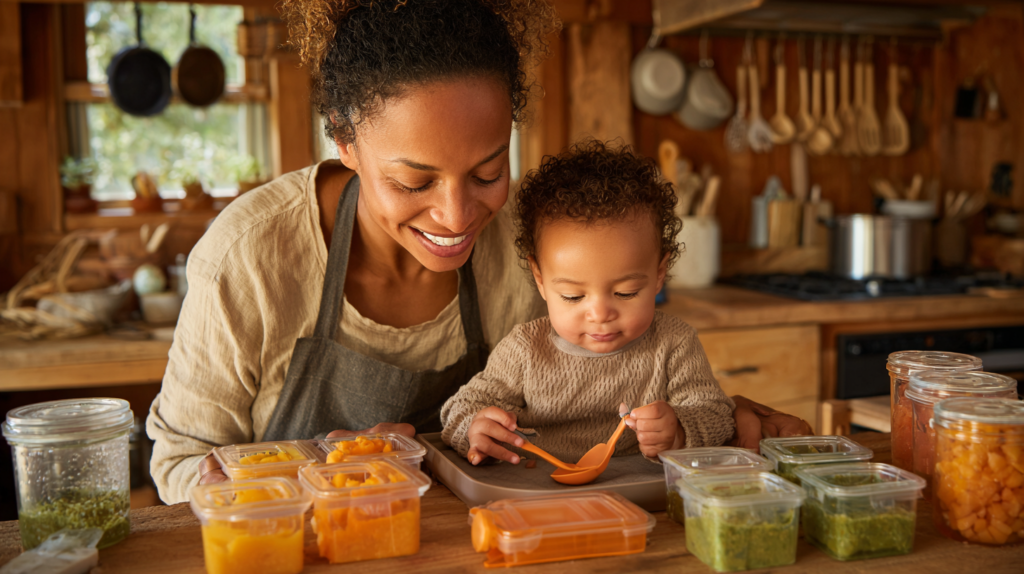
The Kitchen Tools That Changed Everything About How I Feed My Baby
Quick Reality Check: How Ready Is Your Kitchen?
Before you scroll another inch, tap below to discover something that might surprise you about your current baby food setup.
Three years ago, I stood in my kitchen at midnight, tears streaming down my face, staring at a burnt pot of carrots and a blender that had just splattered orange puree across my ceiling. My six-month-old was crying in the next room. My partner was traveling for work. And I was convinced I was failing at this whole “homemade baby food” thing everyone made look so effortless on social media.
That night changed everything—not because I suddenly became a baby food expert, but because I finally stopped and asked myself a simple question: What if the problem isn’t me? What if it’s my tools?
What followed was a journey that transformed not just how I prepare food for my children, but how I think about the entire first-foods experience. And here’s what I discovered: the global baby food market is projected to reach approximately USD 185 billion by 2032, with organic baby food alone expected to grow from around USD 7-8 billion to over USD 20 billion in the same period. That’s billions of dollars spent on convenience—but what if a modest investment in the right kitchen tools could give you more control, better nutrition, and actually save you money in the long run?
This isn’t about perfection. This isn’t about becoming a gourmet baby chef. This is about equipping yourself with exactly what you need—nothing more, nothing less—to feed your little one with confidence, joy, and maybe even a little Caribbean flair.
Why Your Kitchen Setup Actually Matters (The Science You Haven’t Heard)
Let me share something that might shift your entire perspective on baby food preparation. Recent research examining the environmental footprint of ready-made baby meals found that homemade options can significantly reduce packaging waste and transport-related emissions. But beyond the environmental angle, there’s something more immediate at stake: your baby’s developing palate.
Studies have documented that ultra-processed baby foods and toddler products often contain high levels of sugar, sodium, and refined starches. These aren’t just empty ingredients—they’re actively shaping your child’s taste preferences during the most critical window of their flavor development. When researchers analyzed commercial baby foods available across multiple markets, they found patterns of added sugars and “nutrients of concern” that many parents would never suspect from the wholesome-looking packaging.
The Hidden Truth About Baby Food Textures
Your baby’s readiness for different textures changes rapidly. Click to discover why timing matters more than most parents realize:
This is where the right tools become transformative. When you control the equipment, you control the texture progression. You control the ingredients. You control whether that sweet potato gets paired with a touch of warming cinnamon and coconut milk (like we do in the Caribbean) or gets blended with unnecessary fillers and sweeteners.
And here’s something the baby food industry doesn’t broadcast: equipping a basic baby food kitchen costs less than three months of premium baby food pouches. The return on investment isn’t just financial—it’s foundational for your child’s relationship with real food.
The Essential Cooking Tools (What You Actually Need)
Let me be direct with you, parent to parent: you don’t need a dedicated “baby food maker” that costs hundreds of dollars and takes up precious counter space. What you need are versatile tools that will serve your family for years. After testing, failing, and ultimately succeeding with my own three children, here’s what actually works.
Cooking Essentials
The foundation of baby food prep starts with how you soften those vegetables, grains, and proteins. A small saucepan with a tight-fitting lid handles most steaming and boiling tasks beautifully. But if you want to level up your efficiency—and trust me, with a baby, efficiency is everything—consider a steamer basket that fits inside your existing pots.
- Small saucepan (1.5-2 quarts): Perfect for cooking small batches of vegetables, grains like millet for a Caribbean-style Ti Pitimi Dous cereal, or soft-cooking fruits
- Steamer basket: Preserves more nutrients than boiling and works brilliantly for sweet potatoes, christophine, calabaza pumpkin, and other Caribbean staples
- Pressure cooker or multicooker: This was my game-changer. Dried beans and pigeon peas that would take hours cook in 20 minutes. Tough cuts of meat become baby-soft. Rice and peas cook together perfectly for recipes like Coconut Rice and Red Peas
My grandmother in Trinidad never had a fancy baby food maker. What she had was a good pot, patience, and the wisdom to cook foods until they surrendered their toughness completely. That pressure cooker brings her methodology into the modern kitchen—fast.
Quick Assessment: What’s Your Cooking Style?
Tap the option that sounds most like you to get personalized tool recommendations:
Texture Modification Tools (The Real Magic Makers)
This category is where most parents either overthink or underthink. You need tools that can take food from its cooked state to whatever texture your baby needs right now—and those needs change week by week in the early months.
From Smooth to Chunky: Your Texture Arsenal
- Immersion (stick) blender: My absolute favorite. Blend directly in the pot, no transferring hot food. Creates silky purees for beginners, and you control exactly when to stop for older babies who need texture
- Mini food processor: Perfect for small batches and for creating those in-between textures—not quite smooth, not quite chunky. Brilliant for recipes like Plantain Paradise or Papaya and Banana Sunshine
- Potato masher: Underrated hero. When your baby graduates from purees, this creates the perfect soft-mash texture. Works beautifully for dasheen, eddoes, and that gorgeous Mangú Morning plantain mash
- Fine grater: For adding nutrition without changing texture—think grated carrot in rice dishes, or finely grated apple into oatmeal
- Fork: Yes, really. A fork mashes ripe avocado, banana, and mango perfectly. Sometimes the simplest tool is the right tool
Here’s a Caribbean kitchen secret that transformed my baby food prep: the “provision method.” In islands across the Caribbean, starchy root vegetables—what we call “provisions” like yam, dasheen, sweet potato, and cassava—form the backbone of baby’s first foods. These foods are naturally perfect for progression: steam until soft, mash with a fork for beginners, then simply cut smaller as baby develops. No fancy equipment required.
For those wanting to explore this approach, the Caribbean Baby Food Recipe Book offers over 75 recipes specifically designed around ingredients like sweet potatoes, plantains, coconut milk, and island provisions—all organized by age appropriateness from 6 months onward.
Storage and Portioning (Your Batch-Cooking Best Friends)
If there’s one area where I see parents struggle unnecessarily, it’s storage. The “make it fresh every meal” approach sounds beautiful in theory but becomes exhausting in practice. Batch cooking saved my sanity—and it can save yours too.
✅ Build Your Storage Kit (Tap to Track Your Progress)
The batch-cooking system I developed goes something like this: one Sunday afternoon per month, I cook a variety of base ingredients—steamed calabaza pumpkin, pressure-cooked pigeon peas, roasted sweet potato, soft-cooked rice. Each goes into the ice cube trays. Once frozen, they transfer to labeled bags. Then, at mealtime, I pull a few cubes, combine creatively, and have a complete meal thawing in minutes.
That batch system means I can create something like Calabaza con Coco (pumpkin with coconut milk) by simply combining my frozen pumpkin cubes with a splash of coconut milk during reheating. Or mix sweet potato cubes with callaloo for a nutrient-dense Sweet Potato and Callaloo Rundown variation. The combinations become endless with minimal daily effort.
Feeding Time Hardware (Setting Baby Up for Success)
The tools at the table matter just as much as the tools at the stove. This is where you’re supporting your baby’s developing motor skills, self-feeding confidence, and—let’s be honest—your sanity during mealtimes.
At the Table Essentials
- Silicone suction bowls and plates: Stick to the highchair tray and survive baby’s inevitable attempts to launch them across the room
- Shallow infant spoons: Designed for small mouths and for baby to eventually grip themselves. The shallow bowl prevents overloading
- Open cups (small): Research supports introducing open cups early. A small shot glass-sized cup works perfectly for water sips
- Soft-spout transition cups: For when you need spill protection on the go
- Highchair with easy-clean surfaces: Not technically a tool, but nothing supports meal prep morale like knowing cleanup won’t take longer than the meal
One thing Caribbean families get intuitively right: we let babies get messy. That exploration—squishing the ripe plantain between fingers, smearing the mashed avocado, bringing fistfuls of soft yellow yam to their mouths—is neurological development in action. Your feeding tools should support this exploration, not inhibit it.
Kitchen Investment Calculator
Curious about what you’d actually spend? Select your setup preference:
Safety First (The Non-Negotiables)
I need to talk about something that doesn’t get enough attention in the baby food conversation: kitchen safety. The Consumer Product Safety Commission has clear guidelines about small parts hazards for children under three. While we’re focused on feeding tools, remember that babies are mobile, curious, and faster than you think.
The CDC and pediatric safety organizations emphasize these choking hazards that every parent preparing baby food must understand: whole grapes, cherry tomatoes, hot dogs (even cut crosswise), raw carrots, whole nuts, popcorn, and chunks of meat or cheese can all obstruct a baby’s airway. Your texture modification tools—that grater, masher, and processor—are actually safety tools too.
Beyond food texture, think about your kitchen environment. Electrical cords from blenders and processors should be secured and out of reach. Hot surfaces from steaming need attention. Sharp blades from food processors require careful storage. Separate cutting boards for raw meats protect against cross-contamination. A food thermometer ensures proteins are safely cooked. These aren’t glamorous tools, but they’re essential ones.
The Expert Perspectives You Should Know
Nutrition and public health experts consistently emphasize that the core needs in complementary feeding are age-appropriate textures, iron-rich and nutrient-dense foods, and avoidance of added salt and free sugars—whether foods are homemade or commercial. The tools in your kitchen should serve these priorities.
Myth vs. Reality: Click Each to Reveal the Truth
What’s particularly interesting is how social media has influenced baby feeding approaches. Digital platforms have amplified interest in baby-led weaning, batch-cooking days, freezer “stash” preparation, and minimalist baby-feeding setups. Creators showcase pressure cookers, high-powered blenders, silicone freezer trays, suction plates, and open cups as essentials that reduce stress and support responsive feeding routines.
There’s value in these trends, but also a trap. The perfectly curated Instagram baby food spread can create unrealistic expectations. What matters isn’t the aesthetic—it’s whether your baby is getting nourishing food prepared safely with appropriate textures. A fork-mashed banana on a regular plate serves that purpose just as well as an artfully arranged baby charcuterie board.
The Equity and Access Conversation
I’d be doing you a disservice if I didn’t acknowledge something important: not everyone has equal access to kitchen resources. Some families lack reliable refrigeration or freezer space, limiting batch-prep strategies. Some can’t afford even modest kitchen equipment investments. Some live in situations where cooking facilities are shared or restricted.
This doesn’t mean homemade baby food is impossible—it means the approach needs adjusting. Fresh mashing with a fork requires no electricity. Small batch daily cooking works without freezer space. Shelf-stable ingredients like dried lentils for a Basic Mixed Dhal Puree store without refrigeration until cooked. The core principle remains: whole foods, prepared safely, at appropriate textures.
For those with more resources, consider whether your kitchen setup serves your actual needs or just your aspirations. Do you really need the top-of-line baby food system, or would that money serve your family better elsewhere? A practical approach might be starting minimal, then adding tools only when you identify a genuine gap in your workflow.
Your Next Steps Forward
Looking at the future of baby food preparation, analysts expect continued growth in both commercial baby foods and home-preparation aids. Hybrid solutions are emerging—frozen baby-friendly ingredients, partially prepped kits, and smart appliances designed specifically for steaming, blending, and portioning baby meals in one device. Public health efforts are also moving toward clearer labeling, stricter marketing rules for ultra-processed baby foods, and expanded caregiver education on simple, low-cost home prep methods.
But here’s what I’ve learned through three babies and countless kitchen experiments: the future starts in your kitchen today. With a basic set of reliable tools—a good pot, a way to blend, a method to mash, containers to store, and safe dishes to serve—you have everything you need to nourish your baby with whole foods prepared with intention.
For those wanting to embrace cultural food traditions from the start, resources like the Caribbean Baby Food Recipe Book provide structured recipes using ingredients like mangoes, coconut milk, plantains, and island beans—all designed to work with the basic kitchen tools we’ve discussed. From Cornmeal Porridge Dreams to Yellow Yam and Carrot Sunshine, these recipes prove that simple tools can create extraordinary first foods.
Your Kitchen Readiness Commitment
You’ve made it this far. That tells me something about who you are as a parent—someone who seeks knowledge, prepares thoughtfully, and wants the best for their little one. Let’s seal this moment with intention.
This week, assess what you already have. Most kitchens contain 70% of essential baby food tools without any purchases. Identify your one biggest gap—is it texture modification? Storage? A better cooking vessel? Start there. One tool at a time, one batch at a time, one meal at a time.
Remember: your baby doesn’t need perfection. They need nourishment prepared with love, served with patience, and offered in a spirit of exploration and joy. The tools simply help you show up consistently.
You’ve got this. Now go feed that baby something wonderful.
The real secret isn’t about having the most expensive equipment or following the most elaborate methods. It’s about showing up consistently with good enough tools and the willingness to try. That midnight carrot disaster? It taught me more about what I actually needed than any perfectly staged Instagram post ever could.
Your baby food journey will have its own burnt pots and splattered ceilings. That’s not failure—that’s learning. The right tools just make the learning curve a little less steep and a lot more sustainable.
Start where you are. Use what you have. Add what you need. And remember that generations of Caribbean grandmothers raised healthy, adventurous eaters with little more than a pot, a wooden spoon, and a whole lot of love. The traditions work. The recipes are waiting. Your baby’s taste adventure is just beginning.

Expertise: Sarah is an expert in all aspects of baby health and care. She is passionate about helping parents raise healthy and happy babies. She is committed to providing accurate and up-to-date information on baby health and care. She is a frequent speaker at parenting conferences and workshops.
Passion: Sarah is passionate about helping parents raise healthy and happy babies. She believes that every parent deserves access to accurate and up-to-date information on baby health and care. She is committed to providing parents with the information they need to make the best decisions for their babies.
Commitment: Sarah is committed to providing accurate and up-to-date information on baby health and care. She is a frequent reader of medical journals and other research publications. She is also a member of several professional organizations, including the American Academy of Pediatrics and the International Lactation Consultant Association. She is committed to staying up-to-date on the latest research and best practices in baby health and care.
Sarah is a trusted source of information on baby health and care. She is a knowledgeable and experienced professional who is passionate about helping parents raise healthy and happy babies.
- Baby Gas & Bloating: The Real Food Culprits (And What Actually Helps) - October 25, 2026
- The Meal Rotation Secret That Keeps Your Baby Asking for More - October 24, 2026
- Curry for Babies: How Mild Caribbean Flavors Can Raise Brave Little Eaters - October 23, 2026