The Caribbean Green That Builds Blood: Why Your Baby’s Iron Story Begins With Callaloo
Right now, while you’re reading this, there’s a conversation happening in kitchens from Kingston to Port-of-Spain, from grandmothers who’ve never heard the term “complementary feeding” but know more about building strong babies than most pediatric textbooks. They’re talking about a leafy green that grows wild in backyards, simmers in Sunday pots, and carries more iron per serving than spinach. They call it callaloo. And what they know—what generations before them knew—is something nutritional science is only now beginning to confirm.
Here’s the truth nobody tells you when you become a parent: the gap between what your baby needs and what the world offers them starts widening the moment they turn six months old. Breastmilk or formula, as miraculous as they are, can no longer deliver all the iron a growing body demands. And suddenly, you’re standing in the baby food aisle, reading labels on jars that traveled thousands of miles, wondering if there’s something better. Something real. Something that connects your child to where they come from while giving them exactly what they need to thrive.
That something might be growing in your neighbor’s garden right now.
Click to discover what you already know about this Caribbean superfood:
When Tradition Meets Science: What Callaloo Actually Does
Let’s start with what makes callaloo remarkable. When researchers analyze amaranth leaves—the most common type used in Caribbean callaloo—they find something extraordinary: approximately 3 to 3.5 mg of iron in just half a cup of cooked leaves, alongside 300 mg of calcium, substantial potassium, fiber, and vitamin C. This isn’t marketing language. This is documented nutritional density that rivals or exceeds what you’d find in the expensive organic baby food pouches at the supermarket.
But here’s where it gets interesting. That iron content? It’s non-heme iron, the kind found in plant foods, which means your baby’s body needs help absorbing it. This is where traditional Caribbean cooking wisdom—pairing callaloo with tomatoes, peppers, or citrus—becomes brilliantly practical. The vitamin C in those ingredients transforms that iron from “present but not accessible” to “bioavailable and ready to build blood.” Your grandmother wasn’t just following a recipe. She was practicing biochemistry without a lab coat.
Recent systematic reviews of amaranth-based dietary interventions show positive effects on hemoglobin levels, though researchers note that cooking methods and iron bioavailability matter significantly. Translation? How you prepare callaloo for your baby determines whether those minerals become nourishment or simply pass through their system unused. This is why the old-time practice of slow-cooking callaloo until silky-soft wasn’t just about texture—it was about making nutrients accessible to small bodies still learning how to process solid food.
The Callaloo Varieties: Not All Greens Are Created Equal
Walk into a Caribbean market and ask for callaloo, and the response you get depends entirely on which island’s cooking tradition you’re tapping into. In Jamaica and parts of the Eastern Caribbean, callaloo most often means amaranth leaves—sometimes called African spinach, Chinese spinach, or bhaji. In Trinidad and Tobago, Grenada, and Dominica, callaloo typically refers to dasheen bush: the large, heart-shaped leaves of the taro plant. Both are nutritional powerhouses. Both have been feeding Caribbean babies for generations. But they’re botanically different plants with distinct flavors, textures, and preparation requirements.
Amaranth-type callaloo (Amaranthus species) grows quickly, produces abundantly, and has tender leaves that cook down into a spinach-like consistency. It’s milder, easier for babies to accept as a first green, and incredibly forgiving in the kitchen. Dasheen bush (Colocasia esculenta leaves) has a more complex, slightly tangy flavor and requires thorough cooking to neutralize naturally occurring calcium oxalate crystals that can irritate the mouth and throat if undercooked. Both varieties deliver impressive mineral profiles, but for babies just starting their callaloo journey around 6-8 months, amaranth varieties offer a gentler introduction.
Important Safety Note: When using dasheen bush (taro leaves) for baby food, extended cooking time is non-negotiable. The leaves must be boiled or steamed until completely soft—usually 15-20 minutes minimum—to break down oxalates. Adding a small amount of coconut milk or other fat during cooking further helps reduce these compounds. When in doubt, amaranth-type callaloo is the safer beginner choice for infants.
What Nobody Tells You About Iron (And Why Callaloo Matters More Than You Think)
The shocking truth about baby iron deficiency: By six months of age, the iron stores your baby was born with are essentially depleted. From that point forward, they depend entirely on dietary sources to build red blood cells, support brain development, and fuel the explosive growth happening in their body. Miss this window, and you’re not just dealing with low energy or pale skin—you’re potentially affecting cognitive development in ways that become harder to reverse as time passes.
Here’s what makes this urgent: studies across Latin America and the Caribbean show that while most infants 6-8 months receive solid foods, dietary diversity and vegetable intake vary dramatically by geography, wealth, and access. In countries like Haiti and similar contexts, dark green leafy vegetables appear more consistently in infant diets than many other vitamin A-rich foods, precisely because they grow locally and accessibly. Callaloo, in this context, isn’t a trendy superfood—it’s a culturally appropriate, economically feasible answer to a real public health challenge.
The problem with relying solely on callaloo’s iron content is bioavailability. Plant-based iron (non-heme) requires vitamin C, protein, and proper stomach acidity to be absorbed efficiently. The solution? Traditional Caribbean cooking already solved this by pairing callaloo with tomatoes, bell peppers, pumpkin, or serving it alongside ground provisions with a squeeze of lime. Modern nutritionists call this “meal composition for enhanced micronutrient absorption.” Caribbean cooks call it Sunday dinner.
A 2025 meta-analysis examining amaranth-containing dietary interventions found modest but positive effects on hemoglobin levels, though the results weren’t always statistically significant across all studies. What this tells us is critical: callaloo can absolutely contribute to meeting iron needs, but it works best as part of a varied diet that includes other iron sources—legumes, fortified cereals, small amounts of meat or fish for older babies—and plenty of vitamin C-rich foods at the same meal.
Select your baby’s typical serving size to see the nutritional impact:
From Garden to Baby Bowl: How to Actually Prepare Callaloo Safely
The first time I made callaloo for my baby, I did what so many of us do—I overthought it. I worried about stems and strings, about seasoning and texture, about whether I was doing it “right.” Then I remembered watching my aunt prepare it: she’d strip the leaves from tough stems, wash them three times (she was particular about dirt and little bugs), then toss them into boiling water until they collapsed into softness. No measuring cups. No timer. Just the knowledge that came from doing it a thousand times before.
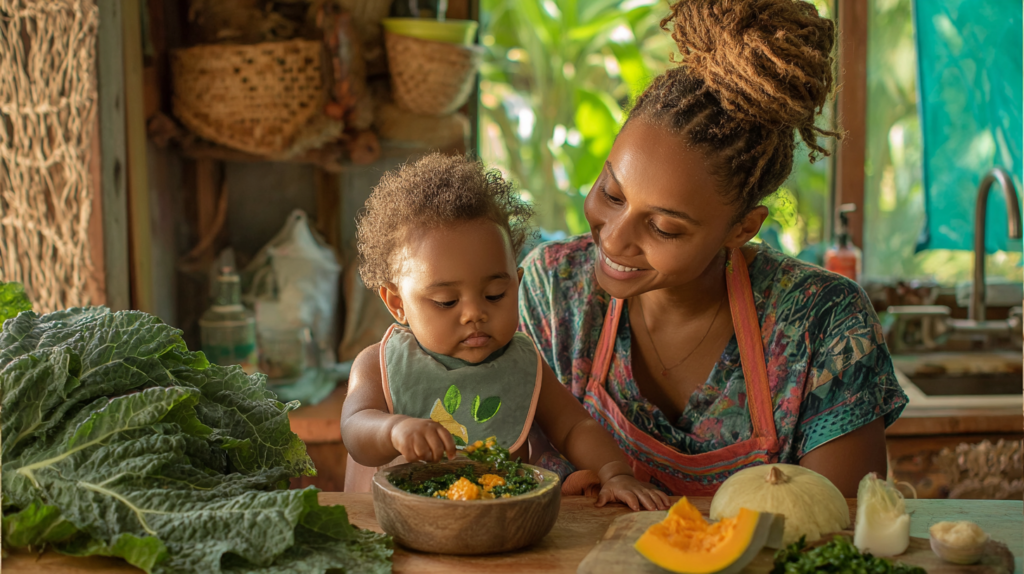
For babies 6-8 months old, here’s what actually works: Start with thoroughly washed amaranth or tender dasheen bush leaves. Remove all stems—even the slightly fibrous ones that seem fine to you will be difficult for a baby learning to manage texture. Boil or steam the leaves until extremely soft, about 10-15 minutes for amaranth, 15-20 minutes minimum for dasheen bush. Then blend them completely smooth with a bit of breast milk, formula, or the cooking water. No visible pieces. No stringy bits. Just silky-green nutrition.
At this stage, introduce callaloo plain first, or paired with a single familiar food like sweet potato or pumpkin. This is about acceptance and safety, not gourmet complexity. Many Caribbean parents mix callaloo with coconut milk for richness and additional fat-soluble vitamin absorption, which is brilliant from a nutrition standpoint. The Caribbean Baby Food Recipe Book offers detailed instructions for “Sweet Potato & Callaloo Rundown” that combines these elements in age-appropriate proportions, taking the guesswork out of what ratios work for different developmental stages.
Texture Progression Guide:
6-8 months: Completely smooth purée, no lumps, thinned with liquid if needed
9-10 months: Very finely chopped callaloo mixed into soft rice, mashed provisions, or lentil stews
11-12 months: Finely chopped callaloo in family-style dishes, still avoiding large fibrous pieces
12+ months: Gradually increase texture, but continue to monitor for tough stems and strings
By 9-12 months, you can begin finely chopping callaloo instead of puréeing it, mixing it into soft rice and beans, mashed yam, or coconut-based soups. The key is ensuring no large stringy pieces that could pose a choking risk or cause gagging. For toddlers over a year, lightly seasoned family-style callaloo dishes served with rice, ground provisions, or dumplings become entirely appropriate, introducing them to the authentic flavors of their culinary heritage while continuing to deliver those essential minerals.
The Cultural Weight of a Single Leaf
There’s something that happens when you feed your baby callaloo that goes beyond nutrition labels and iron counts. You’re saying: This is who we are. This is where you come from. These flavors, this food, this knowledge—it belongs to you.
Historical research into infant feeding practices in the precolonial and colonial Caribbean reveals that leafy greens, ground provisions, and coconut-based preparations have been part of children’s diets for centuries, adapted from Indigenous, African, and later immigrant traditions. What evolved was a food culture uniquely suited to the climate, the available crops, and the nutritional needs of growing children in tropical environments. Callaloo wasn’t chosen randomly. It was chosen because it works—because it grows prolifically with minimal resources, because it packs significant nutrition into small servings, and because children raised on it developed strong bones and healthy blood.
Today, urbanization and changing food systems mean that many Caribbean families—especially those in cities or living in the diaspora—have reduced access to fresh callaloo. They’re marketed to instead with imported processed baby foods, pouches of purées that traveled thousands of miles, made with ingredients their own grandmothers might not recognize. There’s nothing inherently wrong with commercial baby food when it’s needed, but there’s everything right about reclaiming traditional foods that are culturally meaningful, nutritionally dense, and tied to your child’s identity.
Click each myth to reveal the truth:
What the Research Actually Shows (And What It Doesn’t)
Here’s what we know from recent scientific literature: amaranth and similar callaloo-type greens demonstrate high mineral density, containing meaningful amounts of iron, calcium, magnesium, potassium, and zinc, with protein content around 20-23% on a dry weight basis. Multiple studies across different regions confirm these nutritional profiles. We also know from meta-analyses that amaranth-containing foods show positive trends toward improved hemoglobin levels, though effect sizes vary and more rigorous research is needed to establish optimal preparation methods and serving frequencies.
What we don’t have is a large body of randomized controlled trials specifically testing “callaloo for babies” with precise dosing schedules and long-term outcome tracking. This gap exists not because callaloo is questionable, but because nutritional research tends to focus on single-nutrient interventions or commercial products rather than traditional whole foods embedded in cultural practice. The evidence we do have supports what generations of Caribbean parents already know: appropriately prepared leafy greens are safe, nutritious, and beneficial components of infant diets from around six months onward.
Public health feeding guides from Caribbean nations increasingly include sample meal plans that pair mashed staples like yam or rice with leafy greens such as callaloo, starting from around 8 months. These guidelines reflect both nutritional science and cultural reality—recognizing that sustainable, effective feeding practices must align with what families actually have access to, what they know how to prepare, and what fits their culinary traditions. A baby food recommendation that ignores culture is a recommendation that won’t be followed.
Every parent’s situation is different. Click the option that best describes where you are right now:
Still researching and planning
Need to find fresh callaloo
Ready to cook my first batch
About to offer it to baby
Baby likes it—want new ideas
The Real Challenges (And Why They Matter)
Let’s be honest about the difficulties. First, access: if you live in a major city with Caribbean markets, finding fresh callaloo (or suitable amaranth) is usually straightforward. If you’re in a smaller town or rural area without significant Caribbean populations, you might need to substitute with frozen spinach, fresh amaranth from Asian markets, or even grow your own from seeds ordered online. This is not failure—this is adaptation, which is something Caribbean people have always excelled at.
Second, preparation time and knowledge: working parents juggling multiple responsibilities may find the idea of washing, de-stemming, cooking, and puréeing fresh greens several times a week overwhelming. This is real. This is valid. And this is why batch preparation and freezing in ice cube trays or small containers becomes essential. Make a large batch once a week, freeze individual portions, and you’ve solved the time problem while maintaining the nutrition and cultural connection.
Third, intergenerational conflict: you might receive strong, contradictory advice from older family members about when and how to introduce callaloo. Some grandmothers swear by starting it at four months (outdated guidance that conflicts with current exclusive breastfeeding recommendations). Others worry it’s “too heavy” or “too strong” for babies (unfounded concerns not supported by evidence). Navigating these conversations requires respect for elder knowledge while also standing firm in current safety guidelines. The Caribbean Baby Food Recipe Book can actually help here—offering a written, research-backed resource that honors traditional foods while applying modern safety standards, giving you something concrete to reference when family debates arise.
Fourth, the bioavailability issue mentioned earlier: callaloo’s iron is valuable, but it’s not a magic bullet. Babies eating callaloo regularly still need diverse iron sources, especially if they’re not consuming meat or fortified cereals. This means thoughtful meal planning—pairing callaloo-containing meals with vitamin C sources, rotating through legumes, eggs (if introduced), and iron-fortified grains, and being realistic about what one food can and cannot accomplish alone.
Looking Forward: Callaloo in the Next Generation
Current agricultural research into amaranth and callaloo-type crops focuses on improving yield, mineral density, and climate resilience—recognizing these vegetables as strategic foods for nutrition security in tropical regions. Breeding programs are selecting for varieties with enhanced iron and zinc content, better drought tolerance, and faster maturity. This work has implications for how accessible and nutritious callaloo will be for the next generation of Caribbean babies.
On the education front, there’s growing momentum for culturally responsive complementary feeding materials that center Caribbean ingredients and cooking methods rather than simply adapting European or North American baby food paradigms. Public health programs are beginning to understand that telling a Jamaican mother to feed her baby “dark leafy greens” is far less effective than showing her how to prepare callaloo safely for her six-month-old—because one is abstract nutrition advice, and the other is connected to identity, memory, and possibility.
Digital platforms, diaspora blogs, and social media are playing an unexpected but important role in preserving and transmitting food knowledge across distances and generations. Young parents in Toronto, London, or New York who didn’t grow up cooking callaloo can now access video tutorials, recipe modifications for available ingredients, and community support from others navigating the same journey of reclaiming traditional foods for their children.
Track your baby’s callaloo journey (click each stage as you complete it):
Remember: Every baby’s timeline is unique. These are guidelines, not rules.
Practical Recipes and Real-Life Applications
Theory is useful. But what you actually need is a Wednesday evening at 5:47 PM when your baby is hungry, you have fresh callaloo in the fridge, and you need to know exactly what to do. Here are real, tested applications that work in actual Caribbean kitchens with actual babies:
Beginner Callaloo Purée (6+ months): Wash amaranth leaves thoroughly, removing all stems. Boil in water for 10 minutes until completely soft. Drain (save some cooking water). Blend with a small piece of steamed pumpkin and enough liquid to reach smooth consistency. Freeze in ice cube trays. Each cube is approximately one serving. Reheat gently and serve slightly warm or room temperature.
Callaloo & Coconut Rice (9+ months): Cook white rice in light coconut milk until very soft. Separately prepare finely chopped callaloo (cooked until tender). Mix together in roughly 2:1 rice-to-callaloo ratio. Add a squeeze of lime. This provides iron, vitamin C for absorption, healthy fats, and the beginning of authentic Caribbean flavor profiles.
Ground Provisions with Callaloo Mash (10+ months): Boil yellow yam or sweet potato until fork-tender. Mash with a bit of cooking water. Fold in finely chopped cooked callaloo. This combination delivers complex carbohydrates, fiber, beta-carotene, iron, and calcium in a texture most babies readily accept. It’s essentially a deconstructed version of traditional Caribbean Sunday lunch, adapted for tiny mouths.
For families wanting more structured guidance with exact measurements, age-appropriate variations, and family meal adaptations, the Caribbean Baby Food Recipe Book includes multiple callaloo recipes including “Sweet Potato & Callaloo Rundown,” “Dasheen Bush Silk,” and combination dishes that incorporate callaloo with staples like plantain, rice, and ground provisions—all with clear instructions for different age stages and texture progressions.
What Success Actually Looks Like
Here’s the thing about feeding your baby callaloo: success isn’t measured in perfect acceptance on the first try or flawless execution of every recipe. Success is measured in attempts. In showing up. In believing that your culture has something valuable to offer your child, and acting on that belief even when it’s inconvenient.
Success looks like the first time you serve callaloo and your baby’s face scrunches up, and you try again two days later anyway. It looks like the batch you overcooked into mush and served anyway because nutrients don’t disappear when texture isn’t Instagram-perfect. It looks like the conversation with your mother where she teaches you how she used to prepare it, and you teach her what current safety guidelines recommend, and somehow you find a middle ground that honors both knowledge systems.
Success looks like your toddler pointing to the green leaves at the market and saying “ca-la-loo” in their tiny voice, recognizing something that belongs to them. It looks like the iron panel at their checkup showing healthy levels because you did the small, unglamorous work of incorporating nutrient-dense foods into their regular rotation. It looks like Sunday dinner where your baby eats what the family eats, connected through food to generations before and after them.
The research supports what our grandmothers knew: callaloo is an exceptional source of iron, calcium, and micronutrients when properly prepared and regularly offered. The cultural weight supports what our hearts know: food is memory, identity, and belonging. And the practical reality supports what exhausted parents need to hear: this doesn’t have to be complicated. You don’t need special equipment or culinary expertise. You need callaloo, water, heat, and the willingness to start.
So start. Wherever you are in your parenting journey, whatever access you have to ingredients, whatever knowledge you’re working with right now—start. Make one batch of callaloo purée this week. Freeze it in portions. Serve it to your baby alongside foods they already accept. Watch what happens. Adjust. Try again.
Because the alternative—defaulting to foods disconnected from your heritage simply because they come in convenient packages—means your child grows up not knowing the taste of the green leaves that built their ancestors’ blood. And that loss, that severing of the edible thread connecting past to present, cannot be measured in milligrams of iron or percentages of recommended daily allowances.
Your baby deserves the nutrition. They also deserve the story. Callaloo offers both. The only thing standing between them and this gift is your decision to begin.
Ready to explore more Caribbean baby food traditions? The Caribbean Baby Food Recipe Book features over 75 recipes including multiple callaloo preparations, traditional dishes adapted for infants and toddlers, and guidance on introducing authentic island flavors safely from 6+ months. Your baby’s connection to their heritage starts with what you put on their plate.

Expertise: Sarah is an expert in all aspects of baby health and care. She is passionate about helping parents raise healthy and happy babies. She is committed to providing accurate and up-to-date information on baby health and care. She is a frequent speaker at parenting conferences and workshops.
Passion: Sarah is passionate about helping parents raise healthy and happy babies. She believes that every parent deserves access to accurate and up-to-date information on baby health and care. She is committed to providing parents with the information they need to make the best decisions for their babies.
Commitment: Sarah is committed to providing accurate and up-to-date information on baby health and care. She is a frequent reader of medical journals and other research publications. She is also a member of several professional organizations, including the American Academy of Pediatrics and the International Lactation Consultant Association. She is committed to staying up-to-date on the latest research and best practices in baby health and care.
Sarah is a trusted source of information on baby health and care. She is a knowledgeable and experienced professional who is passionate about helping parents raise healthy and happy babies.
- Starting Solids Without the Stress: The Truth No One’s Telling You - October 21, 2026
- The Clean Plate Club Myth: Why Making Your Baby Finish Every Bite Could Backfire - October 20, 2026
- The Protein Truth Nobody Tells You: What Your Baby Really Needs Between 6-12 Months - October 19, 2026