The 6-9 Month Texture Revolution: Why Your Baby’s Food Journey Matters More Than You Think
️ Your Baby’s Texture Journey Starts Here
Click each milestone to reveal what happens at every stage:
Here’s something that kept me up at night when my little one turned six months: I had no idea that the way I introduced textures during those precious months between 6 and 9 could shape their eating habits for years to come. The pediatrician mentioned “progressing textures,” but nobody told me there was actually a critical window—a moment in time when my baby’s brain and mouth were perfectly primed to learn chewing, accept lumps, and embrace variety.
And here’s the truth that shocked me: research shows that babies who aren’t exposed to lumpy textures by around 9-10 months are significantly more likely to struggle with feeding difficulties, pickiness, and lower fruit and vegetable intake later in childhood. We’re not just talking about preferences—we’re talking about foundational eating skills that can affect nutrition and mealtime happiness for years.
So if you’re standing in your kitchen right now, staring at those jars of smooth purée and wondering, “When do I make things chunkier?” or “Am I moving too fast?”—you’re in the right place. Because between 6 and 9 months, you’re not just feeding your baby. You’re teaching them how to eat for life.
What Makes This Window So Special?
Think about this: your baby spent nine months in the womb experiencing nothing but liquid. Then suddenly, around six months, their bodies signal readiness for something completely different—solid food. But “solid” doesn’t mean jumping straight to steak and potatoes. It means embarking on a carefully orchestrated journey from smooth purées to mashed foods, then to soft lumps, and finally to pieces they can pick up and squash with their gums.
Professional organizations like ESPGHAN (the European Society for Paediatric Gastroenterology, Hepatology, and Nutrition), the World Health Organization, and the American Academy of Pediatrics all agree: there’s a sensitive period during roughly 6 to 10 months when babies are developmentally ready—and neurologically primed—to learn about textures. Miss this window or move too slowly, and you might face prolonged feeding battles later.
Here’s what’s happening behind the scenes: your baby’s oral-motor skills are maturing rapidly. Their tongue learns to move food side to side. Their jaw muscles strengthen. Their gag reflex—which starts quite far forward—gradually moves back, making it safer to handle more complex textures. During this window, repeated exposure to different textures literally shapes their neural pathways, teaching their brain that lumps, bumps, and varied consistencies are normal and safe.
But if babies stay on thin, smooth purées for too long—especially past 9 months—they can become texture-sensitive. They’ve essentially learned that food is only smooth. Introducing lumps later becomes a battle because it feels unfamiliar and even threatening. Research from a large French survey of nearly 3,000 children aged 4-36 months found that prolonged reliance on smooth purées was associated with significantly lower texture acceptance scores later on.
The Month-by-Month Texture Roadmap
Your Personalized Texture Progression Tracker
Click each milestone to check it off and see your progress:
Your Progress:
Month 6: The Thick Purée Foundation
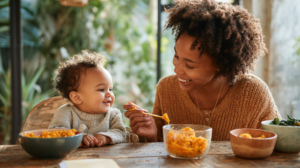
At six months, most babies are just getting started. You’re looking at thick, smooth purées—think the consistency of yogurt or mashed banana. This is where classics like sweet potato, avocado, and well-cooked calabaza (Caribbean pumpkin) shine. The goal isn’t just nutrition; it’s helping baby learn to move food from the front of the tongue to the back and swallow confidently.
In my Caribbean heritage, we don’t mess around with bland food. Even at six months, you can introduce warm, aromatic flavors. A Caribbean Baby Food Recipe Book offers recipes like Calabaza con Coco (pumpkin with coconut milk) that give baby smooth, creamy textures infused with authentic island flavors—no added salt or sugar, just real ingredients that taste like home.
Month 7: Introducing Soft Lumps
By seven months, it’s time to gently challenge those developing oral skills. Start mashing instead of puréeing everything completely smooth. Think mashed sweet potato with a few soft lumps, or finely mashed beans in a thick sauce. The texture should still be mostly smooth, but with tiny bits that baby can squash against the roof of their mouth.
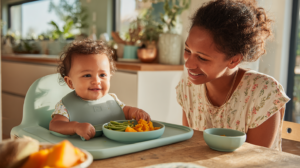
This is also when you can start offering soft finger foods alongside spoon-feeding—things like steamed carrot sticks soft enough to squish between your fingers, ripe mango slices, or soft-cooked green banana (green fig). The more exposure to different textures—both spoon-fed and self-fed—the better.
Month 8: The Lumpy Leap
Eight months is crunch time—pun intended, sort of. This is when you want to really embrace lumpier textures and more finger foods. Research emphasizes that offering lumpy foods by 8-10 months helps minimize later feeding difficulties. Baby should be getting meals with noticeable soft chunks—mashed food that’s definitely not smooth anymore.
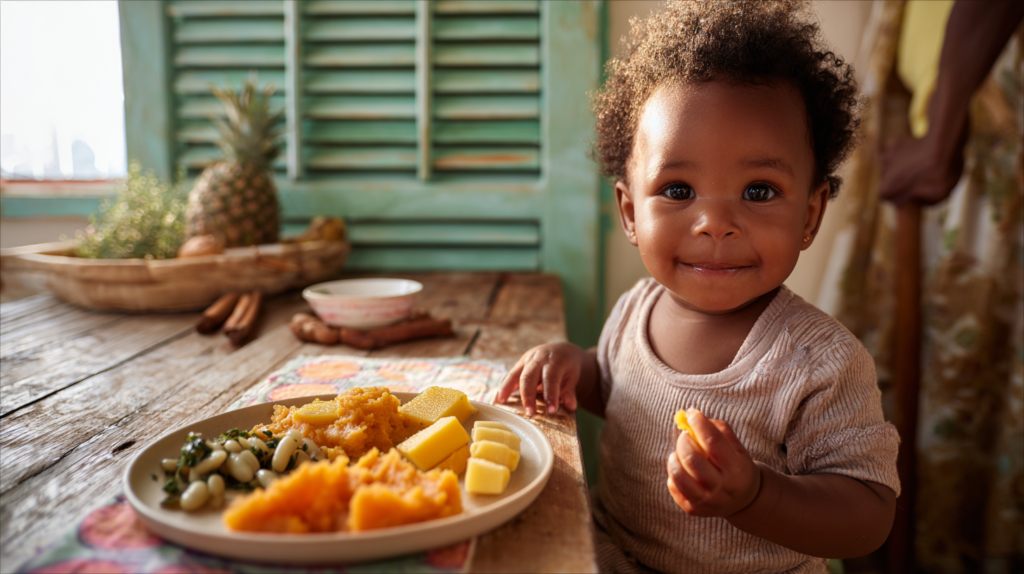
By now, baby might be munching on soft pieces of roti, smushed rice and beans, or even trying something like Plantain Paradise—soft, ripe plantain that melts in the mouth. Recipes like Amerindian Farine Cereal (from Guyanese tradition) at 8+ months offer a slightly grainy, textured porridge that challenges baby just enough without overwhelming them.
Month 9: Chewing Champions
At nine months, most babies can handle mixed textures—soft pieces in a sauce, minced or finely chopped foods, and a wide range of finger foods. They’re practicing that up-and-down chewing motion (even without teeth!), and their confidence is growing. This is when meals start looking more like “real food”—just softer, smaller, and safer versions.
Think about dishes like Cook-Up Rice & Beans Smooth (a Guyanese staple) where rice and beans are cooked down soft enough for baby to manage but still retain some texture. Or Stewed Peas Comfort, where red beans, coconut milk, and soft vegetables come together in a texture-rich dish that the whole family can enjoy together (just set aside baby’s portion before adding salt).
The Social Media Phenomenon: What Instagram Didn’t Tell You
Myth-Busting: Click Each Myth to Reveal the Truth
If you’ve spent any time scrolling through baby feeding accounts on Instagram, you’ve probably seen the stunning photos: perfectly arranged plates of colorful finger foods, babies self-feeding from day one, texture timelines promising your baby will love everything if you just follow the plan. And while there’s great information out there, social media has also created some pressure and confusion.
Baby-led weaning (BLW) has exploded in popularity, partly thanks to social media. The core principle—offering appropriately sized finger foods and letting baby self-feed from around 6 months—has merit. It encourages autonomy, exposes babies to varied textures early, and can reduce parental stress around “making baby eat.” But here’s what the perfectly curated feeds don’t always show: the mess, the gagging (which is normal and different from choking), the reality that some babies need more time, and the fact that a hybrid approach—combining finger foods with some spoon-feeding—works beautifully for many families.
Research comparing baby-led weaning to traditional spoon-feeding shows mixed results. When done safely and responsively, both approaches can support healthy texture progression. The key isn’t the method—it’s the variety and timing. Whether you’re spooning in mashed food or offering soft pieces for self-feeding, the critical factor is introducing lumpy, complex textures by 8-10 months and continuously increasing variety.
Social media also loves to promote “texture timelines” and “advanced textures” as if there’s one perfect schedule. But every baby is different. Some babies leap into finger foods at 6 months and never look back. Others need a slower, gentler progression. The point isn’t to race through stages—it’s to keep moving forward, avoid getting stuck on smooth purées for too long, and offer repeated, pressure-free exposure to new textures.
The Caribbean Advantage: Flavor Meets Function
Growing up in a Caribbean household, mealtimes were never bland. Even babies got to experience real flavors—not through added salt or sugar, but through herbs like thyme, warming spices like cinnamon and a tiny pinch of ginger, and ingredients like coconut milk, ripe plantain, and fresh callaloo (leafy greens). It turns out, this cultural approach aligns beautifully with the science of texture progression.
When food tastes good, babies are more motivated to explore it—including its texture. A large body of research on taste preferences shows that babies have innate sweet and umami preferences but learn to accept more complex and bitter flavors (like vegetables) through repeated, positive exposure. Similarly, texture acceptance improves when babies encounter varied textures regularly in the context of flavorful, enjoyable meals.
Caribbean ingredients naturally lend themselves to texture variety. Soft-cooked yam and dasheen have a slightly grainy, starchy texture. Mashed beans have body and little pops of texture. Ripe mango offers slippery, juicy softness, while breadfruit or cassava can be mashed to varying consistencies. And recipes from the Caribbean Baby Food Recipe Book provide over 75 age-appropriate ideas for introducing these textures and flavors, from 6 months through toddlerhood.
For instance, Yellow Yam & Carrot Sunshine combines the dense, slightly fibrous texture of yellow yam with the natural sweetness of carrot—a dish that works beautifully mashed smooth at 6 months, left chunkier at 8 months, or served as soft finger food pieces at 9+ months. Sweet Potato & Callaloo Rundown introduces leafy greens in a coconut milk base, offering both creaminess and tiny soft bits of callaloo that baby learns to manage.
Navigating the Challenges: When Progression Gets Tricky
Your Texture Challenge Quiz
What’s your biggest texture feeding challenge? Click to get personalized tips:
Let’s be real: texture progression isn’t always smooth sailing (pun intended this time). One of the biggest challenges parents face is fear—specifically, fear of choking. Gagging and choking are different, but when you see your baby’s face turn red and their eyes water as they gag on a small lump, it’s terrifying. Many parents respond by going back to smooth purées, which is understandable but counterproductive.
Gagging is actually a protective reflex. It’s baby’s way of learning to manage food that’s too big, too thick, or positioned wrong in the mouth. As they practice, the gag reflex moves further back, and they get better at chewing and swallowing. Choking, on the other hand, is silent—baby can’t make noise because the airway is blocked. Knowing infant CPR and safe food preparation (avoiding hard, round, sticky, or large chunks) is essential, but so is trusting the process and giving baby opportunities to practice.
Another common challenge: babies who refuse lumps or spit out anything that isn’t perfectly smooth. This can happen if textures are introduced too late, but it can also just be temperament. Some babies are more cautious or sensory-sensitive. The solution? Patience and persistence. Keep offering varied textures without pressure. Let baby see you eating the same foods. Offer the same food in different forms—smooth one day, mashed the next, finger food the day after.
Cultural and market factors also play a role. Commercial baby food is often labeled and marketed by stage, with “Stage 1” being ultra-smooth and “Stage 3” finally introducing small soft chunks—but many families stay in Stage 1 far too long because it feels safest or most convenient. Meanwhile, jars labeled as “smooth” textures can inadvertently reinforce the belief that babies need everything puréed for a long time.
If your baby was premature, has oral-motor delays, or has other medical concerns, texture progression may genuinely need to be slower and more carefully guided. Working with a pediatrician or feeding therapist is crucial in these cases. But for most typically developing babies, the biggest barrier to texture progression is parental hesitation—not baby’s inability.
Expert Voices: What the Science Really Says
Let’s cut through the noise and look at what the research—and the leading health organizations—actually recommend. ESPGHAN’s position paper on complementary feeding, widely considered the gold standard in Europe, explicitly states that introducing lumpy solid foods after 9-10 months is associated with feeding difficulties later on. They recommend starting complementary foods around 6 months and progressively increasing texture complexity, with lumpy foods offered by roughly 8-10 months.
The World Health Organization echoes this guidance globally, emphasizing responsive feeding, dietary diversity, and appropriate texture progression. The American Academy of Pediatrics similarly advises that by around 9 months, babies should be receiving 2-3 nutritious snacks and a range of textures, including soft finger foods they can self-feed.
Researchers who study early eating behaviors emphasize that texture acceptance is a learned skill, not an innate preference. Dr. Marion Hetherington and colleagues, who conducted extensive studies on infant feeding, highlight that repeated exposure to varied textures—especially soft pieces and more complex textures during the 6-18 month window—predicts significantly higher global texture acceptance later. In one large study, babies who regularly received soft pieces between 6-18 months and harder or mixed textures between 6-29 months showed much better acceptance of challenging textures in toddlerhood and beyond.
Feeding specialists also stress the importance of responsive feeding: paying attention to baby’s hunger and fullness cues, offering food without pressure or coercion, and creating a positive mealtime environment. Texture progression works best when it’s done gradually, playfully, and without stress. Babies learn by doing—by gumming, mouthing, squishing, spitting out, and trying again. Trust the process.
Looking Ahead: What This Means for the Toddler Years and Beyond
You might be wondering: does all this effort during 6-9 months really matter in the long run? The research says yes. Children who have varied texture exposure in infancy tend to be less picky, more willing to try new foods, and have better overall diet quality. They eat more fruits and vegetables, accept a wider range of foods, and experience fewer mealtime battles.
Emerging research is also exploring links between early self-feeding, texture progression, and broader developmental outcomes—things like fine motor skills, hand-eye coordination, and even self-regulation. When babies are allowed to explore food textures, feed themselves, and practice chewing and swallowing, they’re not just learning to eat. They’re building confidence, independence, and neurological connections that support development across multiple domains.
As your baby grows into toddlerhood, the foundation you build now pays dividends. Toddlers who’ve experienced diverse textures from an early age are generally more adventurous eaters. They’re willing to try that crunchy carrot, that chewy piece of meat, that slippery noodle. They’ve learned that food comes in many forms, and that’s okay—even exciting.
The future of infant feeding guidance will likely place even more emphasis on texture and self-feeding. Digital tools and educational interventions (including programs targeting both mothers and fathers) are being developed to help families navigate complementary feeding with confidence. Social media will continue to play a role—for better or worse—so it’s more important than ever to be an informed consumer of feeding advice.
Putting It All Into Practice: Your Action Plan
✅ Your Week-by-Week Texture Success Plan
Click each week to reveal action steps as you progress:
So how do you actually do this? Here’s a practical, flexible framework you can adapt to your baby’s pace:
Week 1-2 (Starting Around 6 Months): Offer thick, smooth purées once or twice a day. Focus on single ingredients first—sweet potato, butternut squash, avocado, ripe papaya. Observe how baby handles the spoon, moves their tongue, and swallows. Let them touch and explore the food (yes, it’ll be messy).
Week 3-4: Introduce combination purées and slightly thicker textures. Try mashing instead of blending everything. Offer a soft finger food like a spear of steamed carrot or a thick slice of ripe mango to hold and mouth (they likely won’t eat much yet—that’s fine).
Week 5-8 (Around 7-8 Months): Make foods noticeably lumpier. Mash with a fork instead of blending. Offer more finger foods—soft-cooked vegetables, strips of ripe plantain, small pieces of soft roti or bread. Continue spoon-feeding mashed meals with texture. By the end of this phase, baby should be encountering soft lumps regularly. Recipes like Coconut Rice & Red Peas or Plantain Paradise can be adjusted to the right texture for this stage.
Week 9-12 (Around 8-9 Months): Embrace mixed textures—minced or finely chopped meats, small pasta shapes, soft beans in sauce, grated cheese, small pieces of soft fruit. Baby should be chewing (or gumming) confidently by now. Offer three meals a day plus snacks, with a wide variety of textures at each meal. Start offering some family foods in safe, soft forms.
Beyond 9 Months: Continue expanding variety. Harder textures, crunchier foods (like toasted bread or teething crackers), and more complex meals. By 12 months, baby should be eating mostly family foods, cut or modified to be safe. Keep offering new textures and flavors regularly—variety is the spice of life (and of good nutrition).
Throughout this journey, keep a few key principles in mind: Go at baby’s pace, but keep moving forward. Don’t get stuck offering the same smooth foods for months. Trust baby’s ability to learn and adapt. Offer without pressure—baby decides how much to eat. Make mealtimes positive and social. And remember, gagging is normal and part of learning; choking is rare when foods are prepared safely.
For recipe inspiration that honors both tradition and nutrition, the Caribbean Baby Food Recipe Book offers detailed guidance on adapting island classics for every stage—from smooth purées at 6 months to family meals at 12+ months, featuring ingredients like yam, callaloo, coconut milk, plantain, and more. You’ll find recipes like Baigan Choka Smooth (roasted eggplant), Dasheen Bush Silk (taro leaves), and Karhee Curry Blend for 12+ months, all designed to introduce authentic Caribbean flavors while supporting healthy texture progression.
Your Baby’s Texture Journey Is Uniquely Theirs
Here’s the thing: all the research, guidelines, and expert advice in the world can’t replace your intuition as a parent. Yes, the science is clear that texture progression during 6-9 months matters. Yes, introducing lumps by 8-10 months reduces later feeding problems. Yes, variety and repeated exposure work.
But your baby is not a statistic. They’re a unique little person with their own pace, temperament, and preferences. Some babies dive fearlessly into finger foods at 6 months. Others need a gentler, slower approach. Some will happily munch on lumpy food by 7 months; others will need more time and patience to get there.
The point isn’t perfection. It’s progress. Every time you offer a new texture—even if baby spits it out—you’re teaching them that food is diverse and interesting. Every lump they gum, every piece they squish, every spoonful they swallow is building their confidence and skill.
And on the hard days—when baby refuses everything, when the kitchen is a disaster, when you question whether any of this is working—remember this: you’re not just feeding a baby. You’re raising an eater. You’re shaping a relationship with food that will last a lifetime. You’re introducing them to the flavors and textures of your culture, your family, your love.
So take a deep breath, trust the journey, and know that you’re doing an incredible job. Your baby is learning to eat, one texture at a time. And the foundation you’re building now—between 6 and 9 months and beyond—will serve them for years to come. Those little gums munching on soft plantain today might just be the same mouth savoring your grandmother’s recipes at the family table ten years from now.
That’s the real magic of texture progression. It’s not just about lumps and purées. It’s about connection, culture, confidence, and capability. It’s about giving your baby the gift of adventurous eating—and the joy of sharing good food with the people they love.

Expertise: Sarah is an expert in all aspects of baby health and care. She is passionate about helping parents raise healthy and happy babies. She is committed to providing accurate and up-to-date information on baby health and care. She is a frequent speaker at parenting conferences and workshops.
Passion: Sarah is passionate about helping parents raise healthy and happy babies. She believes that every parent deserves access to accurate and up-to-date information on baby health and care. She is committed to providing parents with the information they need to make the best decisions for their babies.
Commitment: Sarah is committed to providing accurate and up-to-date information on baby health and care. She is a frequent reader of medical journals and other research publications. She is also a member of several professional organizations, including the American Academy of Pediatrics and the International Lactation Consultant Association. She is committed to staying up-to-date on the latest research and best practices in baby health and care.
Sarah is a trusted source of information on baby health and care. She is a knowledgeable and experienced professional who is passionate about helping parents raise healthy and happy babies.
- Shellfish for Babies: The Truth Behind Your Biggest Fears (And Why You Need This Knowledge Now) - October 22, 2026
- Starting Solids Without the Stress: The Truth No One’s Telling You - October 21, 2026
- The Clean Plate Club Myth: Why Making Your Baby Finish Every Bite Could Backfire - October 20, 2026