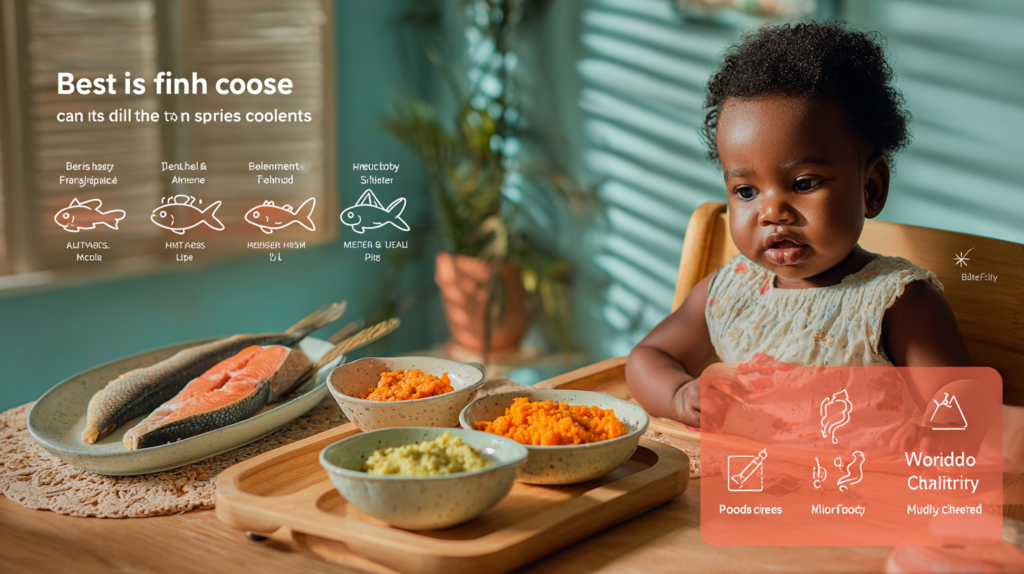
Fish for Baby: The Mercury Truth No One Is Telling You (And What Caribbean Parents Need to Know)
Your Baby’s Fish IQ: Interactive Mercury Safety Calculator
Select the fish you’re considering for your baby, and discover instantly whether it’s safe, how often to serve it, and what makes it special for growing brains.
Here’s something they don’t tell you at the pediatrician’s office or in those glossy parenting magazines: the fish you’re feeding your baby might be robbing them of the very brain development you’re trying to support. And if you’re a Caribbean parent trying to pass down your culture through food—introducing saltfish, snapper, or kingfish the way your grandmother did—you might be caught in an invisible crossfire between tradition and toxicity.
I learned this the hard way when my son turned seven months old and I proudly steamed a piece of what I thought was “good local fish” from the market. An hour later, my mother-in-law—who raised four children on ackee, callaloo, and Saturday morning fish stew—pulled me aside and asked a question that stopped me cold: “You checked the mercury in that, right?” I hadn’t. I didn’t even know I was supposed to.
The truth is, almost every fish contains some level of methylmercury, a potent neurotoxin that bioaccumulates as it moves up the food chain. The bigger and older the fish, the more mercury it carries. And babies—with their rapidly developing brains, smaller bodies, and immature detoxification systems—are far more vulnerable than adults to even trace amounts. Research shows that prenatal and early-life mercury exposure is linked to subtle but measurable deficits in cognition, attention, memory, and language development. Yet here’s the paradox: fish is also one of the most nutrient-dense foods on the planet, packed with DHA omega-3 fatty acids, high-quality protein, iodine, selenium, and vitamins that directly fuel brain growth and immune strength.
So how do you thread this needle? How do you honor your heritage, nourish your baby’s developing mind, and sidestep the hidden dangers lurking in the water? This guide will walk you through the science, the myths, the real-world risks, and the practical strategies that let you confidently put fish on your baby’s plate without the fear or confusion.
The Mercury Reality: What’s Actually Happening in Your Baby’s Body
Methylmercury is not like most food contaminants. It doesn’t wash off. It doesn’t cook out. It binds tightly to proteins in fish muscle, which means the fillet on your plate carries the exact same mercury load as the fish did when it was caught. Once your baby swallows it, methylmercury is absorbed almost completely through the gut, crosses the blood-brain barrier with frightening ease, and accumulates in brain tissue where it disrupts the delicate architecture of developing neurons.
The U.S. Environmental Protection Agency and the Food and Drug Administration have set a reference dose of roughly 0.1 micrograms of methylmercury per kilogram of body weight per day as the level believed to be without appreciable risk. For a typical six-month-old baby weighing about 7 to 8 kilograms, that translates to a tolerance of less than one microgram per day. Most high-mercury fish—like shark, swordfish, king mackerel, and some larger tunas—contain mercury levels between 0.5 and over 1.5 micrograms per gram of flesh. A single small serving of such fish can put an infant over safe exposure limits for days.
Large cohort studies tracking pregnant women and children in high-fish-consumption regions have documented associations between elevated prenatal mercury exposure and lower IQ scores, delayed language acquisition, and attention problems—even when mothers were eating fish for its health benefits. The Seychelles and Faroe Islands studies, two of the longest-running mercury research efforts, show mixed results because they also captured the protective effects of omega-3 fats and selenium in fish, but the consistent takeaway is this: dose matters, and species choice matters even more.
Here’s the part that Caribbean families need to understand: many traditional “Sunday fish” staples—like kingfish, shark, and barracuda—sit at the top of regional food chains and are some of the highest-mercury species you can buy. Meanwhile, smaller, shorter-lived fish like sardines, herring, sprat, and even responsibly sourced tilapia carry negligible mercury and deliver the same or better nutritional punch.
Myth vs. Truth: Fish Edition (Tap to Reveal the Science)
Click each myth to uncover what research actually says.
Mercury levels vary by over 100-fold between species. Salmon, tilapia, sardines, and pollock typically test at 0.01–0.07 µg/g, while swordfish and shark regularly exceed 1.0 µg/g—more than 10–20 times higher. Species choice is the single most powerful tool parents have to control mercury exposure.
Mercury contamination is a global problem driven by industrial emissions that deposit into oceans and bioaccumulate in marine food webs everywhere. Local fish can be just as contaminated—or more—depending on coastal pollution and species type. Safety depends on the fish’s size, age, and diet, not where it was caught.
Methylmercury is chemically stable and heat-resistant. Baking, steaming, grilling, or frying does not reduce mercury content. The only way to lower exposure is to choose low-mercury species in the first place.
Current evidence and guidelines from the American Academy of Pediatrics and major allergy organizations recommend introducing fish (alongside other major allergens) around 4–6 months as part of complementary feeding. Early introduction in age-appropriate forms may actually reduce the risk of developing fish allergy, and the omega-3 benefits are critical during the first year when brain growth is most rapid.
Methylmercury has a half-life of about 50 days in the body, meaning it takes months to fully clear. “Occasional” exposure to high-mercury fish can still result in chronic low-level buildup, especially in babies and toddlers who eat small amounts frequently. It’s safer to build a routine around low-mercury options than to gamble with periodic high-mercury meals.
The Smart Species Strategy: Building a Low-Mercury, High-Benefit Fish Rotation
The FDA and EPA jointly publish a list categorizing fish into “Best Choices,” “Good Choices,” and “Choices to Avoid” for pregnant women, breastfeeding mothers, and young children. These same guidelines apply directly to babies starting solids. Best Choices include fish that are low in mercury and can be eaten two to three times per week. Good Choices are moderate in mercury and should be limited to one serving per week. And Choices to Avoid should never appear on a baby or toddler’s plate.
For Caribbean families, this often means rethinking what “good fish” looks like. Kingfish and shark may be prized culturally, but they’re biologically programmed to concentrate mercury. On the other hand, smaller oily fish like sardines—often overlooked or considered “poor man’s food”—are nutritional powerhouses with virtually zero mercury risk. Salmon, whether wild-caught or farmed, consistently ranks as one of the safest and most omega-3-rich options available globally. Light tuna, particularly skipjack, is also safe in moderation, whereas albacore (white) tuna has three times the mercury and should be limited.
Local favorites like snapper and grouper fall into a gray zone: they’re not the worst offenders, but they’re not the safest either, especially if they’re large, older specimens. If you’re buying whole fish, size is your visual cue. A snapper weighing two or three pounds will have far less accumulated mercury than a ten-pound veteran fish. When in doubt, go smaller, go younger, and rotate species often to minimize cumulative exposure from any single source.
| Fish Type | Mercury Level | Safety Rating for Babies | Serving Frequency |
|---|---|---|---|
| Salmon | Very Low (0.01–0.05 µg/g) | BEST CHOICE | 2–3 times/week |
| Sardines | Very Low (0.01–0.03 µg/g) | BEST CHOICE | 2–3 times/week |
| Tilapia | Very Low (0.01–0.03 µg/g) | BEST CHOICE | 2–3 times/week |
| Pollock | Very Low (0.03–0.06 µg/g) | BEST CHOICE | 2–3 times/week |
| Light Tuna (Skipjack) | Low (0.10–0.15 µg/g) | BEST CHOICE | 2–3 times/week |
| Shrimp | Very Low (0.01 µg/g) | BEST CHOICE | 2–3 times/week |
| Snapper (small) | Moderate (0.15–0.35 µg/g) | Good Choice | Once per week |
| Grouper | Moderate to High (0.25–0.55 µg/g) | Limit Carefully | Once per month or avoid |
| Albacore (White) Tuna | High (0.30–0.40 µg/g) | Limit Carefully | Once per month |
| King Mackerel | Very High (0.70–1.5 µg/g) | AVOID | Never for babies |
| Shark | Very High (0.80–1.5 µg/g) | AVOID | Never for babies |
| Swordfish | Very High (0.90–1.3 µg/g) | AVOID | Never for babies |
| Barracuda | Very High (variable, often >1.0 µg/g) | AVOID | Never for babies |
One practical strategy I use in my own kitchen is the “safe six” rotation: salmon, sardines, tilapia, pollock, light tuna, and shrimp. I keep at least three of these on hand at all times—whether fresh, frozen, or canned—and rotate them across the week so my son gets variety without risk. If you want to incorporate traditional Caribbean fish, reserve them for family meals where adults can enjoy moderate portions, and offer your baby the low-mercury alternatives prepared with familiar seasonings like thyme, garlic, and a hint of coconut milk. You get the cultural connection without the neurotoxic trade-off.
Omega-3 Power: Why Getting Fish Right Matters So Much
Methylmercury is the villain in this story, but omega-3 fatty acids—especially DHA—are the heroes. DHA is a structural building block of the brain and retina, and it’s most critical during the third trimester of pregnancy and the first two years of life when brain growth is explosive. Infants who receive adequate DHA show better visual acuity, improved cognitive performance, and stronger language development compared to those who don’t.
Here’s the challenge: DHA is found almost exclusively in fatty fish and seafood. Plant-based omega-3s from flax, chia, and walnuts provide ALA, which the body converts to DHA at a rate of less than 5 percent—nowhere near enough to meet an infant’s needs. Formula is often fortified with DHA, and breastmilk contains DHA if the mother’s diet includes fish or supplements, but once babies start solids, fish becomes the most direct and bioavailable source.
This is why choosing the right fish isn’t just about avoiding harm—it’s about unlocking potential. A baby eating two small servings of salmon per week is getting roughly 400 to 600 milligrams of DHA, which aligns with expert recommendations. That same baby eating swordfish or kingfish is getting mercury that actively damages the brain structures DHA is trying to build. The difference isn’t subtle; it’s foundational.
Weekly Fish Meal Planner for Babies 6-12 Months
Check off the days as you introduce safe fish meals to track your baby’s omega-3 intake.
Complete your weekly fish rotation for optimal brain-building nutrition!
Preparing Fish Safely: Texture, Temperature, and Bones
Mercury isn’t the only safety concern when feeding fish to babies. Choking risk, bacterial contamination, and allergic reactions are real and manageable with the right preparation techniques. Fish should always be cooked to an internal temperature of at least 145°F (63°C) to kill potential pathogens like Salmonella, Listeria, and parasites. Raw or undercooked fish—including ceviche and sushi—should never be offered to infants.
Bones are another serious hazard. Even small pin bones can lodge in a baby’s throat or puncture soft tissue. When preparing fish for babies under twelve months, debone meticulously. I use a clean tweezer and run my fingers along every section of fillet before cooking. For canned fish like sardines or tuna, mash thoroughly and check for any small, hard fragments.
Texture matters, too. Babies just starting solids (around six months) need fish that’s been flaked into soft, moist pieces or mashed into a spreadable consistency. As they develop their pincer grasp and chewing skills (around eight to nine months), you can offer slightly larger, tender flakes. By ten to twelve months, many babies can handle soft fish cakes or small strips of baked salmon. Always supervise, always offer water, and never rush the developmental progression.
Seasoning is where you can honor your Caribbean roots without compromising safety. Babies under twelve months should avoid added salt, but fresh garlic, a whisper of thyme, a squeeze of lime, and a small amount of coconut milk create familiar, comforting flavors that connect your baby to family meals. The Caribbean Baby Food Recipe Book includes an entire section on safely adapting traditional fish dishes—like Guyanese Fish & Potato (page 106)—for babies, using low-mercury species and age-appropriate textures.
Pro Tip for Caribbean Families: If you’re cooking a traditional fish dish for the family using a higher-mercury species like snapper or grouper, prepare a separate small portion of salmon or tilapia for your baby using the same seasonings and cooking method. Your baby gets the cultural flavors and family connection without the mercury load, and you don’t have to cook two entirely different meals.
Allergy Introduction: The Timing and Technique That Changes Everything
Fish is one of the top nine food allergens, and finned fish allergy can be severe and lifelong. For decades, parents were told to delay fish introduction until age two or three to “prevent” allergies, but current evidence flips that advice on its head. Early introduction—around four to six months, once other signs of readiness for solids are present—may actually reduce the risk of developing fish allergy.
Landmark studies like LEAP (for peanuts) and EAT (for multiple allergens including fish) have shown that regular, early exposure to common allergens in age-appropriate forms leads to lower rates of food allergy compared to delayed introduction. The American Academy of Pediatrics, along with allergy organizations worldwide, now recommends offering fish early and continuing it regularly as part of a varied diet.
The key is how you do it. Start with a very small amount—about a quarter to half teaspoon of well-cooked, mashed fish—on a day when you’re home and alert. Offer it once, wait three to five days while watching for any reaction (hives, vomiting, swelling, difficulty breathing, or unusual fussiness), and if all is well, offer it again. Repeat regularly—at least once per week—to maintain tolerance. Don’t introduce multiple new allergens on the same day, and never force or rush the process.
If your baby has moderate to severe eczema or a known allergy to another food, talk to your pediatrician or a pediatric allergist before introducing fish at home. In some cases, supervised introduction in a medical setting is recommended. But for most healthy babies, introducing fish is straightforward, safe, and one of the most valuable dietary decisions you can make for long-term health.
Safe Fish Shopping List: What to Buy This Week
Check off the items as you shop to build a mercury-safe, omega-3-rich pantry.
The Caribbean Context: Tradition, Access, and Adaptation
For Caribbean families—whether living in the islands or in the diaspora—fish isn’t just food; it’s identity. Saturday morning fish fry, Sunday steamed snapper with okra and breadfruit, saltfish and ackee for breakfast: these are the foods that carry memory, culture, and connection across generations. The idea of “giving up” traditional fish can feel like erasing heritage.
But here’s the reframe: you’re not giving up fish. You’re choosing the safest versions of it for the people you love most. You’re adapting traditions to reflect what we now know about neurotoxicity and child development. And you’re modeling for your children that culture is living, flexible, and responsive—not rigid or dangerous.
Many Caribbean islands have access to smaller local species that are naturally low in mercury. Sprat, herring, flying fish, and sardines are traditional catches in Trinidad, Barbados, and Jamaica, and they’re among the safest fish on earth. If you’re buying from a local market, ask for young, small fish and avoid anything that’s lived long enough to grow large and accumulate toxins. If you’re shopping in North American or European supermarkets, stick with the globally recognized Best Choices list and use Caribbean seasonings to make them taste like home.
The Caribbean Baby Food Recipe Book was created specifically to help parents like you bridge this gap. It takes traditional recipes—like Guyanese Fish & Potato, Sweet Potato & Callaloo Rundown, and Coconut Rice & Red Peas—and adapts them with safe fish options, appropriate textures, and age-specific seasoning guidelines so your baby grows up tasting the islands without the risk.
Real-World Win: One mother I know swapped kingfish for wild-caught salmon in her family’s traditional “brown stew fish” recipe, keeping every other ingredient the same—scotch bonnet (seeds removed), thyme, scallion, tomato, coconut milk. Her toddler devoured it, her mother-in-law approved, and she slept soundly knowing her baby’s brain was protected. Culture preserved, neurotoxin avoided. That’s what smart adaptation looks like.
Navigating the Noise: What to Ignore, What to Trust
Social media is flooded with conflicting fish advice. One influencer says all fish is toxic. Another claims wild-caught is always better. A third insists that organic certifications guarantee safety. Meanwhile, your pediatrician’s handout is five years old and doesn’t mention half the fish you actually eat.
Here’s how to cut through the noise. Trust guidelines from entities that base recommendations on large-scale toxicology data and ongoing surveillance: the FDA, EPA, World Health Organization, and evidence-based pediatric organizations like the American Academy of Pediatrics. These groups update their advice as new research emerges, and their fish consumption recommendations for pregnant women and young children are conservative by design—they build in safety margins to protect the most vulnerable.
Be skeptical of blanket claims. “All fish is dangerous” ignores the overwhelming evidence that low-mercury fish consumption improves child outcomes. “Wild-caught is always safer” isn’t true—wild fish can be just as contaminated depending on the ecosystem. “Mercury-free fish” doesn’t exist; what does exist is fish with mercury levels so low they pose negligible risk when eaten in recommended amounts.
When in doubt, default to species, not source. A small, short-lived fish like sardines will be low-mercury whether it’s wild-caught in the Mediterranean, farmed in Norway, or canned in Thailand. A large, predatory fish like swordfish will be high-mercury no matter where it was caught or how “organic” the label claims it to be.
Living the Safe-Fish Life: Practical Habits That Stick
Knowledge only matters if it translates into action. The families who successfully navigate fish safety aren’t the ones who memorize every microgram of mercury in every species—they’re the ones who build simple, repeatable habits that make safe choices automatic.
Start by identifying three to five safe fish species that your family enjoys and that are accessible where you shop. Write them down. Put the list on your phone or stick it to your fridge. When you’re meal planning or grocery shopping, choose only from that list. This eliminates decision fatigue and the risk of impulse-buying a high-mercury fish because it looked good at the counter.
Batch-prep and freeze. Cook a large salmon fillet, flake it, portion it into small containers or silicone trays, and freeze. Pull one out the night before you need it, and you’ve got instant, safe fish for baby in under five minutes. The same works for canned sardines mashed with avocado or coconut milk—make a big batch, freeze in portions, thaw as needed.
Track frequency loosely. You don’t need a spreadsheet, but a simple mental or written note—”we had salmon twice this week”—helps you ensure your baby is getting regular omega-3s without overdoing any one species. Variety itself is protective, because it dilutes exposure to any contaminant present in a single type of fish.
Teach your child as they grow. By age two or three, start naming the fish they’re eating. “This is salmon—it helps your brain grow strong.” “We don’t eat shark because it’s not safe for little bodies.” You’re building food literacy and self-advocacy skills that will serve them for life, especially if they’re eating outside your home at daycare, school, or with extended family.
Red Flag Alert: If anyone—family, friends, or even a healthcare provider—tells you it’s fine to give your baby king mackerel, shark, swordfish, or large barracuda “just once in a while,” politely ignore them. These fish are not safe for babies at any frequency. Period. No exceptions. Protect your baby’s developing brain by holding that line firmly and without guilt.
Your Baby’s Brain Deserves the Best—and the Safest
There’s a moment in every parent’s journey when you realize that the choices you make today don’t just shape tomorrow—they echo through a lifetime. The fish you serve your seven-month-old isn’t just lunch. It’s the raw material their brain uses to build the neural highways that will carry their thoughts, creativity, language, and memory for the next eighty or ninety years. You have the power to make sure those highways are built from the cleanest, strongest materials available.
Choosing low-mercury fish isn’t about fear. It’s about respect—respect for the science that shows us where the risks are, respect for your child’s developing body, and respect for the traditions you carry forward by adapting them with wisdom. You can feed your baby salmon seasoned with thyme and garlic, sardines mashed with ripe plantain, or tilapia cooked in coconut milk, and give them every bit of the cultural richness they deserve alongside every bit of the brain-building nutrition they need.
Start this week. Pick one safe fish from the list. Cook it simply. Serve it with love. Watch your baby discover a flavor that will fuel their brilliance. And know that you made a choice—an informed, protective, powerful choice—that honors both heritage and health.
The ocean is full of fish. Your baby’s plate doesn’t have to carry the ones that steal potential. Choose wisely, feed confidently, and build a brain that shines.
Your Next Step: Download or screenshot the Best Choices fish list from this article, save it to your phone, and bring it with you the next time you shop. When you get home, cook one safe fish meal using a recipe from the Caribbean Baby Food Recipe Book, and make a note of how your baby responds. That single meal is the first brick in a foundation of brilliant, protected brain health. And it starts right now.

Expertise: Sarah is an expert in all aspects of baby health and care. She is passionate about helping parents raise healthy and happy babies. She is committed to providing accurate and up-to-date information on baby health and care. She is a frequent speaker at parenting conferences and workshops.
Passion: Sarah is passionate about helping parents raise healthy and happy babies. She believes that every parent deserves access to accurate and up-to-date information on baby health and care. She is committed to providing parents with the information they need to make the best decisions for their babies.
Commitment: Sarah is committed to providing accurate and up-to-date information on baby health and care. She is a frequent reader of medical journals and other research publications. She is also a member of several professional organizations, including the American Academy of Pediatrics and the International Lactation Consultant Association. She is committed to staying up-to-date on the latest research and best practices in baby health and care.
Sarah is a trusted source of information on baby health and care. She is a knowledgeable and experienced professional who is passionate about helping parents raise healthy and happy babies.
- Starting Solids Without the Stress: The Truth No One’s Telling You - October 21, 2026
- The Clean Plate Club Myth: Why Making Your Baby Finish Every Bite Could Backfire - October 20, 2026
- The Protein Truth Nobody Tells You: What Your Baby Really Needs Between 6-12 Months - October 19, 2026