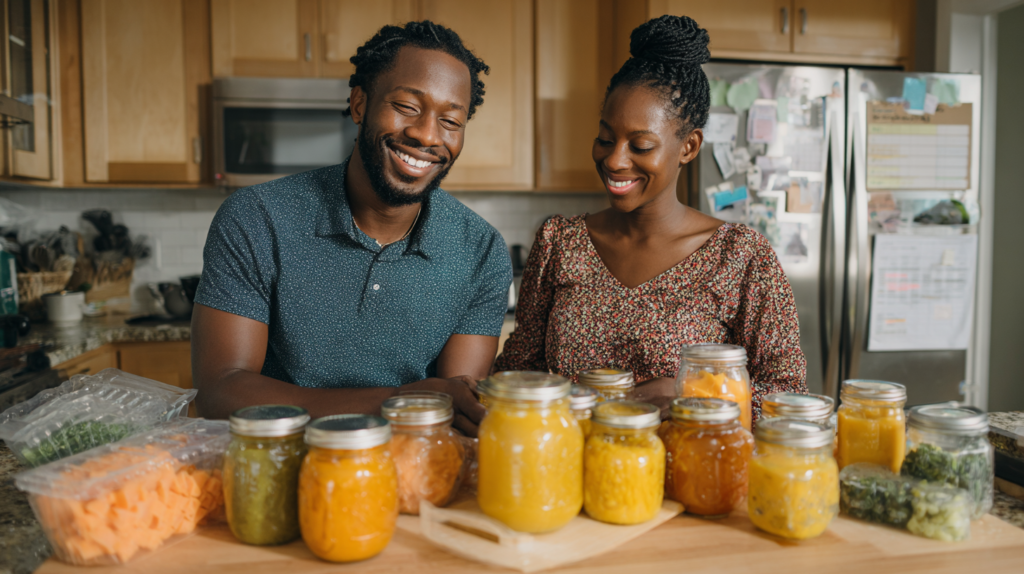
Baby Meal Planning & Prep: The Truth About Safe Storage Times (And How To Stop Guessing)
One evening, after a long day of work and a humid Caribbean sunset outside my kitchen window, I stood staring at a half-finished bowl of pumpkin and coconut milk purée, wondering if it was still safe or if I was about to gamble with my baby’s tummy. That tiny moment of doubt was the spark that turned into a full system for baby meal planning, safe storage, and stress-free feeding.
If you have ever sniffed yesterday’s sweet potato and callaloo mash, held it up to the light like a detective, and whispered, “You safe or not?”—this guide is for you. By the time you reach the end, you will know exactly how long baby food can sit in the fridge, how long it can live in the freezer, and how to build a simple, science-backed routine that works whether you are in Mumbai, Miami, Kingston, or London.
Think of this as your no-guesswork playbook, blending evidence-based food safety with real-life baby chaos and a little island flavor. We are going deep into storage times, batch prep, common mistakes, and some shocking truths about what really happens when baby food hangs out too long in the fridge.
Why Safe Storage Times Matter (More Than You Think)
Babies are not just “small adults” when it comes to food safety. Their immune systems are still in the early learning stages, which means bacteria like salmonella or listeria can cause more serious illness than they would in a healthy adult who eats the same food. That is why global health bodies highlight infant food as a high-risk category and push parents to treat time and temperature as non-negotiable safety tools.
In the last few years, health agencies have sharpened their guidance on baby food handling, emphasizing how quickly bacteria multiply at room temperature and how leftovers that have been warmed and “double-dipped” with a baby spoon should be discarded rather than saved. They are also increasingly vocal about the reality that food poisoning in babies is often invisible online—most families never share that last night’s purée led to a long night of vomiting and worry.
At the same time, there is been a huge comeback of homemade baby food. Parents want control over ingredients, less sugar and salt, fewer additives, and recipes that reflect their culture—like plantain-based mashes, coconut rice and peas, or pumpkin and callaloo inspired by Caribbean kitchens. This homemade movement is beautiful, but it also means more parents are responsible for storage decisions that used to be handled by factories and food technologists.
The Modern Baby Food Landscape: Homemade Revival & Hidden Risks
Walk into almost any parenting forum today and you will see the same mix of photos: neatly labeled freezer trays of purées, glass jars filled with colorful blends, and questions like, “Is this still okay to serve?” or “How long can chicken purée really stay in the fridge?” The last decade has seen an explosion of baby meal-prep culture, as caregivers try to balance tight schedules with the desire to feed babies real, fresh food.
This new landscape is shaped by three big forces: the growth of global baby food markets, the popularity of batch cooking and freezing, and rising awareness about heavy metals and additives in some commercial products. Many families now mix approaches—some commercial pouches for emergencies, some homemade purées on weekends, and family-style meals adapted from everyday dishes like coconut rice and red peas or green fig and avocado mash.
But there is a quiet risk hidden in this enthusiasm. When parents stretch storage times “just one more day,” reheat the same batch twice, or store mixed meals for longer than is recommended, they increase the chances of foodborne illness and reduce the nutrient quality of what their baby eats. In warm or humid climates, such as parts of the Caribbean or India, the margin for error shrinks even more once food leaves the fridge.
Use this as a general guide unless your pediatrician or local health authority advises otherwise:
| Food Type | Fridge (≈4°C) | Freezer (≈−18°C) |
|---|---|---|
| Plain fruit or vegetable purées | 2–3 days | Up to 3 months |
| Cooked meat, poultry, or fish purées | 1–2 days | 1–2 months |
| Mixed meals (e.g., meat + veg, grain + veg) | Up to 2 days | About 1 month |
| Expressed breast milk (in fridge-safe container) | Up to 4 days | Up to 6 months (best quality within 3) |
| Prepared infant formula | Up to 24 hours | Freezing not recommended |
These windows assume you cooled food quickly, stored it in clean containers, and kept it chilled at a safe temperature. If anything stayed out on the counter for more than two hours (or one hour in very hot weather), it is safer to discard rather than save “just in case.”
Interactive Reality Check: Do You Know Your Storage Basics?
Before going further, test yourself with a short no-pressure quiz. The goal is not perfection—it is to show you where tiny habits may be putting your baby’s food quality at risk without you realizing it.
One of the most surprising truths for many parents is that the leftovers from your baby’s spoon or bottle are often the riskiest. As soon as saliva mixes with warm food or formula, bacteria can grow quickly, so those leftovers are meant for the bin, not for “one more meal.” It feels wasteful in the moment, but long nights with a sick baby are far costlier than a spoonful of discarded food.
Another often-missed detail is that freezer time is more about quality than absolute safety. Food kept deeply frozen will not suddenly “go bad” on day 91, but flavors, textures, and some vitamins slowly decline. For babies just learning to love vegetables and spices, tasting dull, freezer-burned purée is hardly the first impression you want them to have of pumpkin, callaloo, green papaya, or malanga.
Meet Your Fridge & Freezer: The Estimator That Ends Guesswork
Instead of memorizing dozens of exact numbers, you can rely on a simple pattern: the higher the risk food (like meat or fish), the shorter its fridge life, and the more cautious you are with mixed meals that combine proteins and grains. A quick mental check of “What is in this purée?” gives you a strong clue about how long it can safely stay chilled.
Use the mini estimator below as a rule-of-thumb helper. It does not replace professional advice or local guidelines, but it gives a practical range you can use right away when planning batches of baby food.
Think of your fridge as a short pause button and your freezer as a temporary time capsule. The fridge keeps flavors and textures closer to fresh but demands faster turnover, while the freezer lets you batch cook Caribbean-inspired baby meals like coconut rice and red peas purée or plantain mash and stretch them over weeks. The magic is in matching the storage method to your real schedule instead of the fantasy version of your life where you always cook fresh.
That is why a lot of parents swear by weekend batch prep: choosing two or three base recipes, dividing them into cubes, and building a mini “baby buffet” in the freezer. If you love the idea of exploring flavors like calabaza with coconut milk, green fig and avocado blends, or millet with cinnamon, you will find even more structured ideas inside the Caribbean Baby Food Recipe Book: Easy & Healthy Homemade Meals for Infants & Toddlers , which pairs storage tips with 75+ recipes based on ingredients such as sweet potato, plantain, mango, and beans.
From Overwhelm To Routine: Choosing Your Batch-Prep Style
Not every household runs on the same rhythm. Some parents love one big Sunday cook-up, filling the kitchen with steam, spices, and labeled trays. Others prefer smaller, more frequent batches to match an unpredictable work schedule or limited fridge space. There is no single “right” way—only the way you can realistically repeat without burning out.
Growing up in a Caribbean home, weekend pots were a ritual. On one side of the stove, there was always a big batch of rice and peas or dhal bubbling away; on the other, some mix of pumpkin, callaloo, yam, or plantain. Adapting that tradition for baby feeding is surprisingly natural: the family eats the main meal, and the baby gets a smoother, unsalted version, cooled quickly and portioned into small containers for the next two or three days or frozen for future use.
Tap the path that feels closest to your current life and see a simple storage-focused strategy.
Whatever path you choose, two habits make the biggest difference: cooling food fast and labeling without fail. Spreading hot purée in a shallow dish before refrigerating helps it pass through the “danger zone” temperatures more quickly, especially in hot climates. Labeling with the recipe and date turns your fridge and freezer into a trustworthy system instead of a guessing game fueled by “I think I made this last week… maybe.”
For example, if you batch cook “Sweet Potato & Callaloo Rundown” inspired purée, you might chill a portion in the fridge for the next day and freeze the rest in small cubes dated for the month ahead. On a hectic Wednesday, you can easily combine a cube of that with a cube of “Yellow Yam & Carrot Sunshine” style mash for a balanced, colorful meal without starting from scratch.
The Shocking Truths About Baby Food Storage (Nobody Warned You About)
Safe storage is not just a matter of “how long” and “how cold.” There are deeper realities that often go unmentioned in glossy meal-prep reels and perfectly staged kitchen photos, especially when it comes to baby food made from real, whole ingredients.
One truth is that storage does nothing to fix heavy metals that may be present in ingredients like rice, some root vegetables, or certain grains. No matter how carefully you refrigerate or freeze, those metals remain. That is why rotating ingredients—using millet, oats, or root vegetables like dasheen and malanga along with rice—and offering variety becomes a quiet form of risk reduction.
Another lesser-known truth is how much micro-decisions about containers matter. Stained plastic with tiny scratches can hold onto residues and become harder to clean properly, especially when you are pureeing richly colored ingredients like pumpkin, callaloo, beets, or guava. Many parents eventually shift toward glass jars or sturdy, BPA-free and phthalate-free containers and silicone trays to reduce both chemical exposure and staining.
In island kitchens where spices like ginger, thyme, geera (cumin), and allspice are used in family meals, there is also a balancing act: you want babies to experience those flavors gently, but with minimal salt and no harsh heat. That often means cooking the family version, then removing a baby portion before adding salt, hot pepper, or heavily fried aromatics, and cooling the baby’s serving quickly for storage while the rest simmers.
What The Pros Recommend (And How To Adapt It To Your Culture)
Pediatric and public health authorities converge on a few core storage principles. Refrigerate homemade baby food within two hours of cooking, or within one hour if the room is particularly hot. Use shallow containers to speed cooling, store in small portions to avoid repeated warming, and prioritize shorter fridge times for protein-heavy dishes such as chicken, fish, or beans combined with grains.
Nutrition experts also encourage planning around diversity: different colors, textures, and ingredients throughout the week. Instead of serving the same rice-based cereal daily, they favor rotating options like millet porridge, cornmeal-based cereals, and root vegetable blends such as cassareep sweet potato, green papaya mash, or malanga purées. This naturally spreads any ingredient-specific risk and helps develop a broad palate.
For Caribbean-influenced homes, this might look like a weekly pattern where you rotate dishes inspired by “Coconut Rice & Red Peas,” “Amerindian Farine Cereal,” “Ti Pitimi Dous” (sweet millet cereal), “Green Papaya Pleasure,” and “Plantain Paradise,” each adapted without salt and blended to the right texture. When you plan those meals with safe storage windows in mind, you do not just add flavor—you add structure.
If you want concrete, age-appropriate recipes built around ingredients like plantain, sweet potato, pumpkin, millet, and beans, along with guidance on when and how to introduce spices, you will find a full roadmap inside the Caribbean Baby Food Recipe Book: Easy & Healthy Homemade Meals for Infants & Toddlers . Many of its recipes include notes on fridge and freezer suitability, so you can confidently pair flavor exploration with safe storage.
Real-World Scenarios: How Storage Times Play Out In Daily Life
Imagine a working parent in a bustling city like Mumbai or Port of Spain. Sunday afternoon, they prepare a pot of dal with pumpkin and a side of rice, plus a soft callaloo-style mix of leafy greens. Before adding salt or chili for the adults, they scoop out a portion of dal and pumpkin, blend it with a little cooled boiled water, and pour it into small glass jars. Two portions go into the fridge for Monday and Tuesday; the rest is frozen as single servings for later in the month.
On Monday evening, the baby eats the refrigerated dal and pumpkin purée within its safe 2–3 day window. On Wednesday, the parent pops a frozen cube of dal purée and a cube of sweet potato-based mash into a heatproof bowl, steams or warms it once until piping hot, lets it cool, and serves. When the baby’s spoon has gone into the bowl, any leftovers are discarded rather than re-chilled.
In another home, a parent might lean on cereal-based breakfasts. One day it is a smooth “Cornmeal Porridge Dreams” style breakfast without sugar or condensed milk. Another day it is “Amerindian Farine Cereal,” and yet another morning it is a millet-based porridge inspired by “Ti Pitimi Dous.” Each batch is cooled quickly, portioned, and stored with a clear label—some servings in the fridge for the next day, the rest frozen for the week ahead.
Over time, these tiny systems reduce mental load. Instead of wondering, “What on earth will my baby eat today?” you are asking a far calmer question: “Which safe, labeled jar am I pulling out of the fridge or freezer—and what new flavor are we exploring this week?”
Challenges, Controversies, And The Emotional Side Of Storage Decisions
Every parent eventually runs into tensions between what is safe, what is convenient, and what feels wasteful. Throwing away leftovers can trigger guilt, especially if ingredients like coconut milk, plantain, or malanga are not cheap in your area. But when weighed against the risk of digestive upset or more serious illness, the safest route is often to value peace of mind over squeezed pennies in that particular moment.
There is also debate about how much nutrient loss occurs with freezing. Some vitamins slowly decline over time in the freezer, and repeated reheating accelerates that loss. However, most experts agree that a properly stored frozen purée is still far better than skipping vegetables or relying only on ultra-processed options for months on end. Consistency and variety across the week matter more than perfection in any single meal.
Another controversial topic is plastics and leaching. While many containers are now marketed as BPA-free, emerging research continues to explore other compounds used as replacements. Some families respond by moving toward glass or high-quality silicone, especially when heating food. Others rely on careful handling: avoiding microwave heating in certain plastics, replacing scratched containers, and letting hot food cool slightly before pouring into plastic storage.
Building Your Own Safe-Storage System (Step By Step)
The most powerful storage system is the one that quietly runs in the background of your life without demanding constant willpower. Instead of aiming for a perfect, magazine-ready kitchen, think in terms of a few simple pillars: plan, portion, label, store, and rotate.
Planning means choosing a small set of recipes that are realistic for your week. These might be inspired by dishes like “Cook-Up Rice & Beans Smooth,” “Stewed Peas Comfort,” “Batata y Manzana” (white sweet potato and apple), or “Mangú Morning” for older babies, all adjusted to your baby’s age and texture needs. Portioning means dividing those into baby-sized servings so you warm exactly what you need.
Labeling and storage go hand in hand: every container gets a simple note—recipe name and date. Rotating means serving the oldest safe batch first and building a habit of quickly checking labels before pulling out a new container. On a busy weekday morning, that tiny label is what saves you from rummaging through mystery jars and asking, “Is this from last week or last month?”
If you want a ready-made structure that aligns with this system, including Caribbean-inspired recipes optimized for batch prep and freezing, the Caribbean Baby Food Recipe Book: Easy & Healthy Homemade Meals for Infants & Toddlers can serve as a backbone for your weekly plan, letting you plug safe storage windows directly into your calendar.
Your Next Baby-Feeding Season Starts Here
One day, you will look back at this season of life and remember flashes: the way your baby’s eyes widened at their first taste of pumpkin, the little hum they made when they tried plantain mash, the messy joy of yogurt on the cheeks and mango on the bib. Almost none of those memories will be about the exact number of hours a jar sat in the fridge—but your behind-the-scenes systems will quietly shape how relaxed you felt as you watched it all unfold.
Safe storage times are not meant to scare you; they are meant to free you. When you know that vegetable purées are happiest in the fridge for 2–3 days, that meat-based blends deserve more caution, and that leftovers from the baby’s bowl are an automatic discard, you stop negotiating with yourself and start moving with confidence. You no longer sniff and guess—you read your label, check the date, and either serve or let it go.
From here, your job is simple: pick your prep path, choose a handful of recipes that fit your culture and your baby’s age, and set up labels and containers that make safe storage automatic. Your baby does not need perfection—they need a caregiver who feels steady, informed, and present enough to enjoy those tiny bites and big milestones.
If you would like a companion that takes the guesswork out of balancing flavor, culture, and nutrition, explore the Caribbean Baby Food Recipe Book: Easy & Healthy Homemade Meals for Infants & Toddlers . Let this guide and that recipe collection work together so you can spend less time worrying about storage times and more time enjoying the smiling, messy face at the highchair.

Expertise: Sarah is an expert in all aspects of baby health and care. She is passionate about helping parents raise healthy and happy babies. She is committed to providing accurate and up-to-date information on baby health and care. She is a frequent speaker at parenting conferences and workshops.
Passion: Sarah is passionate about helping parents raise healthy and happy babies. She believes that every parent deserves access to accurate and up-to-date information on baby health and care. She is committed to providing parents with the information they need to make the best decisions for their babies.
Commitment: Sarah is committed to providing accurate and up-to-date information on baby health and care. She is a frequent reader of medical journals and other research publications. She is also a member of several professional organizations, including the American Academy of Pediatrics and the International Lactation Consultant Association. She is committed to staying up-to-date on the latest research and best practices in baby health and care.
Sarah is a trusted source of information on baby health and care. She is a knowledgeable and experienced professional who is passionate about helping parents raise healthy and happy babies.
- The Clean Plate Club Myth: Why Making Your Baby Finish Every Bite Could Backfire - October 20, 2026
- The Protein Truth Nobody Tells You: What Your Baby Really Needs Between 6-12 Months - October 19, 2026
- Raw Vegetables for Baby: When Are They Safe? - October 18, 2026