The High Chair Truth Nobody Tells You (Until Your Baby’s First Meal Goes Sideways)
What’s your biggest fear about starting solids?
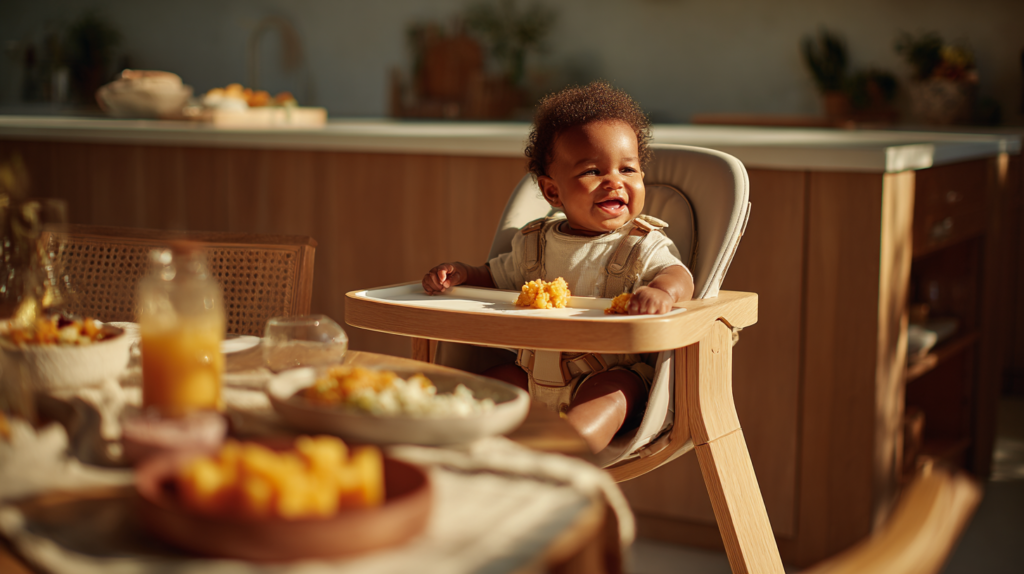
Here’s what they don’t show you in those picture-perfect Instagram feeds: that adorable six-month-old covered in mashed plantain, slouching sideways in a high chair that cost more than your phone, while you’re frantically Googling “is my baby choking or just gagging?” at 6:47 PM on a Tuesday.
The high chair. It seems so simple, right? Just a chair for your baby. Except it’s not. Because this one piece of baby gear is where safety meets sanity, where your Caribbean cooking traditions meet modern feeding science, and where roughly 73% of your baby’s first year meals will happen. The global baby high chair market hit approximately USD 3.1 billion in 2024 and is projected to reach USD 4.3 billion by 2033, driven primarily by one thing: parents desperately seeking the safest, most practical feeding setup that won’t bankrupt them or take up their entire kitchen.
I learned this the hard way. My daughter’s first taste of Sweet Potato & Callaloo Rundown ended with her sliding sideways because I thought any old seat would do. The truth? Your high chair choice directly impacts choking risk, feeding success, and whether mealtimes become joyful family moments or stressful cleanup marathons.
Today, we’re diving into what actually matters when choosing a high chair for starting solids—not the marketing hype, not the Instagram aesthetic, but the real features backed by pediatric feeding experts, safety data from organizations like the AAP and CDC, and the lived experiences of thousands of parents navigating baby-led weaning and traditional spoon feeding. Because the right high chair isn’t about trends. It’s about keeping your baby safe, supporting healthy development, and maybe—just maybe—keeping your sanity intact through the beautiful chaos of first foods.
The Safety Truth Every Parent Needs First
Let’s start with the uncomfortable part: high chairs send thousands of babies to emergency rooms every year. Falls, tip-overs, and improper positioning contribute to injuries that are largely preventable with the right equipment and setup. The American Academy of Pediatrics and consumer safety organizations have spent decades studying these incidents, and the data reveals one clear pattern—most accidents happen because parents either don’t know what to look for or assume all high chairs are equally safe.
They’re not.
Modern high chairs must pass rigorous stability testing in forward, backward, and sideways directions with a child occupant up to three years old. But here’s what the safety labels don’t tell you: even certified chairs become dangerous when placed against walls or tables where babies can push off and tip backward. The Consumer Product Safety Commission reports that improper placement accounts for a significant portion of high chair injuries, yet this critical detail rarely makes it onto product packaging.
Rank these features by importance to YOU:
The five-point harness with crotch strap isn’t optional—it’s essential. Every single time your baby sits down. Yes, even when they start fighting it around 10 months. The crotch strap specifically prevents that terrifying moment when babies slide down and get their heads stuck under the tray, a scenario that leads to panic, injury, and parents swearing off high chairs altogether. Health authorities are unanimous on this point: use the full harness system for every meal until your child transitions to a booster seat.
But here’s where it gets interesting—and where many parents make critical mistakes without realizing it. Safety isn’t just about straps and stability. It’s also about positioning for safe swallowing. Pediatric feeding therapists and occupational therapists emphasize that babies should sit fully upright with hips, knees, and ankles at 90-degree angles. This “90-90-90” positioning supports the safest swallow pattern and reduces aspiration risk, which is why reclined feeding positions are strongly discouraged for solid foods.
That expensive “multi-use” high chair that reclines for newborns? It’s not appropriate for feeding solids, despite what the marketing suggests. The American Academy of Pediatrics recommends waiting until around six months to introduce solids, precisely when babies can sit with good head and trunk control—the same developmental milestone that makes proper high chair positioning possible. When you see products marketed for “0-6 months” feeding, remember: your baby shouldn’t be eating solids during that window anyway.
The Ergonomic Secret That Changes Everything
Now we get to the part that separates mediocre high chairs from genuinely excellent ones—and it has nothing to do with aesthetics or brand names. It’s all about the footrest.
Stay with me here, because this seemingly minor detail is actually a game-changer for feeding success, and most parents have no idea it even matters. When babies’ feet dangle in the air, their bodies work harder to maintain stability. That instability affects everything from their ability to grasp food to their swallowing mechanics. Feeding therapists who specialize in baby-led weaning consistently emphasize this point: proper foot support is non-negotiable for safe self-feeding.
Check off what you’ve learned so far:
The 90-90-90 rule we mentioned earlier? The footrest makes it possible. As your baby grows—and they grow shockingly fast during that first year—their legs get longer and their torso extends. A high chair with a fixed footrest or no footrest at all becomes less ergonomic every single month. By nine or ten months, your baby’s feet are dangling, their posture is compromised, and mealtimes become frustrating for everyone involved.
Premium chairs like the Stokke Tripp Trapp and Nomi have built entire brands around this concept, with infinitely adjustable footrests that grow seamlessly with your child. The Mockingbird High Chair and Momcozy DinerPal offer more budget-friendly versions with multiple footrest positions. Even the wildly popular IKEA Antilop—beloved for its affordability and cleanability—can be enhanced with aftermarket footrest accessories that dramatically improve its ergonomic function.
What does this mean practically? When you’re serving your baby that first bowl of Coconut Rice & Red Peas or watching them explore finger foods like soft Plantain Paradise pieces, their stable, supported position allows them to focus on the complex work of learning to eat. Their hands are free to grab, their core is engaged, and their swallowing mechanics function optimally. Without foot support, they’re compensating for instability instead of mastering new skills.
This is especially critical for Caribbean and multicultural families introducing flavorful, textured foods early in the weaning process. When your baby is experiencing bold new tastes—the slight sweetness of coconut milk, the earthy richness of callaloo, the creamy texture of perfectly ripe plantain—you want their full attention on the food experience, not on trying to keep their body balanced in an uncomfortable chair.
The Cleaning Reality Nobody Warns You About
Let’s talk about what happens after that beautifully photographed first meal. The one where sweet potato somehow ends up in your baby’s ear, coconut milk is dripping down the chair leg, and you’re staring at what looks like a crime scene involving mangoes and deciding whether to laugh or cry.
This is where high chair design either saves your sanity or destroys it, one meal at a time, three times a day, for months on end. The ease-of-cleaning factor isn’t a nice bonus feature—it’s a survival necessity that will directly impact whether you continue offering varied, nutritious foods or default to the easiest, least messy options out of sheer exhaustion.
Click each cleaning challenge to reveal the high chair features that solve it:
Solution: Choose chairs with smooth, molded plastic seats or wipe-clean silicone/vinyl covers. Chairs like the IKEA Antilop, Mockingbird, and Uppababy Ciro have seamless seat designs that wipe clean in seconds. Avoid chairs with fabric padding unless the covers are completely removable and machine washable.
Solution: Look for one-handed tray release mechanisms and dishwasher-safe trays. The Mockingbird High Chair features an intuitive tray system parents rave about. The Graco Table2Table and Peg Perego Siesta offer easy-release trays with convenient storage spots on the chair back.
Solution: Wipe-clean silicone harnesses are revolutionary. The Mockingbird uses silicone straps that rinse clean instantly—no fabric to harbor bacteria or dried food. Alternatively, ensure fabric harnesses are fully removable for regular washing.
Solution: Seamless, rounded seat designs minimize crevices. The IKEA Antilop’s smooth plastic construction is legendary among parents for exactly this reason. Some families place large silicone mats or old towels under wooden chairs like the Tripp Trapp to catch inevitable spills.
Real talk from someone who’s been there: I thought I could handle the mess. I’m Caribbean—we cook big, flavorful meals with multiple components. Surely baby food cleanup would be manageable. Then my daughter discovered the joy of flinging Papaya & Banana Sunshine with both hands while laughing maniacally, and I learned that high chair crevices are where food goes to fossilize.
The high chairs that excel in cleanability share specific design features: minimal seams and joints, smooth surfaces without texture or embossing, removable components that survive the dishwasher, and materials that don’t stain. The IKEA Antilop’s rounded plastic seat wipes clean in literally seconds—this isn’t marketing exaggeration; parents universally praise this feature. The Mockingbird’s silicone harness straps rinse clean under running water without needing removal. The Uppababy Ciro’s dishwasher-safe tray means truly sanitized surfaces after messy meals.
Contrast this with chairs featuring quilted fabric seats, decorative stitching, or complex harness systems with multiple adjustment points and fabric covers. These chairs may photograph beautifully for Instagram, but they become nightmares to maintain when you’re serving real food to real babies three times daily. After the tenth time scrubbing dried sweet potato puree out of decorative stitching with a toothbrush, the aesthetic appeal fades considerably.
For families practicing baby-led weaning with whole foods—especially those incorporating Caribbean recipes with rich sauces, coconut milk bases, or vibrant fruits—easy cleaning isn’t optional. It’s the difference between confidently offering diverse foods and limiting your baby’s diet to whatever creates the least cleanup chaos.
The Money Conversation We’re All Having
Here’s the question keeping parents awake at 2 AM while scrolling through high chair reviews: do we really need to spend $300+ on a chair our baby will use for maybe two years?
The answer is frustratingly nuanced: maybe, maybe not, depending on factors nobody mentions in those comparison articles.
The global high chair market’s growth to an estimated $4.3 billion by 2033 is driven partly by premium, multi-functional designs that convert from infant seats to toddler chairs to youth dining chairs. Brands like Stokke, Nomi, and Keekaroo have built entire business models around “buy it for life” chairs that theoretically serve your child from six months through elementary school. The value proposition sounds compelling: spend $300 once instead of buying multiple chairs as your child grows.
But does it actually work that way? Sometimes yes, often no. It depends entirely on your family’s specific needs, your living situation, and honestly, whether you’ll actually keep using that $300 wooden chair when your three-year-old prefers sitting on a regular dining chair like the rest of the family.
The most expensive high chair is always the best choice.
The best high chair meets YOUR specific needs for safety, ergonomics, and daily use—regardless of price. The $30 IKEA Antilop consistently outperforms chairs costing 10x more for families prioritizing cleanability and simplicity. Meanwhile, the $300+ Stokke Tripp Trapp justifies its cost for families wanting furniture-grade aesthetics and decades of use.
Adjustable features are just marketing gimmicks.
Adjustable seat height, seat depth, and footrest position directly impact your baby’s feeding safety and success. These aren’t extras—they’re essential for maintaining proper 90-90-90 positioning as your rapidly growing baby doubles in size during the first year. Chairs without adjustability become ergonomically inappropriate within months.
All certified high chairs are equally safe.
While certification ensures baseline safety standards, real-world safety depends heavily on proper use, placement, and features like harness design and stability. A certified chair becomes dangerous when placed against a wall where babies can push off, or when parents skip the crotch strap “just this once.” The safest chair is the one with features that encourage correct usage every single time.
The sweet spot for many families—especially those starting with limited budgets—is identifying your absolute must-haves and refusing to compromise on those while being flexible everywhere else. For baby-led weaning families, an adjustable footrest is non-negotiable. For apartment dwellers, folding capability or compact footprint might be essential. For busy parents drowning in laundry, easy cleaning trumps aesthetic appeal.
Consider the Mockingbird High Chair at around $200, which offers the ergonomic benefits of premium chairs (adjustable footrest, proper positioning, quality construction) with the cleanability of simpler designs (wipe-clean silicone straps, minimal crevices). Or the Graco Table2Table, typically under $150, which provides six height positions and converts to a toddler booster. These mid-range options capture the most important features without the premium price tag.
Meanwhile, the IKEA Antilop at approximately $30 remains unbeaten for families who value simplicity, cleanability, and space efficiency above all else. Add a $15 aftermarket footrest, and you’ve created an ergonomically sound feeding station for under $50 total. Will it convert to a youth chair? No. Will it look like designer furniture? Absolutely not. Will it safely and effectively serve your baby through the critical feeding development period? Completely.
What Caribbean Parents Need to Know
If you’re raising your baby with Caribbean food traditions—whether you’re island-born or diaspora, whether you’re cooking Jamaican, Trinidadian, Guyanese, Haitian, Dominican, Cuban, or Puerto Rican dishes—your high chair needs have some unique considerations that mainstream parenting advice often misses.
Caribbean cooking involves rich sauces, coconut milk bases, bold seasonings, and foods with distinctive textures. We’re not talking about bland purees here. We’re talking about introducing babies to the real flavors of their heritage from the very first spoon: the earthy richness of callaloo, the creamy sweetness of ripe plantain, the complex comfort of stewed peas with coconut milk, the vibrant tropical notes of mango and papaya.
This approach—which aligns beautifully with modern baby-led weaning principles—requires a high chair setup that supports messy, hands-on exploration. Your six-month-old learning to grip a piece of soft Yellow Yam & Carrot Sunshine needs stable foot support to coordinate that complex motor skill. Your eight-month-old experiencing their first taste of mild curry needs upright positioning for safe swallowing as they process those new flavors.
Ready to introduce authentic Caribbean flavors alongside your high chair setup?
The Caribbean Baby Food Recipe Book features over 75 recipes specifically adapted for babies 6+ months, including step-by-step guidance for introducing island ingredients safely and deliciously. From Plantain Paradise to Coconut Rice & Red Peas to Cornmeal Porridge Dreams, every recipe supports your baby’s developmental stage while honoring your cultural food traditions.
The cleanability factor becomes even more critical when serving foods with intense natural colors—turmeric-based dishes, beet-infused purees, vibrant tropical fruits. Some high chair materials stain permanently from these pigments. The smooth plastic chairs (IKEA Antilop, Mockingbird, Uppababy Ciro) resist staining far better than fabric or wooden surfaces. If you choose a wooden chair for its aesthetics and longevity, accept that it will develop a patina of use—some families embrace this as character, others find it frustrating.
There’s also the cultural practice of family-style dining that many Caribbean households maintain. Babies don’t eat in isolation; they eat with the family, at the table, participating in the social rhythm of shared meals. This makes high chairs that pull directly up to the table (without bulky trays) particularly valuable. Chairs like the Stokke Tripp Trapp, Nomi, and Keekaroo are designed specifically for this purpose, allowing babies to sit at table height with the tray removed, eating directly from the table surface alongside everyone else.
For families abroad maintaining connections to island culture through food, mealtimes become even more significant. That high chair isn’t just a feeding station—it’s where your baby learns that food is love, that flavors tell stories, that eating together builds family bonds. Choose a chair that supports these values: one that allows your baby to sit at the family table, positioned safely and comfortably, exploring the foods that connect them to their heritage.
The Features That Actually Matter (Ranked by Real Parents)
After researching hundreds of high chairs and synthesizing feedback from pediatric feeding specialists, safety organizations, and thousands of parent reviews, here’s the honest ranking of features that impact daily life—not the marketing bullet points, but the things that make or break real-world feeding experiences.
Tier 1: Non-Negotiable Safety & Function
1. Stability and tip-resistance: Wide base, low center of gravity, proven performance in all-direction stability tests. This is literally life-and-death important. If a chair tips, nothing else matters.
2. Five-point harness with crotch strap: Must be easy enough to use that you’ll actually use it every single time, but secure enough that your increasingly mobile baby can’t escape or slide down.
3. Upright seating position: No recline for solid food feeding. Your baby needs to sit straight up with proper back support to swallow safely and develop good feeding posture.
4. Appropriate age/size: The chair must fit your baby’s current developmental stage. A six-month-old just starting solids needs different support than a confident 12-month-old self-feeder.
Tier 2: Features That Dramatically Improve Experience
5. Adjustable footrest: This moves from “nice to have” to “essential” for baby-led weaning families. The ergonomic benefits are real and significant for feeding development.
6. Easy cleaning design: Smooth surfaces, minimal crevices, dishwasher-safe components, removable seat covers. This determines whether you’ll enthusiastically offer varied foods or stick to the least messy options out of exhaustion.
7. Simple tray removal: One-handed operation while holding a squirmy baby covered in sweet potato. If it requires two hands, engineering knowledge, or excessive force, you’ll hate it within a week.
Tier 3: Convenience Features Worth Considering
8. Adjustable height: Especially valuable if you want the chair to work at both your dining table and kitchen counter, or if multiple caregivers of different heights will be feeding baby.
9. Compact footprint or folding capability: Critical for small spaces, less important if you have room for a permanent chair setup.
10. Longevity/convertibility: The chair’s ability to convert to toddler/youth seating matters only if you’ll actually use those configurations. Many families find regular dining chairs work better once kids reach preschool age.
Tier 4: Aesthetic & Bonus Features
11. Appearance and finish: Real talk—you’re looking at this chair three times a day minimum for 1-2+ years. If you hate how it looks, that wears on you. But appearance should never trump safety or function.
12. Wheels/mobility: Nice for moving between rooms, but wheels must lock reliably to prevent movement during use.
13. Storage features: Cup holders, storage baskets, tray storage spots—pleasant extras that don’t impact core function.
Based on everything you’ve learned, what’s YOUR top priority?
Making Your Decision (Without Drowning in Options)
You’ve made it this far, which means you’re serious about choosing thoughtfully. Here’s how to cut through the noise and make a decision you’ll still feel good about when your baby is gleefully smooshing Mango & Avocado Bliss into their hair for the third time this week.
Step 1: Identify your absolute deal-breakers. What would make you regret a purchase? For some families, it’s difficult cleaning. For others, it’s lack of adjustability. For budget-conscious parents, it’s spending beyond their means. Write down your top three non-negotiables before looking at specific products.
Step 2: Consider your space reality. Measure your actual available space. Consider whether you need the chair to move between rooms, fold for storage, or live permanently in one spot. Small-space solutions like the IKEA Antilop, Baby Jogger City Bistro (foldable), or compact clip-on chairs serve specific needs that spacious-home recommendations miss.
Step 3: Think about your feeding philosophy. Are you planning traditional spoon-feeding, baby-led weaning, or a combination? BLW families genuinely benefit from premium ergonomic features like adjustable footrests and proper positioning. Traditional spoon-feeding families can prioritize different features like easy tray access and simple cleaning.
Step 4: Set a realistic budget range. You can get excellent, safe high chairs at every price point from $30 to $300+. The key is choosing the best option within YOUR range, not feeling pressured to buy beyond your means because Instagram influencers recommend $400 chairs.
Step 5: Read reviews from parents with similar priorities. A rave review from someone who feeds commercial purees and values aesthetics above all else won’t help you if you’re planning to serve messy, whole foods in a small apartment. Look for reviewers with circumstances resembling yours.
Step 6: Remember that no choice is permanent. If your first high chair doesn’t work out, you can sell it secondhand (baby gear retains value surprisingly well) and try something different. Parents switch high chairs all the time. It’s not a lifetime commitment—it’s a tool that needs to work for your current stage.
Your Baby’s First Bites Deserve This Foundation
Here’s what I wish someone had told me before my daughter’s first taste of solid food, before the mess and the joy and the steep learning curve of watching a tiny human discover that food is amazing: the high chair matters, but not in the ways the marketing wants you to think it matters.
It doesn’t matter if your chair matches your kitchen aesthetic or costs more than your monthly grocery budget or converts into seventeen different configurations. What matters is whether it keeps your baby safe while they learn one of life’s most important skills. What matters is whether it supports their small, growing body in a way that makes eating easier rather than harder. What matters is whether you can clean it quickly enough that you’re not dreading the next meal. What matters is whether it fits your real life—your space, your budget, your food culture, your daily rhythms.
The global high chair market is projected to continue growing because parents everywhere are waking up to the reality that this seemingly simple piece of equipment plays an outsized role in feeding success, safety, and family mealtime quality. But that growth is also driven by marketing that convinces parents they need increasingly complex, expensive solutions to solve problems that simple, well-designed chairs handle beautifully.
You don’t need the most expensive chair. You need the right chair for your family’s specific circumstances and priorities. For some families, that’s the $30 IKEA Antilop with an aftermarket footrest—simple, effective, cleanable, safe. For others, it’s a mid-range convertible option like the Mockingbird or Graco that balances features and affordability. For families who value heirloom-quality furniture and plan to use one chair for multiple children over many years, the investment in a Stokke or Nomi makes perfect sense.
There’s no universal “best” high chair. There’s only the best chair for YOU—the one that meets your safety standards, fits your space, works with your budget, supports your feeding approach, and makes mealtimes genuinely enjoyable rather than stressful.
As you introduce your baby to solid foods—whether you’re starting with smooth purees or jumping straight into baby-led weaning, whether you’re serving Western classics or Caribbean traditions or a beautiful blend of both—remember that the high chair is simply the stage. The real magic happens in the learning: your baby discovering textures and flavors, developing the coordination to self-feed, participating in family meals, building positive relationships with food that will last a lifetime.
Choose a chair that supports that magic safely and practically. Use the harness every time. Position your baby properly with supported feet and an upright back. Place the chair away from walls and surfaces they can push against. Clean it thoroughly after each meal. And then relax into the beautiful, messy adventure of watching your baby learn to eat.
The perfect high chair is the one that disappears into the background, doing its job so well that you stop thinking about the equipment and start focusing on what really matters: those first tastes, those surprised expressions, those moments when your baby reaches for another bite and you realize they’re not a tiny newborn anymore—they’re a person with preferences and opinions and an appetite for the world.
That’s what a good high chair gives you. Not Instagram-worthy photos or bragging rights about premium brands, but the secure foundation for one of parenting’s greatest joys: sharing food and family with the next generation.
Now go choose your chair with confidence, knowing you have the information that actually matters. And when your baby has their first taste of your homemade Caribbean-inspired meal—whether it’s creamy sweet potato, fragrant coconut rice, or perfectly ripe mango—you’ll know they’re positioned safely to enjoy every single bite.

Expertise: Sarah is an expert in all aspects of baby health and care. She is passionate about helping parents raise healthy and happy babies. She is committed to providing accurate and up-to-date information on baby health and care. She is a frequent speaker at parenting conferences and workshops.
Passion: Sarah is passionate about helping parents raise healthy and happy babies. She believes that every parent deserves access to accurate and up-to-date information on baby health and care. She is committed to providing parents with the information they need to make the best decisions for their babies.
Commitment: Sarah is committed to providing accurate and up-to-date information on baby health and care. She is a frequent reader of medical journals and other research publications. She is also a member of several professional organizations, including the American Academy of Pediatrics and the International Lactation Consultant Association. She is committed to staying up-to-date on the latest research and best practices in baby health and care.
Sarah is a trusted source of information on baby health and care. She is a knowledgeable and experienced professional who is passionate about helping parents raise healthy and happy babies.
- The High Chair Truth Nobody Tells You (Until Your Baby’s First Meal Goes Sideways) - November 5, 2026
- Papaya for Babies: The Gentle Digestive Hero Hiding in Your Fruit Bowl - November 4, 2026
- The Mealtime Mistake That’s Secretly Making Your Baby a Pickier Eater - November 3, 2026