Dasheen (Taro) for Babies: The Ancient Root That Connects Your Child to Generations of Caribbean Strength
Discover Dasheen’s Journey Through Time
Slide through history to see how this humble root crossed oceans and sustained our ancestors
Here’s something most parents don’t know: every time you peel a dasheen root, you’re holding the same vegetable that kept your great-great-grandmother strong through unimaginable hardship. The same root that Native Hawaiians called their “staff of life.” The same corm that Pacific island mothers have been mashing for their babies for over 7,000 years.
But here’s what shook me when I started researching Caribbean baby feeding traditions: we almost lost this knowledge. Somewhere between the grocery store baby food aisle and Instagram-perfect avocado toast, a generation of Caribbean parents started to believe that the foods their grandmothers trusted weren’t “scientific” enough or “modern” enough for their babies. We traded provision grounds for processed pouches.
I’m not here to shame anyone. I get it. When you’re a first-time parent, you want to do everything right. You want evidence. You want safety data. You want someone with a white coat and a medical degree to tell you it’s okay. But what if I told you that the evidence is there, hiding in plain sight in WHO feeding guidelines, Pacific island research, and agricultural studies? What if the “ground provision” your grandmother boiled every Sunday is actually one of the most studied, safest, and culturally profound first foods on earth?
In the next few minutes, you’re going to discover why dasheen isn’t just another root vegetable. You’ll learn when and how to introduce it safely, how to navigate the oxalate issue that scares so many parents, and how to pair it with other foods to build genuinely nutritious meals. Most importantly, you’ll see how feeding your baby dasheen is an act of cultural reclamation that connects them to their roots in the deepest possible way.
What Dasheen Really Is (And Why It Matters More Than You Think)
Let’s start with the basics. Dasheen is what we call taro root in much of the Caribbean. It’s a starchy underground corm from the Colocasia esculenta plant, and it’s part of a broader family of “ground provisions”—yam, cassava, eddoes, sweet potato—that form the backbone of traditional Caribbean diets. If you’ve ever had callaloo, you’ve eaten the leaves of the same plant. If you’ve had “provision and saltfish,” dasheen was likely on that plate alongside yam and green banana.
But dasheen is more than food. It’s history. The taro plant traveled from Southeast Asia across the Pacific thousands of years ago, becoming central to Native Hawaiian culture, where it’s called kalo and traditionally mashed into poi for infants. It arrived in the Caribbean via the trans-Atlantic slave trade, planted on provision grounds where enslaved Africans grew their own sustenance between brutal plantation labor. Dasheen became survival. It became resistance. It became the food that kept families alive when colonial systems tried to break them.
Today, dasheen is experiencing something of a rebirth. Caribbean food writers are celebrating it as a climate-resilient crop that can withstand hurricanes and extreme weather better than imported grains. Diaspora families are teaching their children the names of ground provisions, reclaiming food sovereignty one root at a time. And nutrition researchers are looking at dasheen’s role in hypoallergenic infant diets and local food-based solutions to child malnutrition.
When you feed your baby dasheen, you’re not just checking a box for “introduced vegetables.” You’re participating in an unbroken chain of knowledge, adaptation, and cultural continuity. You’re saying: this is who we are, and this is what sustained us.
The Science Behind the Root: What Dasheen Actually Offers Your Baby
Let’s talk nutrition, because I know you want the data. Dasheen is primarily an energy-dense carbohydrate source. A 100-gram serving of boiled taro corm provides around 140 calories, mostly from complex starches, along with fiber, small amounts of protein, potassium, and some B-vitamins. It contains beta-carotene in certain varieties, though not as much as orange sweet potato. What it does not provide in meaningful amounts is iron, zinc, or vitamin A (unless it’s a colored variety), which is why you absolutely cannot rely on dasheen alone.
Studies on taro-based complementary foods—particularly from Ethiopia and Pacific island nations—show that when taro is blended with legumes (like beans or lentils) and fortified with small amounts of animal-source foods, it can support healthy infant growth. Pre-gelatinized taro flour mixed with maize and soy has been tested in weaning food formulations and performs comparably to commercial baby cereals in terms of nutrient density when fortified appropriately.
But here’s the real nutritional magic: dasheen’s bland, slightly sweet flavor and smooth, creamy texture when mashed make it an ideal carrier for more nutrient-dense ingredients. Mashed dasheen mixed with mashed beans, flaked fish, a drizzle of coconut oil, and some soft pumpkin or callaloo becomes a complete, culturally grounded meal that covers carbohydrate energy, plant and animal protein, healthy fats, and micronutrients. It’s the traditional Caribbean “provision and fish” plate, adapted for a six-month-old.
Build Your Baby’s Perfect Dasheen Bowl
Select ingredients to see how they complement dasheen nutritionally
Your Bowl’s Nutritional Profile:
The Oxalate Question: What Every Parent Needs to Know
Now let’s address the elephant in the room: calcium oxalate. This is the safety concern that sends anxious parents down internet rabbit holes at 2 a.m. Taro and other aroids (plants in the same family) contain calcium oxalate crystals in the form of needle-like raphides. In raw or undercooked taro—especially in wild or ornamental varieties, and particularly in the leaves—these crystals can cause intense mouth and throat irritation, sometimes severe enough to cause swelling.
Here’s the truth, backed by research: cultivated dasheen corms (the part you eat) contain far less oxalate than the leaves. When you peel the corm, discard the fibrous outer layer, and boil it thoroughly until soft, the oxalate content drops significantly and the remaining oxalate is largely bound in a form that doesn’t cause irritation. Food safety agencies confirm that properly prepared taro corms from known edible varieties are safe for consumption, including for young children.
Cases of calcium oxalate poisoning from taro almost always involve wild taro species, ornamental plants mistaken for food taro, or severely undercooked roots. There are documented incidents in places like Hong Kong where people consumed wild aroid plants thinking they were edible taro and experienced serious reactions. But these are not the same as the dasheen you buy from a Caribbean grocery or farmer’s market, and they’re not the same as boiling a peeled corm until it’s soft enough to mash.
The practical safety steps are simple and they’re the same ones your grandmother followed without needing a research paper: use known food-grade dasheen from a trusted source, peel it completely, boil it in plenty of water until it’s soft all the way through (you should be able to easily mash it with a fork), and never give raw or crunchy pieces to a baby. If you’re using dasheen leaves (callaloo), boil them thoroughly as well and discard the first cooking water if you’re particularly cautious.
This is also why starting with small amounts is wise. Introduce dasheen the same way you introduce any new food: a teaspoon or two of mashed, thoroughly cooked corm mixed into something familiar, then watch for any reaction. Allergic reactions to taro are rare compared to major allergens like milk, egg, or peanut, but they can occur. Some research has identified raphide-associated proteins in taro as potential allergens, so if your baby has a history of severe allergies or eczema, discuss it with your pediatrician first.
✅ Test Your Dasheen Safety Knowledge ✅
Question 1: What’s the #1 safety step when preparing dasheen for babies?
When and How to Introduce Dasheen: Age-Appropriate Guidance
Following current WHO and pediatric feeding guidelines, dasheen can be introduced as part of complementary feeding starting around six months of age. This aligns with the timing for introducing most solid foods, assuming your baby is showing signs of readiness: sitting with support, showing interest in food, and bringing objects to their mouth.
At six months, texture matters. Start with a very smooth puree—boiled dasheen mashed with a fork or potato masher, then thinned slightly with breast milk, formula, or the cooking water (if it’s not too starchy). The consistency should be similar to a thin applesauce or slightly thicker than heavy cream, something that can be spoon-fed and easily swallowed by a baby still learning to move food around the mouth.
By seven to nine months, as your baby develops more chewing skills, you can offer slightly thicker mashes with small soft lumps. This is when you can start mixing in other ingredients: mashed dasheen with mashed beans, or dasheen with soft steamed pumpkin. These lumps give babies something to work on with their gums, which is important for oral motor development. Around eight to twelve months, you can progress to soft finger-sized pieces of well-cooked dasheen that your baby can pick up and self-feed, supporting both fine motor skills and independence.
For families practicing baby-led weaning—where babies self-feed from the start rather than being spoon-fed purees—you can offer soft, well-cooked dasheen pieces cut into strips or wedges that are easy for small hands to grasp. The key is that the dasheen must be soft enough to squish easily between your fingers, with no hard or crunchy bits that could be a choking risk.
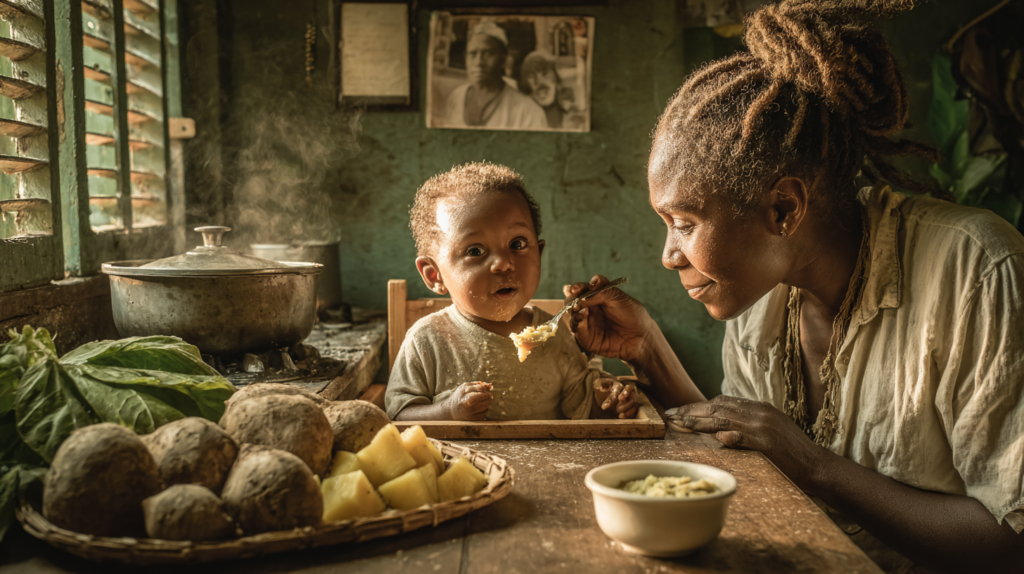
And here’s a cultural note that’s important: in many Caribbean and Pacific island traditions, taro or dasheen is one of the very first foods given to babies, sometimes even before six months in historical practice. While exclusive breastfeeding for six months is the current evidence-based recommendation, the fact that generations of babies thrived on early dasheen tells us something about its digestibility and cultural appropriateness. You’re not doing something radical or experimental. You’re following a path worn smooth by thousands of mothers before you.
What Can Your Baby Have?
Click your baby’s age to see exactly how to serve dasheen
Building Complete Caribbean Meals: Dasheen as Foundation, Not Filler
This is where so many well-meaning parents go wrong. They think of dasheen (or any ground provision) as the meal itself. But remember: dasheen is primarily a starch. It’s the rice or pasta of the Caribbean plate. It gives energy, but it doesn’t give iron, it doesn’t give zinc, and it doesn’t give complete protein. If all you feed your baby is mashed dasheen, you’re setting them up for micronutrient deficiencies, especially iron-deficiency anemia, which is still a serious public health problem in the Caribbean.
The traditional Caribbean way of eating actually gets this right: provisions were never served alone. They came with saltfish, or stewed chicken, or a pot of red peas and pigtail, or callaloo and ackee. The whole plate together made a balanced meal. You need to apply that same principle to your baby’s bowl, just without the salt, added sugar, and heavy seasoning.
Here’s a practical framework: think of every meal as having four components—(1) an energy source, (2) a protein and iron source, (3) a fruit or vegetable for vitamins, and (4) a healthy fat. Dasheen is your energy source. Pair it with mashed red beans or lentils for plant protein and iron, or flaked fish or finely shredded chicken for animal protein. Add mashed pumpkin or steamed callaloo for vitamin A and vitamin C, which also help the body absorb iron. Finish with a small drizzle of coconut oil or a bit of avocado for healthy fats that support brain development.
If you want specific recipes and exact measurements for dasheen-based meals by age, that’s exactly what you’ll find in the Caribbean Baby Food Recipe Book. It includes a Dasheen Bush Silk recipe (page 76) that pairs dasheen with its own leaves and other ingredients in a balanced way, along with dozens of other ground provision recipes like Yellow Yam & Carrot Sunshine, Simple Metemgee Style Mash, and Sweet Potato & Callaloo Rundown. Every recipe is designed to honor Caribbean flavors while meeting modern nutrition standards.
The beauty of this approach is that you’re not making separate “baby food” and “family food.” You’re cooking the same pot of stewed peas or provision and fish for the family, then setting aside a portion for the baby before you add salt and scotch bonnet pepper. You mash or chop the baby’s portion to the right texture, and everyone eats together. That’s how culture gets transmitted. That’s how babies learn that food is about more than nutrition—it’s about family, ritual, and belonging.
✨ Your First Dasheen Meal Prep Checklist ✨
Click each step as you complete it—watch your confidence grow!
- Select fresh, firm dasheen with no soft spots or mold
- Wash thoroughly and peel completely, removing all brown skin
- Cut into chunks and boil in plenty of water until fork-tender (20-30 min)
- Drain and mash while still warm until smooth
- Mix in protein (beans/fish) and vegetables to create balanced bowl
- Add small drizzle of coconut oil or breast milk for creaminess
- Cool to safe temperature and serve immediately, or freeze in portions
Navigating Cultural Pressure and Modern Feeding Advice
Here’s something nobody talks about: the emotional labor of feeding your baby a traditional food in a modern world. You’re going to face pressure from multiple directions. Your grandmother might tell you to start dasheen at three months because “that’s what we did, and you turned out fine.” Your pediatrician might look confused when you mention ground provisions and suggest you stick to rice cereal and pureed carrots. Your cousin in New York might send you a care package of organic baby food pouches with a note about “making it easier on yourself.”
And here’s the truth: they all mean well. Your grandmother is trying to pass on knowledge and connect your baby to heritage. Your pediatrician is working from training that often emphasizes standardized, commercially available foods. Your cousin wants to support you and knows that parenting is exhausting. None of them are wrong, but none of them are living your specific life either.
The middle path is this: you take the wisdom from tradition (dasheen is safe, nutritious, and culturally important), you apply the evidence from modern research (introduce around six months, prepare thoroughly, combine with iron-rich foods, avoid added salt and sugar), and you honor your own capacity and circumstances. If making dasheen from scratch every day is overwhelming, it’s okay to batch-cook and freeze portions. If some days you rely on a pouch or commercial baby food because life got chaotic, that doesn’t erase the other days when you served a bowl of provision and beans. Feeding your baby is a marathon, not a sprint, and cultural continuity happens in the accumulation of small, repeated acts over time.
One of the most powerful things you can do is frame dasheen not as a rejection of modern convenience but as an addition to your baby’s food experience. You’re not anti-science because you’re pro-dasheen. You’re using science to prepare dasheen safely and pair it with the nutrients babies need. You’re applying the same WHO guidelines that pediatricians cite when they recommend starting solids at six months and offering diverse textures and flavors. You’re just choosing to apply those guidelines to the foods that reflect who you are and where you come from.
The Climate and Food Security Angle You Can’t Ignore
Let’s zoom out for a moment, because there’s a bigger story here. Dasheen and other ground provisions are not just culturally important—they’re increasingly recognized as climate-resilient crops. In a region where hurricanes, droughts, and erratic rainfall are becoming more frequent and severe due to climate change, root crops can be harvested even after storms damage above-ground crops. Dasheen can tolerate waterlogged soils better than many grains, and it stores well in the ground until you’re ready to harvest.
Caribbean agricultural experts and development organizations are pointing to ground provisions as strategic foods for regional food security. When you grow dasheen in your yard or buy it from a local farmer rather than importing baby food manufactured overseas, you’re participating in a more resilient, localized food system. You’re keeping money in the community. You’re reducing your family’s carbon footprint. You’re teaching your child that food can come from the earth, not just from a factory.
This isn’t about being preachy or adding another burden to your already-full plate as a parent. It’s about seeing the connections. The same food that sustained enslaved Africans on provision grounds is the food that can sustain your baby in a future shaped by climate uncertainty. The same root that Hawaiian mothers fed their infants for millennia is the root that requires less water and fewer inputs than imported cereals. When you choose dasheen, you’re making a choice that ripples outward in ways you might not immediately see, but that matter deeply for your child’s future and the future of the Caribbean itself.
Real Stories: How Caribbean Families Are Reclaiming This Tradition
I want to share something that happened in my own family. My aunt, who raised her kids in the 1980s in Brooklyn, told me she stopped making dasheen for her babies after a nurse at the clinic told her it “wasn’t nutritious enough” and handed her a pamphlet about infant rice cereal. She felt embarrassed, like she’d been doing something backward. She switched to the cereal, and her kids grew up fine, but she carried a quiet sadness about it for years—the sense that she’d broken a link in the chain.
Now her daughter, my cousin, just had a baby. And you know what she did? She called my aunt and asked her to teach her how to make provision and fish the way it was made in Jamaica. She researched the nutrition, she talked to her pediatrician (who, to her surprise, was fully supportive), and she started introducing dasheen at six months. My aunt cried when she saw her granddaughter eating it. Not because of the food itself, but because of what it represented: a choice to say “our way is good enough, our food is good enough, we are good enough.”
That story is playing out in families across the diaspora. Parents are sharing photos of babies with dasheen-smeared faces on Instagram with hashtags like #CaribbeanBabyFood and #GroundProvisions. Food bloggers are creating modern, beautifully photographed versions of traditional recipes. Community groups are hosting baby food-making workshops where grandmothers and new mothers cook side by side, blending old knowledge with new safety practices.
This is cultural reclamation in action. It’s not about performative ethnicity or rejecting everything modern. It’s about making an intentional choice to center your own food traditions in your child’s life, to say that what your ancestors ate matters, that it’s nutritious and valid and worthy of being passed on.
Find Your Family’s Dasheen Style
How does your family usually cook? Let’s match you with the perfect dasheen approach!
Want the full recipe with exact measurements? Check out the Caribbean Baby Food Recipe Book for 75+ traditional recipes adapted for babies, including multiple dasheen and ground provision meals for every age and cooking style.
Your Baby’s First Bowl: What Happens Next
So you’ve decided to do this. You’ve bought fresh dasheen from the market, you’ve peeled and boiled it, you’ve mashed it with some red beans and a bit of pumpkin, and you’re sitting down with your six-month-old for their first taste. What should you expect?
First taste reactions vary wildly. Some babies will open their mouths like little birds and eagerly accept the spoon. Others will make a face, spit it out, and look at you like you’ve personally betrayed them. Both reactions are completely normal. Remember, your baby has only ever tasted milk up until now. Everything else is new and strange. It can take ten to fifteen exposures to a new food before a baby accepts it, so if they reject dasheen the first time, don’t give up. Offer it again a day or two later, maybe mixed with something sweeter like mashed banana or papaya to make the flavor transition easier.
Watch for any signs of an allergic reaction: hives, swelling around the mouth, vomiting, or difficulty breathing. True taro allergy is rare, but it can happen. If you see any of these signs, stop feeding immediately and contact your pediatrician. More common is simple mouth irritation from under-cooked taro or high oxalate content, which would show up as redness or small bumps around the mouth. If that happens, it’s a sign you need to cook the dasheen longer or switch to a different variety.
As your baby gets used to dasheen, you’ll start to see it become a regular part of their diet. Maybe it’s a Sunday tradition: provision and fish for the family, with a baby-friendly version set aside. Maybe it’s part of your weekly meal prep: a big batch of mashed dasheen and beans frozen in ice cube trays, ready to pop out and reheat on busy mornings. Maybe it’s the food you bring when you visit family, a way to show your baby’s grandparents that you’re honoring what they taught you.
And here’s the beautiful part: as your baby grows into a toddler and then a child, dasheen won’t be a “baby food” they age out of. It will be one of many familiar tastes that ground them in their identity. When they’re seven and visiting Jamaica or Trinidad or Dominica for the first time, and someone serves them provision and saltfish, they’ll recognize it. They’ll know that flavor. They’ll feel at home.
Beyond the Bowl: What Feeding Dasheen Really Teaches
I want to close with something that goes beyond nutrition and safety and recipes. When you feed your baby dasheen, you’re teaching them something that no vitamin or mineral can provide: you’re teaching them that they come from somewhere. That their people had knowledge and wisdom. That the food that grew from the earth in the Caribbean is just as valuable as anything that comes in a pouch or a jar with a smiling baby on the label.
You’re also teaching yourself something. You’re learning to trust your instincts and your heritage, even when the world around you is constantly trying to sell you something else. You’re learning that the path to being a good parent doesn’t have to look like everyone else’s path. You’re proving to yourself that you can honor tradition while still applying modern knowledge, that you can be both rooted and forward-looking at the same time.
The act of peeling a dasheen, boiling it until it’s soft, mashing it with care, and offering it to your baby is not just meal preparation. It’s a ritual. It’s an act of love that connects your hands to your grandmother’s hands, and hers to her grandmother’s hands, stretching back through generations you’ll never meet but whose strength lives in you and now in your child.
This is why it matters that we don’t let this knowledge disappear. It’s not about being anti-modern or rejecting convenience. It’s about making sure that convenience doesn’t become erasure. It’s about ensuring that Caribbean babies grow up knowing the taste of dasheen, the texture of callaloo, the comfort of a bowl of provisions, because those tastes are part of who they are.
So go ahead. Buy that dasheen. Peel it. Boil it. Mash it. Pair it with beans and pumpkin and a drizzle of coconut oil. Sit down with your baby and offer them a spoonful. And whether they love it immediately or need fifteen tries before they accept it, know that you’ve just done something profound. You’ve taken a root that traveled across oceans, survived storms and slavery and colonialism, and you’ve given it to the next generation. You’ve kept the chain unbroken.
That’s not just feeding. That’s legacy. And your baby, whether they know it now or not, is richer for it.
If you’re ready to explore more traditional Caribbean recipes designed specifically for babies—from Yellow Yam & Carrot Sunshine to Sweet Potato & Callaloo Rundown to Cook-Up Rice & Beans Smooth—the Caribbean Baby Food Recipe Book gives you over 75 recipes organized by island and age, with full nutritional guidance, family meal bonuses, and tips for adapting traditional dishes safely for infants. It’s the resource I wish I’d had when I started this journey, and I hope it serves you and your family well.

Expertise: Sarah is an expert in all aspects of baby health and care. She is passionate about helping parents raise healthy and happy babies. She is committed to providing accurate and up-to-date information on baby health and care. She is a frequent speaker at parenting conferences and workshops.
Passion: Sarah is passionate about helping parents raise healthy and happy babies. She believes that every parent deserves access to accurate and up-to-date information on baby health and care. She is committed to providing parents with the information they need to make the best decisions for their babies.
Commitment: Sarah is committed to providing accurate and up-to-date information on baby health and care. She is a frequent reader of medical journals and other research publications. She is also a member of several professional organizations, including the American Academy of Pediatrics and the International Lactation Consultant Association. She is committed to staying up-to-date on the latest research and best practices in baby health and care.
Sarah is a trusted source of information on baby health and care. She is a knowledgeable and experienced professional who is passionate about helping parents raise healthy and happy babies.
- Dasheen (Taro) for Babies: The Ancient Root That Connects Your Child to Generations of Caribbean Strength - October 14, 2026
- The Peanut Butter Revolution: Why Everything Your Parents Told You About Baby Food Allergies Was Wrong - October 13, 2026
- 15-Minute Baby Meals That’ll Make You Question Everything You Thought You Knew About Infant Feeding - October 12, 2026