The Truth About Making Baby Food Without Fancy Equipment (That Nobody’s Telling You)
Quick Reality Check: What’s Your Kitchen Superpower?
Click your answer to discover your baby-food-making personality (and what it means for your journey):
Here’s your truth: Your three tools are enough. In fact, you’re already ahead of the game. Traditional Caribbean grandmothers fed generations of healthy babies with nothing but a pot, a fork, and love. You’re about to learn why less truly is more.
Let me stop you right there. Those 47-step recipes? They’re keeping you stuck. Meanwhile, babies across the Caribbean are thriving on simple mashed provisions, and studies show that homemade baby food doesn’t need to be complicated to be nutritious. You’re about to feel a massive weight lift off your shoulders.
Real talk: The baby food industry makes billions convincing parents they need specialized equipment. But WHO’s 2023 complementary feeding guidelines emphasize safe preparation and nutrient density—not fancy gadgets. Your regular kitchen tools are not only sufficient, they’re exactly what billions of babies have thrived on throughout history.
You already know something that Western parenting culture is just rediscovering: simple, whole-food preparation works. Your instincts are backed by research showing that homemade foods often provide higher fiber and protein than commercial purées. Keep that fork handy—you’re about to learn how to honor your roots while meeting modern nutrition standards.
If you’ve spent even five minutes researching how to make baby food, you’ve probably been bombarded with ads for baby food makers, high-speed blenders, special storage systems, and steamer-blender combo machines that cost more than your monthly grocery budget. Here’s what they won’t tell you: you don’t need any of it.
What you actually need is sitting in your kitchen right now. A pot. A fork. Maybe a potato masher if you’re feeling fancy. That’s it. Yet somehow, we’ve been convinced that feeding our babies requires an equipment arsenal that would make a professional chef jealous.
This isn’t just about saving money (though you’ll save hundreds). It’s about reclaiming the ancient, intuitive practice of preparing food for your baby the way it’s been done for millennia across the Caribbean and around the world—simply, safely, and with ingredients you can actually pronounce.
Why “No Special Equipment” Isn’t Just About Being Cheap
Let’s get something straight right away: choosing to make baby food without specialized equipment isn’t about cutting corners or being frugal. It’s about understanding something fundamental that the baby food industry doesn’t want you to know.
Recent research examining infant food preparation practices found that across thousands of WIC participants, the most common preparation methods for babies aged 7-13 months were mashing, chopping, and dicing—not high-tech pureeing. These caregivers were using forks, knives, and potato mashers to create developmentally appropriate textures. And guess what? Their babies were meeting nutritional milestones just fine.
The truth is, special equipment often creates more problems than it solves. Commercial baby food machines steam and purée everything to the exact same silky-smooth consistency, which sounds convenient until you realize that texture progression is crucial for oral motor development. Babies need to experience different textures—from smooth to mashed to chunky—to develop proper chewing skills, jaw strength, and food awareness.
When you use a fork to mash sweet potato one week and leave it slightly chunkier the next, you’re naturally progressing your baby’s texture exposure. When you use a $200 machine that purées everything identically, you’re actually creating more work for yourself down the line when your 10-month-old refuses anything that isn’t perfectly smooth.
The Caribbean Kitchen Philosophy (That Science Finally Caught Up To)
Here’s where I need to be honest with you about something that shaped my entire approach to feeding my baby. Growing up, I watched my grandmother feed my younger cousins. She didn’t have a baby food maker. She didn’t have a Vitamix. She had a pot, a coal stove, and a fork.
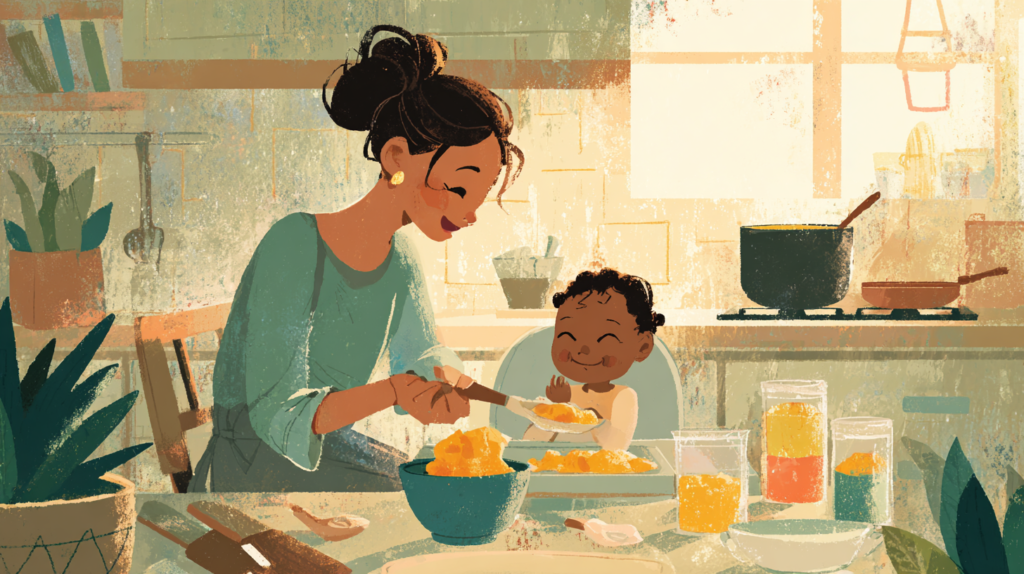
She would boil green bananas, yellow yam, or sweet potato until soft, then mash them with a fork, adding a little coconut milk or the cooking water to adjust consistency. Sometimes she’d mix in some callaloo or dasheen bush. For protein, she’d flake some steamed fish or mash some pigeon peas. The babies ate. They grew. They thrived.
For years, I thought this was just “the old way”—something quaint but probably not as good as modern methods. Then I started researching complementary feeding guidelines from WHO and UNICEF, and I realized something stunning: the Caribbean kitchen philosophy I grew up with aligns almost perfectly with current evidence-based recommendations.
The 2023 WHO guideline on complementary feeding emphasizes nutrient-dense foods prepared with good hygiene using simple household methods. It specifically mentions that thick purées, mashed foods, and soft pieces are all appropriate textures that can be achieved with ordinary kitchen tools. There’s zero mention of requiring specialized baby food equipment.
What my grandmother knew intuitively, science has now confirmed: babies need real food, properly cooked and appropriately textured. The method of getting there—whether with a fork or a $300 machine—matters far less than the quality of ingredients and the safety of preparation.
Click to reveal: The “Secret” Caribbean Method That Fed Generations
The Actual Tools You Need (And Why Each One Matters)
Let me walk you through the real essentials. These aren’t luxury items or specialized gadgets. These are the tools that will carry you through the entire complementary feeding journey, from 6 months to toddlerhood and beyond.
✅ Your Essential Baby Food Arsenal
Click each tool as you inventory your kitchen—you probably have most of these already:
For boiling, steaming, and making everything from provisions to beans to grains
Your primary mashing tool—perfect for bananas, avocados, and cooked vegetables
For larger batches and firmer foods like yam, potato, or provisions
For chopping, dicing, and preparing finger foods as baby progresses
For finely grating raw fruits (apple, pear) or shredding cooked meats
Doubles as a steamer and can help achieve smoother textures for younger babies
For portioning and freezing—no need for special “baby food” versions
For stirring and breaking down softer foods while cooking
Notice what’s not on this list? Blenders. Food processors. Baby food makers. Steam-and-blend machines. You might already own some of these, and if you do, by all means use them. But they’re not necessary. Every single food your baby needs can be prepared with the eight items above.
The knife deserves special mention because as your baby progresses from purées to mashed foods to soft solids and eventually finger foods, a sharp knife becomes your most valuable tool. Research on texture progression emphasizes that babies need exposure to progressively more complex textures from around 6-8 months onward. A knife lets you control exactly how finely you chop foods, graduating from minced to diced to small pieces as your baby develops.
The Texture Progression Nobody Explains Properly
This is where most baby food advice falls apart. Everyone tells you to start with smooth purées and gradually increase texture, but almost nobody explains what that actually looks like in practice when you’re not using a machine with multiple settings.
Here’s the truth that took me weeks to figure out: texture progression isn’t about buying different equipment. It’s about changing how long you mash, how much liquid you add, and when you stop mashing.
Texture Progression Game: Match the Age to the Method
Click each texture stage to reveal the simple fork-and-pot technique:
First foods
Thickening phase
Mashed & lumpy
Finger foods
Pediatric feeding research emphasizes that this texture progression is critical for oral motor development, but it doesn’t require sophisticated equipment. A 2021 study examining food preparation practices found that caregivers successfully progressed their babies through all texture stages using basic mashing, chopping, and dicing techniques. The key wasn’t the equipment—it was understanding when and how to modify preparation methods.
One thing that helped me enormously was testing texture on myself first. Before serving anything to my baby, I’d taste it and test the texture by pressing it against the roof of my mouth with my tongue (which mimics how babies without teeth process food). If I could mash it easily without chewing, baby could handle it. If it required actual chewing, it needed to be softer or smaller.
Batch Cooking Without the Overwhelm
Here’s where things get practical. The biggest concern I hear from parents about making homemade baby food is time. “I don’t have hours to spend making baby food every day.” Neither do I. Neither does anyone.
The solution isn’t fancy equipment. It’s batch cooking Caribbean-style, which means cooking once and using strategically for days.
️ Pick Your Batch Cooking Style
Different schedules need different strategies—click what fits YOUR life:
2-3 hours once a week, prep everything
Cook extra family meals, portion for baby
30 minutes each night, prep next day’s food
One big session, freeze portions for weeks
Boil a pot of mixed provisions (sweet potato, yam, green banana, pumpkin). Boil a pot of legumes (pigeon peas, red peas, or lentils). Steam or boil greens (callaloo, spinach, or pak choi). Cook one protein (chicken, fish, or beef). Once cooled, mash or chop to appropriate texture, portion into containers or ice cube trays, label with date, and freeze. Thaw one container each night for the next day. Time investment: 2-3 hours. Meals produced: 14-21 servings.
Making rice and peas for dinner? Boil extra unseasoned beans and set aside before adding salt. Making curry chicken? Remove baby’s portion before adding pepper. Steaming vegetables? Steam extra and mash for baby. This method requires almost zero extra time because you’re already cooking. Key: Always set baby’s portion aside BEFORE adding salt, sugar, or hot pepper. Store in fridge up to 48 hours or freeze immediately.
After dinner, spend 30 minutes prepping tomorrow’s baby food. Boil, mash, and store one grain, one vegetable, and one protein. Mix and match at mealtimes. Example: Monday evening, prepare mashed sweet potato, mashed pigeon peas, and shredded chicken. Tuesday morning: mix sweet potato and chicken. Tuesday lunch: mix pigeon peas and sweet potato. This keeps food fresher and variety higher with minimal time investment.
Dedicate one afternoon per month to serious batch cooking. Make 6-8 different bases (various provisions, grains, legumes, vegetables), portion into ice cube trays or small containers, freeze completely, then transfer to labeled freezer bags. Mix and match frozen cubes at meals. This requires planning but means you’re only doing “serious” baby food prep once monthly. WHO storage guidelines confirm that properly frozen baby food maintains quality for 3 months. Just remember: always cool food rapidly before freezing (within 2 hours) and reheat thoroughly before serving.
The batch cooking approach that works best depends entirely on your schedule, freezer space, and cooking style. I’ve used all four at different points. When my baby was younger and eating smaller amounts, the Sunday afternoon session worked perfectly. As portion sizes increased and my schedule got busier, I shifted to the double batch method because I was already cooking family meals daily.
One critical food safety point: research on complementary food safety emphasizes that homemade baby food must be cooled quickly and stored properly. After cooking, transfer hot food to shallow containers and cool rapidly—either in the fridge or by placing the container in a bowl of ice water. Refrigerate within 2 hours of cooking. Food can stay in the fridge for up to 48 hours (some sources say 72 hours maximum) before you need to freeze it. Once frozen, homemade baby food keeps for 3 months.
Want Caribbean-inspired recipes that work with basic tools?
The Caribbean Baby Food Recipe Book features over 75 recipes specifically designed for fork-and-pot preparation, including dishes like Sweet Potato & Callaloo Rundown, Coconut Rice & Red Peas, and Plantain Paradise—all made without special equipment.
The Myths That Keep Parents Stuck
Let’s demolish some myths that keep circulating in baby feeding circles. These misconceptions lead parents to spend money they don’t need to spend and feel inadequate when they’re actually doing everything right.
Myth-Busting Challenge
Click each myth to see the evidence-based truth:
What This Actually Looks Like In Practice
Theory is great, but let me walk you through what a week of no-equipment baby feeding actually looks like in my house. This isn’t aspirational or Instagram-perfect. This is real life with a real baby and real time constraints.
Sunday afternoon: I boil a large pot of mixed provisions—sweet potato, green banana, and yellow yam. I boil another pot with pigeon peas and a bay leaf. While those cook, I steam some pumpkin and callaloo in my strainer set over a pot of boiling water. Once everything is soft, I let it cool slightly, then mash the provisions with my potato masher (adding some of the cooking water to reach a good consistency), mash the pigeon peas with a fork, and roughly chop the greens. I portion everything into small containers and freeze most of it, keeping a few days’ worth in the fridge.
Monday through Friday: Each morning, I pull one container of provisions and one of either legumes or greens from the fridge. I mix them together, maybe adding a little coconut milk or a sprinkle of cinnamon (my baby loves cinnamon on sweet potato). That’s breakfast sorted. For lunch and dinner, I take something from whatever we’re eating—if we’re having curry chicken and rice, I’ll shred some of the chicken (without the curry sauce), mash some rice with a fork, add a little of the coconut milk from the curry, and mix in some of the frozen mashed pumpkin for extra nutrients and color.
Some meals come entirely from my batch-cooked freezer stash. Some meals are created by modifying family food on the spot. Most meals are a combination of both. The whole process—pulling from freezer, thawing/heating, mixing, and serving—takes less than 10 minutes.
The weekend: We often do baby-led weaning style meals on weekends when we have more time and less stress. I’ll cut ripe mango into strips, offer soft pieces of roasted sweet potato, or give strips of boiled green banana. These require literally zero preparation beyond cooking and cutting. A knife is your only tool.
The recipes in the Caribbean Baby Food Recipe Book follow this exact philosophy—simple preparations using traditional ingredients that can be batch-cooked and either mashed or offered as finger foods depending on baby’s stage. Dishes like Coconut Rice & Red Peas, Basic Mixed Dhal Pure, and Yellow Yam & Carrot Sunshine are designed for fork-and-pot preparation.
The Nutrition Question Nobody Addresses Properly
Here’s a question that keeps parents up at night: “If I’m not using fortified commercial baby food, how do I know my baby is getting enough nutrients?”
This is a legitimate concern, but the answer isn’t found in equipment—it’s found in food choices. Recent systematic reviews of complementary feeding emphasize that globally, many babies aren’t getting enough diverse, nutrient-dense foods regardless of whether food is homemade or store-bought. The issue isn’t preparation method; it’s food group variety and inclusion of key nutrients.
What babies need most during complementary feeding is iron, zinc, healthy fats, protein, and adequate energy. Commercial baby foods can be fortified with these nutrients, yes. But whole foods also provide them—if you know which foods to prioritize.
Iron-rich foods you can prepare with a fork and pot: Red meat (shredded or minced), chicken liver (mashed), fish (flaked), beans and lentils (mashed), dark leafy greens like callaloo (chopped fine). Cooking these with a small amount of tomato or citrus juice increases iron absorption.
Zinc-rich foods with simple prep: Meat, fish, eggs (mashed), beans, pigeon peas (mashed), pumpkin seeds (ground with a mortar and pestle or the back of a spoon).
Healthy fats: Coconut milk, avocado (mashed with fork), olive oil drizzled on foods, ground nuts or nut butters (thinned with water and mixed into porridges for babies over 6 months with no allergy risk).
Energy density: This is where Caribbean provisions shine. Sweet potato, yam, green banana, and pumpkin are all energy-dense and nutrient-rich. Mashing them with coconut milk or cooking water from beans creates high-calorie, nutrient-packed meals without any fortification needed.
Research on complementary feeding in lower-income countries often identifies plain cereal porridges as problematic because they’re bulky but nutrient-poor. The solution recommended by nutrition experts? Add legumes, animal-source foods, oil, or mashed vegetables to increase nutrient density. This is exactly what Caribbean-style provision-and-peas combinations do naturally.
When Simple Tools Actually Work Better
There are situations where basic equipment isn’t just “good enough”—it’s actually superior to specialized machines. Let me explain what I mean.
Texture control: When you mash with a fork, you have complete tactile feedback. You can feel the consistency, adjust in real-time, and stop exactly when you reach your desired texture. Machines process everything at high speed with minimal feedback, often over-processing food into an identical smooth paste regardless of what you’re making.
Teaching self-feeding: Research on baby-led weaning and complementary feeding consistently shows that babies benefit from self-feeding opportunities from early in the weaning process. Simple tools let you easily create preloaded spoons (mashed food on a spoon that baby brings to their own mouth) and progress to finger foods. High-tech purée machines often extend the smooth-food phase longer than necessary because that’s what they’re designed to make.
Family meal integration: Global feeding guidelines emphasize that babies should gradually transition to family foods and family meal patterns. When you use the same pot, fork, and knife to prepare baby’s food that you use for family meals, this integration happens naturally. When baby food prep involves a separate machine in a separate process with separate storage, you’re creating a parallel food system that you’ll eventually need to phase out anyway.
Reducing picky eating: Studies examining infant feeding practices and later food acceptance suggest that early exposure to varied textures and flavors influences food acceptance in toddlerhood. Simple tools encourage variation—some days food is smoother, some days lumpier, each food has its own texture—because you’re not running everything through an identical processing system. This natural variation may actually support better food acceptance long-term.
Cultural food preservation: If you want your baby to eat and enjoy traditional Caribbean foods, they need to taste like traditional Caribbean foods. Ackee mashed with a fork tastes like ackee. Callaloo chopped and mixed with provisions tastes like callaloo. Run them through a high-speed blender and they become generic green mush. Simple tools preserve the distinct flavors, colors, and yes, textures that make traditional foods special and that you want your baby to recognize and love.
Troubleshooting Common Concerns
“My baby refuses anything with lumps.” This is common and often happens when babies are kept on smooth purées too long. The solution isn’t smoother equipment—it’s patience and gradual progression. Start by making your mashed food slightly less smooth, leaving tiny soft lumps. Do this for a few days. Then increase texture slightly again. Research confirms that most babies adapt to new textures within 10-14 exposures. The key is not going backward to completely smooth food when they refuse, but rather staying consistent at the new texture level or making tiny adjustments until they accept it.
“I don’t have time to cook every day.” You don’t need to. That’s what batch cooking and freezing solve. Even the evening routine method only requires 30 minutes. And the double-batch method requires almost zero extra time because you’re already cooking family meals. If time is genuinely scarce, supplement homemade staples with carefully chosen commercial options for convenience, and don’t feel guilty about it.
“What about traveling or eating out?” This is where simple tools really shine. A fork fits in your purse. At a restaurant, you can order plain rice, mashed potato, steamed vegetables, or scrambled eggs and use your fork to adjust texture for your baby. When traveling, bring a small container with some mashed provisions or cooked rice, pack a fork and small spoon, and you’re set. This is far easier than traveling with jars, pouches, or trying to find electrical outlets for heating equipment.
“Won’t my baby prefer the smooth texture of commercial food?” Babies can certainly develop preferences, but research suggests that early texture exposure influences acceptance. If your baby eats both homemade mashed foods and commercial smooth purées, they’ll likely accept both. The challenge comes if they ONLY eat perfectly smooth machine-processed food for many months and then suddenly face texture. Variety in texture from early on actually tends to create less picky eaters, not more.
“How do I know if food is cooked enough?” The fork test works perfectly. If you can easily push your fork through the food and it mashes without resistance, it’s soft enough for baby. If you’re second-guessing, taste it yourself and try to mash it against the roof of your mouth with your tongue. If you can do this comfortably, baby can handle it.
The Environmental Factor Nobody Talks About
Here’s something that doesn’t get mentioned enough in baby feeding discussions: the environmental impact of your choices. This isn’t about guilting anyone—it’s about recognizing that traditional, simple preparation methods happen to be more sustainable.
Commercial baby food generates enormous packaging waste—pouches, jars, boxes, plastic spoons. Recent reviews analyzing baby food products note that marketing and packaging often contradict health guidance, and much of it is designed for single-use convenience. Even when you recycle, the energy cost of producing, transporting, and processing all that packaging is significant.
Specialized baby food equipment requires manufacturing, shipping, electrical power (for machines with motors), and eventual disposal. These are typically single-use items—you’ll use them for maybe 8-12 months and then they sit in a closet or end up in a landfill.
A pot, fork, and knife last for decades. They serve multiple purposes across your household. They require no electrical power. When you cook once and freeze portions in reusable containers, you’re reducing energy use compared to daily cooking. When you integrate baby food prep with family meals, you’re cooking one meal instead of two separate meal systems.
Caribbean traditional food practices were sustainable by necessity—nothing was wasted, equipment was multi-purpose, and meals were shared across generations. As it turns out, those practices align with modern sustainability goals. You can feed your baby well, save money, honor cultural traditions, AND reduce environmental impact—all with the same simple approach.
Making It Work For Your Family
Everything I’ve shared here comes from both research and real experience. Your situation might be different from mine. Maybe you work long hours. Maybe you have multiple children. Maybe you’re dealing with food insecurity or limited kitchen access. Maybe you have a baby with special feeding needs.
The point of the no-equipment approach isn’t to add another “should” to your already-overwhelming parenting list. It’s to remove barriers. It’s to tell you that you don’t need to spend money you might not have on equipment you don’t actually need. It’s to validate that the simple, traditional ways of feeding babies that your grandmother or great-grandmother used were not primitive or inferior—they were effective, sustainable, and evidence-based before evidence-based was a thing.
If you decide to buy a baby food maker because it works better for your situation, that’s fine. If you supplement homemade foods with pouches sometimes because life is chaotic, that’s fine too. The goal isn’t perfection. It’s nourishing your baby in a way that fits your family, your budget, your values, and your time.
What I want you to know is this: you have options. You are not obligated to purchase specialized equipment to be a good parent. The most important equipment you have is already in your kitchen—and the most important ingredient is the love and intention you bring to feeding your baby.
Ready to start with authentic Caribbean recipes?
Get the Caribbean Baby Food Recipe Book with 75+ recipes designed for simple preparation. Every recipe includes family meal adaptations, so you’re cooking once for everyone—from baby’s first Sweet Potato & Callaloo Rundown to toddler-friendly Coconut Rice & Red Peas.
Your Kitchen Is Already Enough
There’s something powerful that happens when you realize you already have everything you need. When my baby took their first bites of mashed sweet potato—made with a pot, a fork, and the same sweet potato I was roasting for dinner—I felt connected to something bigger than a feeding moment. I felt connected to generations of Caribbean mothers who had done exactly this. Who had fed healthy, thriving children with nothing but whole foods and simple tools.
The baby food industry has spent decades convincing us that feeding babies is complicated, that it requires expertise and equipment and special products. But babies don’t know that. They just know whether food tastes good, feels good in their mouth, and whether the person feeding them is present and loving.
You can provide all of that with what’s already in your kitchen. You don’t need to wait until you can afford the “right” equipment. You don’t need to feel inadequate because you’re using a fork instead of a machine. You’re not taking shortcuts—you’re honoring a tradition of feeding that spans cultures and centuries.
Your pot, your fork, your knife, your hands, and your love are enough. They’ve always been enough. And now you know exactly how to use them.
Start today. Boil something soft. Mash it with a fork. Feed your baby. You’ve got this.

Expertise: Sarah is an expert in all aspects of baby health and care. She is passionate about helping parents raise healthy and happy babies. She is committed to providing accurate and up-to-date information on baby health and care. She is a frequent speaker at parenting conferences and workshops.
Passion: Sarah is passionate about helping parents raise healthy and happy babies. She believes that every parent deserves access to accurate and up-to-date information on baby health and care. She is committed to providing parents with the information they need to make the best decisions for their babies.
Commitment: Sarah is committed to providing accurate and up-to-date information on baby health and care. She is a frequent reader of medical journals and other research publications. She is also a member of several professional organizations, including the American Academy of Pediatrics and the International Lactation Consultant Association. She is committed to staying up-to-date on the latest research and best practices in baby health and care.
Sarah is a trusted source of information on baby health and care. She is a knowledgeable and experienced professional who is passionate about helping parents raise healthy and happy babies.
- Fish for Baby: The Mercury Truth No One Is Telling You (And What Caribbean Parents Need to Know) - August 25, 2026
- The Allergy Prevention Revolution: Why Your Grandma Was Wrong About Introducing Foods - August 24, 2026
- When Travel Turns Feeding Upside Down: The Real Story Nobody Tells You - August 23, 2026