 Skip to content
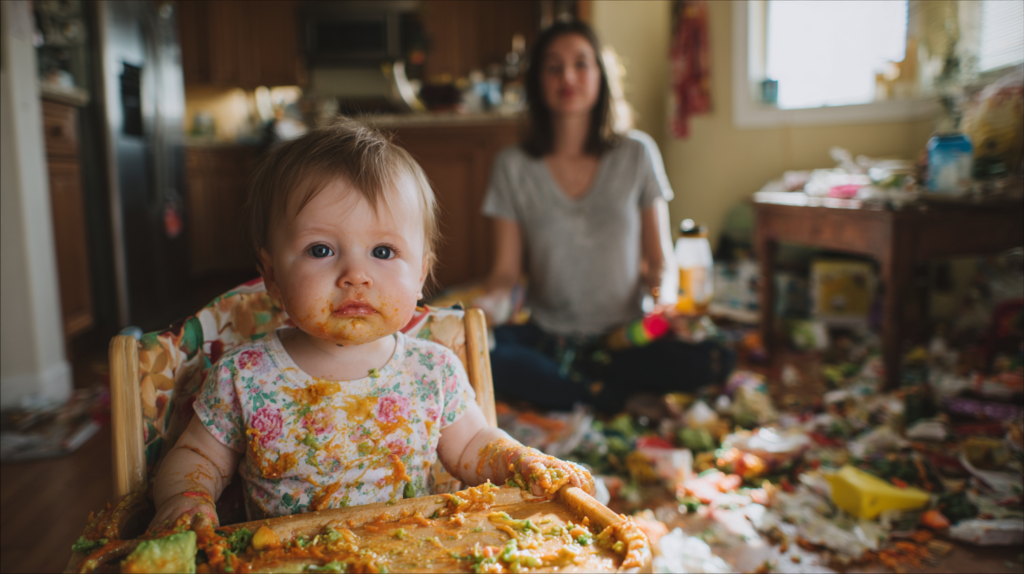
I Documented Every Single Minute of 48 Hours Doing Baby-Led Weaning (And You Won’t Believe What Instagram Didn’t Show Me)
Quick question: How many baby carrots do you think ended up in my seven-month-old’s mouth versus smashed into my carpet fibers, lodged behind her ears, or mysteriously stuck to the ceiling? If you guessed somewhere around 30%, you’re being wildly optimistic. Try 8%.
Let me be straight with you. When I decided to document 48 hours of baby-led weaning without any filters, edits, or strategic camera angles, I thought I knew what I was getting into. I’d seen the Instagram posts. The adorable babies with avocado smears artfully placed on their cheeks. The perfectly arranged rainbow plates of steamed vegetables. The smiling parents casually sipping coffee while their offspring delicately explored a broccoli floret.
What I discovered was so wildly different from those curated snapshots that I actually laughed out loud while scrubbing mashed plantain off my kitchen wall at 7:43 PM on Day Two. Not a gentle chuckle. A full-on, slightly unhinged cackle that made my husband peek around the corner to check if I’d finally lost it.
Because here’s what those Instagram-perfect posts don’t show you: the 20 minutes of cleanup after each 15-minute meal. The food waste that makes your Caribbean grandmother’s spirit weep. The moment you find rice cereal in your bra three hours after breakfast. The exhaustion that settles into your bones when you realize you’re doing this three times a day, every single day, and your baby just threw an entire piece of carefully steamed sweet potato directly at your face with surprising velocity.
The First 24 Hours: When Optimism Meets Reality
Day One started at 7:00 AM with me feeling like a parenting pioneer. I had prepped three different soft-cooked vegetables the night before. I set up my splat mat (a shower curtain from the dollar store, because I’m practical like that). I positioned my phone to record the magic moment when my daughter, Zara, would discover the joy of self-feeding.
The first meal took 18 minutes. She ate for approximately 4 minutes. The rest of the time was spent examining a piece of steamed carrot like it was an alien artifact, squishing it between her fingers, rubbing it in her hair, dropping it on the floor, and then crying because she wanted it back. Then repeat. Four more times.
Interactive Reality Check: Your BLW Mess Predictor
Select what you’re serving today and discover what’s about to happen to your kitchen…
The cleanup took 22 minutes. Let me break that down for you: 3 minutes wiping down the high chair. 4 minutes picking up food pieces from the floor. 2 minutes washing the splat mat. 5 minutes bathing Zara because carrot was somehow in her eyebrows. 8 minutes discovering more carrot in places I didn’t know existed (behind the high chair leg, inside the dog’s water bowl, stuck to the underside of the table).
By lunch at 12:30 PM, I was already recalculating my life choices. I served soft-cooked broccoli and a strip of steamed plantain from my Caribbean Baby Food Recipe Book because I figured familiar flavors might help. The broccoli florets became tiny green projectiles. One landed in my coffee mug. Another somehow ended up stuck to the window. Zara gummed the plantain for exactly 47 seconds before launching it over her shoulder with the precision of an Olympic athlete.
Actual food consumed during lunch: approximately one teaspoon. Maybe. Food waste: enough to make a small meal for an adult. Cleanup time: 19 minutes. My sanity level: dropping faster than those broccoli florets.
The Numbers Instagram Won’t Show You
By the end of the first 24 hours, I started tracking actual data because I’m a nerd like that, and also because I needed concrete evidence that this wasn’t just feeling impossible—it actually was requiring an absurd amount of resources. Here’s what nobody posts in their beautiful BLW highlight reels:
Your Personal BLW Reality Calculator
Move the sliders to match YOUR situation and see what you’re really signing up for…
In my first 24 hours, I served 9 meals (yes, three official meals plus “snacks” because I was trying to be that mom). Total eating time: 63 minutes. Total cleanup time: 118 minutes. Food waste: approximately 70% of what I served. That’s not a typo. Seven. Zero. Percent.
Research backs this up, by the way. Studies show that 70% food waste is completely normal during early BLW stages. Babies aren’t just eating—they’re learning motor skills, exploring textures, and figuring out this whole hand-to-mouth coordination thing. But knowing it’s normal doesn’t make it feel less wasteful when you’re scraping perfectly good sweet potato off the wall.
Hours 25-48: The Unglamorous Truth
By Day Two, I’d developed a system. Kind of. More like organized chaos with slightly less crying (from both of us). Breakfast at 7:30 AM: strips of ripe mango and soft-cooked malanga because I was determined to share my Caribbean heritage with her, even if most of it ended up on the floor.
Here’s what happened that nobody shows you in those perfectly lit Instagram reels: Zara took one look at the mango, grabbed it with her entire fist, squeezed until juice ran down her arm, rubbed her face with her mango-covered hand, then immediately started crying because her eyes were stinging from the juice. I spent the next 15 minutes rinsing her face while she screamed, completely abandoning the meal.
Lunch was supposed to be better. I served soft beans and rice—a simple Jamaican staple I grew up with. The beans became tiny projectiles that bounced. The rice? Do you know what happens when you give a seven-month-old sticky rice? It becomes cement. In her hair. Between her toes. Inside the crevices of the high chair that you didn’t even know existed.
I found rice in my bra. Hours later. How? The laws of physics cannot explain it.
The BLW Survival Quiz
Answer honestly and get your personalized survival strategy…
When you see food on the ceiling, you:
Your baby throws food for the 47th time. You:
What My Caribbean Grandmother Would Say
Around hour 36, completely exhausted and questioning my life choices, I called my grandmother in Jamaica. You know what she said? “Child, why yuh mekkin’ life so hard fi yuhself? Just mash up di food and put it in dem mouth.”
She had a point. But here’s the thing about BLW that I discovered in those 48 hours—it’s not really about the feeding method. It’s about something deeper that nobody talks about. It’s about control. Or rather, the illusion of it.
Before babies, we control so much. What we eat, when we eat, how we eat. Then this tiny human comes along and suddenly you’re trying to maintain some sense of order in the chaos. BLW promises autonomy for the baby, but what it really teaches is surrender for the parent. Surrender to the mess. Surrender to the timeline. Surrender to the fact that your kitchen will look like a food bomb exploded multiple times a day.
That realization hit me somewhere between scrubbing avocado off the dog and finding a bean in my hair during a Zoom call. This isn’t about doing it “right.” It’s about doing it at all, even when it’s hard and messy and nothing like the Instagram version.
The Reality Check Nobody Gives You
Here’s what I wish someone had told me before I started: BLW is beautiful in theory. In practice, it’s a full-contact sport where you’re always losing. But losing in a way that somehow still moves forward, if that makes sense.
By meal 8 on Day Two, I’d developed a rhythm. Not a good rhythm. Not a Pinterest-worthy rhythm. But a rhythm nonetheless. I learned that stripped-down simplicity works better than elaborate meals. Those fancy rainbow plates you see online? They’re lies. Or at least, they’re someone’s absolute best moment captured after 47 attempts.

My actual successful meals looked like this: one or two items max. Prepared simply. Served with zero expectations. I found that recipes from my Caribbean Baby Food Recipe Book—particularly the Simple Metemgee Style Mash and the Plantain Paradise—worked better because they were designed for real babies, not Instagram babies.
⏱️ Your BLW Time Investment Tracker
Let’s calculate what you’re ACTUALLY spending on this BLW journey…
Meal Prep
Steaming, cutting, cooling
15-25 min
per meal
Eating Time
Active supervision needed
15-20 min
per meal
Cleanup
Baby, chair, floor, walls, ceiling
15-25 min
per meal
Total Daily Investment:
135-195 minutes
That’s 2.25 to 3.25 hours EVERY. SINGLE. DAY.
For 3 meals/day. Not including snacks. Not including the time you spend finding food in weird places later.
The Stuff That Actually Helped
Okay, so after 48 hours of documenting this circus, here’s what actually worked (and what was complete nonsense):
What Worked: Dollar store shower curtains under the high chair. Game changer. You can shake them outside and hose them down. My grandmother’s advice about simplicity—she was right. One protein, one vegetable, one carb. Maximum. Strip everything down to basics. The dog positioned strategically under the high chair for pre-cleanup (don’t judge me). Giving up on the idea that every meal needs to be successful. Some days, nursing or formula is perfectly fine as the main source of nutrition. Accepting that this stage is temporary—even though it feels eternal at 7:32 PM when you’re scrubbing squash off the wall.
What Was Nonsense: Those fancy suction plates that supposedly stick to the table. Zara ripped that off in 3.2 seconds flat. The idea that BLW is “less messy” than spoon-feeding. That’s propaganda. Anyone who told me cleanup would take “just a few minutes.” They lied. Those silicone bibs with pockets. The pockets just collect water and grow mold. Skip them. The expectation that your baby will eat a “variety” of foods right away. They’ll eat what they eat, or more accurately, they’ll smash what they smash.
Real Talk About Food Waste
Let’s talk about the elephant in the room: the waste. In my 48 hours, I tracked it because I’m Caribbean and wasting food goes against everything in my DNA. My grandmother’s voice was in my head every single time I scraped mashed sweet potato into the trash.
Here are the brutal numbers: Out of approximately 24 ounces of food served across all meals, Zara consumed about 3 ounces. The rest? Floor (40%), trash (25%), her hair/body (15%), mysteriously disappeared into the void (10%), dog (5%), me eating it out of desperation (5%).
That’s a 70% waste rate, which research confirms is completely normal. But normal doesn’t make it feel better when you’re raised on “waste not, want not.” I started saving the rejected foods and repurposing them into smoothies for myself or incorporating them into family meals. Those soft-cooked carrots Zara rejected? They went into my lunchtime soup. The plantains she smashed but didn’t eat? Mashed into my husband’s breakfast.
BLW Wisdom Roulette
Feeling defeated? Spin for a dose of reality-based encouragement…
The Emotional Rollercoaster
Here’s what nobody prepared me for: the emotions. At hour 32, I sat on my kitchen floor surrounded by smashed food and felt like the world’s worst parent. Why couldn’t I do this “simple” thing that everyone on Instagram made look so easy?
Then I realized—they’re not showing you hours 32. They’re showing you the one moment in hour 47 when their baby successfully gummed a piece of avocado. They’re not showing you the 46 hours and 45 minutes of chaos that preceded it.
The exhaustion is real. The self-doubt is real. The feeling that you’re failing at something that should be “natural” is real. But so is the tiny moment at hour 41 when Zara successfully picked up a piece of mango, brought it to her mouth without launching it at the ceiling, and gummed it for a solid 10 seconds while making satisfied noises.
Those 10 seconds didn’t make up for the previous 40 hours and 50 minutes of chaos. But they gave me a glimpse of why people persist with this method despite the insanity.
What I Learned About Comparison
The biggest lesson from documenting these 48 hours? Comparison is a thief of joy, but it’s also a liar. Every BLW journey looks different. Some babies take to it immediately. Some need months to figure it out. Some babies are developmentally ready at six months. Some need longer.
Zara’s friend Oliver apparently eats entire meals with minimal mess and loves trying new foods. Good for Oliver. But Zara isn’t Oliver. She’s Zara. She needs to squish every food seventeen times before deciding whether it’s edible. She needs to throw it at least twice to understand its aerodynamic properties. She needs to smear it in her hair to fully comprehend its texture.
Is this annoying? Yes. Is this wrong? No. It’s her process.
The Caribbean Approach That Saved Me
Somewhere around hour 44, exhausted and desperate, I abandoned the Instagram-perfect BLW approach and went back to my roots. I made what my grandmother would make: simple, flavorful, culturally relevant foods that meant something to me.
I stopped worrying about perfect strips and proper sizing. I served soft-cooked pieces of yellow yam and carrot from the Yellow Yam & Carrot Sunshine recipe that reminded me of Sunday dinners at my grandmother’s house. I made the Cornmeal Porridge Dreams recipe but offered it thick enough that Zara could grab handfuls of it.
Something shifted. Not dramatically. Zara didn’t suddenly become a perfect eater. But I became a more grounded parent. Because I was feeding her foods that connected her to her heritage, to generations of Caribbean families who figured out feeding babies long before Instagram existed.
The mess was still there. The food waste was still there. But the shame and comparison were gone. This was our journey, and it looked like mashed plantain on the ceiling and cornmeal porridge in her eyebrows, and that was okay.
What Comes After the 48 Hours
So what happened after my documentation ended? Real talk? Not much changed immediately. Meal 10 was just as messy as meal 1. But something had shifted in me. I’d stopped waiting for it to look like the Instagram version. I’d accepted our version—chaotic, messy, culturally grounded, and uniquely ours.
Three weeks later, Zara started actually eating small amounts. Six weeks later, she could pick up smaller pieces. Two months later, we could occasionally sit through a meal without me needing a full shower afterward. But those first 48 hours? They were the hardest, messiest, most humbling hours of my parenting journey.
And I’m glad I documented them. Not because they were pretty or Instagram-worthy. But because they were real. They were the part of BLW that nobody shows you. The part where you’re covered in food, questioning your choices, finding rice in impossible places, and still showing up for the next meal because that’s what parents do.
Your Journey Will Look Different
Maybe your 48 hours will be easier. Maybe they’ll be harder. Maybe your baby will be Oliver, or maybe they’ll be Zara. Maybe you’ll have family support and help with cleanup. Maybe you’re doing this solo while working from home and trying not to scream.
Whatever your journey looks like, know this: the Instagram version is a highlight reel. The reality is messy, exhausting, wasteful, frustrating, and occasionally punctuated by tiny moments of success that make you think, “Maybe this is working?”
You don’t need to do it perfectly. You don’t need to match anyone else’s journey. You just need to show up, serve the food, manage the mess, and trust that somewhere in all that chaos, your baby is learning and growing.
And if you find rice in your bra three hours after breakfast, know that you’re not alone. We’re all out here, covered in food, questioning our choices, and still showing up for the next meal. That’s the real BLW journey. That’s what nobody shows you.
But now you know. And knowing is half the battle. The other half is accepting that your kitchen ceiling may never be the same.

Kelley's culinary creations are a fusion of her Caribbean roots and modern nutritional science, resulting in baby-friendly dishes that are both developmentally appropriate and bursting with flavor. Her expertise in oral motor development and texture progression ensures that every recipe supports your little one's feeding milestones while honoring cultural traditions.
Join Kelley on her flavorful journey as she shares treasured family recipes adapted for tiny taste buds, evidence-based feeding guidance, insightful parenting anecdotes, and the joy of celebrating food, culture, and motherhood. Get ready to immerse yourself in the captivating world of Kelley Black and unlock the vibrant flavors of the Caribbean for your growing baby, one nutritious bite at a time.
- You’re Doing Your Best: The Self-Compassion Revolution Every Feeding Parent Needs - September 11, 2026
- Feeding Therapy: Your Family’s Roadmap from Overwhelm to Progress - September 10, 2026
- When to Seek Professional Feeding Help: Your Complete Guide to Recognizing Warning Signs and Taking Action - September 9, 2026


