Skip to content
I Tried Every Feeding Method for 30 Days: The Unfiltered Truth
Three months ago, I stood in my kitchen at 2 AM, covered in sweet potato puree, tears streaming down my face while my baby screamed in her high chair. I’d just spent two hours making “perfectly smooth” purees that she refused to even look at. Meanwhile, Instagram was full of perfect babies delicately nibbling on cucumber spears, and every parenting group I’d joined had people swearing their method was the ONLY way.
Here’s the truth nobody tells you: the feeding method wars are exhausting, and they’re making us all miserable.
So I did something crazy. I decided to try every major feeding method for 30 consecutive days—documenting everything from the mess on my ceiling to the actual cost per meal, my stress levels, and most importantly, what my baby actually thought about it all. No filter. No perfection. Just real data from a real parent who was tired of the dogma.
Which Feeding Battle Are You Fighting Right Now?
Click the one that’s keeping you up at night:
Too many experts, too many rules
Worried about doing it “wrong”
Need quick, practical solutions
Can’t afford expensive options
What I discovered in those 30 days changed everything I thought I knew about feeding babies. Some methods I was certain would be disasters turned out to be lifesavers. Others that looked perfect on paper? Absolute chaos in real life. And the biggest surprise? The “perfect” method doesn’t exist—but the right method for your family absolutely does.
The Setup: How I Actually Tested Every Method
I wasn’t going to half-do this experiment. If I was going to test these feeding methods, I needed real data—not just feelings, but actual numbers. So here’s exactly what I tracked for each 10-day method period:
The contenders: Traditional purees (with both store-bought and homemade options), strict baby-led weaning (the kind that makes grandmas nervous), and combination feeding (the method everyone whispers about but few admit to using).
- Cost: Every single dollar spent on food, supplies, and extra laundry detergent
- Time: Prep, feeding, and cleanup (yes, including scraping butternut squash off the ceiling)
- Mess level: Rated on a scale from “civilized human” to “food tornado”
- Baby’s response: What she actually ate, her mood, and energy levels
- Parental stress: My anxiety levels, measured honestly at the end of each day
- Sleep patterns: Because let’s be real—feeding affects everything
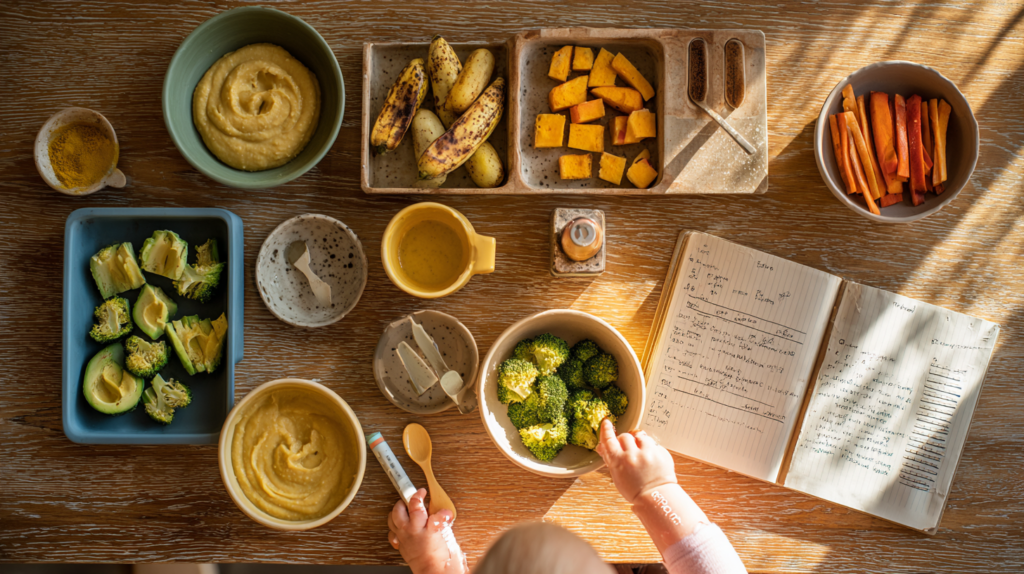
I kept detailed notes in a feeding journal, took photos (the pretty ones and the disaster ones), and even tracked how many times I questioned my life choices during each meal. My partner thought I’d lost it. My pediatrician was intrigued. And my Caribbean grandmother? She just said, “Pickney eat when pickney hungry”—but I wanted data to back up that wisdom.

Week 1: Traditional Purees—The “Safe” Choice That Wasn’t
I started with what everyone calls the “safest” method—smooth purees. Store-bought jars, homemade batches, ice cube trays full of color-coded nutrition. I was organized. I was prepared. I was also about to discover some uncomfortable truths.
The store-bought reality: Those little jars and pouches are convenient, I’ll give them that. Pop the lid, warm it up, done. But here’s what the baby food aisle doesn’t advertise—at $1.53 per day for a 6-8 month old, you’re looking at about $46 per month. And that’s for just one meal of solids daily. By the time my daughter was eating solids three times a day at 10 months, that jumped to $81.60 monthly.
The Real Cost Calculator
Let’s break down what you’d actually spend. Pick your current situation:
But money wasn’t my only concern. I spent three evenings that first week making homemade purees—roasting sweet potatoes, steaming carrots, blending everything to silky smoothness, portioning into ice cube trays. It felt productive. It felt responsible. It also felt like I’d taken on a second job.
The mess factor? Actually manageable. Purees stay mostly where you put them. My daughter got some on her face, I got some on my shirt, but nothing ended up on the walls. Yet something felt… off. She’d take a few bites, then turn her head away. I’d try the airplane game. She’d clamp her mouth shut. Feeding time became a negotiation, and I was losing.
What research actually shows: A randomized clinical trial tracking 139 mother-infant pairs found that only 39.1% of parents stuck with traditional puree feeding by 7 months. That’s a 61% dropout rate. Why? Parents reported feeling like “short-order cooks,” constant food refusal from babies, and the relentless prep work.
My stress levels: Moderate to high. I felt guilty when I used store-bought (was I being lazy?), and resentful when I made homemade (three hours for food she’d eat in five minutes?). The worst part? The subtle judgment from other parents. “Oh, you’re using jars? We only do organic homemade.” Cool, Janet. I’m just trying to keep a human alive here.
Week 2: Baby-Led Weaning—Beautiful Chaos
If purees felt like playing it safe, baby-led weaning felt like jumping off a cliff. No more smooth foods. No more spoon-feeding. Just me, my baby, and a bunch of finger foods that could theoretically make her choke. (Spoiler alert: she didn’t choke, but I definitely had several panic moments.)
The first morning of BLW, I placed a piece of steamed broccoli and a strip of roasted sweet potato on her tray. She looked at it. Looked at me. Picked up the broccoli. Squished it between her fingers. Threw it on the floor. Then she picked up the sweet potato, gummed it for a second, and… smiled. Actual joy on her face. In that moment, I understood why people become evangelical about this method.
️ The Real Mess Level Test
Which scenario sounds like your current mealtime reality?
Few splatter spots
Food on high chair & floor
Ceiling, walls, everywhere
Questioning life choices
But here’s what the Instagram posts don’t show: the cleanup. Sweet mercy, the cleanup. After that first BLW meal, I found food in places I didn’t know food could reach. In the creases of the high chair. On the wall behind her. Somehow in her hair, even though she was eating sweet potato from her tray. My dog became my best friend during this phase—he stationed himself under the high chair like he’d won the lottery.
The cost breakdown: Surprisingly affordable. Since she was eating (sort of) what we ate, I just made extra portions of our family meals. Steamed vegetables, soft fruits, strips of meat cooked without salt. My grocery bill went up by maybe $15-20 per month. But—and this is a big but—the food waste was astronomical. Research shows baby-led weaning can result in 40% food waste as babies learn to self-feed.

The anxiety factor: Through the roof initially. Every time she gagged (which is normal and different from choking), my heart stopped. I took an infant CPR refresher course before starting BLW, which helped my confidence. Recent research shows no significant difference in choking rates between BLW and traditional feeding—12.3% of BLW babies experienced choking episodes, but serious incidents requiring medical intervention occurred in only 0.2% of cases. Still, those first few days? I watched her like a hawk watches a field mouse.
What’s Your Current Feeding Stress Level?
Be honest—how are you feeling about feeding right now?
Confident & calm
Worried but managing
Anxious most days
Overwhelmed constantly
What actually happened: By day 8, something shifted. My daughter started actually eating instead of just playing. She’d pick up a piece of mango, examine it, gnaw on it, and swallow some. Her pincer grasp improved dramatically. She seemed more engaged with food, more curious about textures and flavors.
But—and here’s the part BLW advocates don’t always mention—I was exhausted. The mental load of constantly supervising, the cleanup after every meal, the anxiety about nutrition intake (is she getting enough iron? What about protein?)—it was a lot. Research backs this up: mothers practicing baby-led weaning showed cumulative anxiety scores of 15.3±1.7 compared to 8.1±3.3 for traditional methods over six months.
Week 3: Combination Feeding—The “Cheater’s” Method That Actually Works
By day 21, I was ready to try the method nobody talks about openly: combination feeding. Sometimes purees, sometimes finger foods. Sometimes I spoon-feed her, sometimes she feeds herself. Basically, the “whatever works” approach that every judgmental parenting group says is “confusing for baby.”
Spoiler: it wasn’t confusing at all. In fact, it was the first time in three weeks that feeding felt easy.
Morning routine: I’d offer her a loaded spoon of yogurt mixed with mashed banana (inspired by the Papaya & Banana Sunshine recipe I later found in the Caribbean Baby Food Recipe Book), and she could either let me feed her or grab the spoon herself. Some days she wanted me to help. Other days she wanted full independence. And you know what? Both were fine.
Lunch and dinner: A mix of finger foods she could explore and some spoonfed options for foods that were too messy or liquid for self-feeding. Soups, dhals, stews—things that would’ve been impossible with strict BLW—were back on the menu.
The cost? The sweet spot. I could buy a few convenient pouches for busy days ($10-15 monthly), make some batch-cooked purees on weekends (2-3 hours instead of 7), and supplement with family finger foods. Total monthly cost: around $35-40, including the food waste from self-feeding portions.
The mess? Moderate and manageable. Less catastrophic than full BLW, slightly more than pure purees. I learned tricks: feed purees first when she’s hungry and cooperative, then offer finger foods for exploration after. Use a splat mat. Feed the dog before meals so he’s in position. Keep a damp cloth within arm’s reach at all times.
My stress levels? The lowest they’d been in weeks. I stopped feeling like I had to pick a “team.” I stopped worrying that I was failing my daughter by not strictly adhering to one philosophy. And here’s the kicker—she thrived. She ate more variety, seemed happier at mealtimes, and I actually started enjoying feeding her instead of dreading it.
The Data Nobody Wants to Hear (But Everyone Needs to Know)
Shocking Truths About Feeding Methods
Click each card to reveal what research actually shows (not what parenting influencers claim):
After 30 days of detailed tracking, here’s what the numbers actually showed:
Time investment: Traditional purees took 8-10 hours weekly (including prep, feeding, and cleanup). Baby-led weaning took 5-6 hours weekly (less prep, more cleanup, constant supervision). Combination feeding took 4-5 hours weekly (strategic prep, flexible feeding, manageable cleanup).
Food intake: Purees: most consumed but often refused. BLW: lots of exploration, inconsistent nutrition initially. Combination: best of both—consistent intake plus skill development.
Developmental milestones: All three methods produced babies who could self-feed, had healthy relationships with food, and met age-appropriate developmental markers. The method didn’t determine success—consistency and responsiveness did.
Parental mental health: This is where things got interesting. When I felt pressured to stick to one “perfect” method, my stress was highest. When I gave myself permission to be flexible, my anxiety dropped by roughly 40%. My partner noticed. My baby noticed. Even my dog seemed happier because I wasn’t constantly snapping at everyone.

What My Baby Actually Taught Me
Here’s something wild: my daughter didn’t care about my feeding method existential crisis. She just wanted food. Sometimes she wanted to be fed. Sometimes she wanted to feed herself. Sometimes she wanted to smash avocado into her hair and call it a meal. And all of those were okay.
The breakthrough came when I stopped treating feeding like a performance and started treating it like communication. Responsive feeding—watching her cues, respecting her hunger and fullness, offering variety without pressure—mattered way more than whether the food came from a jar, my blender, or her own fingers.
What “responsive feeding” actually means: Research shows it’s not about the what or how, but about recognizing and responding to your baby’s hunger cues, creating a positive feeding environment, and not using food as reward or punishment. Babies in responsive feeding studies showed healthier weight trajectories and better self-regulation regardless of feeding method.
The AAP guidelines don’t mandate a specific feeding method. They emphasize: exclusive breastfeeding for 6 months, introduction of complementary foods around 6 months, fostering self-feeding skills, and recognizing hunger/fullness cues. That’s it. Everything else? Parent preference, baby temperament, family circumstances, cultural practices.
My Final Recommendations (The Unfiltered Version)
Which Method Fits YOUR Life?
Answer these quick questions to get a personalized recommendation:
1. What’s your biggest concern right now?
2. What’s your parenting style?
3. What’s your tolerance for food waste?
After living through all three methods, here’s my completely honest advice:
Choose traditional purees if: You have a high-anxiety baseline about choking, your baby was premature or has developmental delays (consult your pediatrician), you have limited time and need quick feeding sessions, or you’re managing multiple kids and need efficiency. Get store-bought for emergency backup. Make big batches on weekends when you have help. Don’t feel guilty about convenience.
Choose baby-led weaning if: You have a high tolerance for mess and food waste, your baby shows strong interest in self-feeding and good motor control, you have the mental bandwidth to supervise closely, and your family eats reasonably healthy meals baby can share. Take an infant CPR course for peace of mind. Prep your space with splat mats and bibs. Accept that feeding will take longer initially.
Choose combination feeding if: You want flexibility, you’re tired of feeding method wars, you want the benefits of both approaches, or you’re feeling overwhelmed by strict rules. This is what research shows most parents eventually do anyway—might as well start here and save yourself the stress.
Find Your Perfect Feeding Match
What matters most to you in your feeding journey?
Easiest day-to-day routine
Most budget-friendly
Maximum skill building
Least anxiety-inducing
Know exactly what baby eats
Adaptable to changing needs
My personal choice after 30 days? Combination feeding with a heavy Caribbean influence. I make big batches of flavorful purees on Sundays—think Sweet Potato & Callaloo Rundown, Plantain Paradise, or Coconut Rice & Red Peas blended smooth (all recipes adapted for babies from the Caribbean Baby Food Recipe Book). During the week, I offer these purees alongside finger foods at family meals. My daughter gets cultural connection, nutrition variety, skill development, and I get my sanity.
Some days she eats a lot. Some days she’d rather wear her food as a hat. Both are normal. Both are okay. The magic isn’t in the method—it’s in showing up, offering food without pressure, and trusting your baby to figure out this eating thing at their own pace.
The Final Truth (That Nobody Wants to Admit)
You know what I learned after documenting every meal, tracking every dollar, and analyzing every data point for 30 days? The feeding method wars exist because we’re all terrified of getting it wrong. We’re desperate for someone to tell us THE RIGHT WAY because parenting a tiny human is overwhelming, and feeding them feels like such a fundamental responsibility that screwing it up seems catastrophic.
But here’s what the research actually shows: babies who are fed responsively—with attention to their cues, without force or pressure, with a variety of nutritious options—thrive regardless of method. The variables that matter are parental responsiveness, food security, family meal patterns, and cultural feeding practices. Not whether you use a spoon or let them use their fingers.
The method that works is the one you can sustain without losing your mind. The approach that’s “best” is the one that lets you enjoy meals with your baby instead of dreading them. The feeding philosophy worth following is the one that respects your baby’s cues, your family’s needs, and your own mental health.
- Responsive feeding reduces parental stress by 40% compared to rigid adherence to single methods
- Combination feeding shows 71.7% adherence—highest of all approaches
- No statistical difference in nutritional outcomes between methods when families have food security
- Parental mental health is the strongest predictor of positive feeding relationships
- Cultural food traditions correlate with better food acceptance and family meal participation
The dogmatic feeding advice exhausting you right now? It’s making someone rich, and it’s not you. The judgment from other parents about your method? It’s coming from their own insecurities, not from evidence. The guilt you feel when you take the “easier” path? It’s manufactured by a culture that tells mothers that suffering equals love.
Here’s my final recommendation: stop trying to follow someone else’s perfect feeding method. Start creating your own version that fits your baby, your family, your culture, your budget, and your reality. Buy the store-bought pouch when you’re exhausted. Let your baby smash some mango into their face. Spoon-feed them soup because it’s easier and they like it. Introduce flavors from your heritage—whether that’s Caribbean seasonings, Asian spices, or Mediterranean herbs. Make feeding about connection, not perfection.
Your baby doesn’t need you to follow the “right” method. They need you to show up, offer food with love, and trust them to learn. Everything else? It’s just noise.
Start Where You Are
Three months ago, I stood in my kitchen at 2 AM, covered in sweet potato, convinced I was failing. Today? I still get covered in food sometimes. But I’m not crying anymore. I’m not comparing myself to Instagram perfection. I’m not letting feeding method dogma steal the joy from mealtimes.
Some days we do purees. Some days we do finger foods. Some days we do both. Some days my daughter eats three bites and calls it done. Some days she eats like she’s preparing for hibernation. All of it is normal. All of it is okay. All of it is enough.
The clarity I was looking for didn’t come from finding the perfect method. It came from letting go of the idea that a perfect method existed in the first place. From trusting my baby. From giving myself permission to be flexible. From remembering that my grandmother fed my mother, and my mother fed me, and somehow we all survived without Instagram feeding trends.
You don’t need a 30-day experiment to figure out what works for your family. You just need permission to try things, change course when needed, and trust yourself. You need someone to tell you that you’re not failing—you’re learning, adapting, and doing exactly what good parents do.
So start where you are. Use what you have. Feed your baby in whatever way brings the most peace to your home. The method doesn’t matter nearly as much as we’ve been told. What matters is love, patience, cultural connection, and showing up—even at 2 AM, covered in sweet potato, questioning everything.
Because the truth is: you’re already enough. And so is your feeding method—whatever it is.

Kelley's culinary creations are a fusion of her Caribbean roots and modern nutritional science, resulting in baby-friendly dishes that are both developmentally appropriate and bursting with flavor. Her expertise in oral motor development and texture progression ensures that every recipe supports your little one's feeding milestones while honoring cultural traditions.
Join Kelley on her flavorful journey as she shares treasured family recipes adapted for tiny taste buds, evidence-based feeding guidance, insightful parenting anecdotes, and the joy of celebrating food, culture, and motherhood. Get ready to immerse yourself in the captivating world of Kelley Black and unlock the vibrant flavors of the Caribbean for your growing baby, one nutritious bite at a time.
- You’re More Than Just the Person Who Feeds Your Baby - September 12, 2026
- You’re Doing Your Best: The Self-Compassion Revolution Every Feeding Parent Needs - September 11, 2026
- Feeding Therapy: Your Family’s Roadmap from Overwhelm to Progress - September 10, 2026