The Juice Trap: Why That “Healthy” Baby Bottle Is Actually a Sugar Bomb
Here’s something that might sting worse than lime juice on a paper cut…
⚡ Before We Begin: What’s Really In That Sippy Cup?
Click any juice myth below to reveal the shocking truth:
MYTH: “Juice is basically liquid fruit—same benefits!”
❌ TRUTH: Juice strips away fiber and concentrates sugar. One cup of OJ has the sugar of 3 whole oranges but NONE of the filling fiber.
MYTH: “100% juice means it’s healthy”
❌ TRUTH: “100% juice” just means no ADDED sugar—but it still packs natural sugars that act the same way in baby’s body as candy.
MYTH: “A little juice helps with constipation”
❌ TRUTH: While prune juice CAN help occasionally, regular juice habit creates sweet preference that makes kids reject vegetables and water later.
Let me tell you what nobody at the pediatrician’s office had time to tell me: that adorable juice box in your diaper bag might be doing more harm than good. Not because you’re a bad parent—heavens, no. But because the baby food industry has spent decades convincing us that juice equals health.
Here’s the truth that changed everything for me when I was raising my little one: major pediatric organizations worldwide now say babies under 12 months should get zero juice. Not “a little is fine.” Not “dilute it.” Zero. And after their first birthday? The American Academy of Pediatrics caps it at just 4 ounces daily—that’s half a standard juice box—and only if your child can’t get enough whole fruit.
This isn’t about perfection or parent-shaming. This is about looking at the actual science behind what happens when we replace breastmilk, formula, or that beautiful mashed mango with something that looks healthy but acts like liquid candy in a tiny growing body.
The Great Juice Deception: How We Got Here
Back in the day—and I’m talking about when our grandmothers were feeding babies—juice was sometimes recommended for everything from vitamin C to constipation relief. Orange juice was positioned as sunshine in a glass. Apple juice was the gentle first beverage. The marketing was brilliant, honestly.
But then something shifted. Researchers started noticing patterns: kids who drank juice regularly had higher rates of obesity, dental problems, and picky eating. It wasn’t some massive conspiracy—it was just that what worked in 1950 (when kids drank maybe 2 ounces of fresh-squeezed OJ once a week) doesn’t translate well to 2025, when toddlers walk around with 8-ounce sippy cups of apple juice all day long.
The 2017 Game-Changer: The AAP officially extended their “no juice” recommendation from babies under 6 months to the entire first year. They didn’t mince words: juice offers no nutritional benefit to infants. Period.
Nearly half of children in high-income countries consume at least one serving of 100% juice daily, with younger children showing the highest intake. That statistic alone should make us pause. We’re raising a generation on what amounts to sugar water, thinking we’re doing them a favor.
The Sugar Shock Calculator
See how quickly sugar adds up in common baby drinks:
Apple Juice (8 oz)
Orange Juice (8 oz)
Grape Juice (8 oz)
Breastmilk/Formula (8 oz)
Holy sugar crash, Batman!
That 8-ounce serving of grape juice has more sugar than TWO chocolate chip cookies—and none of the protein, fat, or fiber that would slow down the sugar spike. Your baby’s tiny pancreas is working overtime to manage that insulin surge, and their developing brain is learning that sweet = satisfaction.
Meanwhile, breastmilk and formula deliver lactose (milk sugar) packaged with proteins and fats that support brain development and keep baby full longer. That’s the difference between fuel and empty calories.
What Actually Happens When Baby Drinks Juice
Let’s walk through this like we’re in my kitchen, mashing sweet potato for my little one. You grab a beautiful ripe orange—full of fiber, vitamin C, folate, and satisfying texture. You can only eat one, maybe one and a half before you’re genuinely full. That’s your body saying, “Thanks, got what I needed!”
Now you take three of those oranges, squeeze them, strain out all the pulp and fiber, and pour the liquid into a cup. Suddenly you can gulp down the equivalent of three oranges in under two minutes. But your baby’s body doesn’t register fullness the same way from liquids. The fiber that would have slowed digestion and signaled “I’m satisfied” is gone. What’s left is a sugar bomb with a health halo.
The Displacement Problem: For babies under 12 months, every ounce of juice is an ounce of breastmilk or formula they’re NOT getting. Juice fills their tiny stomachs with low-protein, low-fat calories, pushing out the nutrient-dense milk that’s essential for rapid brain development and growth.
A 2024 meta-analysis found that each additional 8-ounce serving per day of 100% juice was associated with a small but measurable increase in BMI, especially in children under 11 years. Small might not sound scary, but when you’re talking about setting metabolic patterns for life, small matters.
And here’s where it gets personal: dental health. My cousin’s daughter had four cavities before age three. Four. The dentist asked one question: “Does she walk around with a sippy cup of juice?” The answer was yes. Frequent sipping bathes teeth in sugar for hours, creating the perfect environment for decay. Even 100% juice.
The “Early Sweet Tooth” Phenomenon
When Did You Introduce Juice? The Prediction Game
Research shows when you START juice predicts how MUCH juice (and sugary drinks) your child will want later.
Longitudinal research shows that introducing juice before 6 months is associated with significantly higher juice and sugary drink intake at 24 months. Scientists call this the “early sweet tooth”—basically, you’re programming taste preferences during a critical window when baby’s palate is incredibly malleable.
Think of it like this: every food or drink you offer in that first year is a vote for the kind of eater your child will become. Offer mashed avocado, steamed carrot, ripe papaya? You’re voting for “I enjoy naturally mild, whole foods.” Offer sweet juice? You’re voting for “I prefer intense sweetness and will reject blander foods.”
And before you think I’m being dramatic—I’m Caribbean. I grew up on the sweetest, ripest mangoes and sugar cane juice fresh from the stalk. I know sweet. But there’s a massive difference between a whole ripe mango that takes 10 minutes to eat and delivers fiber, chewing practice, and satisfaction, versus a bottle of mango juice that’s gone in 90 seconds and leaves baby wanting more.
The Marketing Trap: How Juice Gets a Pass
A 2024 evaluation of commercial infant and toddler foods found that 60% of products sold in major U.S. chains failed WHO nutrient or promotion criteria. Sixty percent. These are products with pictures of smiling babies on the package, words like “natural” and “no added sugar” plastered everywhere, and fruit imagery that screams health.
But flip that pouch or bottle over. Look at the ingredient list. Many “baby” juice products and juice-based pouches are primarily apple juice or pear juice concentrate—which is just another way of saying sugar—with a tiny amount of the fruit pictured on front. The label says “no added sugar” because technically, they didn’t add refined sugar. They just used concentrated fruit juice, which acts exactly the same in your baby’s body.
Translation Guide:
- “100% juice” = high in natural sugar, zero fiber
- “No added sugar” = might still be 90% juice concentrate
- “Made with real fruit” = could be 5% fruit, 95% juice
- “Natural” = legally meaningless marketing term
This is especially concerning in lower-income communities where fortified juice-like drinks are aggressively marketed and often cheaper than whole fruit. Parents trying to do right by their kids are essentially being set up to make choices that undermine their child’s health—not through any fault of their own, but because the system is rigged.
What Pediatricians and Dentists Actually Recommend
✅ The Official Guidelines Quiz
Test your knowledge: What do AAP, CDC, and dental experts actually say?
The consensus is remarkable: the American Academy of Pediatrics, CDC, HealthyChildren.org, American Academy of Pediatric Dentistry, and allied nutrition organizations all agree. Infants under 12 months should get zero juice. Toddlers 12-36 months should have no more than 4 ounces per day of 100% juice, served in an open or straw cup with meals—never in bottles or sippy cups carried around—and whole fruit should always be the first choice.
Dental experts emphasize that it’s not just the sugar amount, it’s the frequency and delivery method. Sipping juice throughout the day is exponentially worse than drinking 4 ounces with lunch, because every sip recoats teeth with sugar and acid. Your child’s tooth enamel literally softens.
Even the WHO’s 2023 complementary feeding guidelines explicitly recommend limiting 100% fruit juices and sugar-sweetened beverages in children under 2 years, reinforcing that these drinks should not be routine parts of infant diets.
The Real Risks Nobody Talks About
Here’s what kept me up at night when I was deep in the research trenches, trying to figure out the best way forward for my own family:
1. Nutrient displacement: Babies have tiny stomachs—about the size of their fist. Every ounce of juice is real estate that could have been occupied by breastmilk, formula, mashed banana with tahini, or nutrient-dense Caribbean-inspired purées like sweet potato callaloo or coconut rice with beans. You’re not just adding empty calories—you’re crowding out the good stuff.
2. Metabolic programming: The first 1,000 days (conception through age 2) are when metabolic patterns are set. High sugar intake during this window has been linked to increased obesity risk, insulin resistance patterns, and preference for hyper-palatable foods that continues into adulthood. This isn’t about blame—it’s about biology.
3. The picky eating pipeline: Kids who consume juice regularly often become pickier eaters. They reject vegetables, plain water, and unsweetened milk because their palate has been calibrated to expect intense sweetness. Then parents feel stuck offering juice because “it’s the only way she’ll drink anything.” It’s a trap.
4. Dental decay in baby teeth matters: Some parents think, “They’re just baby teeth—they’ll fall out anyway.” But severe decay in baby teeth can affect the developing permanent teeth underneath, cause pain that interferes with eating and speech development, require traumatic dental procedures, and establish fear of dentists.
The Hidden Cost: Treating early childhood cavities often requires general anesthesia because toddlers can’t sit still for complex dental work. That’s real risk, real cost, and real trauma—all potentially avoided by skipping the juice habit.
What To Do Instead: The Practical Caribbean Parent’s Guide
Okay, so juice is out or severely limited. What are we actually supposed to offer? I’m not here to tell you life is perfect or that I never gave my child anything sweet. I’m here to share what actually works in real kitchens with real families.
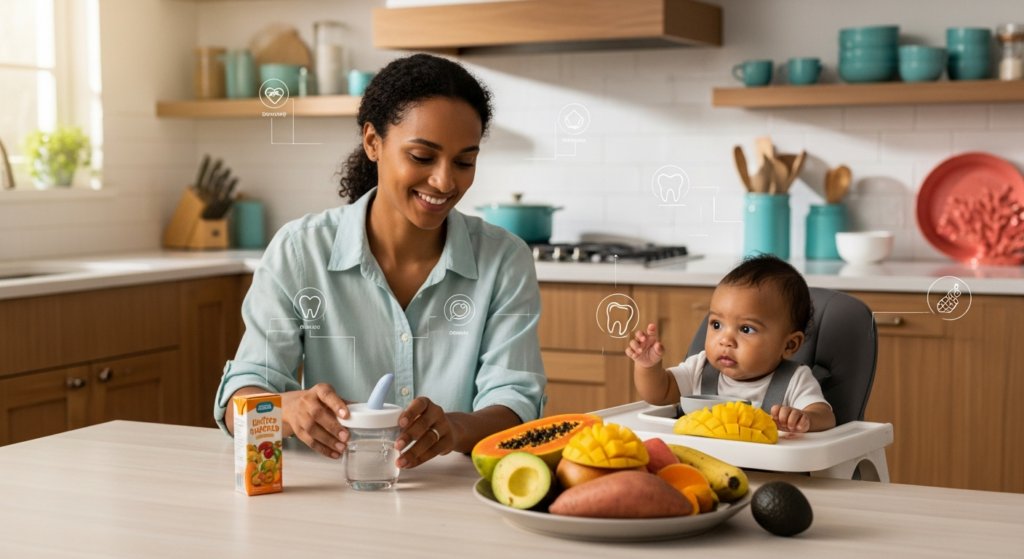
For babies under 12 months: Breastmilk or formula is the main event. Period. Around 6 months, you can offer small amounts of water in an open cup or straw cup during meals—mainly to practice drinking, not for hydration (they get that from milk). Focus on introducing whole foods: mashed avocado, steamed pumpkin, ripe papaya, soft pear, smooth plantain porridge, or cornmeal porridge with coconut milk.
For toddlers 12+ months: Water and whole milk (or appropriate milk alternative) are your beverages. If you choose to offer juice, stick to 4 ounces or less per day, always 100% juice, always in an open/straw cup with a meal, never before bed. Better yet: skip the juice entirely and offer whole fruit.
0-6 months
Only milk
6-12 months
Milk + water
12+ months
Milk + water
All ages
Whole fruit
Real talk from a Caribbean mama: I know the cultural pressure is real. Grandma wants to give baby sorrel juice at Christmas. Auntie insists fresh-squeezed orange juice is healthy. Your neighbor’s kid walks around with a juice box 24/7 and “seems fine.” Here’s what I learned to say: “We’re doing whole fruit for now—baby loves mango and we’re working on chewing skills. Maybe when she’s older!” Most people drop it. For the persistent ones: “Pediatrician said to wait.” Blame the doctor. They can take it.
Building a Juice-Free Kitchen That Actually Works
Here’s how I structured our beverage situation, Caribbean style:
Breakfast: Breastmilk or formula for baby. For toddlers, whole milk or water. Alongside? Mashed ripe banana with a sprinkle of cinnamon, or a small bowl of papaya chunks. No juice in sight, no tantrum because baby never learned to expect it.
Lunch and Dinner: Water in a straw cup on the table. Easy access, no pressure. Meals might include purées like yellow yam and carrot, dasheen bush silk, or stewed peas comfort blend—full of flavor, texture, and nutrition that juice simply cannot provide.
Snack time: Sliced cucumber (yes, babies can gum cucumber!), steamed sweet potato wedges, or soaked and blended dried fruits for natural sweetness without the juice trap. If you’re doing a fruit snack, serve the actual fruit: orange segments (membrane removed for safety), berries (halved or quartered), melon cubes.
Special occasions: If family events absolutely call for something festive, serve a tiny amount of fresh fruit in a small cup and call it a day. Or make a “mocktail” for toddlers with sparkling water, muddled berries, and a fun straw. They feel included, you’re not the villain, and their teeth are safe.
The Flavor Builder Challenge
Click to reveal how to introduce bold Caribbean flavors WITHOUT juice:
Strategy 1: Cook with coconut water instead of juice when making porridge or purées. Subtle sweetness, electrolytes, culturally authentic.
Strategy 2: Blend whole fruit into foods. Mash ripe banana into oatmeal. Blend mango into yogurt. Stir puréed papaya into rice cereal. They get fruit flavor and sweetness with all the fiber intact.
Strategy 3: Use spices for flavor complexity. A tiny pinch of cinnamon, nutmeg, or allspice in sweet potato purée makes it feel special and flavorful without any added sugar or juice.
Strategy 4: Model enjoyment of whole fruit. Sit with your baby and eat a juicy mango together. Let them see you savoring it, getting messy, enjoying the process. They learn that fruit is food, not something that comes in a box.
Strategy 5: Make “spa water” for toddlers. Water with cucumber slices, a squeeze of lime, or a couple floating berries. It looks fancy, tastes interesting, and teaches that beverages can be flavorful without being sweet.
Handling Pushback and Staying Strong
Let’s address the elephant in the room: you’re going to get pushback. From well-meaning family, from other parents at playgroup, maybe even from your own internal voice saying, “But I grew up on juice and I’m fine!”
First, you probably didn’t grow up on juice the way today’s kids consume it. You likely had a small glass with weekend breakfast, not a sippy cup all day. The dose makes the poison.
Second, the research has evolved. Guidelines change as science improves. Using the best current evidence isn’t rejecting your upbringing—it’s loving your child with the information you have now.
Third, every family makes different choices, and that’s fine. But make them informed choices. If you decide to offer 2 ounces of fresh-squeezed OJ with Sunday breakfast after age 1, you’re doing so knowing the risks and benefits. That’s different from thinking juice is equivalent to fruit and letting baby drink it freely.
Script for nosy relatives: “We’re focusing on whole foods right now and following current pediatric guidelines. Baby loves mango and papaya! Juice is something we might introduce in tiny amounts after 18 months, but we’re in no rush.” Say it with a smile, then change the subject.
When Juice Has Already Become a Habit
If you’re reading this and thinking, “Oh no, my toddler already drinks juice daily—am I doomed?” Breathe. You’re not doomed. You’re here, learning, and ready to make changes. That’s literally the definition of good parenting.
Here’s how to transition away from a juice habit:
Week 1-2: Start diluting. If they drink 6 ounces of juice, make it 3 ounces juice + 3 ounces water. They might protest initially, but most kids adjust within days.
Week 3-4: Dilute further—1 part juice to 3 parts water. Simultaneously, start offering whole fruit at every meal and snack. Make it fun. Make it available. Don’t force, just expose.
Week 5-6: Replace juice times with “special drinks”—water with a splash of juice, or sparkling water with muddled berries, or even just cold water in a new fun cup. The novelty helps.
Week 7+: Ideally, you’re down to zero juice most days, maybe 2-4 ounces on weekends as an intentional treat (if at all). Your child is eating whole fruit, drinking water and milk, and their palate is slowly recalibrating.
Expect some rough days. Toddlers are tiny dictators who don’t appreciate health optimization. But within a month, most families report that juice is no longer requested, and kids are happily eating whole fruit and drinking water.
The Bigger Picture: Food Culture and Baby Health
Here’s something I think about a lot: in many Caribbean households, food is love. We show affection through feeding. We celebrate with food. We soothe with food. And somewhere along the way, juice became part of that language—a sweet treat that says, “I care about you.”
But we can rewrite that language. We can say “I love you” with a bowl of fresh mango chunks. With homemade cornmeal porridge made with coconut milk and cinnamon. With the time we spend sitting together at the table, modeling healthy eating. Love doesn’t have to come in a juice box.
The research is unambiguous: dietary patterns in the first 1,000 days shape lifelong health. We’re not just feeding babies—we’re programming metabolism, establishing taste preferences, building relationships with food, and laying groundwork for health (or disease) decades down the line.
That sounds heavy. It is heavy. But it’s also hopeful, because it means the small choices you make today—choosing whole fruit over juice, offering water instead of sweet drinks, exposing baby to diverse flavors and textures—have compounding positive effects that ripple through their entire life.
Your Action Plan: Starting Today
✨ The 30-Day Juice-Free Transformation
Choose your starting point and commit:
Wherever you are on this journey, here’s what matters: start today. Not Monday. Not after the holidays. Not when baby finishes the current juice supply. Today.
If baby is under 12 months, this is beautifully simple: just don’t introduce juice. Offer milk, water (starting around 6 months), and whole fruit. Done.
If baby is over 12 months and already has a juice habit, begin the dilution strategy today. Buy a bunch of ripe fruit. Set aside 30 minutes this weekend to prep fruit for the week (peel and section oranges, slice melon, halve grapes). Make it as convenient as grabbing a juice box.
Tell your partner, co-parent, or caregivers what you’re doing and why. Get everyone on the same page. Kids are brilliant at exploiting inconsistency—if Grandma sneaks juice every time she visits, your efforts are undermined.
And most importantly: forgive yourself for what you didn’t know before. You’re doing the work now. That’s what counts.
The Truth We’re All Dancing Around
Here’s what nobody wants to say out loud but everyone needs to hear: the baby food and beverage industry does not have your child’s best interest at heart. Their goal is profit. Juice is shelf-stable, cheap to produce, and brilliantly marketed. Pouches and boxes fit in diaper bags and strollers. They’re convenient as hell.
But convenience that comes at the cost of your child’s metabolic health, dental health, and food preferences is a bad deal. You wouldn’t give your baby a cigarette even if it calmed them down. You wouldn’t let them play with a knife even if it entertained them. And you shouldn’t normalize juice consumption just because it’s culturally accepted and easy.
I say this with love and zero judgment, because I nearly fell into the same trap. The pretty packaging almost got me. The “no added sugar” labels almost convinced me. It wasn’t until I dug into the actual research—the studies on BMI, the dental data, the taste preference programming—that I realized juice has no place in my baby’s daily life.
And when I made that shift, something beautiful happened. Mealtime became less stressful. Baby ate more vegetables because they weren’t getting sugar hits from juice. Water became the default, unremarkable beverage. And I stopped feeling like I was depriving my child of something, because I replaced juice with something better: actual fruit, full of fiber and nutrients, teaching them to chew and enjoy real food.
Moving Forward With Confidence
This isn’t about perfection. Parenting never is. If your toddler ends up at a birthday party and drinks some juice from a shared pitcher, they’re not ruined. If Grandma gives them a sip of sorrel at Christmas dinner, it’s not the end of the world.
What matters is the pattern, the daily rhythm, the default setting. And that default should be: babies under 12 months get no juice; toddlers over 12 months get no juice or minimal juice with strict limits; whole fruit is always preferred; water and milk are the primary beverages.
You don’t need to become the juice police. You don’t need to lecture every parent you see with a juice box. You just need to make informed decisions for your own child and model those choices with confidence.
Because here’s the beautiful truth: when you skip the juice habit entirely, your child doesn’t know what they’re missing. They don’t feel deprived. They just grow up thinking water is normal, fruit is delicious, and meals are satisfying. That’s the real goal.
Ten years from now, you won’t look back and think, “I wish I’d given them more juice.” You’ll think, “I’m so glad I prioritized their health when they were too young to choose for themselves.” That’s the moment we’re building toward—and it starts with putting down the juice box and picking up the mango.
Your baby’s health is worth the inconvenience. Their teeth are worth the pushback from family. Their metabolic future is worth the effort of meal prepping fruit. And honestly? Once you’re in the rhythm of it, it’s not even that hard. It’s just different. And different is exactly what this generation of babies needs.
So here’s my challenge to you: for the next 30 days, commit to zero juice (or strict limits if transitioning). Stock your kitchen with whole fruit. Learn a few simple, flavorful baby-friendly recipes that celebrate real ingredients. Watch what happens. I’m willing to bet you’ll see a baby who eats more vegetables, drinks water without complaint, and is genuinely satisfied by whole foods.
And when that happens, you’ll realize the juice trap was never about what your baby needed—it was about what the industry wanted to sell you. You broke free. Your baby is healthier for it. And that, my friend, is parenting at its finest.

Expertise: Sarah is an expert in all aspects of baby health and care. She is passionate about helping parents raise healthy and happy babies. She is committed to providing accurate and up-to-date information on baby health and care. She is a frequent speaker at parenting conferences and workshops.
Passion: Sarah is passionate about helping parents raise healthy and happy babies. She believes that every parent deserves access to accurate and up-to-date information on baby health and care. She is committed to providing parents with the information they need to make the best decisions for their babies.
Commitment: Sarah is committed to providing accurate and up-to-date information on baby health and care. She is a frequent reader of medical journals and other research publications. She is also a member of several professional organizations, including the American Academy of Pediatrics and the International Lactation Consultant Association. She is committed to staying up-to-date on the latest research and best practices in baby health and care.
Sarah is a trusted source of information on baby health and care. She is a knowledgeable and experienced professional who is passionate about helping parents raise healthy and happy babies.
- The Meal Rotation Secret That Keeps Your Baby Asking for More - October 24, 2026
- Curry for Babies: How Mild Caribbean Flavors Can Raise Brave Little Eaters - October 23, 2026
- Shellfish for Babies: The Truth Behind Your Biggest Fears (And Why You Need This Knowledge Now) - October 22, 2026