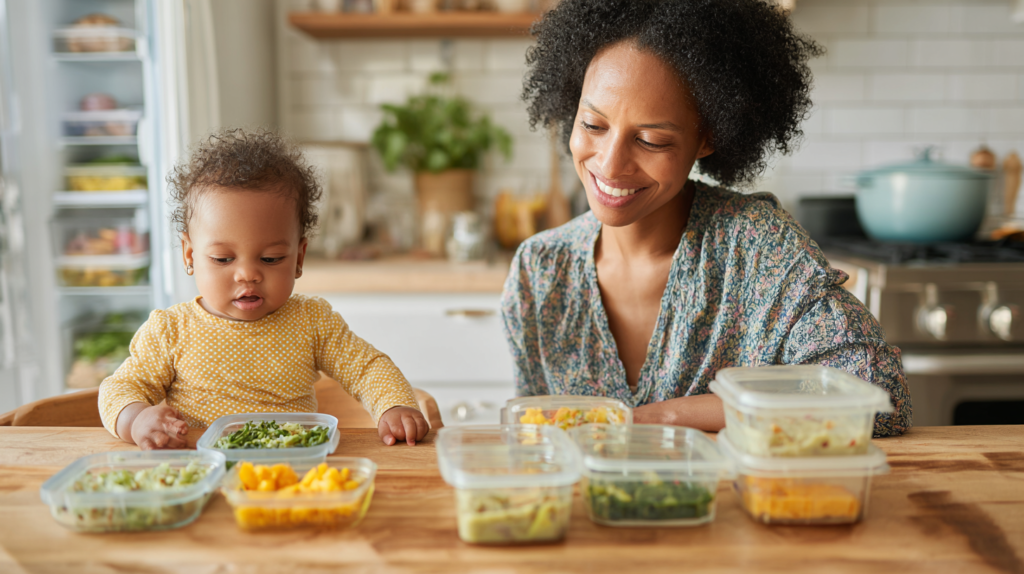
Sunday Meal Prep for Baby: The One Day That Buys You Freedom All Week
⏰ First, Let’s Get Real About Your Current Situation
Click the statement that hits closest to home:
Here’s what nobody tells you when you start feeding solids: the first month feels like running a restaurant with one very demanding customer who changes their menu preferences daily. You’re cooking multiple times a day, washing tiny bowls until your hands prune, and still wondering if your baby is getting enough variety. By week three, you’re Googling “is it okay if baby eats sweet potato for the fifth day straight” at 11 PM.
But here’s the truth that changed everything for me: one focused afternoon of cooking can set you free for an entire week. Not just free from the stove, but free from the mental load of figuring out what to feed your baby three times a day while keeping nutrition balanced, textures appropriate, and flavors interesting. Sunday meal prep for babies isn’t about being a perfect parent—it’s about being a strategic one.
The research backs this up completely. Recent studies on infant food preparation show that caregivers who batch-cook and plan weekly menus report lower stress levels and offer babies more food variety compared to daily, ad-hoc cooking. A 2024 parenting survey found that parents using Sunday prep routines save an average of 8-12 hours per week on baby meal tasks. That’s not just time—that’s your sanity, your energy, and those precious moments when you can actually sit with your baby instead of hovering over a pot of steaming carrots.
The “Sunday meal prep for baby” movement has exploded across parenting communities over the past three years, with Instagram and TikTok filled with real parents showing their weekly prep sessions—not the picture-perfect kind, but the messy, realistic, “I-did-this-in-yoga-pants-with-a-toddler-hanging-off-my-leg” kind. What makes it work isn’t fancy equipment or gourmet recipes; it’s understanding the system, the safety rules, and the smart shortcuts that let you cook once and feed confidently all week.
Why Sunday Prep Works (And Daily Cooking Doesn’t)
Let’s start with the uncomfortable truth: the traditional advice to “cook fresh for baby every meal” sounds beautiful in theory but crashes hard against reality. Between nap schedules, work demands, and the fact that your baby might decide today is the day they reject everything green, daily cooking becomes a pressure cooker of stress. You end up either cutting corners on variety (hello, banana purée for the third time today) or spending so much time in the kitchen that you miss out on actual floor time with your baby.
Sunday prep flips the entire equation. Public health guidance from the American Academy of Pediatrics emphasizes that babies starting solids around 6 months need frequent exposure to varied foods, multiple textures by 8-12 months, and iron-rich foods several times per week. Meeting these goals with daily cooking means constantly cycling through ingredients, managing shopping trips, and keeping mental track of what you served yesterday. With Sunday prep, you plan the whole week in one sitting, cook in efficient batches, and know with certainty that your baby is getting balanced nutrition because you mapped it out in advance.
The safety piece is massive too. Food safety studies show that proper batch cooking—when done with rapid cooling, correct refrigeration, and safe reheating—is actually more controlled than rushed daily cooking where foods might sit at room temperature too long or get reheated multiple times. When you’re doing Sunday prep, you’re focused, methodical, and following a system. When you’re throwing together lunch while your baby is screaming in the high chair, mistakes happen.
And here’s the part that sold me completely: Sunday prep supports family-style feeding. Modern complementary feeding guidance encourages including babies in regular family meals, just adapted for texture and salt. When you batch-cook family-friendly bases on Sunday—like stewed beans, roasted vegetables, plain rice, and soft proteins—you can pull from the same ingredients for both baby and adult meals all week. One cook session, multiple uses. That’s not just efficient; it’s how we teach babies to enjoy the foods their family actually eats.
The Sunday Prep Framework: What You’re Actually Doing
Sunday baby meal prep is not about cooking seven individual meals and labeling them Monday through Sunday like some kind of military operation. That’s exhausting and unnecessary. Instead, you’re batch-cooking versatile components—think grains, proteins, two or three different vegetables, and one or two combination dishes—that you mix and match throughout the week to create varied plates.
Here’s the framework that works for most families: dedicate 2-3 hours on one day (doesn’t have to be Sunday; pick whatever works) to cooking and portioning. Your goal is to prepare enough food to cover 5-7 days of main meals, stored partly in the refrigerator for the first few days and the rest in the freezer for later in the week. During the week, “cooking” becomes a 10-15 minute assembly task: thaw or reheat your prepped components, add a fresh element if you want (like mashed avocado or a bit of plain yogurt), and serve.
Build Your Sunday Prep Foundation
Select the components you want to prep this Sunday:
The beauty of this system is flexibility. If your baby is in the early purée stage (6-8 months), you’re mostly blending or mashing those components into smooth or slightly textured consistencies. If your baby is doing baby-led weaning or eating more textured foods (9+ months), you’re cutting things into appropriate finger-food sizes or keeping soft chunks. Same cooking session, different final forms depending on your baby’s developmental stage.
Caribbean families have been doing versions of this forever, by the way. Sunday cooking—making a big pot of rice and peas, stewed chicken, provisions (ground foods like yam, sweet potato, and dasheen)—is deeply embedded in the culture. You just adapt portions and textures for baby while the family eats the regular version. If you’re batch-cooking something like coconut rice with red peas, you can purée or mash a baby portion before adding salt to the adult batch. Same effort, double output. (If you want specific recipes for this approach, the Caribbean Baby Food Recipe Book has over 75 island-inspired, baby-friendly recipes designed exactly for this kind of batch prep.)
The Shocking Truth About Time (It’s Not What You Think)
The Time-Saving Secret No One Talks About
Here’s what nobody tells you: Most parents spend 45-60 minutes per day on baby meal tasks when cooking individually—shopping, cooking, portioning, cleaning, reheating. That’s 5-7 hours per week minimum. Sunday prep takes 2-3 hours total for the entire week.
You’re not saving a little time. You’re cutting your weekly baby meal workload by more than half.
But it gets better: because you’re cooking in batches, you’re also using less energy, doing fewer dishes (one big pot vs. three small ones daily), and wasting less food because you planned exact portions. A 2024 analysis found that meal-prep families reduce food waste by approximately 30% compared to daily cooking households.
The real game-changer? Mental load. When you finish Sunday prep, you know baby’s meals are handled for the week. No more 5 PM panic about what to feed at dinner. No more realizing you forgot to defrost something. No more mental Tetris trying to remember what baby ate yesterday so you don’t repeat it today. That cognitive freedom is worth more than the time savings alone.
Let me break down a realistic Sunday prep timeline so you can see exactly what those 2-3 hours look like. First 15 minutes: you’re getting organized—pulling out your storage containers, checking what you already have in the fridge and freezer, and reviewing your weekly plan. Next 90-120 minutes: active cooking, using your stove, oven, and maybe a pressure cooker or slow cooker simultaneously to maximize efficiency. Final 30-45 minutes: portioning, cooling, labeling, and storing. That’s it. And if you have a partner or helper, you can easily cut this time by teaming up on tasks.
Compare that to daily cooking: 15 minutes prep and planning per meal, 25-30 minutes cooking (especially if you’re doing proteins or anything that needs careful monitoring for baby safety), 10-15 minutes portioning and cooling, plus cleanup. Multiply that by 2-3 meals per day, and you’re easily at an hour daily, often more. Over a week, that’s 7+ hours minimum, and that’s assuming everything goes smoothly—no crying baby interruptions, no forgotten ingredients, no last-minute substitutions.
⏱️ Calculate Your Weekly Time Savings
How many baby meals do you typically cook per day?
Step-by-Step: Your First Sunday Prep Session
Alright, let’s walk through exactly how to do this, from grocery list to sealed containers in your freezer. I’m giving you the realistic version—not the Instagram-perfect one—because the goal is for you to actually do this, not just admire it.
Step 1: Plan Your Week (20 minutes, Thursday or Friday before)
Sit down with a simple grid: Monday through Sunday, breakfast/lunch/dinner. You don’t need different foods at every single meal—babies do great with some repetition, and variety comes from rotating through your prepped components. Decide on your base components: which grain (rice, quinoa, oatmeal, pasta), which proteins (lentils, beans, chicken, fish), and which vegetables (sweet potato, pumpkin, green beans, spinach, etc.). Aim for 2-3 proteins, 3-4 vegetables, 1-2 grains, and maybe one combination dish like a mild curry or stew.
This is where you check nutrition boxes: iron-rich foods several times (meat, beans, lentils, fortified cereal), fruits and vegetables at most meals, healthy fats (avocado, nut butters if age-appropriate, coconut milk, olive oil), and variety in colors and textures. Write your shopping list from this plan, grouping by store section so you’re efficient.
Step 2: Shop Smart (Saturday or Sunday morning)
Batch shopping is different from daily shopping. You’re buying in slightly larger quantities, but not bulk-store crazy amounts—just enough for the week plus a small buffer. Focus on fresh vegetables that hold well (root vegetables, squash, broccoli, cauliflower), proteins you can freeze immediately if not using right away, and pantry staples (grains, dried beans/lentils, canned beans, coconut milk). Frozen vegetables are your friend too—they’re pre-prepped, nutritionally solid, and often cheaper than fresh. If you’re incorporating Caribbean ingredients—things like callaloo, cho-cho (chayote), yellow yam, or green banana—grab those too; they batch-cook beautifully and add authentic flavor variety.
Step 3: Prep Your Space (15 minutes)
Before you start cooking, set yourself up for success. Clear your counter space. Get out all your storage containers—small ones for individual portions, medium ones for 2-3 servings. Label materials (masking tape and a marker work perfectly). Pull out your tools: pots, steamer basket, blender or food processor if you need it, knife and cutting board. Fill your sink with hot soapy water so you can wash as you go. Put on music or a podcast. This is your time.
Step 4: Cook in Layers (90-120 minutes)
Here’s where the magic happens. You’re going to cook multiple things simultaneously using different heat sources. Start your longest-cooking items first—like a pot of beans or lentils on the stove, a whole chicken or fish in the oven, or a slow cooker full of stew. While those are going, prep and start your vegetables: roast a big tray of cubed sweet potato, steam a pot of broccoli, sauté some spinach or callaloo. Get your grain going—a big pot of rice or quinoa.
The key is strategic layering: while the oven is roasting sweet potato, your stovetop is handling two pots (protein and grain), and you’re prepping the next vegetable to go in when the steamer is free. You’re not waiting for one thing to finish before starting the next; you’re orchestrating. This is why Sunday prep is actually faster per meal than daily cooking—you’re using your kitchen’s full capacity instead of one burner at a time.
Food safety check: cook everything thoroughly (proteins to safe internal temperatures, vegetables until completely soft for young babies), and once cooked, cool foods rapidly. Don’t leave cooked food sitting at room temperature for more than 2 hours total. The USDA guidance is clear: hot food should be cooled and refrigerated within that window to prevent bacterial growth.
Step 5: Portion and Store (30-45 minutes)
Once your components are cooked and slightly cooled (cool enough to handle safely but not sitting out too long), start portioning. For young babies (6-9 months), think 2-4 tablespoons per portion. For older babies (10-12 months), portions are more like 1/4 to 1/2 cup per food. Use your storage containers, silicone freezer trays, or even ice cube trays for very small portions.
Label everything—seriously, label everything. “Sweet potato, 12/8” is all you need, but do it. Three weeks from now, you will not remember if that orange mush is carrot or butternut squash. Refrigerate what you’ll use in the next 2-3 days. Freeze the rest. Most cooked baby foods keep 3-4 days in the fridge and 2-3 months in the freezer, though quality is best within the first month.
Step 6: Clean Up and Plan Combinations (15-20 minutes)
While you’re cleaning your kitchen (it’s not as bad as it looks because you’ve been washing as you go), think through your weekly combinations. Maybe Monday breakfast is oatmeal mixed with mashed banana and a spoonful of puréed mango. Lunch is rice with mashed black beans and steamed broccoli. Dinner is shredded chicken with sweet potato mash and avocado. Tuesday breakfast is the same oatmeal base but with puréed berries instead of mango. You’re mixing and matching components to create variety without cooking new things.
Pro tip from Caribbean kitchens: if you’ve made something like a base stew or curry, you can portion it as-is for baby meals, but you can also use it as a flavor base for the week. Add different vegetables or proteins to small portions of the base each day, and suddenly you have five “different” meals from one Sunday cook. That’s how our grandmothers did it, and it works.
Safety First: The Non-Negotiables
Let’s talk about the part that keeps parents up at night: food safety. Batch cooking for babies is completely safe when you follow proper guidelines, but there are rules you absolutely cannot skip. The research on infant food preparation practices shows that the biggest risks come from inadequate cooking, slow cooling, and incorrect storage temperatures—all preventable with knowledge and attention.
Cooking temperatures: All proteins (meat, poultry, fish, eggs) must be cooked to safe internal temperatures. For poultry, that’s 165°F; for ground meats, 160°F; for fish, 145°F. Use a food thermometer—don’t guess. Beans and lentils should be cooked until completely soft, no firmness in the center. Vegetables for young babies should be cooked until tender enough to mash easily with a fork.
Cooling and storage: After cooking, cool foods quickly. Don’t let a big pot of rice sit on the counter for two hours before portioning—that’s prime time for bacterial growth. Divide into smaller containers to speed cooling, and get them into the refrigerator or freezer as soon as they’re cool enough (within that 2-hour window total from cooking). Your refrigerator should be at 40°F or below; your freezer at 0°F or below.
Reheating: When you pull a portion from the fridge or freezer, reheat it thoroughly—steaming hot all the way through, then cool to an appropriate temperature before serving. Reheat each portion only once; don’t reheat, serve half, refrigerate the leftover half, and reheat again. That’s how bacteria multiply. If baby doesn’t finish a meal, discard what’s been in the bowl or touched by baby’s spoon; don’t save it for later.
Storage times: Cooked foods keep 3-4 days in the refrigerator, 2-3 months in the freezer (though best quality is within 1-2 months). Label with dates so you know what needs to be used first. When in doubt, throw it out—baby’s food safety is not worth the risk of using something that’s been stored too long.
One more critical point: never add salt, sugar, or honey to baby foods. Babies under 12 months should not have added salt or honey (honey is a botulism risk), and added sugars are unnecessary and create poor taste preferences. When you’re batch-cooking family foods, remove baby’s portion before adding these seasonings to the adult version. Mild spices and herbs like cinnamon, thyme, ginger, or a tiny bit of garlic are fine and encouraged—they introduce flavor variety and are culturally important in many cuisines—but salt and sugar are hard nos for baby portions.
The Caribbean Advantage: Flavor and Nutrition in One
Here’s something that took me far too long to realize: the foods I grew up eating—rice and peas, stewed chicken, callaloo, sweet potato, pumpkin, plantain, mangoes, papaya—are not just culturally important. They’re nutritionally perfect for babies. Caribbean cuisine is built on whole foods, bold flavors from spices and herbs (not salt), one-pot dishes that cook low and slow, and ingredients that are naturally rich in the vitamins and minerals babies need.
When you’re doing Sunday prep with a Caribbean lens, you’re already thinking in terms of batch cooking. A big pot of split pea soup, a tray of roasted provisions, a pot of stewed beans—these are meals that were always meant to feed a family for days. You just adapt the texture for baby (mash or purée instead of serving whole), hold the salt on baby’s portion, and you’re done. The flavors are there—thyme, bay leaf, a hint of allspice, coconut milk—so baby is learning to love real food, not bland mush.
Take something like rice and red peas (kidney beans). You cook a big pot on Sunday: rice, beans, coconut milk, thyme, maybe a scotch bonnet pepper for the adults (removed before serving baby), garlic, a bit of onion. Baby gets a portion mashed or served as soft finger food (if they’re at that stage), no added salt. Adults get the full seasoned version. One cook, two outputs. Or roasted sweet potato and callaloo: toss cubed sweet potato with a tiny bit of olive oil, roast until soft, steam or sauté callaloo (or any leafy green), mix together with a splash of coconut milk. Baby gets it mashed; you get it as a side dish. Efficient, nutritious, delicious, culturally connected.
Ingredients like yellow yam, pumpkin (calabaza), breadfruit, green banana, plantain, ackee, cassava—all of these batch-cook beautifully and offer different nutrient profiles and textures. They’re filling, naturally sweet or savory, and they freeze well. If you’re incorporating these into your Sunday prep, you’re giving your baby both nutritional variety and a taste education that connects them to culture and family food traditions. (Again, if you need recipes specifically designed for babies using these ingredients, the Caribbean Baby Food Recipe Book breaks down exactly how to prepare traditional dishes safely for infants and toddlers.)
What to Do When Sunday Doesn’t Go as Planned
Real talk: not every Sunday is going to be a perfect 3-hour cooking marathon. Sometimes baby is clingy, sometimes you’re exhausted, sometimes life just happens and Sunday comes and goes with zero prep done. Here’s what you do: you don’t abandon the system; you adjust it.
Option 1: The Mini Prep. If you only have 45-60 minutes, do a scaled-down version. Cook just 2-3 components instead of a full week’s worth—maybe one big pot of something (like a bean stew or chicken and vegetable mix), one batch of a grain, and one batch of a vegetable. That covers you for 3-4 days. Do another mini prep mid-week if needed. It’s still way more efficient than daily cooking.
Option 2: The Freezer Bank. If you know ahead of time that next Sunday is going to be chaotic, double your portions this Sunday and freeze the extras. Build a freezer “bank” of baby meals over time—every Sunday you prep, make a little extra and freeze it. Then, when you have an off week, you’re pulling from your freezer stash instead of scrambling. This is advanced-level Sunday prep, and it’s a total game-changer.
Option 3: The Partner Swap. If you have a partner or helpful family member, take turns. You do Sunday prep one week; they do it the next. Or split the session: one person handles proteins and grains, the other does vegetables and portioning. Teamwork makes the dream work, and it keeps one person from burning out on the routine.
Option 4: The Strategic Store-Bought Hybrid. There is zero shame in combining homemade Sunday prep with strategic store-bought items. Maybe you cook proteins and grains on Sunday but keep a stash of good-quality store-bought vegetable purées or frozen vegetable blends for quick additions. Or you prep all the vegetables and grains but grab pre-cooked rotisserie chicken to shred for baby portions (just rinse off excess salt). The goal is a system that works for your life, not a rigid rule that makes you feel like you’re failing if you can’t do it all.
Your Sunday Prep Personality
Which prep style matches your lifestyle?
Beyond the Basics: Leveling Up Your Prep Game
Once you’ve done a few Sunday prep sessions and you’ve got the basic system down, there are ways to make it even more efficient and varied. These are the techniques that separate the Sunday prep beginners from the veterans:
Theme weeks: Instead of cooking completely different foods every Sunday, rotate through weekly themes. One week is “Mediterranean-inspired” (quinoa, chickpeas, roasted eggplant, tomatoes). Next week is “Caribbean classics” (rice and peas, plantain, callaloo, stewed chicken). The week after is “Asian fusion” (rice, steamed bok choy, mild tofu, sweet potato). This simplifies your planning because you’re working within a framework, and it ensures your baby gets exposed to different flavor profiles and cuisines over time.
Flavor bases: Prep a couple of unsalted flavor bases on Sunday—like a simple tomato sauce, a coconut milk base, or a vegetable broth. During the week, you can mix these with your prepped proteins and vegetables to create “new” dishes without additional cooking. A serving of lentils is just lentils; those same lentils mixed with your tomato base and a bit of mashed sweet potato is suddenly a different meal. Same components, different combinations, more variety.
Texture progression: If your baby is moving from puréed to more textured foods, use your Sunday session to prep the same components in different textures. Mash half the sweet potato smooth, leave the other half in soft chunks. Blend some of the chicken into a fine purée for mixing into grains, shred the rest for finger food practice. This way you’re supporting their developmental progression without doubling your cooking effort.
Spice and herb packs: Pre-measure your spice and herb combinations for the week—little baggies or containers of thyme + bay leaf, or cinnamon + a tiny bit of nutmeg, or cumin + coriander. When you’re doing your mid-week reheating or combining components, you can add a pinch to create different flavor notes without having to think through your spice cabinet every time.
The 2-week rotation: Once you’ve built up a repertoire of 10-12 successful Sunday prep components, rotate them on a 2-week cycle. Week 1 you do batch A (chicken, lentils, sweet potato, broccoli, rice); week 2 you do batch B (fish, black beans, butternut squash, green beans, quinoa). By week 3, you’re back to batch A, but it’s been two weeks so everything feels fresh again. This eliminates menu fatigue without requiring constant new recipe development.
The Real-Life Test: Tracking Your Progress
Your Sunday Prep Success Tracker
Mark the wins you’ve experienced (or expect to experience):
Here’s what nobody tells you about switching to Sunday prep: the first week feels like an experiment. The second week feels a bit smoother. By the third week, you’ve figured out your rhythm, your timing, and your storage system, and suddenly it clicks. By week four, you’re wondering how you ever did it any other way. The cumulative effect of consistent weekly prep is dramatic—not just in time saved, but in stress reduction, nutrition confidence, and the sheer relief of knowing you’re not going to be standing at the stove tomorrow at 6 PM trying to figure out what to feed your baby.
Parents who stick with Sunday prep for a month report measurable differences: better sleep (because they’re not stressed about the next day’s meals), more relaxed mealtimes (because the food is already ready and they can focus on baby instead of cooking), and better food acceptance from babies (because consistent variety and repeated exposure to foods happens automatically when you’ve planned the week). One study on meal planning interventions found that families using structured weekly prep were significantly more likely to meet dietary guidelines for fruits, vegetables, and whole grains compared to families without a plan.
And here’s the part that surprised me most: Sunday prep makes you a better cook. When you’re batch-cooking regularly, you get efficient fast. You learn which vegetables roast at the same temperature, which proteins can go in the oven together, how to layer cooking times so nothing sits around getting cold. You develop instincts for portioning, for seasoning, for texture. After a few months of Sunday prep, you’re the person who can look at a random collection of ingredients and instantly know what to do with them, because you’ve practiced the systems that make cooking intuitive instead of stressful.
Your Sunday Freedom Plan
So here’s what it comes down to: Sunday meal prep for baby isn’t about being a super-parent or a meal-prep influencer. It’s about strategic use of your time and energy so that feeding your baby becomes something you can do confidently and calmly instead of something that dominates your entire day, every day. It’s about setting up systems that support good nutrition without requiring you to be a short-order cook from 6 months through toddlerhood.
The framework is simple—plan your week, shop once, cook in batches, store safely, combine flexibly. The execution takes a bit of practice, but after a few rounds, it becomes second nature. And the payoff is massive: hours back in your week, better food variety for your baby, lower stress, less waste, more confidence, and the freedom to actually enjoy mealtimes instead of dreading them.
If you take nothing else from this, take this: feeding your baby doesn’t have to be complicated or time-consuming to be good. You don’t need a culinary degree, a kitchen full of gadgets, or a Pinterest-perfect setup. You need a plan, a Sunday afternoon, and a willingness to batch-cook strategically. Everything else is just noise.
Start small if you need to. Pick three components for your first Sunday: a grain, a protein, a vegetable. Cook them, portion them, store them, and use them through the week. See how it feels. Notice the difference on Tuesday when you’re not scrambling to figure out lunch. Notice the difference on Thursday when you pull a pre-portioned meal from the freezer and you’re done in 10 minutes. That’s the difference between reactive daily cooking and proactive weekly planning. That’s the freedom you get back.
And if you’re looking for the recipes that make Sunday prep not just efficient but also culturally rich and flavorful, definitely check out the Caribbean Baby Food Recipe Book. It’s designed exactly for this—batch-friendly Caribbean recipes that work for babies and families, with proper safety guidelines, texture modifications, and that real-food flavor that connects your baby to heritage and family meals.
So what are you waiting for? This Sunday, give yourself the gift of a week’s worth of freedom. Your future self—and your baby—will thank you.

Expertise: Sarah is an expert in all aspects of baby health and care. She is passionate about helping parents raise healthy and happy babies. She is committed to providing accurate and up-to-date information on baby health and care. She is a frequent speaker at parenting conferences and workshops.
Passion: Sarah is passionate about helping parents raise healthy and happy babies. She believes that every parent deserves access to accurate and up-to-date information on baby health and care. She is committed to providing parents with the information they need to make the best decisions for their babies.
Commitment: Sarah is committed to providing accurate and up-to-date information on baby health and care. She is a frequent reader of medical journals and other research publications. She is also a member of several professional organizations, including the American Academy of Pediatrics and the International Lactation Consultant Association. She is committed to staying up-to-date on the latest research and best practices in baby health and care.
Sarah is a trusted source of information on baby health and care. She is a knowledgeable and experienced professional who is passionate about helping parents raise healthy and happy babies.
- Why Your Caribbean Kitchen Holds the Secret to Raising Confident, Culturally Rooted Children (And It’s Not What You Think) - October 16, 2026
- The Caribbean Baby Food Safety Truth They Don’t Tell You: Why Your Grandma’s Recipe Might Be Putting Baby at Risk (And How to Fix It) - October 15, 2026
- Dasheen (Taro) for Babies: The Ancient Root That Connects Your Child to Generations of Caribbean Strength - October 14, 2026