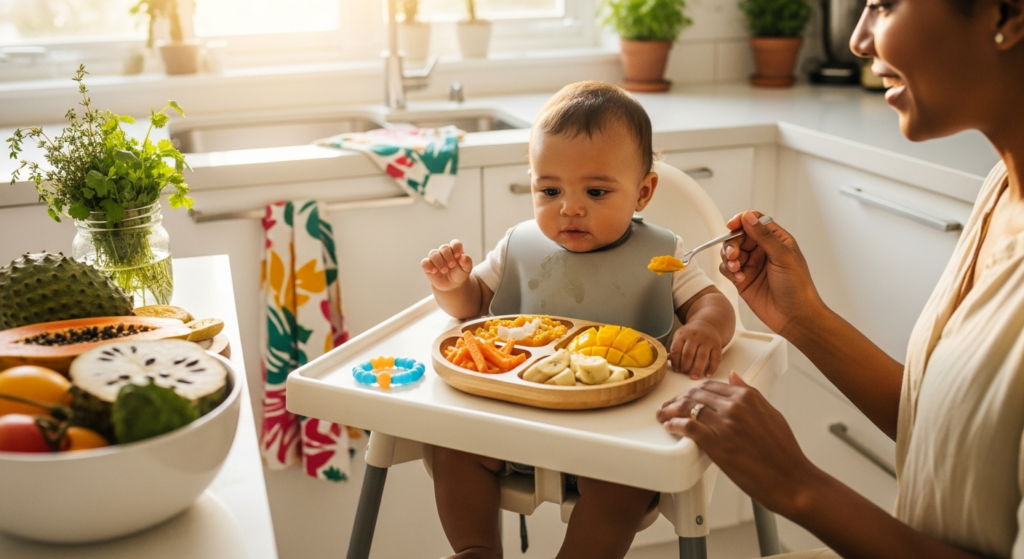
Starting Solids During Teething: The Truth No One Tells You (And the Caribbean Secret That Makes It Easier)
Right at this exact moment, somewhere in your home, there’s probably a teething ring sitting in the freezer next to tomorrow’s dinner. And maybe—just maybe—you’ve been staring at those first food purees wondering if your baby’s swollen gums mean you should wait another week. Or another month.
Here’s what changed everything for me: My nephew started showing all the classic readiness signs at five and a half months—sitting with support, reaching for food, that intense stare whenever anyone ate near him. But his two bottom teeth were pushing through at the same time, turning him into a drooling, fussy little person who wanted nothing but cold things against his gums. My sister was caught in this impossible place: start solids when he seemed ready, or wait until the teething settled down?
That’s when my grandmother—who raised six children across two Caribbean islands—said something that completely shifted our perspective: “Teething babies need to eat too, darling. You just got to know what to give them and when.” And she was absolutely right.
Click to reveal how common your concern actually is:
The truth is that starting solids during teething isn’t just possible—it can actually be beneficial when you understand a few key principles. Recent research tracking over 130 infants found that 26.2% experienced at least one choking episode between 6-12 months, but here’s the surprising part: there was no significant difference between baby-led weaning, traditional spoon-feeding, or mixed methods. The method wasn’t the risk factor—the food preparation and supervision were.
What does that mean for you? It means that teething doesn’t have to pause your baby’s food journey. It just means you need a slightly different roadmap—one that considers texture, temperature, and timing in ways that standard feeding advice doesn’t always cover.
The Science Behind Teething and Eating (Why Your Gut Feeling Is Right)
Let’s talk about what’s actually happening in your baby’s mouth during this phase. Teething typically starts anywhere from 4 to 10 months, which creates a nearly perfect overlap with the recommended window for introducing solids around 6 months. This isn’t coincidental—it’s developmental biology doing its thing.
When those primary teeth start pushing through the gum tissue, inflammation and pressure create discomfort. Some babies barely notice; others become temporarily different people—fussier, droolier, wanting to gnaw on absolutely everything. But here’s what pediatric feeding specialists emphasize: the discomfort comes in waves, not constant states. Most babies have genuinely sore gums for maybe 2-3 days right before a tooth breaks through, then relief for a while before the next one starts its journey.
What this means practically is that you’re not looking at months of avoiding solids—you’re working around shorter windows of peak discomfort. And during those peak times, you’re not stopping food introduction; you’re adapting textures and temperatures.
Studies on maternal anxiety during solid introduction reveal something fascinating: mothers using full baby-led weaning reported higher generalized anxiety scores across the first 6 months of feeding compared to those using traditional or combined methods. But—and this is crucial—the anxiety wasn’t about actual choking events (which remained rare). It was about the fear of choking and the mental load of constant vigilance.
This is where understanding the difference between gagging and choking becomes your superpower. Gagging is noisy, has color change but continued breathing, and is your baby’s natural protective reflex. Choking is silent, involves no airflow, and requires immediate intervention. Once you can recognize this distinction (and I recommend watching demonstration videos from pediatric sources before you start solids), your confidence increases dramatically.
What Actually Works: The Caribbean-Informed Approach
Growing up around Caribbean feeding traditions taught me something that modern pediatric research is now confirming: babies can handle more texture variety than we give them credit for, even with sore gums. The key is matching texture to comfort level and using temperature strategically.
Click each food to see if it’s teething-safe:
On the days when teething is at its worst, think soft, cool, and soothing. In Caribbean households, this might look like slightly chilled calabaza (pumpkin) puree with coconut milk, or room-temperature mashed yam with just a hint of cinnamon. The Caribbean Baby Food Recipe Book has an entire section on soothing first foods that work beautifully during teething phases—recipes like Sweet Potato & Callaloo Rundown and Plantain Paradise that can be served at different temperatures and textures depending on your baby’s comfort level.
When the gums are less sore, you can gradually introduce more texture. This might mean moving from smooth mashes to fork-mashed consistency, or from very soft steamed vegetables to slightly firmer (but still mashable) pieces. The progression isn’t about age milestones as much as it is about your individual baby’s teething pattern and comfort.
Temperature matters more than you’d think. Many parents instinctively reach for frozen teething toys, but extremely cold foods can sometimes increase sensitivity. Think “refrigerator cool” rather than “freezer frozen.” Room temperature foods are often easiest on sore gums, with occasional cool options (like chilled yogurt or refrigerated ripe mango) offering relief without shock.
Here’s a practical example from my own family: when my nephew’s molars started coming in at 13 months, his appetite dropped significantly for about four days. Instead of panicking about nutrition, my sister offered smaller, more frequent eating opportunities with focus on soft proteins and cooled starches. She’d cook batata (white sweet potato) until it was very soft, let it cool, and serve it alongside room-temperature avocado. On better days, she’d add slightly more texture with recipes like Geera Pumpkin Puree (a mild, cumin-spiced option) or Cornmeal Porridge Dreams served lukewarm instead of hot.
The baby feeding accessories market has exploded recently—reaching 2.2 billion USD in 2023—with countless products marketed as “teething feeders” or “mesh feeders.” While some families find these helpful, they’re not necessary. What matters more is understanding safe food preparation: cooking until soft enough to mash between your fingers with gentle pressure, cutting round foods into strips rather than coins, avoiding hard chunks that could break off, and always supervising actively.
Method Matters Less Than You Think (But Here’s What the Research Says)
Click each method to explore pros and cons during teething:
Traditional Spoon-Feeding
During Teething: Click to learn more
Baby-Led Weaning
During Teething: Click to learn more
Mixed Approach
During Teething: Click to learn more
Multiple studies from 2022-2025 comparing baby-led weaning to traditional spoon-feeding found remarkably similar outcomes in terms of safety. Choking rates hovered around 5-7% across methods, with extremely low rates requiring medical intervention—typically under 1%. One comprehensive study even found that serious choking occurred in 2.7% of traditionally fed infants versus 0.6% of baby-led weaning infants, though the difference wasn’t statistically significant when foods were age-appropriately prepared.
What does differ significantly is parental anxiety. Research shows that mothers using full baby-led weaning experienced higher anxiety scores, likely due to increased vigilance around choking risk and nutrient intake concerns. However, families using a mixed approach—offering both purees and soft finger foods—often reported feeling more flexible and reassured, especially during teething discomfort.
From a teething perspective, each method has advantages. Traditional spoon-feeding allows you to easily adjust to very smooth purees on peak discomfort days without your baby needing to do the work of self-feeding. Baby-led weaning offers soft graspable foods that can double as gum massagers—think soft strips of steamed carrot or ripe avocado that babies can gnaw on. The mixed approach gives you the freedom to follow your baby’s lead: spoon-feed smooth foods when they’re uncomfortable, offer finger foods when they’re feeling better and want to explore.
In Caribbean feeding traditions, this mixed approach has always been the norm, even before it had a formal name. You’d offer your baby a bit of mashed provision (root vegetables) from your spoon, then hand them a soft piece of steamed christophene (chayote) to hold and explore. It wasn’t “baby-led” or “traditional”—it was responsive, adapting to the child’s needs in the moment.
If you’re looking for recipes that work across different feeding methods and teething phases, the Caribbean Baby Food Recipe Book includes over 75 options specifically designed with texture flexibility in mind. Many recipes include family meal adaptations too, so you’re not preparing completely separate food for your baby—you’re just modifying texture and seasoning from what the rest of the family eats.
The Mental Game: Managing Your Anxiety (Because It’s Real and It’s Valid)
Move the slider to match your current stress level around feeding during teething:
Let’s be honest about something that doesn’t get talked about enough: the fear is real. Qualitative studies examining parental experiences during solid introduction found that fear of choking, allergic reactions, and future pickiness were nearly universal themes. These weren’t irrational anxieties—they were reasonable concerns about keeping a vulnerable human alive and healthy.
But here’s where it gets interesting: the parents who managed that anxiety most successfully weren’t the ones who avoided it or minimized it. They were the ones who prepared for it. They took infant CPR classes (or at least watched thorough online demonstrations). They learned the difference between gagging and choking by watching videos before starting solids, not in the panicked moment. They kept a written or mental checklist: Is baby making noise? Is there still some airflow? Are they coughing or actively trying to clear it? That’s gagging—watch and support, but don’t intervene.
Silent, no airflow, blue or pale? That’s choking—start back blows and chest thrusts and call emergency services. Having this distinction clear before you ever face it reduces catastrophic thinking during meals.
The research on parental mental health during complementary feeding suggests that anxiety often peaks around 2-3 months into the feeding journey, then gradually decreases as competence builds. That means your first few weeks will likely feel hardest, especially if teething is happening simultaneously. This is normal. This is expected. And it gets better with practice.
One coping strategy that helps many families: pre-planned safety routines. Before each meal, do a quick mental run-through: Baby is sitting upright in highchair with footrest? Check. I’m sitting directly across where I can see their face clearly? Check. No distractions—phone away, TV off? Check. Food is soft enough to mash between my fingers? Check. This kind of ritual creates a sense of control and preparation that reduces ambient anxiety.
If your anxiety is significantly impacting your ability to start solids or is causing distress beyond normal concern, please reach out for support. Recent studies found that parents with high baseline anxiety, previous trauma, or children with medical complexities benefit enormously from early referral to feeding clinics, pediatric dietitians, or perinatal mental health professionals. There’s no shame in needing extra support—in fact, seeking it is one of the smartest things you can do for both you and your baby.
Busting the Biggest Myths (Click to Reveal the Truth)
Your Practical Action Plan (What to Do Tomorrow)
Enough theory—let’s talk about what this actually looks like in your kitchen tomorrow morning. If your baby is showing readiness signs (sitting with support, good head control, interest in food, loss of tongue-thrust reflex), you can start solids even if teething is actively happening. Here’s how:
Step 1: Assess today’s teething situation. Is this a peak discomfort day (drooling heavily, very fussy, constantly gnawing) or a better day? On peak days, start with the smoothest textures you’re comfortable with—whether that’s a silky puree or a very soft mash. On better days, you can introduce slightly more texture or offer soft finger foods.
Step 2: Choose your first food strategically. Single-ingredient foods that are naturally soft and easy to modify are your friends. Sweet potato, avocado, banana, well-cooked pumpkin, ripe mango, soft-cooked plantain—these all work beautifully and can be served at different textures and temperatures. If you’re drawing from Caribbean ingredients, think about options like batata (white sweet potato), calabaza (West Indian pumpkin), or ripe papaya. The Caribbean Baby Food Recipe Book includes simple starting recipes like Papaya & Banana Sunshine and Yellow Yam & Carrot Sunshine that work across feeding methods.
Step 3: Prepare food safely. Cook vegetables until they’re soft enough to mash easily with gentle pressure between your fingers. If offering finger foods, cut into strips (about the length of your pinky finger and the width of two fingers) rather than coins or chunks. For purees, blend to whatever consistency your baby can manage—completely smooth if needed, or with tiny soft lumps if they’re ready.
Step 4: Consider temperature. Most babies with sore gums do best with room temperature or slightly cool (not freezing) foods. You can test this: offer food at room temperature first. If they seem more interested in it after it’s been in the fridge for 20 minutes, that’s feedback—lean into cooler options for a few days.
Step 5: Create your safety setup. Baby in highchair, sitting upright, with feet supported. You’re directly across where you can see their face clearly. Phone on silent, attention fully on baby. Food within their reach if you’re doing baby-led, or spoon ready if you’re parent-feeding. First few times, offer just 1-2 small tastes or pieces to see how they manage it.
Step 6: Expect mess and gagging. Both are completely normal. Gagging might happen several times in early meals—it’s loud, they might make faces, but they’re learning to move food around their mouth. Stay calm, stay close, but don’t intervene unless it’s clear choking (silent, no airflow, color change).
Step 7: Offer solids at a time of day when baby isn’t overtired or starving. Mid-morning after a milk feed, or early evening before the bedtime routine, often work well. You want them alert and interested, not desperately hungry (milk still provides most nutrition in early months anyway).
Click to check off each milestone as you accomplish it:
The Long View: What Happens Next
Here’s something that brings me comfort on the harder parenting days: this phase is temporary. The intense teething will pass. The early feeding learning curve will smooth out. What you’re building right now—through every anxious meal, every texture experiment, every moment of trusting your baby’s ability—is a foundation for a lifetime of eating.
Research tracking complementary feeding approaches over time is increasingly looking at how early experiences shape long-term eating behavior, including self-regulation, food variety acceptance, and relationship with food. The evidence isn’t conclusive yet on which method creates the “best” eaters, but there are some interesting patterns: babies who have early exposure to varied textures (even during teething) tend to accept lumpy foods more readily later. Families who approach feeding with less anxiety and more responsiveness tend to have children with fewer eating difficulties down the line.
The future of infant feeding support is likely to include more mental health integration—routine screening of parental anxiety during the solids window, better access to feeding therapists and dietitians, and digital tools that provide real-time reassurance. We’re already seeing growth in apps, remote video coaching, and interactive workshops designed to help parents distinguish gagging from choking and build confidence with texture progression during teething and beyond.
The market for baby feeding products continues to expand—projected to grow at about 8.5% annually through 2033, driven by innovation in multi-functional designs and safety features. But ultimately, the best “tool” you have isn’t something you can buy. It’s your attention, your responsiveness to your individual baby’s cues, and your willingness to adapt as you learn what works for your unique child.
Building Your Flavor Foundation
One of the most beautiful aspects of introducing solids during teething—or any time—is the opportunity to share your culture and heritage through food. Caribbean cuisine offers incredible variety in terms of textures, flavors, and nutritional profiles that work wonderfully for babies.
Think about the natural progression: you might start with simple Sweet Potato & Callaloo Rundown (smooth, nutrient-dense, naturally mild) when teething is active, then move to slightly textured options like Plantain Paradise or Yellow Yam & Carrot Sunshine as gums feel better. As your baby grows and can handle more complex flavors, you can introduce gentle spices—a tiny pinch of cinnamon, a hint of thyme, eventually a touch of mild curry or cumin.
The Caribbean Baby Food Recipe Book follows this exact philosophy, with recipes organized not just by age but by texture and flavor complexity. You’ll find everything from first purees to 12+ month meals, including family meal adaptations so you’re not cooking separately for baby. Recipes like Cornmeal Porridge Dreams, Coconut Rice & Red Peas, and Basic Mixed Dhal Pure can all be adjusted in texture depending on your baby’s teething status and developmental stage.
What I love most about Caribbean-informed feeding is the emphasis on real food—whole vegetables, fruits, ground provisions, pulses, and moderate amounts of meat or fish, all prepared simply with herbs and mild spices. There’s no reliance on processed “baby foods” or single-use pouches. You’re cooking for your family and adapting a portion for baby. This approach naturally creates varied texture exposure and flavor familiarity, which research suggests supports better long-term eating patterns.
When Things Don’t Go According to Plan
Let’s talk about what happens when your baby flat-out refuses to eat, even when you’ve done everything “right.” This happens. It’s normal. And it doesn’t mean you’ve failed or that something is wrong.
Teething can temporarily suppress appetite. Some babies lose interest in solids completely for a few days during peak teething discomfort, preferring only breast or bottle. This is okay. Milk is still the primary nutrition source until closer to one year anyway. Solids before one are largely about learning, exposure, and skill-building—not about hitting specific calorie targets.
If your baby refuses a food, it might mean: it’s too hot or cold for their current comfort level; the texture is challenging today; they’re not hungry right now; they’re overstimulated or distracted; or they simply don’t like that particular food (which is also valid). Research on “picky eating” shows that it takes an average of 8-15 exposures to a new food before acceptance, and that number can be higher during phases of discomfort like teething.
Your job isn’t to force eating or to stress about every refused meal. Your job is to offer, to create a positive eating environment, and to trust that your baby will eat when they’re ready and comfortable. Some days that means they take three bites. Some days they just play with food and get it all over themselves (which is actually valuable sensory learning). Some days they eat more than you expected.
If feeding refusal persists beyond teething phases, if your baby seems distressed around food, if they’re not gaining weight appropriately, or if you’re consistently anxious about feeding—these are times to reach out to your pediatrician or a pediatric feeding specialist. Most feeding difficulties are absolutely solvable with the right support, and early intervention makes a significant difference.
Your Permission Slip
Here’s what I want you to hear clearly: you don’t have to be perfect at this. You don’t have to choose the “right” feeding method or the “optimal” first food or the exact perfect moment to start. You need to be present, responsive, and willing to adapt. That’s it.
Teething will complicate things sometimes. Babies will surprise you—both in wonderful ways and in challenging ways. You’ll have moments of doubt. You’ll wonder if you’re doing enough, doing too much, doing it wrong entirely. These feelings are part of the process, not evidence that you’re failing.
The research tells us clearly that there’s no single “right” way to introduce solids. Traditional spoon-feeding works. Baby-led weaning works. Mixed approaches work. What matters most is safety (appropriate textures, supervision, readiness), responsiveness (following baby’s cues rather than forcing), and your own mental wellbeing (because an anxious, exhausted parent struggling through meals isn’t serving anyone).
Give yourself permission to start small. Permission to adjust your plan based on how it’s actually going, not how you thought it would go. Permission to choose the approach that feels most manageable for you, even if it’s not the trendy method everyone’s posting about online. Permission to take breaks on really hard teething days and try again tomorrow. Permission to ask for help.
Years from now, your child won’t remember whether you started solids at exactly 6 months or 6.5 months, whether you offered purees or finger foods first, whether you used a special feeding method or just figured it out as you went. What they’ll carry forward is the foundation you’re building right now: exposure to varied foods, positive associations with eating, and the experience of a caregiver who was present and responsive to their needs.
So take a breath. You’ve got this. Even when it feels like you don’t, even when the teething is bad and the gagging is scary and you’re tired and worried—you’ve got this. And every small step you take is moving you both forward, building skills and confidence one meal at a time.
Go make that first simple food. Sit with your baby in that highchair. Offer that first taste or that first soft strip of sweet potato. Stay close, stay calm, and trust the process. This moment right here—this messy, uncertain, beautiful moment of beginning—is exactly where you’re supposed to be.
For more Caribbean-inspired recipes that work beautifully through every teething phase and feeding stage, explore the Caribbean Baby Food Recipe Book. You’ll find everything from soothing first purees to family meals, all designed with texture flexibility and cultural authenticity in mind. Because feeding your baby should connect them to their heritage, not stress you out.

Expertise: Sarah is an expert in all aspects of baby health and care. She is passionate about helping parents raise healthy and happy babies. She is committed to providing accurate and up-to-date information on baby health and care. She is a frequent speaker at parenting conferences and workshops.
Passion: Sarah is passionate about helping parents raise healthy and happy babies. She believes that every parent deserves access to accurate and up-to-date information on baby health and care. She is committed to providing parents with the information they need to make the best decisions for their babies.
Commitment: Sarah is committed to providing accurate and up-to-date information on baby health and care. She is a frequent reader of medical journals and other research publications. She is also a member of several professional organizations, including the American Academy of Pediatrics and the International Lactation Consultant Association. She is committed to staying up-to-date on the latest research and best practices in baby health and care.
Sarah is a trusted source of information on baby health and care. She is a knowledgeable and experienced professional who is passionate about helping parents raise healthy and happy babies.
- Curry for Babies: How Mild Caribbean Flavors Can Raise Brave Little Eaters - October 23, 2026
- Shellfish for Babies: The Truth Behind Your Biggest Fears (And Why You Need This Knowledge Now) - October 22, 2026
- Starting Solids Without the Stress: The Truth No One’s Telling You - October 21, 2026