Rice and Peas for Baby: How to Keep the Soul, Change the Recipe
When cultural tradition meets modern safety—and why you don’t have to choose between them
Before we dive in, tap the memory that feels most like home to you:
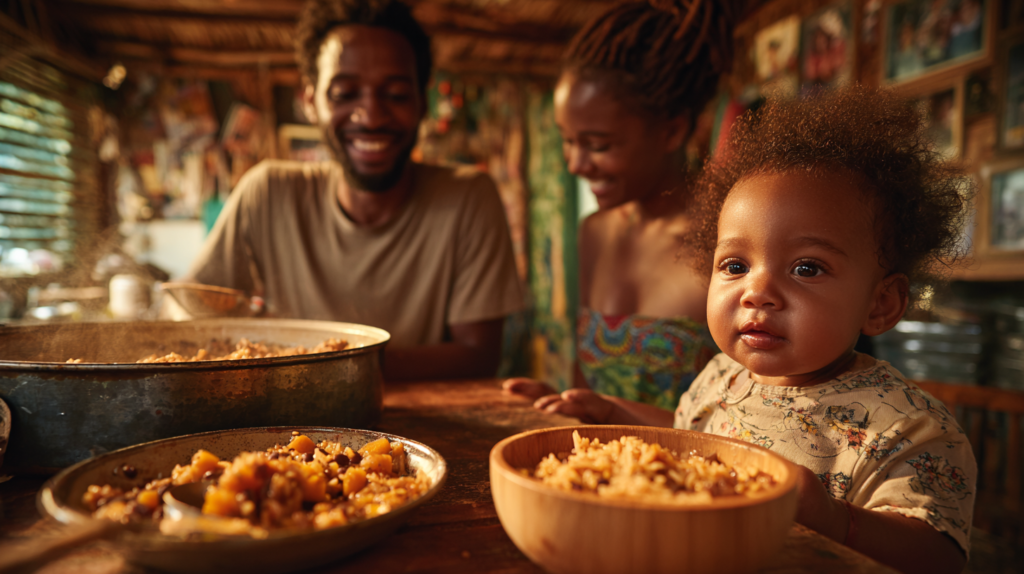
Here’s the thing about rice and peas that nobody tells you until you become a parent yourself: it was never just food. It was Sunday. It was family. It was the sound of your grandmother humming at the stove, the smell of thyme and coconut milk filling the whole house, the way the adults’ plates were piled high while you got “a little taste” because supposedly you were “too small for real food yet.”
And now you’re the parent. You’re standing in your own kitchen, baby on your hip, staring at that pot of rice and peas. You want to pass it down—that same smell, that same tradition, that same belonging. But then you hear all these voices: No salt before one. Whole peas are a choking hazard. Watch the arsenic in rice. What about the coconut milk fat content?
It’s enough to make you want to give up and just serve plain oatmeal until your baby turns five.
But what if you didn’t have to choose? What if you could keep the soul of rice and peas—the coconut, the thyme, the soft kidney beans mashed into creamy perfection—while making it safe for your six-month-old? What if modifying the recipe wasn’t about erasing culture, but about honoring it enough to bring your baby into the circle sooner?
That’s exactly what we’re doing today. Because rice and peas isn’t just a side dish. It’s an invitation to belong. And your baby deserves that invitation from day one of solids—with a few smart tweaks that keep everyone safe and satisfied.
Why Rice and Peas Matters More Than You Think
Let’s start with what rice and peas actually is, beyond nostalgia. At its core, it’s a one-pot meal that combines rice with legumes—usually red kidney beans or pigeon peas—cooked in coconut milk with aromatics like thyme, scallion, garlic, and sometimes a whole Scotch bonnet pepper for fragrance. For many Caribbean families, it’s the Sunday staple, the celebration dish, the meal that says “we’re home.”
From a baby nutrition perspective, though? Rice and peas is quietly brilliant. You’ve got complex carbohydrates for energy, plant-based protein and iron from the legumes, healthy fats from the coconut milk, and aromatic herbs that train baby’s palate without needing salt or sugar. In fact, food-based dietary guidelines across Latin America and the Caribbean specifically recommend legumes and grains as daily staples for infants starting around six months.
The Science Behind the Tradition: Global complementary feeding guidelines encourage offering babies a variety of food groups from around 6 months, including grains, legumes, vegetables, and healthy fats—while avoiding added salt and sugar in the first year. Rice and peas, properly modified, checks every single box.
The challenge isn’t the dish itself. It’s how we usually prepare it for adults: heavy on salt, sometimes with salted meats, whole beans that can be choking hazards, and that Scotch bonnet heat that even some adults can’t handle. But here’s the beautiful part—you don’t need to throw out the recipe. You just need to pull baby’s portion out before you add the grown-up seasonings.
Cultural Win Nutritionally Dense Budget-Friendly Freezer-Friendly
The Clash Nobody Warned You About
Let me tell you what happens in real life. You’re excited to introduce solids. You’ve read all the guidelines about iron-rich foods and offering variety. You know rice and peas could be perfect. But then—
Your mother says, “Just give the baby what we’re eating. We didn’t have all these fancy rules and you turned out fine.”
Your partner’s grandmother insists that food without salt is “food for sick people” and refuses to believe the baby will actually eat unsalted rice.
Your aunt warns you that coconut milk is “too rich” for babies and will cause colic.
And your pediatrician looks at you with concern and says, “Traditional foods are fine, but…” and proceeds to list every possible choking hazard and sodium warning.
So you’re stuck in the middle, feeling like you have to choose between honoring your family’s food legacy and keeping your baby safe. That tension is real, it’s painful, and it’s completely unnecessary—because the answer isn’t picking a side. It’s understanding what each side is actually worried about, and then cooking in a way that addresses all of it.
The Real Issue: It’s not rice and peas itself that’s the problem. It’s the adult preparation—high sodium, whole round beans, potentially spicy cooking liquid, and sometimes tough, chewy rice. Modify those four things, and you’ve got a perfect baby food that still tastes like home.
What the Research Actually Says
Here’s where we separate emotion from evidence. Because yes, your grandmother raised healthy children on traditional food. And yes, modern guidelines have stricter rules about salt and choking hazards. Both can be true. Let’s break down what we actually know:
On Salt: Babies under 12 months should have less than 1 gram of salt per day (about 400mg of sodium), and ideally none added to their food. Their kidneys aren’t fully mature yet, and early high-sodium exposure can set taste preferences that increase risk for high blood pressure later. Traditional rice and peas, especially when cooked with salted meats or stock cubes, can easily contain an adult’s full day of sodium in a single cup.
On Legumes: Beans and peas are actively encouraged as complementary foods starting around 6 months. They’re rich in protein, iron, zinc, and fiber—all things babies need as breastmilk or formula alone stops meeting their needs. The catch? They must be thoroughly cooked until very soft, and mashed or cut small enough to prevent choking. Whole round peas and beans are on every choking hazard list for infants.
On Rice: Rice is a common first food globally, but health authorities now caution against making it the only grain, especially rice cereal, because of inorganic arsenic accumulation in rice plants. The guidance isn’t to avoid rice—it’s to rotate grains and not rely on rice products at every meal. In the context of rice and peas, that means serving it a few times a week alongside other grains like oats, quinoa, cornmeal, or ground provisions.
On Coconut Milk: The concern about coconut milk being “too rich” is mostly myth. Babies need healthy fats for brain development. Light coconut milk, used in moderation, provides that fat along with a creamy texture that helps other foods go down easier. The key is not to flood every meal with it, but used 2-3 times per week in dishes like rice and peas, it’s nutritionally beneficial.
On Spices: Aromatic herbs like thyme, scallion, and garlic are perfectly safe and even encouraged for babies. They help develop a varied palate without adding sodium or sugar. Hot peppers like Scotch bonnet are a different story—the capsaicin can cause pain, digestive upset, and feeding aversions in babies. The solution? Cook your pot with aromatics, but keep the hot pepper out of baby’s portion entirely.
Quick Knowledge Check: What’s Safe to Modify?
Can you cook rice and peas with thyme and garlic for a 7-month-old?
Should you add a stock cube to baby’s rice and peas for flavor?
Can you serve whole red kidney beans to a 9-month-old?
The One-Pot, Two-Path Method
This is where it gets practical. You’re not making a separate baby meal that lives in exile. You’re making one pot of rice and peas, and you’re strategic about when you season it. Here’s the game plan:
Step 1: Cook the base. Start with your beans—canned are fine if you rinse them well, or pre-cooked dried beans. Add them to a pot with water, thyme, scallion, garlic, and a bay leaf. Let them simmer until very, very soft—softer than you’d normally cook them.
Step 2: Add coconut and rice. Stir in light coconut milk (or full-fat, diluted with a bit of water), then add your washed rice. Use a bit more liquid than usual so everything cooks softer. Let it simmer, covered, until the rice is tender and the liquid is mostly absorbed.
Step 3: Split the pot. Before adding any salt, pepper, salted meats, or stock cubes, scoop out baby’s portion into a separate bowl. Taste it—it should smell and taste like thyme, garlic, coconut, and beans, which is plenty of flavor for a baby.
Step 4: Adjust baby’s texture. Depending on your baby’s age and chewing skills, mash the beans into the rice, or blend a portion smooth, or thin it with a bit of cooking liquid or breastmilk. Make sure there are no whole beans or hard bits.
Step 5: Season the adult pot. Now you can go back to the main pot and add your salt, Scotch bonnet, salted pork, whatever makes it taste like the rice and peas you grew up with. Everyone eats from the same pot—just at different stages of seasoning.
This method takes maybe 60 extra seconds. You don’t need a separate recipe, a separate cooking session, or a completely different meal plan. You’re just being intentional about the timing of salt and spice.
Pro Caribbean Parent Tip: Make a big batch on Sunday, portion out baby’s unsalted servings into freezer containers before seasoning the rest, and you’ve got baby rice and peas ready for the whole week. Thaw, reheat, and serve alongside whatever vegetables or proteins you’re offering that day.
If you want more Caribbean recipes already adapted with this same philosophy—keeping the flavor, adjusting the texture and salt—the Caribbean Baby Food Recipe Book has over 75 island-inspired meals designed exactly this way, including multiple rice and bean combinations tailored to different ages.
How Should You Modify for Your Baby’s Age?
Tap your baby’s age range to see the right texture and preparation:
Navigating the Family Politics
Let’s be honest—the hardest part of this isn’t the recipe. It’s the grandmother who thinks you’re being “too fussy.” It’s the uncle who insists babies need to “toughen up” and eat what everyone else eats. It’s the comment section in your head saying you’re rejecting your culture.
Here’s what I’ve learned: you’re not rejecting anything. You’re adapting it, which is what every generation does. Your grandmother cooked differently than her grandmother. She used canned beans when dried beans were the only option before. She maybe used a rice cooker instead of a coal pot. She adjusted to what she had and what she knew. You’re doing the exact same thing—you’re adjusting to what current research tells us about sodium, choking risks, and infant nutrition, while keeping every single flavor note that matters.
When family pushes back, try this framing: “I’m not saying the old way was wrong. I’m saying I want baby to taste this food from as early as possible, and the only way to do that safely is to pull out their portion before we add the salt and pepper. They’re still eating rice and peas—just the baby-safe version. When they’re older, they’ll eat it exactly how you make it.”
That’s usually enough. Because what grandparents actually want isn’t for you to ignore safety guidelines—it’s for their grandchild to be connected to the family’s food story. And this method does that. You’re inviting baby to the table sooner, not later. You’re saying, “This is your food too, we’re just preparing it in a way your little body can handle right now.”
Cultural Preservation, Not Rejection: Every culture around the world has modified traditional foods for babies—Japanese families mash rice into okayu, Indian families thin dal, Mexican families blend beans. Modifying isn’t erasing. It’s including.
Seasoning Safety Check
Tap each item to see if it’s safe for baby’s rice and peas:
Age-by-Age Modifications That Actually Work
Different ages need different approaches. Let’s break it down so you’re not guessing:
6-8 Months (New to Solids): At this stage, most babies are still learning the basic mechanics of moving food from the front of their mouth to the back and swallowing. They might be doing baby-led weaning, spoon-feeding, or a combination. Either way, texture matters a lot.
For rice and peas, you want everything very soft and either smooth or just barely textured. Cook the rice softer than normal, with extra liquid. Mash the beans completely into the rice, or blend a portion of the mixture with additional cooking liquid or breastmilk until it’s a thick, smooth purée. You can serve this on a pre-loaded spoon or let baby scoop with their hands—the key is that there are no whole beans, no firm grains, nothing that could get stuck.
Flavor-wise, thyme, garlic, scallion, and a small amount of coconut milk are perfect. This age doesn’t need salt to enjoy food—in fact, babies are naturally drawn to the slightly sweet taste of well-cooked beans and coconut.
9-11 Months (Learning to Chew): By now, most babies have developed the up-and-down “munching” motion, even if they don’t have many teeth yet. They can handle more texture—soft lumps, slightly mashed foods, and small soft pieces they can pick up.
Your rice and peas can be less blended. You can mash the beans with a fork so they’re flattened but still visible, mixed into softer-than-adult rice. You might form the mixture into small, soft balls or patties that baby can hold and gum, or continue with a thick mash served on a spoon. The beans should still be soft enough to squash between your fingers, and you still want to avoid whole round beans that could be a choking risk.
Coconut milk can be a bit more generous at this stage, and you can add finely minced garlic and scallion right into baby’s portion. Still no added salt, no hot pepper, and no chewy or hard grains.
12+ Months (Approaching Family Texture): After the first birthday, most toddlers are handling family foods much more easily. They have better jaw strength, tongue coordination, and they’re eating more volume. This is when you can start bridging the gap between “baby rice and peas” and “adult rice and peas.”
The rice can be closer to normal texture—not mushy, just tender. The beans can be soft but whole, as long as you’re confident your child can chew them and isn’t stuffing too much in their mouth at once (which is a choking risk at any age). You can serve a small portion of almost-regular rice and peas alongside other foods, still pulling baby’s portion before you add adult-level salt or any hot pepper.
Some parents at this stage start adding a tiny pinch of salt to toddler portions, especially if the child is eating a variety of low-sodium foods throughout the day and the total daily sodium stays under recommended limits. But this isn’t necessary—if your toddler has been eating unsalted rice and peas all along, they’re used to it and it tastes good to them.
| Age Range | Rice Texture | Bean Preparation | Serving Style |
|---|---|---|---|
| 6-8 months | Very soft, extra liquid, often blended smooth or mashed | Completely mashed into rice, no whole beans | Thick purée on spoon or for scooping |
| 9-11 months | Soft but with visible grains, slightly lumpy | Mashed/flattened, mixed into rice, no round shapes | Thick mash, soft balls, or pre-loaded spoon |
| 12+ months | Closer to family texture, tender not mushy | Soft whole beans (if chewing well) or still mashed | Small portions on plate, self-feeding with spoon or hands |
Your Baby-Safe Rice & Peas Checklist
Tap each modification as you complete it:
Common Fears and How to Handle Them
Even with all this information, I know there are still worries floating around. Let’s tackle the most common ones:
“Won’t unsalted food taste bland to my baby?” No. Babies don’t have years of salt conditioning like we do. To them, the natural sweetness of coconut milk, the earthiness of beans, and the aromatic punch of thyme and garlic IS flavorful. In fact, babies introduced to low-salt foods tend to prefer them long-term and have lower blood pressure as adults.
“What if my baby refuses to eat it?” Babies are unpredictable eaters. They might love rice and peas one day and refuse it the next. That’s normal and not a reflection on your cooking or your culture. Keep offering it alongside other foods, without pressure. It can take 10-15 exposures before a baby accepts a new food. Keep showing up with it, and eventually, it’ll click.
“Isn’t coconut milk too heavy for babies?” Not when used in moderation. Light coconut milk provides healthy fats that babies need for brain development. If you’re worried, you can dilute full-fat coconut milk with water, or use light coconut milk straight. Just don’t make every single meal coconut-based—variety matters.
“What about arsenic in rice?” This is a real concern, but it’s about frequency, not about banning rice entirely. Serve rice and peas 2-3 times per week, and on other days offer oats, quinoa, cornmeal, ground provisions, or other grains. Rinse rice well before cooking and use extra water, then drain off excess—that reduces arsenic levels. Rotating grains protects baby while still letting rice and peas stay in the rotation.
“Can I use canned beans?” Yes, absolutely. Just rinse them thoroughly under running water to remove as much added sodium as possible, then re-cook them in your pot with fresh water until they’re softer than canned beans usually are. Dried beans that you soak and cook yourself have less sodium to start, but canned beans are a huge time-saver and totally fine when rinsed and re-cooked.
Real-World Wins from Parents Who’ve Done This
I’ve talked to dozens of Caribbean parents who’ve successfully introduced rice and peas early. Here’s what they say works:
Batch cooking on Sundays. Make a big pot, pull out baby portions before seasoning, freeze them in small containers or ice cube trays, and you’ve got baby rice and peas ready all week. The adults get their full-flavored version, baby gets theirs, and you only cooked once.
Serving it alongside familiar foods. Pair baby’s rice and peas with a vegetable they already like—steamed carrot sticks, mashed avocado, roasted sweet potato. That way if they’re hesitant about the new dish, they still have something they recognize.
Letting baby see you eat the adult version. Babies are copycats. When they see you enjoying a big plate of rice and peas, they’re more interested in trying theirs. Family meals matter.
Not making it the only dish. Some parents stress themselves out trying to make rice and peas the main event every week. It doesn’t have to be. Serve it when it makes sense—when you’re already making it for the family, when you have time to batch cook, when baby’s in a good eating phase. There are plenty of other Caribbean-inspired foods to offer too.
For more culturally-rooted baby meal ideas beyond rice and peas—like callaloo mash, plantain purées, stewed peas adaptations, and coconut-based porridges—check out the Caribbean Baby Food Recipe Book, which has age-specific variations and family meal bonuses so everyone eats together.
The Bigger Picture: Why This Matters
At the end of the day, this isn’t really about rice and peas. It’s about belonging. It’s about your child growing up knowing that the food on their plate is connected to something bigger—a history, a people, a rhythm of Sundays and celebrations and kitchens full of love.
When you modify rice and peas for your baby, you’re not watering down culture. You’re translating it. You’re saying, “This is ours, and I’m bringing you into it as early as I safely can.” You’re teaching them that the smell of thyme and coconut means home. That the texture of soft beans and rice is comfort. That family meals are where you belong.
And years from now, when your child is older and eating the full-salt, full-flavor adult version, they won’t remember that there was ever a “baby version.” They’ll just remember that rice and peas was always there. That it was always theirs. That it tasted like you, like grandma, like home.
That’s what we’re really doing here. We’re not just feeding babies. We’re passing down stories, one modified spoonful at a time.
Your Personalized Rice & Peas Action Plan
Select your top priorities, then generate your custom action steps:
Your Next Sunday
So here’s what I want you to do. Next time you’re making rice and peas—whether that’s this Sunday or next month or whenever you’re ready—I want you to try the one-pot, two-path method. Just once.
Cook your beans with thyme and garlic until they’re falling-apart soft. Add your rice and coconut milk. Let it all simmer together. And then, before you reach for the salt or the Scotch bonnet, scoop out a small portion for baby. Mash it, thin it if needed, let it cool. Serve it.
And then season the rest of the pot however you want. Let the adults eat their full-flavored version. Let baby have theirs.
You’re not choosing between culture and safety. You’re choosing both. You’re saying, “This is our food, and we’re all eating it together—just prepared in ways that work for where each of us is at right now.”
That’s not compromise. That’s love. That’s the whole point of cooking for family in the first place.
If you want more guidance on adapting Caribbean classics for babies—complete with measurements, age ranges, and troubleshooting tips—the Caribbean Baby Food Recipe Book walks you through every step, with over 75 recipes that honor flavor while prioritizing safety. Think of it as your kitchen companion for this whole journey.
But whether you get the book or not, whether you make rice and peas this week or next year, just remember: your baby doesn’t need perfect. They need you, showing up, trying, adapting, and inviting them to the table. Everything else is just details.
Now go make that rice and peas. The Sunday pot is waiting.

Expertise: Sarah is an expert in all aspects of baby health and care. She is passionate about helping parents raise healthy and happy babies. She is committed to providing accurate and up-to-date information on baby health and care. She is a frequent speaker at parenting conferences and workshops.
Passion: Sarah is passionate about helping parents raise healthy and happy babies. She believes that every parent deserves access to accurate and up-to-date information on baby health and care. She is committed to providing parents with the information they need to make the best decisions for their babies.
Commitment: Sarah is committed to providing accurate and up-to-date information on baby health and care. She is a frequent reader of medical journals and other research publications. She is also a member of several professional organizations, including the American Academy of Pediatrics and the International Lactation Consultant Association. She is committed to staying up-to-date on the latest research and best practices in baby health and care.
Sarah is a trusted source of information on baby health and care. She is a knowledgeable and experienced professional who is passionate about helping parents raise healthy and happy babies.
- The Protein Truth Nobody Tells You: What Your Baby Really Needs Between 6-12 Months - October 19, 2026
- Raw Vegetables for Baby: When Are They Safe? - October 18, 2026
- The Raw Truth About Unpasteurized Foods: What Every Caribbean Parent Must Know Before Baby’s First Bite - October 17, 2026