Do You Really Need a Baby Food Maker? The Truth Behind the Gadget Hype
One quiet Sunday afternoon, I was bouncing my baby on my hip, dhal bubbling on the stove, plantains in the pan, and three browser tabs open—each insisting a baby food maker was the one thing standing between me and “perfect” motherhood.
Meanwhile, my old faithful pressure cooker hissed in the corner like, “Really now?” It was the moment I realised something huge: our babies do not eat better just because we plug in more appliances. They eat better when we feel confident, calm, and clear about what actually matters.
Shocking truth: In current research, there is no evidence that babies fed with food made in a baby food maker are healthier, smarter, or safer than babies fed food made with your regular pots, pressure cooker, blender, or even a fork mash.
The machine changes your workflow, not your baby’s basic nutritional needs. Once you understand that, the whole decision feels a lot less stressful—and a lot more in your control.
If you have been wondering whether a baby food maker is essential, nice-to-have, or just clever marketing dressed up as “must-have”, this deep dive is for you. You will walk away knowing exactly how this gadget fits into modern baby meal planning, what the research actually says about homemade vs store-bought baby food, and how to decide what works in your kitchen—whether that is a tiny apartment in Mumbai, a breezy Caribbean home, or anything in between.
Let us unpack the hype, the hidden truths, and the practical realities, so you can stop doom-scrolling gadget reviews at 2 a.m. and start feeling grounded about how you feed your baby.
What Exactly Is a Baby Food Maker (and Where Did It Come From)?
Baby meal planning and prep simply means organising, cooking, portioning, and safely storing foods that match your baby’s age, appetite, and development. It is the parent-friendly translation of official feeding guidelines: more variety, minimally processed foods, safe textures, and a rhythm that does not burn you out. Modern parents use weekly or monthly prep, freezer batches, and shared family meals to make this actually doable.
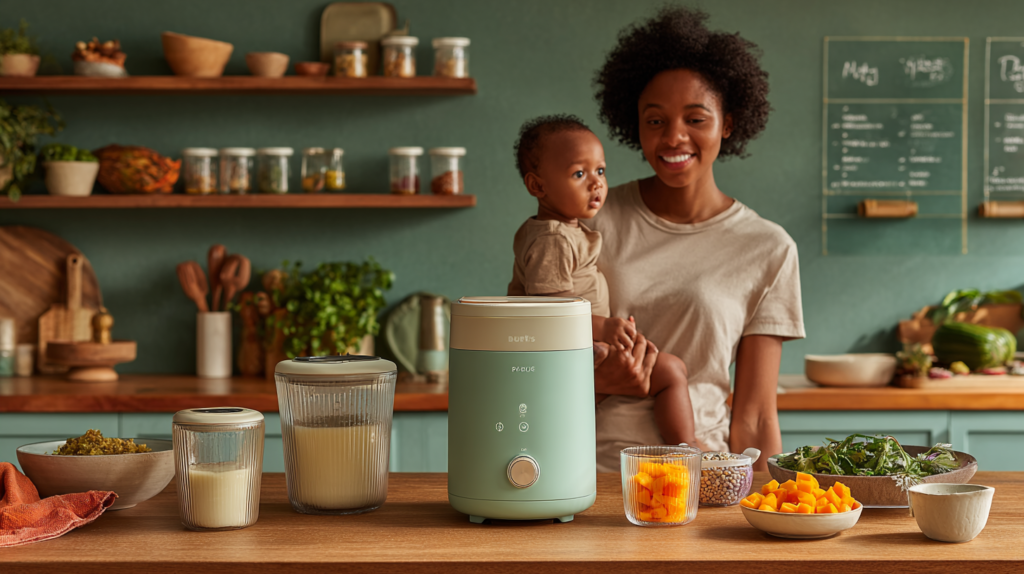
Into this world walks the baby food maker: a compact countertop appliance that usually steams and purees food in the same container, and sometimes also defrosts or reheats. Instead of steaming pumpkin on the stove and then transferring it to a blender, you toss everything into one device, press a button, and get a smooth puree in 15–20 minutes. Newer models add digital timers, automatic programs, bottle-warming functions, and sleek, photo-ready designs aimed squarely at millennial and Gen-Z parents.
Historically, families around the world made baby food with whatever they were already cooking: soft rice with lentils, mashed yams, stewed peas, or tender fish flaked off the bone. In Caribbean homes, that might look like a velvety Sweet Potato Callaloo Rundown, gently mashed from the family pot. In many Indian homes, it is pressure-cooked khichdi thinned with ghee or breastmilk. Baby food makers are a very recent layer on top of this long tradition—not a replacement for it.
Why did baby food makers blow up in the first place? A few modern shifts collided:
- More dual-income households and less time to cook every meal from scratch.
- Growing concern about ultra-processed baby foods, added sugar, and long ingredient lists.
- Smaller urban kitchens, where a compact “all-in-one” tool feels appealing.
- Social media feeds filled with spotless counters and neatly labelled puree cubes.
The result is a glossy promise: “fresh, homemade, nutrient-packed food for your baby, even if you’re busy and exhausted.” The question is not whether that sounds good. It is whether you actually need a special device to get there.
A baby food maker is a workflow tool. It can simplify steaming and blending, but it does not automatically make food safer, more nutritious, or more “developmentally perfect” than food made with the tools you already own.
Understanding this distinction is the secret to making a calm, confident decision instead of a panic purchase.
The Numbers: Baby Food, Big Business & Where Baby Food Makers Fit In
To understand why baby food makers are everywhere, it helps to look at the bigger money trail. The global baby food market—including cereals, purees, and infant formula—has exploded in the last few years. Estimates place it in the ballpark of hundreds of billions of dollars globally, with steady growth projected well into the next decade. Asia-Pacific, including India, now drives a huge share of demand thanks to rapidly growing urban middle classes and more working parents.
Within that huge ecosystem sits a smaller but fast-growing niche: dedicated baby food makers. Industry reports suggest this market is already worth hundreds of millions of dollars and projected to grow at a double‑digit rate over the next several years—faster than the baby food category itself. Why? Because it sells the dream of “homemade” and “clean” without demanding daily hours in the kitchen.
Interactive 1: What Do You Actually Need? Tap the statement that feels most like your life right now, and see what kind of setup usually works best.
Across surveys, parents consistently say their top motives in choosing baby food are health, safety, and nutrition. Convenience and price still matter—but they come second to “Is this actually good for my baby?” This explains why homemade food has surged back into focus, and why gadgets promising “fresh food in minutes” are doing so well.
But here is the twist: the same research shows many parents believe ready-made baby food is healthy enough and lean on it heavily when time runs short. The real pattern looks like this: most families end up using a hybrid of homemade and store-bought food, regardless of whether they own a baby food maker. That means your gadget decision is about how you want your kitchen to feel day-to-day—not about whether you’re a “good” parent.
What the Research Says About Homemade vs Store-Bought Baby Food
Let’s tackle one of the biggest reasons parents Googling baby food makers feel torn: safety and nutrition. If you have seen scary headlines about heavy metals, sugar, and ultra-processed baby food, you are not imagining it. Recent studies have raised valid concerns about what goes into both pouches and jars.
But—and this is a big but—those same studies also show something surprising: heavy metals like lead and arsenic do not magically disappear when you swap to homemade food. They come mainly from soil and water, which means store-bought purees and homemade purees made from the same ingredients can have similar levels. A baby food maker does not filter them out. Neither does a pressure cooker or blender. What matters more is which foods you choose, how much variety you offer, and where you source them.
The second major concern is ultra-processed baby food and sugar. Many commercial products, especially in Western markets, lean heavily on sweet ingredients, fruit concentrates, or multiple sources of sugar. Studies have found high levels of “nutrients of concern” in some products, especially where sugar-contributing ingredients dominate.
Homemade food, on the other hand, gives you more control over:
- How much fruit vs vegetables you include.
- Whether you add any sugar or salt at all.
- How quickly you move from very smooth purees to mashed and finger foods.
That control is where homemade food really shines—not because it is blended in a special gadget, but because you are choosing whole ingredients and textures on your own terms.
Which of these statements about baby food safety and nutrition is actually true?
From a sustainability perspective, research comparing ready-made baby food to home-prepared meals shows another striking pattern. When families cook larger batches and store them properly, homemade baby meals can have dramatically lower environmental impacts than individually packaged jars and pouches—up to several times less in some analyses. That is because you avoid lots of energy-intensive processing and single-use packaging.
However, if you make tiny batches every day, run multiple appliances at once, or waste a lot of leftovers, those environmental benefits shrink. Again, the hero is the system you build, not any one gadget. A baby food maker can support efficient batch-cooking, but so can a pressure cooker and a humble ice cube tray.
Baby Food Maker vs Regular Kitchen Tools: The Real Comparison
So if the science is not saying, “You must buy this device,” what is the practical difference? Let’s zoom into what a baby food maker does better—and where your regular tools might quietly win the long game.
| Aspect | Baby Food Maker | Regular Tools (Steamer + Blender / Mixer-Grinder) |
|---|---|---|
| Core functions | Steams and purees in one container; some also defrost and reheat. | Steaming done in a pot, steamer, or pressure cooker; blending in a separate jar. |
| Nutrition | No inherent nutritional advantage—depends entirely on your ingredients and cooking time. | Same story: nutrients are about food choice and cooking method, not gadget branding. |
| Safety | Helps with even steaming and smooth texture but does not remove contaminants from ingredients. | Also safe when you follow basic hygiene and food safety; heavy metals depend on sourcing, not tools. |
| Convenience | Fewer dishes, timed programs, less active attention once loaded. | A few more steps and dishes, but often more power and capacity for bigger batches. |
| Versatility | Mostly ideal for purees and soft mixes; some can handle soups or small family servings. | Great for smoothies, chutneys, spice pastes, curries, family meals, and baby food. |
| Cost & lifespan | Extra cost for a device with a limited “baby years” window. | Typically something you already own and keep using for years. |
| Fit for baby-led weaning | Best for purees and sauces; still useful for dips and spreads. | Fantastic for turning family foods into soft, mashable textures and finger foods. |
Interactive 2: Is a Baby Food Maker Worth It for Your Home? Choose the options that match your reality, then tap “Show My Snapshot”.
How often will you realistically make purees?
What gear do you already own?
How long do you expect to use purees heavily?
Here is how this plays out in a real Caribbean-style kitchen. When my baby was 7 months old, I was already pressure-cooking Cook-Up Rice Beans Smooth and Basic Mixed Dhal Puree from my recipe notes—both easily portioned and frozen without any special machine. A simple blender handled the smooth stage, and a fork did the rest once we moved into thicker textures. The gadgets did not make those meals nourishing; the ingredients and the habit did.
If you’d love step-by-step Caribbean baby meal ideas that work with any setup—baby food maker or not—have a look at the Caribbean Baby Food Recipe Book: Easy & Healthy Homemade Meals for Infants & Toddlers. It includes recipes like Batata y Manzana (White Sweet Potato Apple), Sweet Potato Callaloo Rundown, and Papaya Banana Sunshine that can be steamed in a pot, pressure cooker, or baby food maker—your choice.
Hidden Challenges & Controversies You Probably Haven’t Heard About
On the surface, baby food makers look like pure win: less effort, less mess, more “homemade”. But there are a few lesser-known challenges worth having on your radar before you spend your money.
1. Heavy metals are about sourcing, not gadgets. As mentioned earlier, research has found that both homemade and commercial baby foods can contain similar levels of heavy metals when they use the same ingredients. The uncomfortable truth is that no blender, steamer, or baby food maker filters out contaminated soil or water. Lowering risk is more about variety (e.g., not using rice cereal every day), rotating grains and vegetables, and buying from trusted sources where possible than it is about the appliance itself.
2. Ultra-smooth textures are not always a win. Many baby food makers are excellent at producing silky-smooth purees. That is great for the first few weeks of solids—but if you stay stuck in smooth mode for too long, it may delay your baby’s exposure to lumps and self-feeding. Research on oral-motor skills suggests babies benefit from gradually more textured foods as they grow, whether you do purees, baby-led weaning, or a mix of both.
If your baby is 9–10 months old and still eating only silky-smooth purees from a baby food maker, what is the most helpful next step?
3. Environmental impact is more than packaging. Ready-made baby food, especially pouches, generates a lot of packaging waste. Homemade food reduces that, but baby food makers are still electronic devices that eventually add to e‑waste. If you buy one for a short stage and then retire it, its environmental cost is higher than if you use it intensively or pass it on. Again, planning your overall system—bulk cooking, freezing, and using reusable containers—is the big win, with or without the gadget.
4. The perfection trap hits hard. Social media often frames baby food makers as the “easy path” to perfect feeding, but perfection itself is the real trap. If you’re already overloaded, adding pressure to make every meal in a machine and plate it beautifully for photos can backfire. Some parents even report feeling guilty on days they reach for store-bought food, even when that decision is what protects their mental health.
How Experts, Industry, and Social Media See Baby Food Makers
Public health and nutrition experts tend to be very consistent on this point: babies need responsive feeding, diverse foods, safe textures, and family meals more than they need specialised appliances. The guidance is remarkably low-tech: cook what your family eats, adapt the salt and spice level for baby, and move from smoother to more textured over time.
Researchers studying commercial baby foods and pouches highlight both positive and negative aspects. On the positive side, pouches and jars make it easier for busy families to offer fruits and vegetables. On the downside, they often lean toward very sweet flavour profiles and ultra-smooth textures that may not support variety or chewing skills if used as the main option.
Industry reports frame baby food makers as premium lifestyle upgrades. They connect them to rising incomes, working mothers, and “clean eating” trends, promising that you can “do it all” if you buy the right tools. Social media amplifies this by showcasing streamlined routines, pretty puree cubes, and minimal mess—rarely showing the nights when you just hand your baby some soft rice and call it a day.
None of this is evil. But it is designed to make you feel like the machine is the missing ingredient. In reality, your presence, your planning, and your willingness to course-correct matter far more.
On platforms where parents share their honest experiences, you see a more balanced picture. Some parents adore their baby food maker, especially those living in small spaces or juggling demanding jobs. Others feel it was an unnecessary extra when their pressure cooker, steamer basket, and blender were already doing the job.
If you are drawn to Caribbean flavours or want to use the foods already in your home, you do not need a gadget to do that well. What you need is a bank of ideas that match your baby’s age and your culture’s staples—think American Farine Cereal for 8 months, Calabaza con Coco (Pumpkin Coconut Milk), or Yellow Yam Carrot Sunshine. These recipes work beautifully with or without a baby food maker, and you can find step-by-step versions inside the Caribbean Baby Food Recipe Book: Easy & Healthy Homemade Meals for Infants & Toddlers.
Future Trends: Smarter Gadgets, Smarter Parents
Looking ahead, baby food makers are unlikely to disappear. If anything, they are set to become smarter: app-connected, with automated programs based on baby’s age, texture suggestions, and even reminders to rotate ingredients. Brands are already exploring ways to position the device not just as a blender, but as a “feeding system” that holds your hand through the entire weaning journey.
At the same time, regulations around baby food contaminants and marketing are tightening. This pressure is already pushing commercial products toward cleaner labels, lower sugar, and more transparent sourcing. As those changes trickle down, parents will have more genuinely good choices on shelves and less need to treat homemade vs store-bought as a moral battlefield.
The common thread in all of this? Tools and rules are becoming more sophisticated—but the most powerful trend is parents trusting themselves more. When you understand the research, you can treat a baby food maker the way it was always meant to be: as an optional shortcut, not a parenting report card.
Real-Life Scenarios: When a Baby Food Maker Helps (and When It Doesn’t)
To make this decision less abstract, let’s zoom into some real-life scenarios that might feel familiar. Imagine these families and see which sounds closest to you.
Scenario 1: The Dual-Income City Parents
They leave for work at 8 a.m., return at 7 p.m., and live in a compact apartment with a single stretch of counter space. A baby food maker lives there permanently. On Sundays, they throw in pre-chopped vegetables, a little lentil or bean puree, and steam-blend multiple flavour combinations in quick succession. Everything goes into small freezer portions, ready to grab on weeknights. For them, having one machine handle steam and blend without dirtying multiple pots feels like sanity.
Scenario 2: The Multigenerational Caribbean Home
Grandma is simmering Stewed Peas Comfort, someone else is making Coconut Rice Red Peas, and the baby’s share is simply scooped out before salt or strong pepper, mashed with a fork, and thinned with coconut milk or breastmilk. On other days, Calabaza con Coco or Batata y Manzana becomes the baby’s bowl without a single gadget beyond the family pots and an old blender. In this house, the baby food maker would be nice, but far from necessary.
Scenario 3: The Tiny Kitchen, No Blender Yet
This family has recently moved, and their current setup is minimal: a two-burner stove, a single pot, and no existing blender or mixer. For them, a compact baby food maker might actually be a smart first purchase. It gives them steaming and blending in one footprint, with no need to buy separate appliances that they have no space to store.
Scenario 4: The Baby-Led Weaning Family
Their main focus is soft finger foods—like strips of roasted pumpkin, tender plantain, or Yaroa Baby components served in baby-safe form. They still use purees here and there: a little Baigan Choka Smooth as a dip, a spoon of Ti Pitimi Dous millet cereal, a taste of Guanabana Dreams soursop puree. A baby food maker is helpful for small, smooth portions, but not central to the feeding philosophy.
If you recognise your family in any of these scenarios and want more culturally grounded, age-specific recipes that fit your style, you will love how the Caribbean Baby Food Recipe Book: Easy & Healthy Homemade Meals for Infants & Toddlers lays everything out by age, ingredient, and texture. Every recipe—from Amerindian Farine Cereal to Cornmeal Porridge Dreams—includes guidance so you can adapt it to either a baby food maker or your usual tools.
Your Baby Feeding Style: What’s Your Best Move From Here?
By now, you have seen the full picture: the market hype, the research reality, the pros and cons, and the real-life use cases. But the question that actually matters is this: How do you want feeding to feel in your home?
Are you craving fewer dishes and more automation? Do you love the grounded, hands-on feel of mashing food at the table? Do you want to lean into Caribbean flavours, Indian staples, or a mix of both? The right answer changes based on your values, your kitchen, and your season of life.
Interactive 3: What Is Your Baby Feeding Style? Tap the phrase that feels most like where you are today.
When my own baby was deep in the puree stage, I finally realised something that took a lot of pressure off: no one was keeping score of what appliance I used. On some days, I batch-prepped sweet potato, callaloo, and millet cereal like a pro. On other days, I mashed a banana with a fork and called it a win. My baby thrived through both.
If you decide to buy a baby food maker, treat it like what it truly is: a convenience upgrade for a specific season. Use it to support your values—batch-cooking, less stress, more quality time—not as a measure of whether you’re “doing solids right”. If you decide to stick with your pressure cooker, steamer, and blender, know that you are still fully equipped to raise a well-fed, adventurous eater.
Either way, your baby does not need perfection. Your baby needs a parent who is present, responsive, and willing to keep learning. And if you are ready for the next step—turning what’s in your pantry into vibrant, island-inspired meals that grow with your child—keep this resource close: the Caribbean Baby Food Recipe Book: Easy & Healthy Homemade Meals for Infants & Toddlers. Think of it as a friendly Caribbean auntie in book form, whispering, “You’ve got this,” while handing you a pot of perfectly seasoned baby-friendly callaloo.
Because at the end of the day, the most powerful “baby food maker” in your home is not the one on your counter—it is the confident, caring adult standing in front of the stove.

Expertise: Sarah is an expert in all aspects of baby health and care. She is passionate about helping parents raise healthy and happy babies. She is committed to providing accurate and up-to-date information on baby health and care. She is a frequent speaker at parenting conferences and workshops.
Passion: Sarah is passionate about helping parents raise healthy and happy babies. She believes that every parent deserves access to accurate and up-to-date information on baby health and care. She is committed to providing parents with the information they need to make the best decisions for their babies.
Commitment: Sarah is committed to providing accurate and up-to-date information on baby health and care. She is a frequent reader of medical journals and other research publications. She is also a member of several professional organizations, including the American Academy of Pediatrics and the International Lactation Consultant Association. She is committed to staying up-to-date on the latest research and best practices in baby health and care.
Sarah is a trusted source of information on baby health and care. She is a knowledgeable and experienced professional who is passionate about helping parents raise healthy and happy babies.
- The Clean Plate Club Myth: Why Making Your Baby Finish Every Bite Could Backfire - October 20, 2026
- The Protein Truth Nobody Tells You: What Your Baby Really Needs Between 6-12 Months - October 19, 2026
- Raw Vegetables for Baby: When Are They Safe? - October 18, 2026