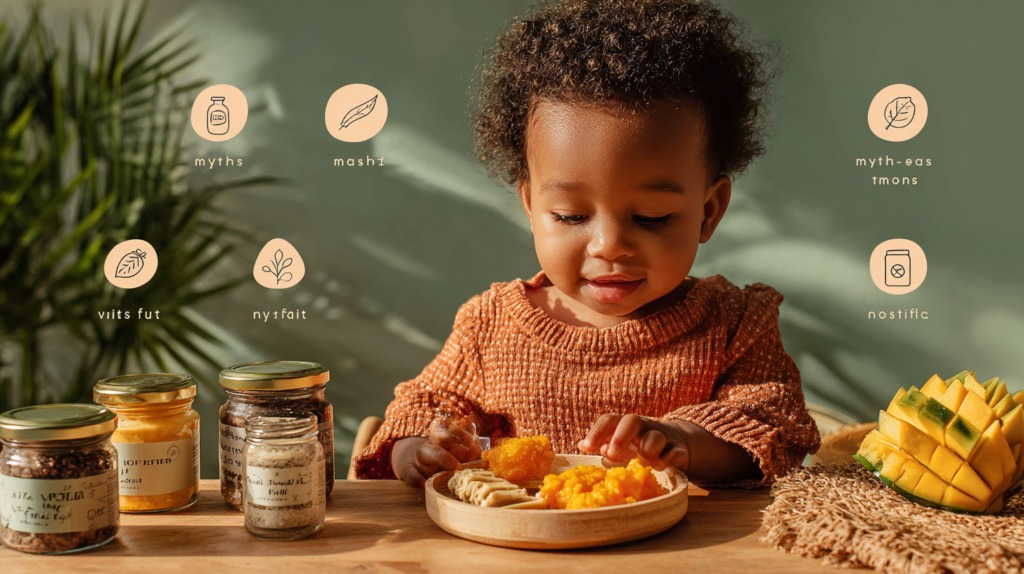
Baby Myths & Facts: 10 “Rules” About Baby Food That Are Quietly Holding You Back
Somewhere between your pediatrician, your mother‑in‑law, and that confident stranger on social media, you have probably been told at least one thing about baby food that sounded right, felt comforting, and was… not actually true.
When the first baby in the family arrived, older aunties in my Caribbean family swore that a “thick cereal bottle” at night would make the baby sleep longer. Years later, as the nutrition research caught up with tradition, I realised that advice was more myth than magic—and that many of us were carrying similar stories into every spoonful.
This article pulls together current science, global guidelines, and real‑life feeding struggles, then blends them with practical, island‑inspired tips so you can move from “Am I messing this up?” to “I know exactly why I’m choosing this bite.”
Why Baby Food Myths Spread So Easily
Baby‑feeding myths don’t survive because parents are careless; they survive because parents are overwhelmed. You are trying to protect a tiny human while absorbing advice from relatives, health professionals, food companies, and social media all at once. Myths offer simple rules, while real science often comes with nuance, context, and the annoying phrase “it depends.”
Over the last few decades, recommendations around breastfeeding, introduction of solids, allergens, and even which grains to use first have changed dramatically as new studies emerged. What your grandmother learned as a young mom, what your own parents did, and what your pediatrician recommends today may all be different. Without a clear, calm explanation, it can feel safer to default to what you have seen rather than what you are reading now.
At the same time, commercial baby foods and online wellness content use strong claims—“immune boosting,” “brain food,” “never feed your baby this”—because dramatic messaging gets attention. The more emotional the claim, the faster it spreads, even if it is only half true. That is exactly why walking through the biggest myths one by one can feel like taking a deep breath in a noisy room.
If you tapped “many commercial baby foods don’t fully meet nutrition guidelines,” you just hit our first shocking truth: analyses from recent years show that a large portion of baby and toddler products are higher in sugar or otherwise less balanced than parents assume from the front label. That doesn’t mean you must avoid them all; it does mean we need to look deeper than the marketing words on the pouch or jar.
Myth #1: “Babies need solids early so they sleep better”
This myth is powerful because it preys on something every new parent craves: a full night of sleep. For years, caregivers have been told to slip cereal into a bottle or start solids well before six months with the promise of more peaceful nights. Yet studies following infant sleep patterns and feeding show that early solids do not reliably improve sleep and may actually create new problems—like digestive discomfort or misplaced expectations about how often young babies naturally wake.
Modern guidance from global health bodies and pediatric organizations centres on exclusive breastfeeding for about six months when possible, or appropriate formula feeding, with solids added around the six‑month mark when babies show readiness signs. That shift moved us away from using food as a sedative and toward using food as nutrition tailored to developmental needs. If a baby is waking at night, it’s more likely tied to normal sleep cycles, separation anxiety, or growth than to the lack of cereal in their bottle.
A more helpful approach is to focus on responsive feeding—offering milk and later solids based on hunger and fullness cues—while building sleep routines that do not depend on overfilling the stomach. Think of solids as a chance to teach skills and flavours, not as a quick fix for tired parents. It is less glamorous than the “magic cereal bottle,” but far kinder to baby’s body.
Myth #2: “Rice cereal must be the first—and main—baby food”
Rice cereal earned its reputation as the default first food because it is easy to digest, easy to mix with milk, and historically was considered low‑risk for allergies. For years, parents were encouraged to lean heavily on it as the base of baby’s diet. More recent research, though, has raised concerns about inorganic arsenic levels in rice‑based products. Regulators have responded by setting limits and conducting ongoing monitoring, which is good news—but it also means rice cereal no longer deserves its automatic first‑place medal.
At the same time, nutritionists emphasise that babies need foods rich in iron and zinc once they hit the complementary‑feeding stage. Those nutrients are not unique to rice, and many iron‑fortified alternatives or naturally rich foods—like oats, millet, lentils, beef, chicken, or fish—can play the starring role instead. Rice can still appear on the menu, just as one grain among many rather than the unquestioned foundation of every meal.
In practice, this looks like rotating cereals and combining grains with legumes or meat to create gentle, iron‑boosting meals. A Caribbean‑inspired baby bowl might feature soft pumpkin with a little coconut milk and mashed red peas, or smooth cornmeal porridge made without added sugar. Variety spreads out any one contaminant risk and gives your baby’s palate a richer education right from the start.
Myth #3: “Homemade baby food is always safer and healthier than store‑bought”
Homemade baby food can be fantastic. You control the ingredients, salt, and sugar; you can lean into the flavours your family actually eats; and for many parents, it is more affordable. But turning this into an absolute rule—“homemade is always better”—creates two problems: it ignores real safety concerns at home, and it unfairly shames parents who rely on commercial products.
At home, improper storage, reheating, or ingredient choice can introduce risks, especially when dealing with foods higher in natural nitrates or when freezing and thawing repeatedly. Commercial products must meet strict safety standards and are tested for things like pathogens and consistency in nutrient content. Where many fall short is not on safety but on ideal nutrition: some contain more sugar (even from fruit concentrates), less iron, or textures that keep babies on super‑smooth purées for too long.
The sweet spot is a flexible, realistic mix. Use store‑bought options when you need convenience—such as plain vegetable or meat purées with simple ingredient lists—and lean on homemade when you want more texture, local produce, or spices. If you love the idea of Caribbean flavours, recipes like “Papaya & Banana Sunshine,” “Sweet Potato & Callaloo Rundown,” or “Cornmeal Porridge Dreams” can be made baby‑friendly at home while still fitting within modern safety and nutrition guidelines.
If you’d like a structured way to do that, a resource like the Caribbean Baby Food Recipe Book: Easy & Healthy Homemade Meals for Infants & Toddlers walks you through over 75 island‑inspired recipes using ingredients such as pumpkin, coconut milk, beans, green bananas, and plantains in age‑appropriate forms.
Myth #4: “Delay peanuts, eggs, and other allergens to avoid allergies”
This is one of the most dramatic reversals in baby‑feeding advice. For years, parents were told to hold off on common allergens—peanut, egg, fish, cow’s milk products, gluten—often until after the first or even second birthday. Large studies now show that, for many babies, delaying those foods may actually increase the chance of developing an allergy. Carefully introducing small, safe forms of allergens around the time solids start, and then keeping them in the diet regularly, is now considered protective.
Current recommendations vary slightly by country, but the broad pattern is clear: once a baby is ready for solids, most can have well‑prepared peanut, cooked egg, and other allergens introduced gradually, unless they have severe eczema or known allergy risk that requires specialist guidance. The key is form and frequency. A thin smear of smooth peanut paste mixed into yogurt is very different from handing over a chunky spoonful of peanut butter, and a well‑cooked, mashed egg is very different from undercooked whites.
If your family has a strong allergy history, your pediatrician may suggest specific timing, in‑office challenges, or blood tests. For everyone else, the bigger danger lies in never introducing these foods at all. In other words: the myth that “waiting keeps them safe” is being replaced with “controlled early exposure, done right, may keep them safer.”
For most babies, peanut can be introduced around six months as a smooth paste mixed into familiar foods like breast milk, formula, or yogurt. The serving should be very soft and thinned, not sticky, and offered in tiny amounts at first. The goal is to keep peanut in the rotation—perhaps a couple of times a week—rather than treat it as a one‑time “test.”
Cook egg thoroughly until both white and yolk are firm, then mash into purées or soft foods. Scrambled egg broken into tiny pieces, or egg mixed into mashed vegetables, works well once babies manage soft lumps. Regular, small exposures integrate egg into their normal food world instead of making it feel like a special, scary event.
Mild, low‑mercury fish can be flaked carefully to remove all bones, then mixed into starchy vegetables or grains. This gives babies high‑quality protein and important fats. Introducing fish early but safely helps families who eat a lot of seafood include baby at the same table rather than cooking entirely separate meals.
Myth #5: “Honey is a harmless natural sweetener for babies”
Honey carries a kind, wholesome image in many cultures. It is used in home remedies, sweet drinks, and as a soothing spoonful for sore throats. For babies under 12 months, however, honey is clearly off the table—no matter how “raw,” “local,” or “organic” it might be. The risk has nothing to do with sugar itself and everything to do with spores that can cause infant botulism, a serious illness affecting the nervous system.
Health authorities around the world agree on this point: no honey before the first birthday, and that includes baked goods or drinks with honey as an ingredient. After 12 months, the digestive system is more mature and can usually cope with spores that would have been dangerous in infancy. Until then, sweet flavour experiments should come from fruits, breast milk, or formula—not from bee products.
If you value traditional remedies, you can still honour that instinct while protecting your baby. Keep honey‑based teas or syrups for the adults in the house, while babies with coughs or colds get safer, evidence‑based support from their healthcare provider. The myth that “natural equals safe at any age” is worth challenging, especially for the youngest tummies in the family.
Myth #6: “Baby‑led weaning is dangerous and causes choking”
Baby‑led weaning (BLW) has exploded in popularity online, often framed as the bold opposite of spoon‑feeding: babies feed themselves soft, graspable pieces of food from the start. Critics worry this puts infants at higher risk for choking. Research comparing well‑implemented BLW to traditional spoon‑feeding, however, does not show dramatically higher choking rates when parents are taught to choose and prepare textures properly.
The real challenge is that many parents do not get that detailed teaching. Online clips may glamorise big chunks, raw slices, or rushed progression without explaining signs of readiness or how gagging differs from true choking. In reality, both spoon‑feeding and BLW can be safe or unsafe depending on how they are done. A mash of soft plantain, well‑cooked pumpkin pieces, or tender shredded chicken can work across approaches when the pieces are small, soft, and supervised.
If you like the BLW philosophy but feel nervous, think of it as a spectrum rather than an all‑or‑nothing identity. Many families use a hybrid style: some spoon‑fed purées and some self‑fed finger foods, gradually moving toward more independence as baby’s skills grow. What matters most is that your child keeps advancing in texture instead of getting stuck on ultra‑smooth foods for months.
Myth #7: “Babies should stay on smooth purées for a long time”
Parents often keep purées ultra‑smooth for months out of love and fear: love, because they want to protect baby from discomfort; fear, because gagging looks scary and is easily confused with choking. Yet staying on completely smooth textures for too long can make it harder for children to accept more complex foods later, sometimes contributing to picky eating, texture aversions, or mealtime battles in toddlerhood.
Feeding experts recommend gradually moving from smooth purées to thicker, then to soft lumps and finger foods during the second half of the first year. This progression helps babies practise chewing motions, coordinate tongue and jaw movements, and learn to manage different textures safely. It is a skill, not a switch, and like any skill it improves with repetition.
Caribbean‑inspired meals are perfect for this progression: think “Sweet Potato & Callaloo Rundown” thinned at first, then served a little chunkier, or “Cook‑Up Rice & Beans Smooth” starting as a blended dish and slowly becoming more textured as your baby gets better at chewing. The goal is not to rush, but to keep gently introducing challenges so your child’s mouth learning keeps pace with their growing curiosity.
Myth #8: “Organic pouches are automatically the healthiest choice”
Organic labelling reassures many parents, but it only speaks to how ingredients were grown, not the overall balance of the meal. An organic pouch that is mostly fruit can still deliver a high‑sugar, low‑iron snack, even if that sugar is naturally occurring. When babies mainly drink purées from pouches, they can also miss out on important experiences like seeing, smelling, and touching whole foods, and learning to move food around in their mouths.
Studies assessing commercial baby foods have found that a significant share does not fully meet ideal nutrient guidelines, often due to excess sugar or limited diversity of ingredients. That does not make them forbidden, but it does mean parents need to read ingredient lists and nutrition panels rather than relying on the words “organic,” “natural,” or “no added sugar” alone.
A practical rule: use pouches as tools, not as the backbone of the diet. Choose ones that highlight vegetables, legumes, or grains rather than only fruit, and when possible, squeeze them into a spoon or small bowl so your baby sees the food and practises normal eating movements. Between those and simple homemade dishes—like “Papilla de Arroz con Frijoles Negros” for older babies or pumpkin with coconut milk for younger ones—you can build a pattern far healthier than any marketing campaign.
Myth #9: “Baby food should be bland—no herbs, no spices”
In many Caribbean homes, babies have always gotten gentle tastes of the family pot: a little pumpkin with coconut milk, a hint of thyme or bay leaf, soft callaloo, or dhal with cumin. Modern research on flavor exposure supports this cultural instinct. Babies are born ready to explore taste, and offering mild herbs and spices (without added salt, hot pepper, or heavy seasoning mixes) can actually help them accept a wider range of foods later on.
The real risk is not flavour but excess sodium and very strong chilli heat. High salt intake is hard on infant kidneys, and fiery peppers can irritate. But aromatic ingredients like cinnamon, ginger, allspice, bay leaf, thyme, or coconut milk can be used thoughtfully in baby dishes. A tiny pinch in a larger pot, with a portion removed for baby before extra salt or pepper is added for adults, strikes a beautiful middle ground between tradition and safety.
This is where a well‑tested collection of recipes helps. A guide that respects regional ingredients—like dishes built around dasheen, callaloo, sweet potato, chayote, or cornmeal—can show you exactly how to combine them in age‑appropriate ways. The Caribbean Baby Food Recipe Book: Easy & Healthy Homemade Meals for Infants & Toddlers was designed with that balance in mind, giving you both inspiration and clear guidance on when a dish is right for 6+ months, 8+ months, or 12+ months.
Myth #10: “If you were formula‑fed or can’t exclusively breastfeed, you’re already behind”
Few myths hurt parents more than the idea that feeding decisions define whether they are “good.” Breastfeeding has clear health benefits and is strongly recommended when possible, but reality is more complicated: medical issues, supply struggles, work constraints, mental health, and lack of support all influence what is possible. Formula is a safe, regulated alternative, and babies fed with formula can absolutely thrive when the rest of their feeding journey is supported with responsive care and thoughtful solids.
Research on infant and young child feeding shows that the combination of early experiences matters more than any single factor. Responsive feeding, adequate nutrient intake, good hygiene, and loving interaction at mealtimes consistently show benefits. In other words, you are not “behind” if you did not follow an idealised feeding script; you are always ahead when you stay curious, adjust as you learn, and seek evidence‑based guidance over guilt.
From a Caribbean perspective, this also means embracing the reality of multigenerational homes, rotating caregivers, and busy work lives. Instead of chasing perfection, aim for a pattern: milk that suits your family’s situation, complemented by simple, nourishing foods—like “Amerindian Farine Cereal,” “Cook‑Up Rice & Beans Smooth,” or “Cornmeal Porridge Dreams” adapted without added sugar—served with conversation, eye contact, and patience.
From Overwhelm to Confident Feeding
By now, you have walked through ten of the biggest myths shaping modern baby‑feeding conversations: from sleep promises and rice cereal traditions to allergy timing, honey, textures, pouches, spices, and formula guilt. The big picture that emerges is surprisingly hopeful. When you look past the noise, the core principles are simple: start solids around six months when your baby is ready, prioritise iron‑rich and nutrient‑dense foods, move steadily through textures, introduce allergens in safe forms rather than avoiding them, and create a rhythm that respects both science and your family’s culture.
As a Caribbean‑rooted parent, some of the most joyful moments have been when my little one reached for what I was eating—a spoonful of pumpkin and coconut, a mash of plantain and beans, a taste of softly spiced dhal—and I knew enough to make it safe rather than say no. Those are the memories that last longer than any debate in a comment section. Your baby does not need a flawless plan; your baby needs a curious, informed adult who is willing to keep learning.
If you would like step‑by‑step guidance on turning these principles into everyday meals, you can lean on tools created exactly for that purpose. The Caribbean Baby Food Recipe Book: Easy & Healthy Homemade Meals for Infants & Toddlers takes ingredients you already love—sweet potatoes, coconut milk, beans, dasheen, cornmeal—and shows you how to adapt them for 6+ months all the way to toddlerhood. Use it as a starting point, then season it with your own family stories.
Before you close this tab, reset one myth
Tap the statement you most want to carry forward from today. One of these is still secretly a myth. The rest are truths you can build on.
On the days when your kitchen is messy, the baby is fussy, and every bite feels like a negotiation, remember this: progress in baby feeding is rarely a straight line. It is more like a Caribbean shoreline—curved, beautiful, and shaped by many small waves over time. You do not need to know every step. You just need to take the next honest, informed one.

Expertise: Sarah is an expert in all aspects of baby health and care. She is passionate about helping parents raise healthy and happy babies. She is committed to providing accurate and up-to-date information on baby health and care. She is a frequent speaker at parenting conferences and workshops.
Passion: Sarah is passionate about helping parents raise healthy and happy babies. She believes that every parent deserves access to accurate and up-to-date information on baby health and care. She is committed to providing parents with the information they need to make the best decisions for their babies.
Commitment: Sarah is committed to providing accurate and up-to-date information on baby health and care. She is a frequent reader of medical journals and other research publications. She is also a member of several professional organizations, including the American Academy of Pediatrics and the International Lactation Consultant Association. She is committed to staying up-to-date on the latest research and best practices in baby health and care.
Sarah is a trusted source of information on baby health and care. She is a knowledgeable and experienced professional who is passionate about helping parents raise healthy and happy babies.
- The Meal Rotation Secret That Keeps Your Baby Asking for More - October 24, 2026
- Curry for Babies: How Mild Caribbean Flavors Can Raise Brave Little Eaters - October 23, 2026
- Shellfish for Babies: The Truth Behind Your Biggest Fears (And Why You Need This Knowledge Now) - October 22, 2026