The Texture Progression Timeline No One Tells You About: Why Your Baby’s First Foods Matter More Than You Think
What’s Your Biggest Feeding Fear Right Now?
Click your answer and discover what really matters (and what doesn’t)
Here’s something they don’t tell you at those shiny baby feeding workshops: the window between smooth purees and adventurous eating is smaller than you think. And staying on thin, bland purees for too long? That might actually be setting your little one up for pickier eating down the road.
I remember standing in my kitchen at 2 AM, convinced I was doing everything right with my carefully blended sweet potato puree, only to discover months later that I’d been playing it too safe. My baby needed texture challenges, flavor adventures, and yes—even a little gagging practice (the safe kind, not the terrifying kind). The research backs this up: infants have a sensitive period between roughly 6 and 9 months when they’re most open to new textures and flavors, and missing this window can lead to feeding difficulties later on.
The truth is, texture progression isn’t just about moving from smooth to lumpy foods. It’s about building oral-motor skills, preventing picky eating, supporting proper jaw development, and yes—introducing your baby to the rich, vibrant flavors of real food. Whether you’re thinking about traditional Caribbean flavors like those soft-cooked plantains and aromatic coconut rice, or just trying to figure out when it’s safe to move beyond applesauce, this guide will walk you through every stage with evidence-based timelines and practical strategies that actually work in real life.
The Science Behind the Stages: Why Texture Actually Matters
Let’s get one thing straight: texture progression isn’t some made-up trend from Instagram feeding accounts. It’s rooted in decades of research on infant oral-motor development and complementary feeding practices. The World Health Organization emphasizes that while many infants worldwide receive breast milk or formula in their first six months, far fewer get nutritionally adequate and safely textured complementary foods between 6 and 23 months—the very period when texture matters most.
Here’s what’s happening in your baby’s mouth and brain during this critical window: around 6 months, babies develop the ability to move food from the front to the back of their tongue using a wave-like motion. By 7 to 8 months, they start using up-and-down chewing movements even without teeth. And by 9 to 12 months, they’re working on rotary chewing patterns that let them handle complex mixed textures. Each of these milestones needs practice with progressively challenging textures to develop properly.
Recent studies show that babies introduced to lumpy, textured foods after 10 months tend to have more feeding difficulties and are more likely to refuse foods later in childhood. One large analysis found that delaying texture progression beyond this sensitive period was associated with picky eating behaviors in toddlerhood. The reason? Babies who only experience smooth purees miss out on the oral-sensory learning that helps them accept variety.
But here’s the part that changed everything for me: it’s not just about avoiding picky eating. Early exposure to diverse textures supports better nutrient intake because textured family foods—think well-cooked vegetables, soft meats, beans, and whole grains—are often more nutrient-dense than commercial smooth purees. A 2021 study of US infants aged 7 to 13 months found that caregivers who understood texture progression guidelines were more likely to offer foods like ground meats, finely chopped vegetables, and soft finger foods, all of which provided better iron, zinc, and protein than purees alone.
Busting the Biggest Texture Myths
Click each myth to reveal the shocking truth
MYTH: Babies need teeth before they can handle textured foods
MYTH: Purees are safer than finger foods for preventing choking
MYTH: You should spend months on each texture stage
MYTH: Gagging means your baby isn’t ready for that texture
The takeaway? Texture progression is a developmental necessity, not a nice-to-have. And the timeline matters more than most of us realize.
The Real Timeline: From First Bites to Family Table
Forget those vague “6 months and up” labels on baby food jars. Here’s the actual, research-backed texture progression timeline that takes you from first tastes to confident eaters—and yes, it moves faster than you probably expect.
️ Click Each Stage to Unlock the Details
Stage 1: Smooth Start (6-7 months)
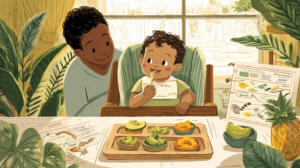
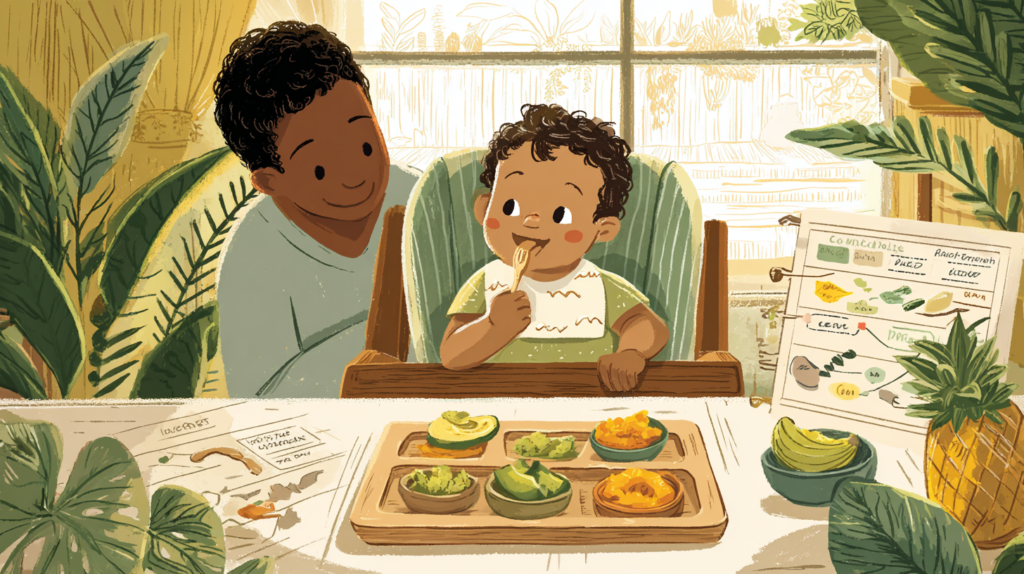
What it looks like: Thin to thick purees with a consistency somewhere between heavy cream and Greek yogurt. Think mashed avocado, pureed sweet potato, or smooth Caribbean-style pumpkin with a touch of coconut milk.
Skills developing: Tongue thrust reflex fading, learning to move food from front to back of tongue, accepting a spoon, and closing lips around it.
How long to stay here: 1-2 weeks max. Yes, really. Once your baby can consistently swallow smooth purees without pushing them back out, it’s time to level up.
Pro tip: Even in week one, you can offer a safe finger food alongside the puree—like a soft-cooked spear of plantain or a thick strip of mango. Babies learn by exploring with their hands too.
Stage 2: Textured Terrain (7-9 months)
What it looks like: Thicker mashes with soft lumps, like mashed banana with tiny pieces, roughly mashed beans, or thick cornmeal porridge with soft fruit stirred in. You’re aiming for textures that easily squish between your fingers.
Skills developing: Up-and-down chewing motions (even without teeth!), moving food from side to side in the mouth, and coordinating chewing with swallowing.
Foods to try: Mashed yam with a few small soft chunks left in, thick lentil dhal, shredded slow-cooked chicken mixed into mash, soft-cooked vegetable pieces in sauces, and well-cooked grain porridges.
Caribbean connection: This is the perfect stage for dishes like callaloo mashed with sweet potato, or rice and peas cooked extra soft and gently mashed. The rich flavors help develop taste preferences while the textures challenge those growing skills.
Stage 3: Finger Food Freedom (8-10 months)
What it looks like: Soft, graspable pieces about the size and shape of an adult pinky finger. Think steamed carrot sticks, roasted sweet potato wedges, strips of omelet, or soft-cooked plantain slices.
Skills developing: Pincer grasp (picking up smaller pieces with thumb and forefinger), self-feeding, biting off appropriate-sized pieces, and rotary chewing.
The self-feeding revolution: This is when babies really start taking charge. You might still offer some mashed or chopped foods on a spoon, but increasingly, they want to do it themselves. Let them. The mess is temporary; the skills are permanent.
Safety note: Foods should still be soft enough to squish between your thumb and forefinger. Avoid hard, round, or sticky foods. Test everything yourself first—if you can’t easily mash it with your tongue against the roof of your mouth, it’s not ready for baby.
Stage 4: Family Food (10-12 months)
What it looks like: Smaller, bite-sized pieces of soft family foods, mixed textures in the same meal, and increasingly complex dishes. Your baby eats what the family eats—just cut appropriately and cooked until tender.
Skills developing: Advanced chewing, managing mixed textures (like rice with beans and vegetables), drinking from cups, using utensils (messily but enthusiastically).
The milestone: By 12 months, most babies can handle minced, chopped, or diced family foods and are working on more challenging textures like slippery pasta, leafy greens, and ground meats in sauces.
Real talk: This stage is where cultural food traditions really shine. Whether it’s coconut rice and red peas, curry chicken with dumplings, or seasoned fish with provisions, babies at this age can participate in real family meals with just minor modifications—no salt, no honey, and everything cut to safe sizes.
One thing I wish someone had told me earlier: these stages overlap. You don’t graduate from purees and never look back. You can offer a thick mashed meal at breakfast, finger foods at lunch, and a combination at dinner. The goal is gradual, consistent exposure to more challenging textures—not perfection at every meal.
If you’re looking for texture-appropriate recipes that bring authentic island flavors to each stage, the Caribbean Baby Food Recipe Book breaks down over 75 recipes by age and texture level, from smooth Calabaza con Coco for beginners to textured Stewed Peas Comfort and finger-friendly Plantain Paradise for more advanced eaters.
Navigating the Scary Stuff: Gagging, Choking, and Fear
Let’s talk about the elephant in the room—or rather, the fear that keeps so many parents stuck on smooth purees long past the ideal progression window. Choking is every parent’s nightmare, and it’s the number one reason caregivers delay introducing textured foods and finger foods.
But here’s what the research actually shows: choking incidents occur at similar rates regardless of whether parents use traditional spoon-feeding or baby-led weaning approaches, as long as safety guidelines are followed. A 2023 study tracking 130 babies through their first year found that about 26% experienced at least one choking episode, but there was no significant difference between feeding methods. The key factors? Food preparation, supervision, and teaching babies to eat in an upright, supported position.
The difference between gagging and choking is something every parent needs to understand viscerally, not just intellectually. Gagging is noisy. Your baby might cough, make retching sounds, their eyes might water, and their face might turn red. It looks and sounds alarming, but they can breathe, and they’re actively working to move the food forward or clear it from their mouth. Gagging is a protective reflex—and it’s positioned far forward on the tongue in young babies precisely so they can learn to manage food safely.
Choking is silent. A choking baby can’t cry, cough, or make noise because their airway is blocked. They might look panicked, turn blue, and be unable to breathe. This is a true emergency requiring immediate intervention. The critical distinction: if your baby is making noise, they’re not choking.
Every parent introducing solids should take an infant CPR and choking response course—not because choking is common when you follow guidelines, but because confidence in your ability to respond transforms fear into empowerment. When you know what to do in an emergency, you can focus on what actually prevents problems: safe food preparation.
Safe or Not? Test Your Food Safety Knowledge
Click each food to see if it’s safe for a 7-month-old (properly prepared)
The actual high-risk foods to avoid until age 4: whole grapes and cherry tomatoes (quarter them lengthwise), hot dogs and sausages (slice lengthwise and then chop), hard raw vegetables like carrots (cook until very soft or grate finely), whole nuts and seeds, popcorn, chunks of hard cheese, sticky foods like peanut butter by the spoonful (spread thinly instead), and marshmallows or similar soft, sticky, compressible foods.
The safe texture rule: If you can easily squish the food between your thumb and forefinger or mash it with your tongue against the roof of your mouth, it’s generally safe for a baby learning to manage textures. Foods should either dissolve quickly in the mouth (like baby crackers) or be soft enough to gum into smaller pieces.
I learned this the hard way when I gave my baby a slightly-too-firm steamed carrot at 8 months. The gagging that followed was terrifying for both of us—but it was exactly what her reflexes were designed to do. She pushed it forward, coughed it out, looked at me with wide eyes, and then reached for more food. Her body knew what to do even when my anxiety didn’t.
Expert Approaches: Traditional Spoon-Feeding vs. Baby-Led Weaning (And Why You Don’t Have to Choose)
There’s a lot of noise in the parenting world about the “right” way to introduce solids. Traditional spoon-feeding (starting with purees and gradually increasing texture) has been the standard for decades in many countries. Baby-led weaning (BLW), which skips purees entirely and lets babies self-feed appropriately prepared finger foods from the start, has surged in popularity over the last 15 years, especially on social media.
Here’s what the research actually shows: both approaches work, and there’s no clear winner in terms of developmental outcomes, nutrition, or safety when done correctly. A systematic review of baby-led weaning studies found that when parents were given clear safety guidance, there was no increased choking risk compared with traditional spoon-feeding. Some studies even suggested that babies offered more diverse textures early on—whether through BLW or simply progressive texture advancement in spoon-feeding—showed better acceptance of new foods and fewer texture-related refusals later.
The BLISS approach (Baby-Led Introduction to SolidS) is a modified version of BLW designed by researchers specifically to address nutrient and safety concerns. It emphasizes offering at least one high-iron food and one high-energy food at each meal, and avoiding high-risk foods entirely. In studies, BLISS babies showed similar growth and nutrient intake to traditionally fed babies, with no increase in choking.
But here’s the secret nobody tells you: you don’t have to pick a camp. Most families around the world use a combination approach—sometimes called “mixed feeding” or “responsive feeding.” You might offer a loaded spoon that your baby brings to their own mouth, or give a thick puree alongside soft finger foods for tactile exploration. You might spoon-feed breakfast porridge but offer self-feeding at lunch. The world isn’t divided into Team Puree and Team Finger Foods; it’s full of parents doing what works for their babies, their schedules, and their cultural food traditions.
The real expert consensus is this: whatever method you choose, focus on responsive feeding—paying attention to your baby’s hunger and fullness cues, offering variety, progressing texture in a timely way, and making mealtimes positive and low-pressure. That’s what actually predicts healthy eating habits down the road, not whether the first food was a puree or a spear of roasted sweet potato.
The Cultural Lens: Why Caribbean and Global Textures Matter
One of the most beautiful things about texture progression is that it opens the door to your family’s real food traditions. While many commercial baby food brands offer bland, single-ingredient purees, babies around the world are introduced to the complex, layered flavors and textures of their cultural cuisines from the very beginning.
In the Caribbean, food is never just fuel—it’s memory, identity, and love served on a plate. The gentle sweetness of ripe plantain, the creamy richness of coconut milk, the warmth of thyme and bay leaf, the tender bite of slow-cooked provisions—these aren’t “too advanced” for babies. They’re exactly what babies should be tasting as they learn to eat, because these are the foods they’ll share with family for the rest of their lives.
Research on complementary feeding globally shows that children introduced to a wider variety of flavors and textures—including herbs, spices, and mixed dishes—in the first year tend to be less picky and more adventurous eaters. A study from Nigeria found that while many babies were fed bland porridges with little variety, those who received culturally appropriate mixed dishes earlier showed better dietary diversity and nutrient intake by age two. The same principle applies everywhere: babies benefit from real food, not simplified versions of it.
When you’re thinking about texture progression, don’t just think about moving from smooth to lumpy in the abstract. Think about how to adapt the dishes you actually cook. That pot of stewed peas with kidney beans, pumpkin, and dumplings? Mash it well for a 7-month-old. Mash it less for an 8-month-old. Cut the pumpkin and dumplings into soft finger-friendly pieces for a 10-month-old. By 12 months, they’re eating the family meal with just smaller portions.
Callaloo, that beloved leafy green dish, can be blended smooth with sweet potato for an early texture or served finely chopped in a soft mash later. Plantain can be steamed and mashed, then served in thicker slices, then offered as soft finger food. Coconut rice, cornmeal porridge, provision mash, seasoned ground meats in rich sauces—all of these can be texture-appropriate at every stage if you understand the principles.
The Caribbean Baby Food Recipe Book includes recipes like Sweet Potato & Callaloo Rundown, Coconut Rice & Red Peas, and Yellow Yam & Carrot Sunshine, each adapted for babies starting at 6+ months and progressing in texture. It’s not about making “baby versions” of Caribbean food—it’s about making real Caribbean food safely accessible for developing skills.
Common Pitfalls (And How to Avoid Them)
Even with the best intentions, there are a few common mistakes that can derail texture progression—and I’ve made most of them myself.
Pitfall #1: Staying on smooth purees too long. I get it—purees feel safe, they’re easy to control, and your baby swallows them without drama. But if you’re still offering only smooth, thin purees at 8 or 9 months, you’re missing the sensitive period for texture acceptance. Research shows that babies who don’t experience lumpy textures by 9-10 months are more likely to be picky eaters later. The fix: start thickening purees and adding soft lumps by 7 months at the latest.
Pitfall #2: Offering only commercial pouches. Pre-made puree pouches are a lifesaver when you’re out and about, but relying on them exclusively teaches babies to suck smooth food rather than practice chewing and tongue movements. The fix: use pouches as a convenience option, but make sure the majority of meals involve textured foods on a spoon or self-fed pieces that require oral work.
Pitfall #3: Being inconsistent with textures. If you offer lumpy mash one day, go back to smooth puree for a week because baby made a face, then try lumps again, your baby never gets consistent practice. Babies need repeated exposure to textures to build skills and confidence. The fix: once you introduce a new texture, keep offering it regularly even if your baby seems uncertain. Acceptance can take 10-15 tries.
Pitfall #4: Freaking out at every gag. If you gasp, rush in, or pull the food away every time your baby gags, you’re communicating that something is wrong and food is dangerous. This can make babies more anxious about eating and more resistant to new textures. The fix: stay calm, stay nearby, trust the reflex. If your baby is gagging, they’re breathing and working it out. Offer encouragement, not panic.
Pitfall #5: Not offering finger foods until late. Even young babies can explore soft finger foods alongside purees. Waiting until 10 or 11 months to introduce self-feeding means missing opportunities for motor skill practice and sensory learning. The fix: from 6 months, offer at least one appropriately soft, graspable food at meals—even if it’s just for play at first.
Pitfall #6: Comparing your baby to others. Your friend’s baby might be munching toast at 6 months while yours is still figuring out how to move puree to the back of the tongue. Every baby moves through the stages at their own pace within the general timeline. The fix: watch your baby, not the baby next door. As long as you’re offering appropriate textures and your baby is progressing over weeks (not stuck in the same place for months), you’re on track.
✅ Is Your Baby Ready to Progress? Quick Checklist
Check off each sign you’re seeing (click each item)
The Messy Middle: What to Do When Progress Stalls
Not every baby moves smoothly through the texture timeline, and that’s completely normal. Sometimes you’ll hit a plateau where your baby seems resistant to new textures, spits out anything with lumps, or suddenly refuses foods they previously ate happily.
First, rule out the obvious: teething pain, illness, developmental leaps, and sleep disruptions can all affect eating. A baby who’s cutting molars might prefer softer foods temporarily, and that’s fine. The key is to keep offering varied textures without pressure so that when they’re feeling better, they’re still familiar with the options.
If your baby consistently gags or refuses textured foods for more than a few weeks, try these strategies:
- Go slower, but don’t go backward: Instead of jumping from smooth puree to chunks, spend more time in the thick mash phase. Gradually add smaller, softer lumps over a week or two.
- Mix textures together: Stir tiny amounts of mashed texture into a mostly smooth puree so baby experiences the new texture with familiar flavors and minimal surprise.
- Let them see and touch food first: Babies who are tactile explorers often do better when they can squish, smear, and investigate food with their hands before it goes in their mouths. Let them play.
- Model eating: Babies are born imitators. Sit with your baby and enthusiastically eat the textured food yourself, making exaggerated chewing movements and happy sounds. They’ll want to copy you.
- Offer textures at different times of day: Some babies are more adventurous when they’re not ravenously hungry. Try new textures at a mid-morning snack when the stakes feel lower.
If your baby continues to struggle with textures past 10-11 months, or if they’re consistently gagging and refusing nearly all foods, check in with your pediatrician or a pediatric feeding therapist. Occasionally, oral-motor delays, sensory processing differences, or structural issues can make texture progression more challenging, and early intervention makes a huge difference.
For most babies, though, patience and consistency are the magic ingredients. Keep offering, keep trusting the process, and keep the pressure off. Food should be exploration, not combat.
Building the Skills That Last a Lifetime
Here’s what I’ve come to understand after going through this journey and seeing my baby graduate from tentative puree tastes to confidently munching family meals: texture progression isn’t really about food. It’s about building competence, confidence, and resilience.
Every time your baby encounters a new texture and figures out how to manage it, they’re not just learning to chew. They’re learning that new things can be safe, that challenges can be overcome, that their body is capable of more than they thought. They’re learning to trust themselves and to trust you to offer them foods that are appropriate for their skills.
The oral-motor skills they develop now—tongue lateralization, coordinated chewing and swallowing, jaw strength and stability—set the foundation for clear speech later on. The sensory tolerance they build by experiencing diverse textures helps them navigate a world full of different tactile experiences. The self-feeding skills they practice support fine motor development and hand-eye coordination that will serve them in everything from writing to sports.
And the flavor memories? Those are priceless. When your baby tastes the foods of your culture, your heritage, your family table, they’re being woven into a story bigger than any one meal. They’re learning that food is connection, tradition, and love—not just nutrition on a plate.
This is why I push back against the idea that babies need bland, boring food. They don’t. They need safe food, appropriately prepared food, food that matches their developmental stage—but within those parameters, the world is wide open. Thyme, garlic, ginger, cumin, cinnamon, coconut, citrus, sweet, savory, complex, layered—all of it is fair game. The Caribbean Baby Food Recipe Book includes a full guide to introducing spices and bold flavors month by month, because babies deserve to taste the richness of real food from the very beginning.
Your Next Steps: Taking Action Today
If you’ve made it this far, you’re probably feeling a mix of excitement and overwhelm. That’s normal. The good news? You don’t have to implement everything at once. Start where you are.
If your baby is just starting solids (6 months): Offer smooth or slightly textured purees, but plan to thicken and add soft lumps within the first two weeks. Introduce at least one soft finger food per day for tactile exploration, even if it’s just for play at first. Focus on single ingredients to watch for allergies, but don’t be afraid to add gentle seasonings like cinnamon or mild herbs.
If your baby is 7-8 months: You should be solidly in the textured puree and soft lump stage by now. If you’re still on smooth purees, start thickening them this week. Add soft finger foods at every meal—steamed veggie sticks, soft fruit, well-cooked grain patties, anything they can grasp and gum. Start offering small amounts of water in an open cup or straw cup.
If your baby is 9-10 months: Prioritize self-feeding and finger foods now. Most meals should include soft, bite-sized pieces they can pick up themselves. Continue offering mashed or chopped foods on a spoon, but let them try using the spoon too (yes, it’s messy). Introduce mixed textures—like rice with beans and chopped vegetables—so they practice managing complexity.
If your baby is 11-12 months: They should be eating modified family meals at this point. Whatever you’re cooking, adjust it for safety (chop small, cook soft, no added salt or honey) and serve it. Continue to challenge them with varied textures, different cuisines, and new combinations. Encourage cup drinking and utensil practice.
Write down one small action you’ll take this week to support your baby’s texture progression. Maybe it’s thickening a puree, offering a new finger food, or trying a recipe that brings your family’s flavors to the table. Don’t wait until you feel perfectly ready, because that moment doesn’t exist. Clarity comes from doing, not from waiting.
Track Your Texture Confidence
Click to move through the stages and watch your confidence grow
The Journey, Not the Destination
I think back to those early days when I stood in my kitchen at 2 AM, blending sweet potatoes into oblivion, convinced that smoother was safer and that I had all the time in the world. I didn’t know then that the window was narrow, that textures mattered more than I thought, that my baby was capable of so much more than I was giving her credit for.
The truth is, texture progression isn’t a test you pass or fail. It’s a journey you and your baby take together—messy, imperfect, full of gagging and spit-out food and moments of pure joy when they finally figure out how to manage that piece of mango. It’s about trust: your baby trusting you to offer safe challenges, and you trusting your baby to rise to meet them.
Somewhere along the way, the fear fades. You stop holding your breath at every gag. You stop second-guessing every food choice. You start to see your baby as the capable, curious learner they’ve been all along. And one day, you’ll look across the table and realize they’re eating what you’re eating—seasoned, textured, real food—and that you got here not by waiting until you felt ready, but by taking it one small, imperfect step at a time.
The only regret you’ll have is that you didn’t start sooner. So don’t wait. Your baby is ready. The question is: are you?
If you’re ready to bring bold, authentic flavors into your baby’s texture journey with recipes designed for every stage from smooth purees to family table foods, explore the Caribbean Baby Food Recipe Book—because your baby deserves to taste the richness of their heritage from the very first bite.

Expertise: Sarah is an expert in all aspects of baby health and care. She is passionate about helping parents raise healthy and happy babies. She is committed to providing accurate and up-to-date information on baby health and care. She is a frequent speaker at parenting conferences and workshops.
Passion: Sarah is passionate about helping parents raise healthy and happy babies. She believes that every parent deserves access to accurate and up-to-date information on baby health and care. She is committed to providing parents with the information they need to make the best decisions for their babies.
Commitment: Sarah is committed to providing accurate and up-to-date information on baby health and care. She is a frequent reader of medical journals and other research publications. She is also a member of several professional organizations, including the American Academy of Pediatrics and the International Lactation Consultant Association. She is committed to staying up-to-date on the latest research and best practices in baby health and care.
Sarah is a trusted source of information on baby health and care. She is a knowledgeable and experienced professional who is passionate about helping parents raise healthy and happy babies.
- The Texture Progression Timeline No One Tells You About: Why Your Baby’s First Foods Matter More Than You Think - November 17, 2026
- Baby Nutrition Essentials: The Empty-Calorie Traps You Must Dodge In Your Baby’s First Years - November 16, 2026
- Heavy Metals in Baby Food: The Truth Behind the Headlines (And What You Can Actually Do About It) - November 15, 2026