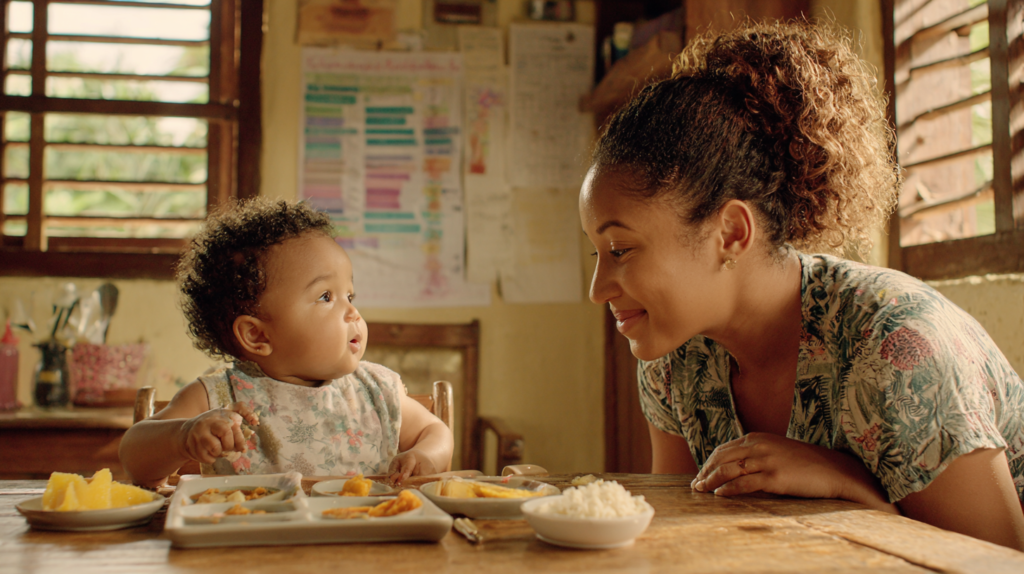
Do You Really Need to Count Calories for Your Baby?
Here’s the truth most parenting books won’t tell you upfront: your baby doesn’t need you to be a nutritionist with a calculator. They need you to be present, responsive, and trust that thousands of years of evolution equipped them with an internal fuel gauge that works better than any app.
But—and this is important—that doesn’t mean energy needs don’t matter. They absolutely do. Babies are growing faster in their first year than they ever will again, doubling their birth weight by about 5 months and tripling it by their first birthday. That kind of explosive growth requires serious fuel. The World Health Organization notes that breast milk or formula supplies roughly half of a child’s energy between 6 and 12 months, with complementary foods filling the rest. By the time they turn one, those little spoonfuls of mashed sweet potato, that fingerful of peanut butter, and yes, even those handfuls of rice thrown gleefully on the floor, make up about two-thirds of their daily energy.
So if you’re not meant to count, how do you know your baby is getting enough? And when should you worry? Let’s walk through this together, the way my own grandmother would have—with common sense, a little science, and the reminder that babies have been thriving long before calorie-counting apps existed.
What Babies Actually Need
If you’ve ever Googled “how many calories does my baby need,” you’ve probably come across numbers like 100 calories per kilogram per day. That’s the general pediatric guideline, but it’s more like a ballpark than a bullseye. Newer research using precise metabolic measurements shows that energy needs are highest in early infancy—around 108 kcal per kilogram per day in the first six months—and gradually taper down to about 82 to 100 kcal per kg by the end of the first year as growth velocity slows.
Let’s put that in real terms. A 6-kilogram 4-month-old (that’s about 13 pounds) might need somewhere between 500 and 650 calories per day. A 9-kilogram 12-month-old (roughly 20 pounds) might need between 800 and 1,000 calories per day from breast milk, formula, and solids combined. But here’s the kicker: those numbers are averages. Your baby might need a little more if they’re crawling everywhere, or a little less if they’re a chill observer who prefers to sit and watch the world go by.
Slide to see rough estimates—remember, this is just a guide, not gospel.
700 calories/day
This is a rough estimate based on ~100 kcal/kg. Your baby’s actual needs depend on activity, metabolism, and growth pattern. Trust the growth chart and your baby’s cues more than any number.
For most of the first year, breast milk or formula carries the load. One study tracking feeding patterns found that at 6 months, milk still provides the majority of energy, with solid foods making a modest contribution. By 9 to 12 months, solids step up—but milk remains critical. The American Academy of Pediatrics recommends continuing breast milk or formula as the primary beverage through the first year, not because solids don’t matter, but because milk is energy-dense, hydrating, and packed with fat for brain development.
And here’s where it gets interesting: babies are shockingly good at self-regulating. Research into infants’ capacity to adjust their energy intake shows that when offered a variety of foods in a responsive feeding environment, most healthy babies naturally balance their intake across meals and days. One day they might devour a bowl of Calabaza con Coco, and the next they’ll barely touch their Plantain Paradise—and that’s completely normal.
Why Most Parents Don’t Need to Count
I’ll be honest: when I started feeding my own baby solids, I briefly spiraled into a phase of weighing portions and checking nutrition labels like I was preparing for a bodybuilding competition. It was exhausting. And then my grandmother—who raised five children on a mix of whatever grew in the yard and whatever she could afford at the market—looked at me like I had two heads.
“You think I weighed every plantain?” she said. “I watched the child. If the child was happy, playing, filling diapers, growing—then the child was eating enough.”
She was right. The gold standard for knowing if your baby is getting enough energy isn’t a calorie log—it’s the growth chart. Pediatricians plot weight-for-age, length-for-age, and weight-for-length at every well-child visit. If your baby is tracking along their curve (even if it’s in the 10th percentile or the 90th), they’re thriving. What matters is the trend, not the percentile.
Other signs your baby is getting enough include:
- Plenty of wet diapers: At least 5 to 6 heavy wet diapers per day is a good sign of hydration and adequate intake.
- Regular poops: Consistency and frequency vary, but your baby should be pooping regularly without signs of constipation or extreme diarrhea.
- Meeting developmental milestones: Rolling, sitting, babbling, and eventually crawling all require energy. If your baby is hitting milestones, they’re fueled.
- Happy and alert during awake times: A well-fed baby has energy to engage and explore. Constant fussiness or lethargy can sometimes signal inadequate intake.
Tap each item that applies to your baby right now:
The beauty of responsive feeding—a term you’ll hear from pediatricians, dietitians, and feeding guidelines alike—is that it shifts the focus from external rules (finish this bottle, eat this much) to internal cues. Responsive feeding means offering food when your baby shows hunger signals, respecting when they turn away or close their mouth, and trusting that over the course of a day or week, intake will balance out. Studies consistently show that babies fed responsively have better self-regulation and lower obesity risk later in childhood.
This doesn’t mean anything goes. It means structure and attunement. You decide what to offer and when; your baby decides how much to eat. You create the opportunity; they do the self-regulation. And in that dance, calorie counting becomes background noise.
When the Numbers Do Matter
Now, let’s pump the brakes. While most healthy, full-term babies don’t need parents tracking every gram and calorie, there are real scenarios where energy calculations become essential tools—not anxiety triggers, but lifelines.
Premature or low-birth-weight babies often need carefully calculated higher-calorie diets to support catch-up growth. A preemie’s energy needs can run as high as 110 to 135 kcal per kg per day, and many require fortified breast milk or special formulas to hit those targets. In NICU and follow-up care, dietitians and neonatologists closely monitor intake because every calorie counts toward brain development, organ maturation, and survival.
Growth faltering or failure to thrive is another scenario where calorie targets come into play. If your pediatrician notices your baby has dropped off their growth curve or isn’t gaining appropriately, they may recommend increasing calorie density—adding healthy fats like coconut oil or avocado, offering more frequent feeds, or switching to a higher-calorie formula. In these cases, you’re not counting obsessively; you’re working with a care team to solve a medical puzzle.
Medical conditions like congenital heart disease, metabolic disorders, or gastrointestinal issues can increase energy needs or make it harder for babies to absorb what they eat. Some babies with chronic illness need 120% or more of typical energy requirements just to maintain weight. Here, calorie counting isn’t about perfectionism—it’s about precision medicine.
Even in these situations, the goal isn’t to make you a 24/7 calorie accountant. It’s to give you a framework so you and your healthcare team can course-correct together. And once growth picks back up and your baby is thriving, the numbers often fade back into the background where they belong.
What About Too Many Calories?
If you’re reading this from a place where food is abundant and processed baby snacks line every aisle, you might worry about the opposite problem: is my baby eating too much?
Here’s what we know. Obesity in children under 2 is rising globally, and early-life feeding patterns matter. Research shows that babies who are encouraged to “finish the bottle” or who are fed in response to every fuss (whether they’re hungry or not) may be at higher risk for rapid weight gain. The issue isn’t usually total calories per se—it’s the pattern of overriding a baby’s natural fullness signals.
That said, a chubby baby is not necessarily an overfed baby. Many perfectly healthy infants are round and rolly, especially if they’re exclusively breastfed. The difference is in the growth pattern. If your baby is gaining appropriately along their curve—even if it’s a higher percentile—that’s normal for them. But if they’re jumping curves rapidly, or if their weight-for-length is climbing out of proportion, your pediatrician may explore feeding practices, not to restrict calories, but to ensure you’re responding to hunger rather than habit or schedule.
The real culprits in early obesity tend to be things like:
- Sugary drinks (juice, sweetened milk, or introducing cow’s milk too early)
- Ultra-processed baby snacks high in salt and sugar but low in nutrients
- Pressure feeding or using food as a pacifier for every emotion
- Lack of opportunity for movement and active play
Preventing overfeeding is less about calorie math and more about feeding philosophy. Offer whole foods, watch for cues, allow your baby to stop when they’re done, and prioritize variety and quality. If you’re filling their bowl with nutrient-dense options like steamed yam, mashed black beans, and Sweet Potato & Callaloo Rundown, you’re already miles ahead.
Learning to Read Your Baby’s Cues
This is where the magic happens. Forget the spreadsheets—your baby is going to tell you everything you need to know, if you learn their language.
Test your cue-reading skills. Tap whether each behavior signals hunger or fullness:
Early hunger cues look like rooting, sucking on hands, lip smacking, turning toward the breast or bottle. As babies get older and start solids, they’ll lean in, open their mouth, get excited when they see the spoon. These are your green lights.
Fullness cues are equally clear, if we’re willing to see them. Turning the head away. Closing the mouth. Pushing the spoon or food away. Playing with food instead of eating it. Slowing down dramatically or seeming distracted. These are your stop signs. And honoring them—even if there’s still food in the bowl or formula in the bottle—is one of the most respectful, health-promoting things you can do.
It takes practice, especially in cultures where finishing your plate is tied to respect or love. But learning to trust your baby’s signals is a gift that lasts far beyond the high chair. It teaches them to listen to their body, not external pressure. And it frees you from the mental load of trying to be the calorie police.
Real-World Feeding Scenarios
Let’s get practical. What does a day of eating actually look like for a baby who’s getting enough energy without anyone counting calories?
At 6 months, a typical day might look like: 4 to 6 breast or bottle feeds providing the bulk of energy, plus 1 to 2 small “meals” of solids—maybe some iron-fortified baby cereal mixed with breast milk, a bit of mashed avocado, or a few spoonfuls of pureed sweet potato. Total solid intake might be just a few tablespoons, and that’s completely appropriate.
By 9 to 10 months, you might see: 3 to 4 milk feeds, plus 2 to 3 solid meals and 1 to 2 snacks. Meals could include things like soft-cooked rice and peas, mashed plantain, shredded chicken, or fingerfoods like steamed carrot sticks. Portion sizes are still small—think a quarter to a half cup per meal—but variety and texture are expanding.
By 12 months, it starts to resemble a toddler pattern: 2 to 3 milk feeds (breast milk, formula, or now whole cow’s milk if you choose), plus 3 meals and 1 to 2 snacks. Energy increasingly comes from the table. A lunch might be a small bowl of Stewed Peas Comfort, a few cubes of soft cheese, and some sliced mango. Dinner could be Coconut Rice & Red Peas with a side of steamed callaloo.
Notice what’s not in that description? Calorie counts. Portion sizes measured to the gram. Stress over whether they ate exactly what you planned. Because the goal isn’t perfect intake every meal—it’s varied, nutrient-dense foods offered consistently, with room for your baby’s appetite to ebb and flow.
Navigating Cultural and Family Pressure
One thing I didn’t expect when I started feeding my baby: the opinions. Oh, the opinions.
“That child is too thin, you need to feed her more.”
“You’re giving too much food, you’ll spoil their appetite.”
“Why are you letting the baby make a mess? Just finish the bottle for them.”
If you come from a Caribbean, South Asian, African, or Latin American background—or really, any culture where food is love and a chubby baby is a badge of honor—you know exactly what I’m talking about. The pressure to overfeed, to coax one more bite, to measure success by how much a baby eats rather than how well they’re growing, is real.
And it comes from a place of love, truly. Many of our elders grew up in times of food scarcity, where every calorie was precious and a fat baby was a safe baby. But we live in different times now. In many places, the health risk has shifted from undernutrition to overnutrition, from not enough to too much of the wrong things.
Here’s how I’ve learned to navigate it: I listen respectfully, I thank them for caring, and then I hold my boundary. “The pediatrician says she’s growing perfectly on her curve, and I’m learning to trust her cues.” “I know it looks like she didn’t eat much, but babies are really good at knowing when they’re full.” “I appreciate you wanting to help—what she needs most right now is for me to follow her lead.”
It’s not always easy. Sometimes I’ve had to repeat myself a dozen times. Sometimes I’ve had to gently redirect well-meaning grandparents who try to sneak in extra spoonfuls or bottles. But protecting your baby’s ability to self-regulate is worth the awkward conversations.
When to Seek Help
Trusting the process is great—until it’s not. So how do you know when to stop trusting your instincts and call for backup?
Red flags that warrant a conversation with your pediatrician include:
- Your baby is losing weight or not gaining over multiple weeks
- They’re dropping percentiles on the growth chart, especially crossing two major curves
- Fewer than 5 to 6 wet diapers per day or signs of dehydration
- Extreme fussiness, lethargy, or lack of interest in feeding consistently
- Developmental delays—not meeting milestones for sitting, crawling, babbling
- Persistent vomiting, diarrhea, or other feeding difficulties
If any of these apply, don’t wait. Early intervention can make all the difference. Your pediatrician may refer you to a pediatric dietitian, a feeding therapist, or a specialist depending on the issue. In these cases, yes, you might end up tracking intake closely for a period of time—but it’s a tool to solve a problem, not a lifelong sentence.
On the flip side, if your baby is gaining rapidly and jumping curves upward, that’s also worth discussing. It doesn’t mean you did anything wrong, but it’s a chance to review feeding practices, check for added sugars or overly calorie-dense processed foods, and make sure you’re offering structure without pressure.
The Big Picture: Food Is More Than Fuel
Here’s what calorie counting misses entirely: food is culture. Food is connection. Food is how we pass down stories, how we gather family, how we mark celebrations and comfort sorrows.
When I sit down with my baby and offer a bowl of cornmeal porridge made the way my grandmother made it—with a little cinnamon, a drizzle of condensed coconut milk, and a whole lot of love—I’m not calculating macros. I’m sharing a piece of home. I’m teaching her that food is something to savor, to enjoy, to explore. I’m giving her permission to feel the textures, to taste the spices, to say no when she’s done and yes when she wants more.
That’s the lesson I want her to carry into adulthood. Not “food is numbers,” but “food is nourishment, pleasure, and respect for my body’s signals.”
If we spend the first years of our children’s lives hyper-focused on calories, we risk teaching them that eating is a math problem to be solved rather than an intuitive, joyful part of being human. And that mindset—where external rules override internal cues—is precisely what contributes to disordered eating, yo-yo dieting, and a lifetime of struggling with food.
So yes, energy needs matter. Yes, there’s science behind how much fuel a growing baby requires. But the art of feeding—the relationship part, the trust part, the cultural part—matters just as much, if not more.
Your Path Forward
If you’ve made it this far, you’re probably wondering: okay, so what do I actually do tomorrow morning when I’m standing in the kitchen with a hungry baby and a thousand conflicting pieces of advice swirling in my head?
Here’s your personalized action plan. No calorie counting required.
Trust the Journey
Babies have been growing, thriving, and learning to eat for millennia without calorie-counting apps, without macro breakdowns, without parental anxiety spirals. They come equipped with an innate ability to regulate their intake when we create the right environment: nutritious foods offered regularly, responsive caregivers who watch and listen, and freedom from pressure to eat more or less than their body needs.
Your job isn’t to be a dietitian. It’s to be a guide. To offer nourishment—both the food kind and the emotional kind. To model a healthy, joyful relationship with eating. To pass down the foods that matter to your family, your culture, your story.
And when you’re standing there at 6 a.m. with a baby who just flung an entire bowl of carefully prepared food onto the floor, and you’re wondering if you’re failing because you don’t know exactly how many calories they’ve consumed—remember this: your baby doesn’t need a nutritionist with a calculator. They need you. Present, patient, and willing to trust that they know their body better than any chart ever could.
So put down the app. Step away from the scale. Watch your baby instead. And trust that in the dance between offering and accepting, between hunger and satisfaction, between your love and their wisdom, everything they need will find its way.

Expertise: Sarah is an expert in all aspects of baby health and care. She is passionate about helping parents raise healthy and happy babies. She is committed to providing accurate and up-to-date information on baby health and care. She is a frequent speaker at parenting conferences and workshops.
Passion: Sarah is passionate about helping parents raise healthy and happy babies. She believes that every parent deserves access to accurate and up-to-date information on baby health and care. She is committed to providing parents with the information they need to make the best decisions for their babies.
Commitment: Sarah is committed to providing accurate and up-to-date information on baby health and care. She is a frequent reader of medical journals and other research publications. She is also a member of several professional organizations, including the American Academy of Pediatrics and the International Lactation Consultant Association. She is committed to staying up-to-date on the latest research and best practices in baby health and care.
Sarah is a trusted source of information on baby health and care. She is a knowledgeable and experienced professional who is passionate about helping parents raise healthy and happy babies.
- Do You Really Need to Count Calories for Your Baby? - September 20, 2026
- The Shocking Truth About Lumpy Foods (And Why Your Baby’s Future Depends On Getting This Right) - September 19, 2026
- First Molars, Big Leaps: How to Unlock New Food Possibilities Safely - September 18, 2026