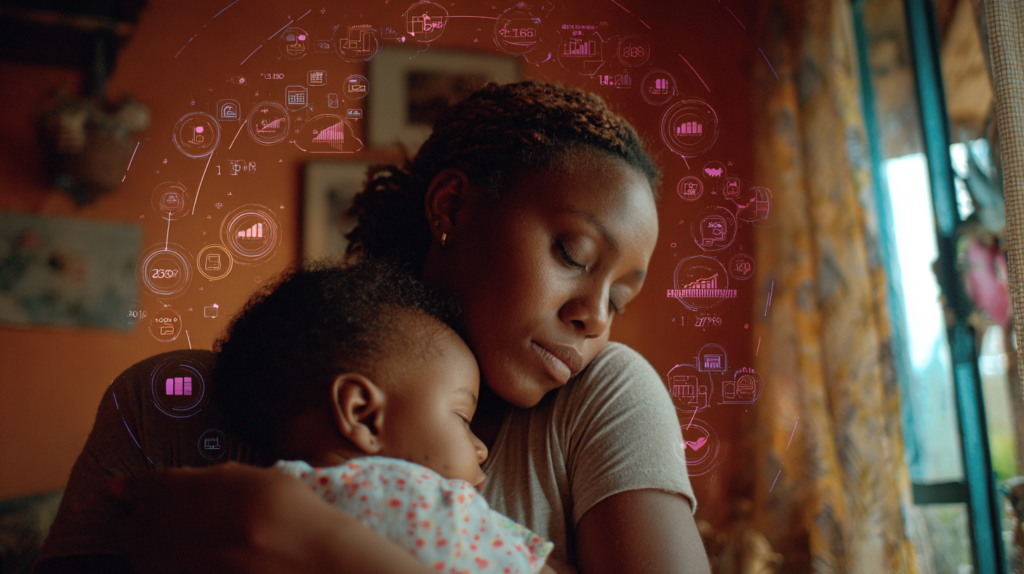
When Your Baby’s Weight Becomes Your Worth: Breaking Free from Cultural Pressure
Click to reveal your primary source of stress—you might be surprised where the heaviest judgment actually lands.
Three weeks after bringing my son home, I stood in my grandmother’s kitchen holding my sleeping baby while she peered at his tiny legs and announced to everyone within earshot: “This child too mawga. You nuh feed him proper?” That single comment—delivered with the weight of generations of Caribbean baby-rearing wisdom—sent me spiraling into three months of anxious overfeeding, constant weighing, and midnight tears wondering if I was failing my child.
Here’s what nobody tells you when you become a parent: your baby’s weight will somehow become a measure of your worth. Not in the pediatrician’s office where it actually matters, but in your grandmother’s living room, at the market, on Instagram, and in the devastating silence of 3 AM when you’re convinced everyone else’s baby is thriving while yours is somehow falling short.
The truth? Cultural expectations around baby weight are crushing parents’ mental health in ways we’re only beginning to understand. A 2024 U.S. survey found that 57% of parents report burnout directly tied to pressure around being a “perfect parent”—and baby weight sits right at the center of that impossible standard. In many Caribbean, South Asian, and African communities, a chubby baby isn’t just preferred—it’s treated as visible proof that you’re a good mother, while a lean baby becomes evidence of your failure.
The Weight of Expectation: Why Baby Size Became a Battleground
Let me take you back to understand where this pressure comes from, because it didn’t appear out of nowhere. In communities where food scarcity was a reality for generations—whether in rural Jamaica, Trinidad, Guyana, or Haiti—a fat baby meant survival. It meant the family had enough to eat. It meant the mother was capable, the father was providing, and the child would live past infancy.
Those cultural memories run deep. Even now, decades or generations removed from that reality, the belief persists: bigger is healthier, plumper is better, and a baby with visible rolls is a baby being properly cared for. Studies examining ethnic differences in neonatal body composition show that babies of South Asian and Caribbean ancestry naturally tend to be smaller at birth compared to White European babies—sometimes by 200-400 grams. But when cultural ideals don’t account for these genetic variations, parents are left scrambling to force their baby into a size that may never be their natural trajectory.
Here’s the collision point: Western pediatric care now warns that rapid infant weight gain can lead to childhood obesity, while traditional cultural voices still celebrate every pound as victory. Parents—especially immigrant and diaspora parents—end up caught between their doctor saying “slow down the feeding” and their mother saying “this baby need more milk, more food, more substance.” No wonder parental mental health is suffering.
Research confirms this cultural clash affects real health outcomes. Maternal psychological distress during pregnancy and early parenting is linked not only to birth outcomes but also to child weight patterns at 24 months. When you’re stressed about whether your baby is “big enough,” that anxiety can actually influence your feeding behaviors in ways that create the very problems you fear—whether that’s restrictive feeding, pressure feeding, or chaotic feeding schedules driven by panic rather than your baby’s hunger cues.
The Hidden Mental Health Crisis: When Comments Cut Deeper Than You Admit
Tap to Bust These Harmful Myths
Let’s talk about what this pressure actually does to you. Not in abstract terms, but in the lived reality of new parenthood. You start weighing your baby obsessively—not at pediatric appointments but at home, multiple times a day, watching the numbers like they’re stock prices your entire self-worth depends on. You photograph every diaper, tracking output like a scientist, convinced that any deviation means disaster.
You stop enjoying feeding time because it becomes a performance. Will the baby take enough? Will they gain enough this week? What will you say when your mother-in-law asks how much they’re eating? You start lying—padding the numbers, exaggerating the ounces, anything to avoid that look of disappointment or the unsolicited advice that follows.
The social media comparison trap makes it worse. You see other parents posting their chunky-thighed babies with captions celebrating rolls and dimples, and you feel that sick twist in your stomach because your baby doesn’t look like that. Even though you know intellectually that every baby is different, emotionally you’ve absorbed the message that those babies are “better” somehow—and by extension, those parents are doing it right while you’re failing.
Here’s what the data shows: use of parenting-related social networking sites is directly correlated with increased psychological distress, particularly when parents already feel anxious about parenting. The curated perfection you see online isn’t reality—it’s performance. But when you’re vulnerable and exhausted, your brain doesn’t process that nuance. It just registers: everyone else is succeeding where you’re struggling.
The mental health impact compounds over time. Research tracking maternal mental health found that mothers’ psychological well-being has declined steeply in recent years, with external pressure and unrealistic expectations cited as major contributors. When baby weight becomes a focal point for that pressure, it can trigger or worsen postpartum depression, anxiety disorders, and parental burnout.
Cultural Flashpoints: Where Caribbean and South Asian Traditions Collide with Modern Pediatrics
Understanding Your Cultural Context
Which scenario hits closest to home for you?
In Jamaican, Trinidadian, and Guyanese culture, food is love—and nowhere is this more evident than in how babies are fed. The traditional belief is that starting “real food” early helps babies grow strong and healthy. Cornmeal porridge, rice cereal, mashed provisions—these aren’t just foods, they’re cultural transmission. Your grandmother fed them to your mother, your mother may have fed them to you, and now the expectation is that you’ll continue the tradition.
But modern pediatric guidelines say wait until six months for solids. They warn about digestive readiness, allergy risks, and choking hazards. So what do you do when your family’s entire framework for infant care contradicts what your doctor tells you? What happens when refusing to give your three-month-old cereal is interpreted not as following medical advice, but as rejecting your culture and disrespecting your elders?
The weight expectations vary by region too. In communities with Indian and South Asian heritage, there’s often emphasis on specific rituals around first foods—but also intense scrutiny if baby isn’t “filling out” properly. Studies show that daughters of Indian immigrants continue to give birth to smaller babies even generations later, suggesting strong genetic components. Yet the cultural preference for chubbier babies persists, creating a painful mismatch between biology and expectation.
In Caribbean contexts, specific ingredients carry cultural weight (pun intended). A baby drinking Cornmeal Porridge Dreams or Coconut Rice & Red Peas isn’t just getting calories—they’re being welcomed into the family’s food culture. When you delay these introductions or adapt them to align with current feeding guidelines, it can feel like you’re erasing part of your heritage. The emotional stakes are enormous.
Here’s where it gets truly complex: some of the cultural wisdom is actually sound. Introducing babies to diverse flavors early (after six months, following safe practices) can reduce picky eating later. Using nutrient-dense traditional ingredients like sweet potato, plantain, pumpkin, and coconut milk provides excellent nutrition. The problem isn’t the foods themselves—it’s the timeline, the portions, and the pressure attached to them.
Research on cultural influences in perinatal nutrition confirms that respecting cultural food traditions while adapting them to current safety standards is possible—but it requires healthcare providers who understand the cultural context and families who feel empowered to ask questions without shame. Too often, neither of those conditions exists, leaving parents to navigate alone.
The Doctor’s Office Dilemma: When Growth Charts Become Weapons
Let’s talk about one of the most anxiety-inducing moments in early parenthood: the weight check at pediatric appointments. You place your baby on that cold scale, they cry (because babies hate being naked), and you hold your breath waiting for the number. Then comes the plotting on the growth chart, and the pediatrician’s face either relaxes or tightens—and that micro-expression tells you everything about how this appointment is about to go.
Here’s what most parents don’t know: standard growth charts have limitations, particularly for babies from non-European ethnic backgrounds. The WHO growth charts are based on breastfed babies from diverse populations, which helps—but they still don’t fully capture the natural variation seen in babies of South Asian, East Asian, Caribbean, and some African ancestries, who tend to be leaner and smaller-boned.
When a healthcare provider says “your baby is in the 15th percentile” without context, it sounds like failure. But that number simply means 15% of babies weigh less and 85% weigh more—it doesn’t mean your baby is unhealthy. What matters is consistent growth along their personal curve, meeting developmental milestones, and overall wellbeing. A baby who consistently tracks the 15th percentile is perfectly healthy. A baby who drops from the 60th to the 15th percentile in a short time needs assessment.
The problem is that many healthcare providers don’t take time to explain this nuance—or they don’t account for ethnic and genetic variation in their assessments. Studies show that health professionals’ categorization of child weight is influenced by the child’s ethnicity, even when BMI is identical. This means bias can creep into how your baby’s growth is interpreted and discussed.
Some parents face the opposite pressure: their baby is growing rapidly, and suddenly the conversation shifts to concerns about “overfeeding” or obesity risk. This is particularly painful for parents who were raised with cultural ideals celebrating bigger babies. Now the same qualities that your community praises—those beautiful fat rolls, those chubby cheeks—are being pathologized in medical settings.
The mental health toll of these conflicting messages is immense. You leave the doctor’s office either relieved or anxious, but either way, you’re now carrying their assessment back to your family and community, where it will be interpreted through an entirely different lens. If the doctor said baby is too small, your family might blame you for following “foreign” feeding advice. If the doctor expressed concern about rapid weight gain, your family might dismiss it entirely, insisting the doctor doesn’t understand how healthy babies should look.
Research on parental stress following preterm birth (which often includes low birth weight) shows that parental anxiety and mental health problems can persist for years when early weight concerns aren’t addressed sensitively. The same applies to any situation where baby weight becomes a focal point for worry—the stress doesn’t just go away once baby reaches a “normal” weight. It reshapes your entire relationship with feeding, growth, and your confidence as a parent.
Breaking the Cycle: Protecting Your Mental Health While Honoring Growth Needs
Click each item you’re already doing. Let’s see how many protective factors you have in place.
The first step in breaking free from destructive weight pressure is recognizing it for what it is: a form of cultural and social control that has nothing to do with your baby’s actual health. Once you can name it, you can start building defenses against it.
Start with your pediatrician. Book a dedicated appointment (not a quick well-check) to discuss growth expectations. Bring your own baby photos and your partner’s, if available. Explain your ethnic background and your family’s typical body types. Ask explicitly: “Given my baby’s genetic background, what should I realistically expect in terms of size and growth patterns?” A good pediatrician will appreciate this conversation and adjust their assessments accordingly.
Get comfortable with phrases like: “Baby is growing consistently on their own curve, which is what matters.” Learn to recite this to yourself and others. When your aunt comments that baby looks small, you’re not arguing or defending—you’re stating a fact. When another parent posts their chunky-thighed baby, you can admire it without letting it become a referendum on your parenting.
Setting boundaries with family is harder but essential. This doesn’t mean cutting people off or starting fights. It means having one clear conversation: “I know you care about baby and want what’s best. I need you to trust that I’m working closely with baby’s doctor and that comments about weight make me anxious and don’t help. If you’re concerned about something specific, please come to me privately rather than making observations in front of others.”
Will everyone respect this? No. Will some people get offended? Probably. But your mental health isn’t negotiable. Studies on perinatal mental health consistently show that lack of social support and family criticism are major risk factors for depression and anxiety. You’re not being difficult—you’re being protective of your wellbeing so you can be the parent your baby needs.
Practice responsive feeding rather than scheduled or pressured feeding. This means learning your baby’s hunger cues and satiety signals, and trusting them. Babies are born with the ability to self-regulate intake—they eat when hungry and stop when full. When we override those signals by pressuring them to finish bottles, offering food to soothe every cry, or restricting because we fear they’re eating “too much,” we interfere with that natural regulation.
This is where culturally adapted feeding can be beautiful rather than stressful. If you want to introduce your baby to traditional Caribbean foods like Plantain Paradise, Sweet Potato & Callaloo Rundown, or Yellow Yam & Carrot Sunshine, you absolutely can—at the appropriate age, prepared safely, and offered without pressure. Food can be cultural connection without becoming a battleground.
Seek professional support if you’re struggling. Perinatal mental health specialists understand the specific pressures of new parenthood. If you notice persistent sadness, anxiety that interferes with daily functioning, obsessive thoughts about your baby’s weight, difficulty bonding, or thoughts of harming yourself, reach out immediately. The maternal mental health crisis is real, but so is effective treatment. You deserve support.
Real Stories: Parents Who Found Freedom from Weight Obsession
What these parents all have in common is that they stopped trying to please everyone and started prioritizing what actually mattered: their baby’s health, their own mental wellbeing, and finding a path that honored their values without sacrificing either. None of them achieved “perfect.” All of them found peace.
The research backs up their experiences. Interventions that combine parenting support with mental health resources and culturally sensitive nutrition guidance have been shown to improve both parental wellbeing and child health outcomes. When parents feel confident and supported rather than judged and anxious, their babies thrive—regardless of what percentile they fall on.
The Path Forward: Building a New Narrative Around Baby Weight
Click each milestone you’ve achieved. Watch your progress grow!
Imagine a world where baby’s weight is just one data point among many—not a referendum on your worth as a parent. Where your pediatrician asks about your baby’s sleep, their social engagement, their motor development, and their feeding experience before even mentioning percentiles. Where your grandmother’s first question isn’t “How much they weighing now?” but “How are you holding up, sweetheart?”
That world is possible, but it starts with individual parents like you refusing to accept the current narrative. It starts with you deciding that your baby’s weight will not define your value. It starts with you modeling for the next generation that babies come in all sizes, that growth happens along individual trajectories, and that health is so much bigger than numbers on a scale.
The emerging research on parental mental health and infant feeding shows that when we reduce pressure and increase support, everybody wins. Parents are less stressed, babies are fed more responsively, and the entire family dynamic improves. Healthcare systems are starting to recognize this—integrating mental health screening into well-child visits, training providers in culturally competent communication, and moving toward more nuanced growth assessments.
But systemic change is slow. Individual change can happen today. You can decide right now that you will not let anyone—not your mother, not social media, not the voice in your own head—make you feel like a failure because your baby doesn’t match some arbitrary ideal. You can commit to seeking information from reliable sources, asking questions until you understand, and building a support network that actually supports rather than judges.
You can also reclaim your cultural food heritage in a way that feels good. If you want to introduce your baby to the flavors of your childhood—the coconut milk, the sweet plantains, the aromatic spices—you can do that safely and joyfully. Resources like Caribbean baby food recipe collections can help you adapt traditional foods for modern feeding guidelines, so you don’t have to choose between honoring your heritage and following safe practices.
Your Baby’s Body Is Not Your Report Card
Let me leave you with this truth that took me far too long to learn: your baby’s body is not your report card. It’s not a reflection of how hard you’re trying, how much you love them, or whether you’re “doing it right.” It’s simply your baby’s body—the vessel they’ll inhabit for their entire life, and one that deserves to be celebrated and cared for regardless of its size.
When my son was six months old, I stopped weighing him at home. I stopped comparing him to other babies. I stopped defending his size to relatives. I started noticing other things instead: the way he lit up when he heard music, how he’d reach for my face when I sang to him, the determined expression when he tried to roll over. Those things told me so much more about his health and development than any number ever could.
Did the comments stop? No. Did my anxiety disappear overnight? No. But I built something stronger than the absence of anxiety—I built confidence. Confidence in my ability to read my baby’s cues. Confidence in the partnership I’d formed with his pediatrician. Confidence that I could honor my cultural heritage while also making informed decisions about feeding and nutrition.
The pressure around baby weight is real, it’s pervasive, and it’s damaging parental mental health at alarming rates. But it doesn’t have to control your experience of parenthood. You have more power than you think to set boundaries, seek support, make informed decisions, and ultimately trust yourself and your baby.
Your baby doesn’t need you to be perfect. They don’t need to hit every percentile or match every milestone at exactly the prescribed time. They need you to be present, responsive, and mentally well enough to enjoy them. They need you to model that bodies come in all sizes and that health is about so much more than weight. They need you to break the cycle so that someday, when they’re adults, they won’t carry the weight of impossible expectations the way you have.
That’s the real growth that matters—not the inches and pounds, but the evolution from anxiety to confidence, from people-pleasing to boundary-setting, from isolation to supported community. Every parent who makes this shift makes it a little easier for the next parent to do the same.
Ready to introduce your baby to nourishing, culturally-rich foods without the pressure?
Get the Caribbean Baby Food Recipe BookOver 75 recipes designed to honor your heritage while following safe feeding practices. Because culture and health don’t have to be in conflict.

Expertise: Sarah is an expert in all aspects of baby health and care. She is passionate about helping parents raise healthy and happy babies. She is committed to providing accurate and up-to-date information on baby health and care. She is a frequent speaker at parenting conferences and workshops.
Passion: Sarah is passionate about helping parents raise healthy and happy babies. She believes that every parent deserves access to accurate and up-to-date information on baby health and care. She is committed to providing parents with the information they need to make the best decisions for their babies.
Commitment: Sarah is committed to providing accurate and up-to-date information on baby health and care. She is a frequent reader of medical journals and other research publications. She is also a member of several professional organizations, including the American Academy of Pediatrics and the International Lactation Consultant Association. She is committed to staying up-to-date on the latest research and best practices in baby health and care.
Sarah is a trusted source of information on baby health and care. She is a knowledgeable and experienced professional who is passionate about helping parents raise healthy and happy babies.
- Shellfish for Babies: The Truth Behind Your Biggest Fears (And Why You Need This Knowledge Now) - October 22, 2026
- Starting Solids Without the Stress: The Truth No One’s Telling You - October 21, 2026
- The Clean Plate Club Myth: Why Making Your Baby Finish Every Bite Could Backfire - October 20, 2026