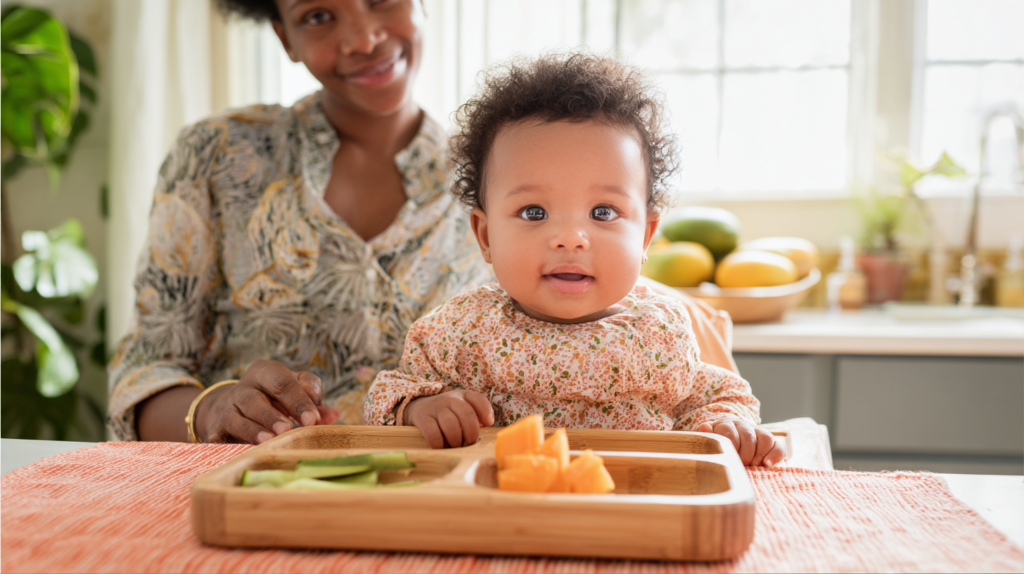
Can Babies Really Eat Without Teeth? The Truth That Will Change How You Start Solids
️ Interactive Gum Strength Simulator
Before we dive in, let’s bust the biggest myth right now. Move the slider to see what baby gums can actually handle:
Here’s something that stopped me cold when I first started my baby feeding journey: my six-month-old daughter sat in her high chair, gums bare as the day she was born, and I’m supposed to give her actual food? Not a tooth in sight, and everyone’s telling me she can handle sweet potato strips and soft chicken?
I remember staring at those tiny gums, panic rising in my chest. This can’t be safe. This can’t be normal. Surely babies need teeth to eat solid food—that’s why we have teeth, right?
Wrong. So magnificently, beautifully wrong.
What I discovered over the next few months changed everything I thought I knew about baby feeding. And if you’re sitting there right now, wondering if your toothless baby is really ready for solids, worrying that every bite might be the dangerous one, or secretly thinking you should just stick with purees until those molars finally show up—this article is going to flip your entire perspective.
The Shocking Truth About Baby Gums
Let’s start with the fact that rocked my world: baby gums aren’t soft. I know, I know—they look soft, feel soft when you touch them gently. But here’s what’s actually happening beneath that tender surface.
Research on infant oral motor development reveals that baby gums contain developing teeth and solid bone structure underneath, creating surprisingly firm ridges that can exert considerable pressure. Those little gums can generate enough force to mash cooked sweet potato, tender meat, ripe mango, soft beans, and dozens of other foods your family eats every day. In fact, studies comparing different complementary feeding approaches found no significant difference in choking episodes between baby-led weaning and traditional spoon-feeding when proper food textures and safety guidelines are followed.
The real kicker? Those molars everyone thinks babies need for eating? They don’t typically arrive until 10 to 16 months—sometimes not until closer to two years old. If babies actually needed teeth to eat solid foods, they’d be stuck on purees for their entire first year and well into their second. That makes exactly zero evolutionary sense.
Think about it: for thousands of years, across every culture on earth, parents offered family foods to babies around six months. There were no baby food companies, no industrial blenders, no stage-1-2-3 progression charts. Just soft-cooked yams, mashed plantains, tender stewed meats, and ripe fruits. Caribbean grandmothers have been feeding babies provision, callaloo, and rice and peas for generations—long before any baby had a full set of teeth.
Developmental Readiness Versus Dental Readiness
✅ Is Your Baby Ready for Solids? Interactive Checklist
Check off the milestones your baby has achieved. The tracker will tell you if they’re ready:
Your Readiness Score
Here’s what actually matters for starting solids: your baby’s neuromuscular development, not their dental development. The current professional consensus from pediatric nutrition experts emphasizes that most term infants can begin complementary foods around six months when they demonstrate core motor skills—sitting with support, good head control, bringing hands and objects to mouth, and showing interest in food.
The tongue thrust reflex—that automatic forward push when something touches baby’s lips—typically begins fading around four months and substantially decreases by six months as babies develop more controlled tongue movement. This reflex served a protective purpose during exclusive milk feeding, but its gradual disappearance signals readiness for managing different textures. If your six-month-old still has some tongue thrust activity, that’s normal; it doesn’t mean solids are dangerous, just that the first few attempts might be messy as your baby learns.
I’ll be honest: those first feeding sessions with my daughter were hilarious and frustrating in equal measure. Sweet potato everywhere. Mashed avocado in her hair, on the floor, somehow on the wall behind her. But even then, even when 90% of the food ended up not in her mouth, she was learning. Her jaw muscles were strengthening. Her tongue was figuring out how to move food around. She was developing the oral motor patterns she’d need for speaking, chewing, and eating for the rest of her life.
What Foods Can Toothless Babies Actually Handle?
Interactive Food Safety Checker
Click each food to reveal whether it’s safe for a baby without teeth:
The key to safe feeding isn’t about what your baby can bite—it’s about what they can mash. Food safety experts and pediatric feeding specialists recommend the “squish test”: if you can easily squash a food between your thumb and finger, it’s generally appropriate for a baby without molars.
This opens up an incredible world of foods. Well-cooked Caribbean provisions—yellow yam, dasheen, eddoes, cassava—pass the squish test beautifully. Ripe plantain, mashed with a fork. Soft beans from stewed peas. Tender callaloo. Coconut rice that’s been cooked until the grains are soft. The Caribbean Baby Food Recipe Book features dozens of traditional recipes specifically adapted for babies at different stages—many designed for little ones with no teeth at all, like the Simple Metemgee Style Mash or Plantain Paradise.
Proteins? Absolutely. Ground meat cooked until tender, shredded chicken that falls apart easily, flaked fish (watching carefully for bones), well-cooked eggs, mashed beans and lentils. Babies don’t need molars to handle these—remember, they’re not chewing like we chew. They’re using their gums to compress and break down food, mixing it with saliva, and practicing the tongue movements that will eventually become mature chewing patterns.
What you do need to avoid are foods that present actual choking hazards, and here’s the crucial part: these are dangerous because of their shape and texture, not because your baby lacks teeth. Round, firm foods that can block the airway are the enemy. Research on pediatric choking injuries consistently identifies whole grapes, chunks of hot dog, raw carrot rounds, whole cherry tomatoes, and popcorn as high-risk items. These foods are dangerous for babies with teeth too—even toddlers with a full set of chompers shouldn’t have whole grapes or hot dog rounds.
Hard foods that can break into sharp shards—raw apple chunks, hard crackers, nuts—are also concerning. But notice: we’re not avoiding these because baby has no teeth. We’re avoiding them because of choking mechanics. A baby with six teeth is no safer with a whole grape than a baby with zero teeth.
The Research That Changed Everything
For years, parents worried that baby-led weaning—letting babies self-feed whole foods from the start—would increase choking risk, especially for babies without teeth. The anxiety was real. I felt it. But here’s what the science actually shows.
A 2023 randomized clinical trial comparing baby-led weaning to traditional spoon-feeding found no significant difference in choking episodes when both groups received proper safety education. A systematic review examining complementary feeding approaches and choking risk came to similar conclusions: the feeding method itself wasn’t the problem. What mattered was food preparation, appropriate textures, and caregiver supervision.
Studies on infant oral motor development reveal something fascinating: babies need texture progression during a critical window between roughly six and nine months. Differing structural properties of foods actually help develop mandibular control and muscle coordination. Babies who get appropriate texture challenges during this period—not just smooth purees, but soft lumps, strips they can hold, foods with varying resistance—develop better feeding skills and are more likely to accept diverse textures later.
This doesn’t mean you should hand your six-month-old a raw carrot and hope for the best. It means that appropriately prepared foods with varied but safe textures help your baby’s oral motor system develop as it should. Those gums need resistance to build strength. That tongue needs practice moving food around. Those jaw muscles need to work.
What Parents Actually Worry About
Myth-Busting Accordion: Click to Reveal the Truth
Survey data from 2025 examining maternal anxiety during solid food introduction found that choking concern was the number one source of stress for parents, with many significantly overestimating the risk from appropriately prepared foods while underestimating dangers from high-risk shapes. One study found about 40% of parents introduced solids before four months, often due to advice or beliefs that solids would help babies sleep—starting too early, ironically, before developmental readiness regardless of teeth.
The social media landscape has intensified these anxieties. Instagram and TikTok are flooded with baby-led weaning content—accounts like Solid Starts have millions of followers watching six-month-olds tackle whole food strips. Reddit communities debate BLW versus purees endlessly. Parents see other babies eating and wonder why they’re so anxious, or they see one scary video and decide finger foods are off the table until two years old.
Here’s what I learned: those perfectly curated feeding videos don’t show the learning curve. They don’t show the 15 tries before baby figured out how to manage that piece of chicken. They don’t show the mess, the gagging that made mom’s heart stop (but baby handled fine), the food that got spit out and tried again next week.
The Real Risks and How to Prevent Them
Let’s talk honestly about choking, because the fear is valid even if it’s often misdirected. Choking is a leading cause of unintentional injury death in young children. But—and this is crucial—the foods most likely to cause fatal choking are specific shapes and textures, many of which remain dangerous even when children have a full set of teeth.
High-risk foods identified by child safety organizations and supported by injury data include:
- Whole grapes, cherry tomatoes – Quarter them lengthwise
- Hot dogs, sausages – Never serve in rounds; slice lengthwise into thin strips
- Hard raw vegetables – Carrot sticks, celery, raw broccoli must be cooked until soft
- Nuts and seeds – Avoid until after age 4 unless finely ground into butter
- Popcorn – Not appropriate until age 4+
- Chunks of firm foods – Apple, raw carrot, hard cheese in chunks
- Sticky foods – Globs of peanut butter, thick caramel, chewy candy
- Round, firm foods – Whole berries, chickpeas (smash them), firm tofu cubes
Notice that none of these restrictions are because baby lacks teeth. These are about airway obstruction mechanics. A round grape can lodge in a toddler’s windpipe whether they have 20 teeth or no teeth.
Safety comes from three things: food preparation, supervision, and position. Cut foods into appropriate shapes—long strips for early eaters, small soft pieces as pincer grasp develops. Stay present during meals. Never leave a baby eating alone, not even for a minute. And ensure baby is sitting upright in a stable high chair, never reclining, never eating in a car seat or while moving around.
Know infant choking first aid. Every caregiver should learn the proper technique: five back blows between the shoulder blades with baby face-down on your forearm, alternating with five chest compressions with baby face-up. Not because you’ll likely need it, but because preparedness reduces panic. Most concerning moments during eating are gagging, not choking, and resolve on their own—but if true choking occurs, you want to know exactly what to do.
How Texture Progression Actually Works
Interactive Texture Timeline: Click Each Age to Explore
Discover what textures and foods work best at each stage of your baby’s first year:
Appropriate Textures: Soft strips they can hold (steamed sweet potato, ripe mango spears), smooth purees for spoon practice, very soft foods that mash easily.
Caribbean Examples: Plantain Paradise puree, mashed provision, soft-cooked dasheen strips, ripe papaya spears
Appropriate Textures: Soft lumps in purees, minced foods, foods with more resistance but still mashable, small soft pieces for practicing pincer grasp.
Caribbean Examples: Coconut Rice & Peas with soft texture, Basic Mixed Dhal with gentle lumps, shredded callaloo in sweet potato mash, tender stewed chicken pieces
Appropriate Textures: Chopped family foods, meals with varied textures, foods requiring more chewing practice (still soft enough to mash).
Caribbean Examples: Ackee Adventure, Geera Pumpkin, Cook-Up Rice & Beans, Cassareep Sweet Potato, soft versions of festival or Johnny cakes
Appropriate Textures: Most family foods with appropriate modifications, foods requiring more chewing, wider variety of textures.
Caribbean Examples: Most recipes from family meals—curry chicken (boneless), rice and peas, provision with more texture, roti pieces (still avoid large chewy pieces), tender oxtail meat
What fascinated me most in researching infant feeding development is that progression isn’t about adding teeth—it’s about building motor skills. Those first few months with solids, baby is figuring out basics: How do I get this food from my hand to my mouth? How do I move it with my tongue? What do I do with this texture that’s not milk?
By seven or eight months, lateral tongue movement emerges, letting babies move food to the sides of their mouth where gum pressure is strongest. The munching pattern develops—that rhythmic up-and-down jaw movement that looks like chewing but isn’t quite there yet. They’re practicing, building muscle memory, strengthening the whole oral motor system.
Around 10-12 months, babies start developing rotary chewing—the circular jaw motion that characterizes mature chewing. And here’s the thing: this often begins before molars arrive. The developmental pattern doesn’t wait for teeth. Babies’ bodies are preparing for those molars, building the skills they’ll need once those grinding teeth actually emerge.
This is why the Caribbean Baby Food Recipe Book organizes recipes by age ranges and texture stages rather than by tooth count. A 10-month-old might have two teeth or eight teeth or no teeth—but their developmental feeding abilities at 10 months are roughly similar, and that’s what determines which recipes are appropriate. The Pholourie Snack recipe for 8+ months? Designed for gums. The Pastelón Style recipe for 12+ months? Still works for babies without molars, because the texture is appropriate for their developmental stage.
Cultural Wisdom Meets Modern Science
One of my favorite discoveries in this journey was realizing that traditional Caribbean feeding practices align beautifully with what research now confirms. Caribbean grandmothers never waited for teeth. They mashed up provision, softened plantain, diluted soups and stews, and fed babies family foods from six months onward.
This wasn’t reckless—it was informed by generations of observation. Babies thrived on these foods. They grew strong. They learned to eat what the family ate. There was no disconnect between “baby food” and “real food” because babies always ate real food, just prepared appropriately.
Modern research on complementary feeding validates this approach. Studies emphasize responsive feeding—paying attention to baby’s hunger and fullness cues, offering family foods, eating together as a family. This is exactly what traditional cultures have done forever, including across the Caribbean.
The global baby food market is enormous—projected to reach $185 billion by 2032—but much of that is driven by convenience marketing, not necessity. You do not need expensive stage-1-2-3 puree pouches. You do not need special “baby” versions of foods if you’re preparing family meals thoughtfully. A Caribbean baby can eat what a Caribbean family eats: provision, rice and peas, stewed meats, callaloo, ripe fruits. The ingredients just need appropriate preparation and texture modification.
Think about it economically too. That $185 billion market exists partly because parents fear doing it “wrong.” But babies across the Caribbean, across Africa, across Asia, across indigenous communities worldwide have eaten family foods for millennia. The science supports this traditional approach, and honestly, it’s more affordable, more culturally connected, and often more nutritious than processed baby food products.
The Social Media Effect and Real-Life Feeding
I have complicated feelings about baby feeding content online. On one hand, accounts focused on baby-led weaning and safe food preparation have educated millions of parents. They’ve shown that babies can handle more than we think. They’ve demonstrated proper food sizes and shapes. They’ve normalized mess and gagging and learning curves.
On the other hand, the highlight reel effect is real. You see pristine babies eating perfect strips of food, and you don’t see the 20 attempts before that, the rejected foods, the meals where nothing got eaten, the days when baby just wanted milk and wanted nothing to do with solids.
Reddit discussions reveal this disconnect. Parents ask, “Is BLW really as common as social media makes it seem?” Others confess anxiety about not measuring up to what they see online. The pressure to present a certain kind of feeding experience—adventurous eater, no stress, beautiful photos—doesn’t match the messy, frustrating, hilarious reality of actually feeding a baby.
Here’s permission you might need: your baby’s feeding journey doesn’t have to look like anyone else’s. Some babies dive into solids with gusto from day one. Some take weeks to really engage. Some prefer holding food. Some prefer being spoon-fed initially. Some gag constantly in the beginning (normal). Some barely gag at all (also normal).
The viral videos of six-month-olds demolishing entire chicken drumsticks? Cool. Impressive. Also, not the standard and not required. If your toothless baby prefers smoother textures mixed with some finger foods, that’s fine. If they eat three bites and call it a day for the first month, that’s fine too. As long as they’re getting breast milk or formula as their primary nutrition, solids before one year are about exploration and skill-building, not meeting caloric needs.
Practical Strategies for Confident Feeding
So how do you actually do this? How do you confidently feed a baby with no teeth, managing your anxiety and setting up success?
Start with your mindset. The goal is not perfect eating. The goal is exposure, practice, and developing skills. Some of the food will end up in baby’s mouth. Much of it won’t. Both outcomes are fine.
Learn what safe textures look like. Practice the squish test with everything you offer. If it doesn’t easily squash between your fingers, it’s not appropriate yet. This removes guesswork.
Prioritize foods that are nutritious and naturally soft. Sweet potato, avocado, banana, ripe mango, papaya, cooked carrots, well-cooked beans, tender meats, eggs, soft-cooked rice and grains. These are nutrient-dense and baby-friendly.
Integrate family meals. If you’re making stewed chicken for dinner, pull out a piece before adding salt and heavy spices, shred it, and that’s baby’s protein. If you’re steaming broccoli, make it extra soft. If you’re cooking rice and peas, pull out a portion before it gets too seasoned. Baby learns to eat what the family eats, and you’re not making separate meals.
Embrace Caribbean flavors appropriately. Babies can absolutely enjoy gentle seasoning. Fresh thyme, a touch of coconut milk, mild spices introduced gradually. The Caribbean Baby Food Recipe Book includes specific guidance on introducing Caribbean spices month by month, helping babies develop a palate for these flavors without overwhelming their systems. Recipes like Baigan Choka Smooth for 8+ months or Yellow Yam & Carrot Sunshine demonstrate how traditional flavors translate beautifully to baby-appropriate textures.
Supervise closely. Stay within arm’s reach during every meal. Watch how baby handles food. You’ll quickly learn their patterns—how they move food around, what textures they manage best, when they’re done. This observation builds your confidence and ensures safety.
Trust gagging as a learning process. Your baby will gag. Maybe a lot at first. It’s loud, looks alarming, triggers every protective instinct you have. But unless they’re silent and turning blue (actual choking), they’re handling it. Gagging means food went too far back and baby’s body is correcting it. Resist the urge to intervene. Let them work through it. They’re learning.
Take an infant first aid course. This single action will reduce your anxiety more than anything else. When you know exactly what to do in a true emergency, feeding becomes less scary. Most parents never need these skills, but having them provides enormous peace of mind.
Looking Forward Without Fear
Here’s what I want you to take away from all of this: your baby’s lack of teeth is not a barrier to starting solids. It’s not a reason to delay, to stress, or to stick exclusively with purees for months and months. Nature designed babies to start eating around six months, and nature designed their bodies to handle it—gums and all.
The global research consensus supports this. The traditional feeding practices of cultures worldwide demonstrate it. And most importantly, your baby’s developing oral motor system needs the practice that comes from managing different textures and self-feeding.
Will there be mess? Absolutely. Will there be gagging moments that make your heart stop? Probably. Will your baby sometimes reject foods you carefully prepared? Count on it. Will they sometimes surprise you by demolishing something you thought they couldn’t handle? Yes, and those moments are magic.
The feeding journey is long. First teeth, then molars, then losing baby teeth, then adult teeth—and through all of it, your child will be eating, learning, growing, developing preferences and skills. These first months of solids are just the beginning. There’s no perfect way to do it, no magic milestone where it suddenly becomes easy.
But there is confidence that comes from understanding how it actually works. From knowing that those strong little gums are capable of amazing things. From seeing research that says babies don’t need teeth to eat safely and well. From watching your own baby figure it out, mess and all.
Your Next Steps: Ready to Start?
Based on everything you’ve learned, choose your feeding approach and get personalized recommendations:
Perfect! Here’s Your Personalized Plan:
Feed Your Baby, Not Your Fear
The day I finally let go of the anxiety about teeth—or lack thereof—was the day feeding became joyful instead of stressful. I stopped obsessing over every gag. I stopped comparing my daughter’s eating to babies on Instagram. I stopped worrying that we were doing it wrong because she had zero teeth at seven months.
Instead, I watched her. I celebrated the small victories: the first time she actually swallowed a piece of sweet potato instead of just gumming it and spitting it out. The afternoon she grabbed a strip of ripe mango and figured out how to eat the whole thing. The evening she tried callaloo and made the funniest disgusted face, then went back for more. The morning she reached for my plantain and insisted on sharing my breakfast.
These moments were never about teeth. They were about development, about learning, about becoming part of our family’s food culture. And they were beautiful.
Your baby is ready for this journey. Their strong little gums, their developing oral motor skills, their growing curiosity about food—it’s all there, teeth or no teeth. The research backs you up. Traditional wisdom backs you up. And most importantly, your baby’s body is designed for this.
So take a deep breath. Trust the process. Trust your baby. And trust yourself. Those gums are stronger than you think, your baby is more capable than you imagine, and the feeding journey ahead—messy, imperfect, and teeth-optional—is going to be amazing.
Feed your baby with confidence. Feed them your culture, your family’s foods, prepared with love and appropriate texture. And watch them thrive, one gummy smile at a time.

Expertise: Sarah is an expert in all aspects of baby health and care. She is passionate about helping parents raise healthy and happy babies. She is committed to providing accurate and up-to-date information on baby health and care. She is a frequent speaker at parenting conferences and workshops.
Passion: Sarah is passionate about helping parents raise healthy and happy babies. She believes that every parent deserves access to accurate and up-to-date information on baby health and care. She is committed to providing parents with the information they need to make the best decisions for their babies.
Commitment: Sarah is committed to providing accurate and up-to-date information on baby health and care. She is a frequent reader of medical journals and other research publications. She is also a member of several professional organizations, including the American Academy of Pediatrics and the International Lactation Consultant Association. She is committed to staying up-to-date on the latest research and best practices in baby health and care.
Sarah is a trusted source of information on baby health and care. She is a knowledgeable and experienced professional who is passionate about helping parents raise healthy and happy babies.
- Baby Nutrition Essentials: The Quiet Signs Your Baby Is Not Getting Enough - October 6, 2026
- Why Your Baby’s “Sweet Tooth” Is Normal—And How to Handle It Without Stress - October 5, 2026
- Rice and Peas for Baby: How to Keep the Soul, Change the Recipe - October 4, 2026