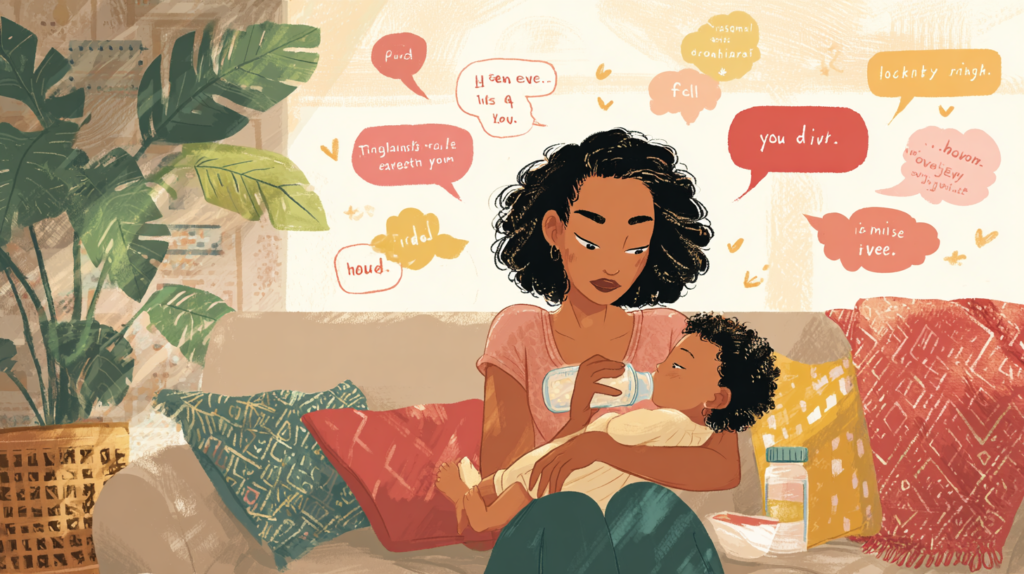
The Silent Feeding Saboteur: How Body Comments Are Stealing Your Baby’s Best Start
Before you read another feeding guide or stress over breastfeeding versus formula, there’s something we need to talk about. Something nobody warned you about during pregnancy. Something that’s quietly reshaping how millions of parents feed their babies.
⚡ Click the scenario that hits closest to home:
Here’s what shocked me when I started researching this topic: over half of new mothers report experiencing weight-based judgment from healthcare providers, family members, or complete strangers during pregnancy and postpartum. But here’s the part that made my stomach drop—these comments aren’t just uncomfortable. They’re actively changing how parents feed their babies, shortening breastfeeding duration, increasing formula guilt, and creating a toxic shame cycle that affects both breast and bottle feeders.
The truth nobody’s saying out loud? Your feeding journey isn’t just being shaped by lactation consultants, pediatricians, or even your baby’s hunger cues. It’s being hijacked by body comments—those seemingly harmless remarks about your size, shape, “baby weight,” and how your body looks while nourishing your child. And it’s time we called it what it is: a feeding saboteur hiding in plain sight.
The Double Bind Nobody Warned You About
When researchers started digging into the connection between body image and infant feeding, they uncovered something disturbing: a “shame either way” dynamic that traps parents no matter what feeding choice they make. Breastfeed in public? Face harassment, criticism, or even being secretly filmed and shamed online. Formula feed? Endure judgment for not giving your baby “the best.” Choose to breastfeed longer than culturally accepted? Get accused of being inappropriate or doing it “for yourself.”
But the body comments layer adds another cruel twist. Parents who breastfeed may hear that they’re “letting themselves go” or not “getting their body back” fast enough. Those who stop breastfeeding to pursue weight loss or avoid body changes face shame for “giving up.” And underneath it all, there’s this unspoken pressure: be thin, but not too thin (or you’re “not eating enough for breastfeeding”). Look good, but don’t try too hard (or you’re “vain” and not prioritizing your baby).
Research Reality: Women with more positive body image during pregnancy show higher breastfeeding intentions, higher initiation rates, and longer breastfeeding duration. Conversely, those with appearance concerns and body dissatisfaction breastfeed for significantly shorter periods—not always by choice, but because external pressure makes it unsustainable.
The cruel irony? Public health campaigns push “breast is best” messaging without addressing the body-shaming culture that makes breastfeeding feel impossible for many parents. Meanwhile, formula companies subtly market convenience and control—lifestyle promises that align perfectly with “bounce back” culture—while parents who use formula are stigmatized as failures.
Tap to reveal: What most doctors won’t tell you about weight talk and feeding outcomes
Weight-focused counseling in pregnancy and postpartum can actually undermine breastfeeding by increasing distress, eroding trust in healthcare providers, and crowding out supportive discussions about actual feeding goals and challenges. Body-neutral care improves feeding outcomes.
The Body Comments That Break Feeding Journeys
Let’s get specific about what we’re talking about. Body comments in the feeding context include remarks about your size (“you’re too big/small”), your shape (“pregnancy ruined your body”), your breasts (everything from sexualization to “they’re not big enough to breastfeed”), your eating habits (“are you sure you should eat that while breastfeeding?”), and comparisons to other mothers (“she lost all her baby weight in three months”).
What makes these comments so damaging is that they often come disguised as concern, compliments, or helpful advice. “You look amazing—you’ve lost the weight so fast!” seems positive, but it reinforces the expectation that rapid weight loss should be every new parent’s priority. “You need to eat more if you’re going to breastfeed” sounds caring, but it reduces your body to a feeding vessel and ignores your autonomy. “Just give the baby formula so you can get back to the gym” might seem practical, but it frames your body’s appearance as more important than your feeding preferences.
Body Comment Impact Tracker
Select all the sources where you’ve experienced body-related pressure about feeding:
Qualitative research with healthcare providers who are also mothers revealed something heartbreaking: even professionals who deeply understand breastfeeding benefits can feel torn between knowing the science and feeling pressured to restrict food or stop breastfeeding to avoid body changes. If trained nurses and midwives struggle with this conflict, imagine the impossible position it puts parents in who lack that professional knowledge or support system.
And here’s where it connects to your baby’s nutrition: when you’re constantly bombarded with messages that your body is wrong, too big, too small, not “back to normal” fast enough, it creates an environment where feeding decisions become tangled with appearance anxiety. Some parents avoid breastfeeding because they fear breast changes or weight retention. Others stop earlier than they wanted because the mental load of body criticism becomes unbearable. Still others develop disordered eating patterns while trying to “eat for breastfeeding” and “lose baby weight” simultaneously—two goals that often contradict each other.
The Social Media Feeding Frenzy
If body comments in person are destructive, social media has amplified them into a full-blown crisis. Parents today navigate a digital landscape where breastfeeding photos attract hostile comments about indecency, where formula feeding triggers accusations of harming their baby, where every feeding choice is publicly dissected, judged, and weaponized.
Recent incidents highlight the toxicity: mothers breastfeeding in public spaces have been secretly filmed, posted online, and subjected to thousands of comments telling them to “cover up,” go to a bathroom, or stop being “attention-seeking.” On the flip side, parents who share their formula feeding journey face comments like “why did you even have a baby if you won’t give them the best?” or “you’re lazy and selfish.” Meanwhile, the algorithm serves up endless “postpartum body transformation” content, celebrity “snap back” stories, and before-and-after posts that make it seem like everyone else is effortlessly shedding weight while exclusively breastfeeding.
Myth-Busting Zone: Tap Each Myth to Reveal the Truth
MYTH: “Breastfeeding will make you lose weight automatically”
TRUTH: Breastfeeding burns calories, but bodies respond differently. Some people lose weight, some maintain, some gain due to increased hunger, hormonal changes, or metabolic shifts. There’s no “automatic” outcome, and weight change has nothing to do with how well you’re feeding your baby.
MYTH: “If you’re eating healthy, you shouldn’t gain weight while breastfeeding”
TRUTH: Your body may hold onto weight while breastfeeding as a biological reserve for milk production. This is normal and protective. “Healthy eating” looks different for everyone, and your body knows what it needs—regardless of what the scale says.
MYTH: “Formula feeding is the easy way out for vain mothers”
TRUTH: Formula feeding is a valid choice for countless reasons: medical complications, mental health, lactation challenges, personal preference, or returning to work. Body concerns are legitimate—your mental health and bodily autonomy matter. Fed is what matters.
MYTH: “Breastfeeding will ruin your breasts”
TRUTH: Pregnancy itself causes breast changes, not breastfeeding. Genetics, age, and weight fluctuations play bigger roles. But even if breastfeeding did change your breasts—so what? They fed your baby. That’s not ruin; that’s function. Your body doesn’t owe anyone an ornamental appearance.
MYTH: “You just need more willpower to lose the baby weight and keep breastfeeding”
TRUTH: Willpower has nothing to do with it. Hormones, sleep deprivation, stress, mental health, access to support, structural barriers, and individual biology all play massive roles. Framing it as a willpower issue is gaslighting that ignores systemic and physiological realities.
The data backs up what many parents feel intuitively: exposure to idealized postpartum body images and feeding narratives on social media correlates with increased body dissatisfaction, feeding guilt, and shorter breastfeeding duration. But here’s where it gets interesting—emerging research also shows that diverse, realistic portrayals of postpartum bodies and varied feeding journeys can actually support mental health and feeding confidence. The problem isn’t social media itself; it’s the narrow, shame-based narratives that dominate it.
What Your Healthcare Provider Should Be Saying (But Probably Isn’t)
When researchers examined weight stigma in pregnancy and postpartum care, they found that many healthcare encounters actively harm feeding outcomes through body-focused messaging. Repeated weigh-ins without clinical justification. Comments like “you just need to lose the baby weight.” Directive advice about feeding that centers the parent’s weight rather than the baby’s needs or the parent’s mental health.
Here’s what evidence-based, weight-inclusive care actually looks like: asking permission before discussing weight. Separating infant feeding counseling from appearance-focused advice. Screening for body image distress and depression alongside lactation challenges. Validating parents’ experiences of weight stigma rather than dismissing them. Offering mental health referrals and body-image-informed support alongside feeding guidance. Recognizing that sustainable feeding practices require supporting the whole parent—not just optimizing milk production or pushing arbitrary timelines.
Clinical Reality Check: Studies show that parents who experience weight stigma during childbirth have higher odds of postpartum depression and anxiety—conditions that directly impact feeding capacity and choices. Treating bodies with respect isn’t “nice to have”; it’s essential healthcare.
Unfortunately, many healthcare providers haven’t received training in weight-inclusive care or the connections between body image and feeding outcomes. This means you might need to advocate for yourself: ask that weight discussions be limited to medical necessity, request that feeding support focus on your goals (not societal expectations), and don’t hesitate to switch providers if you’re experiencing weight-based judgment or shame.
And if you’re building your baby’s nutrition foundation with real, nourishing foods when they’re ready for solids, that’s another opportunity to reclaim feeding from diet culture. Introducing nutrient-dense ingredients like sweet potatoes, plantains, beans, and coconut milk—foods celebrated in Caribbean traditions—helps babies develop healthy relationships with food from the start. The Caribbean Baby Food Recipe Book offers over 75 recipes that prioritize nutrition and flavor without the weight-obsessed messaging that plagues mainstream feeding advice.
Rewriting the Script: Body-Neutral Feeding Strategies
So how do you protect your feeding journey from body comment sabotage? It starts with shifting from body shame to body neutrality—and from external pressure to internal authority. Body neutrality means you don’t have to love your postpartum body or think it’s beautiful. You just have to respect it as the vessel that’s doing incredibly hard work growing, birthing, and potentially feeding a human.
Here are research-backed strategies that actually work:
️ Boundary Scripts for Body Comments
- For weight comments: “I’m not discussing my weight right now. Let’s talk about how the baby is doing.”
- For feeding criticism: “We’re working with our pediatrician and feel confident in our approach.”
- For appearance pressure: “My body just grew and birthed a baby. I’m focusing on health, not aesthetics.”
- For comparative remarks: “Every body and every feeding journey is different. Comparisons aren’t helpful.”
- For unsolicited advice: “I appreciate your concern, but I didn’t ask for advice on this.”
Practice these scripts before you need them. Body comments catch you off guard when you’re sleep-deprived and vulnerable, so having prepared responses helps you hold your ground without having to think on the spot.
Next, curate your environment ruthlessly. Unfollow social media accounts that make you feel bad about your body or your feeding choices—even if they’re “inspirational.” Mute family members who repeatedly make harmful comments. Seek out healthcare providers who practice weight-inclusive care and respect your feeding autonomy. Join communities (online or in person) that celebrate diverse postpartum bodies and varied feeding journeys.
Tap to flip: The #1 feeding mindset shift that protects against body shame
Shift from “My body should look a certain way while feeding my baby” to “My body is doing what it needs to do to care for my baby and myself.” Function over form. Your body doesn’t owe anyone an aesthetic. It owes YOU health, strength, and the capacity to care for your child—however that looks.
If you’re breastfeeding and struggling with body image, consider reframing your breasts and body through a functional lens. Your breasts aren’t decorative; they’re making food for a human. Your belly isn’t a failure; it protected your baby during pregnancy. Your changing shape isn’t something to “fix”; it’s evidence of the profound work your body has done. This doesn’t mean you have to love every change—but it can help reduce the shame that makes feeding unsustainable.
If you’re formula feeding (by choice or circumstance), know that protecting your mental health and bodily autonomy is a valid reason to choose formula. Full stop. You don’t need to justify it with medical conditions or lactation failure. “This is what works for my family” is a complete sentence. And feeding your baby formula while simultaneously rejecting diet culture and body shame? That’s radical self-respect.
The Cultural Intersection: Body Comments in Different Communities
Body comments and feeding pressures don’t exist in a vacuum—they’re shaped by cultural norms, intergenerational patterns, and community values. In many Caribbean families, for example, there’s deep cultural knowledge about nourishing postpartum bodies with specific foods like coconut milk porridges, ginger tea, and provision-based meals. But there can also be conflicting messages: pressure to “keep your figure” while simultaneously being told to “eat for the baby.”
Understanding how your cultural context shapes body and feeding expectations can help you navigate them more consciously. Some cultural traditions around postpartum care are protective and supportive—like the emphasis on rest, community feeding support, and nutrient-dense foods. Others may inadvertently perpetuate body shame or rigid feeding expectations. You get to keep what serves you and your baby, and release what doesn’t.
For instance, the emphasis on whole, minimally processed foods in traditional Caribbean cooking aligns beautifully with modern nutrition science for babies. Recipes like Calabaza con Coco (pumpkin with coconut milk), Sweet Potato & Callaloo Rundown, or Yellow Yam & Carrot Sunshine give babies rich, varied flavors and nutrients without processed additives. When you’re ready to introduce solids, connecting with these cultural food traditions can be a way to honor heritage while nourishing your baby—and it’s a feeding choice that centers actual nutrition rather than diet culture nonsense.
Cultural Feeding Wisdom Check
Which traditional postpartum or baby feeding practices from your culture support your wellbeing? (Select all that apply)
The Partner and Family Factor
Research consistently shows that partner and family support—or lack thereof—dramatically impacts feeding outcomes. But here’s what often gets missed: family members need education about how their comments affect feeding journeys. A partner who says “when are you going to lose the baby weight?” or “your body doesn’t look the same” may not realize they’re undermining breastfeeding. A grandmother who comments “you’re getting so big from all that breastfeeding eating” may think she’s being observational, not harmful.
Educating your support network isn’t your responsibility when you’re exhausted and trying to keep a tiny human alive—but it can be protective if you have the bandwidth. Share articles like this one. Explicitly tell partners and family what kind of support you need: “I need you to never comment on my weight or body.” “I need you to back me up when others criticize my feeding choices.” “I need you to bring me nourishing food and water, not diet talk.”
And if your partner or family can’t or won’t provide body-neutral, feeding-supportive care? That’s information. You may need to limit their involvement, seek support elsewhere, or in extreme cases, reevaluate the relationship. Your mental health and your baby’s nutrition are too important to sacrifice to appease people who won’t respect your boundaries.
Moving Forward: Your Feeding Journey Belongs to You
Here’s what I want you to take away from all of this: your feeding journey should be determined by your baby’s needs, your capacity, your preferences, and your goals—not by other people’s opinions about your body. Whether you breastfeed, formula feed, pump, or do a combination, the measure of success isn’t how fast you “bounce back” or how well you meet society’s impossible standards. It’s whether your baby is fed, whether you’re supported, and whether you can sustain the approach mentally and physically.
Body comments are a form of sabotage because they redirect your attention from what actually matters (is my baby thriving? am I okay?) to what doesn’t (do I look how others think I should?). Every moment you spend anxious about your postpartum body is a moment stolen from being present with your baby, from healing, from finding joy in this incredibly difficult and transformative time.
✨ The Bottom Line: Feeding your baby—however you do it—while protecting your mental health and rejecting body shame is an act of resistance. You’re interrupting generational cycles of appearance-based worth. You’re modeling body respect for your child. You’re reclaiming feeding from a culture that tries to make it about your shape instead of your baby’s nourishment.
As you navigate feeding decisions in these early months, remember that you’ll eventually transition to introducing solid foods—another opportunity to approach feeding with intention and respect. When that time comes, focusing on nutrient-dense, flavorful first foods can help your baby develop a healthy relationship with eating from the start. The Caribbean Baby Food Recipe Book includes options like Cornmeal Porridge Dreams, Basic Mixed Dhal Puree, and Coconut Rice & Red Peas that introduce babies to wholesome ingredients without the diet-culture baggage that infiltrates so much mainstream baby food guidance.
Your Body, Your Baby, Your Rules
Years from now, when your baby is older, they’re not going to remember whether you breastfed or used formula. They’re not going to know what size you wore postpartum or how fast you “bounced back.” But they will absorb how you spoke about bodies—yours and others. They will internalize whether you modeled self-respect or self-criticism. They will learn feeding values from watching you navigate this impossible landscape of conflicting pressures.
So here’s my challenge to you: what if you fed your baby—and yourself—with radical body neutrality? What if you surrounded yourself only with people who respect your feeding choices and your body? What if you rejected every comment, campaign, and comparison that tried to make feeding about appearance instead of nourishment?
It won’t be easy. The pressure is relentless, the comments are constant, and the culture is stacked against you. But every time you hold a boundary, every time you prioritize function over form, every time you choose feeding sustainability over aesthetic expectations, you’re rewriting the script. Not just for yourself—for your baby, who deserves to grow up in a world where bodies are respected and feeding is about connection and nutrition, not shame.
Your body grew a human. It’s feeding a human (one way or another). It’s carrying you through the hardest transition of your life. It doesn’t owe anyone thinness, bounce-back, or Instagram-worthiness. It owes you respect, care, and the space to feed your baby on your terms.
The silent feeding saboteur thrives in silence. The more we name it, challenge it, and refuse to let body comments dictate our feeding journeys, the less power it has. So speak up. Set boundaries. Seek support. Feed your baby however works for your family. And tell body shame exactly where it can go—because it has no place at the feeding table.
Ready to Reclaim Feeding from Diet Culture?
When you’re ready to introduce solids, start with nutrient-dense, culturally rich foods that prioritize your baby’s health over restrictive food rules. The Caribbean Baby Food Recipe Book offers 75+ recipes featuring ingredients like sweet potatoes, plantains, mangoes, coconut milk, and beans—foods that nourish without the weight-obsessed messaging. From Plantain Paradise to Stewed Peas Comfort to Mangú Morning, these recipes help you build your baby’s nutrition foundation with flavor, culture, and respect.

Expertise: Sarah is an expert in all aspects of baby health and care. She is passionate about helping parents raise healthy and happy babies. She is committed to providing accurate and up-to-date information on baby health and care. She is a frequent speaker at parenting conferences and workshops.
Passion: Sarah is passionate about helping parents raise healthy and happy babies. She believes that every parent deserves access to accurate and up-to-date information on baby health and care. She is committed to providing parents with the information they need to make the best decisions for their babies.
Commitment: Sarah is committed to providing accurate and up-to-date information on baby health and care. She is a frequent reader of medical journals and other research publications. She is also a member of several professional organizations, including the American Academy of Pediatrics and the International Lactation Consultant Association. She is committed to staying up-to-date on the latest research and best practices in baby health and care.
Sarah is a trusted source of information on baby health and care. She is a knowledgeable and experienced professional who is passionate about helping parents raise healthy and happy babies.
- The Hidden Truth About Hot Dogs and Your Baby: What Every Parent Needs to Know Right Now - September 13, 2026
- The Budget-Friendly Starting Solids Guide: How to Feed Your Baby Real Food Without Going Broke - September 12, 2026
- Pigeon Peas for Baby: The Caribbean Protein Secret Your Grandmother Knew (But Never Told You Why) - September 11, 2026