Skip to content
The Starting Solids Mistakes That Are Secretly Sabotaging Your Baby’s Relationship with Food
Your baby is six months old. You’ve waited for this moment. You’ve read the books, joined the Facebook groups, bought the perfect silicone spoons. But here’s what nobody told you: the mistakes that matter most aren’t about what you feed—they’re about how you’re thinking about feeding entirely.
What if I told you that right now, in kitchens across the world, well-meaning parents are making invisible mistakes that will echo through their children’s eating habits for years? Not dramatic mistakes. Not dangerous ones. Just subtle shifts in approach that change everything.
I learned this the hard way when my own little one turned six months. I thought I was doing everything right. Turns out, I was setting us both up for mealtime battles I didn’t even know were coming.
First, Let’s Get Personal: Where Are You Right Now?
Click your baby’s current stage to reveal the biggest mistake parents at YOUR stage are making:
The Uncomfortable Truth About Starting Solids
Here’s what the Instagram reels and baby food blogs won’t tell you: complementary feeding—that’s the official term for starting solids—isn’t just about nutrition. It’s about creating a relationship. And most of us are unconsciously teaching our babies the wrong lessons from day one.
Global health bodies like the WHO and CDC agree that starting solids around six months is the sweet spot. But timing is just the beginning. Research from 2024 shows that how we introduce solids during this critical window influences obesity risk, food acceptance, and eating behaviors that persist into adulthood. We’re not just feeding babies pureed sweet potato. We’re programming their palates and their psychology around food.
The Window That Changes Everything: From 6 to 12 months, babies need approximately 11 mg of iron daily—more than most adults. Yet surveys show that many parents delay iron-rich foods like meat, legumes, and fortified cereals in favor of sweet fruits and vegetables. This single pattern creates both a nutritional gap and a taste preference problem that compounds over time.
The modern feeding landscape has changed dramatically. Twenty years ago, babies ate what families ate, mashed up. Today, we have an entire industry built around “baby food”—pouches, puffs, and specially marketed products. While convenient, many of these contain hidden sugars and keep babies stuck on smooth, sweet textures long past the point where they should be learning to chew.
The Seven Mistakes That Haunt Parents (And How They Actually Unfold)
Let me walk you through what I call the “cascade mistakes”—errors that seem small in the moment but trigger a domino effect. These aren’t theoretical. They’re patterns researchers have documented, pediatric dietitians see daily, and social media parenting communities discuss endlessly.
❌ MISTAKE #1
Tap to reveal the timing trap
Starting Too Early or Too Late
Before 4 months? Higher obesity risk. After 7 months? Iron deficiency and texture aversion. The 6-month mark exists for developmental and nutritional reasons—not arbitrary rules.
Mistake #2: The Sweet Trap
It starts innocently. Apples. Bananas. Sweet potato. Carrots. All nutritious. All delicious. All sweet. Within weeks, your baby has had twenty different sweet purees and zero savory, bitter, or umami flavors. Then you offer green beans or lentils, and they reject them. You think, “My baby doesn’t like vegetables.” But the truth? You accidentally trained their palate to expect sweetness at every meal.
Research on flavor exposure shows babies need 8-15 tries of a new food before accepting it. But if you’ve already established a pattern of sweet-only foods, you’re now fighting an uphill battle. The solution parents rarely hear: start with iron-rich, savory foods from day one. Pureed chicken. Lentils with a hint of cumin. Eggs. Yes, these seem “advanced,” but they’re actually foundational.
What’s Actually Happening in Your Baby’s Brain?
Most parents don’t realize that taste preferences are being wired in real-time. Click to see the neuroscience:
Here’s the brain truth: Babies are born with an innate preference for sweet and an aversion to bitter (evolutionary protection against toxins). But their taste system is plastic—meaning it can be shaped by exposure. When you repeatedly offer sweet foods during the 6-12 month window, you’re strengthening neural pathways that say “sweet = food.” Meanwhile, pathways for savory, bitter, and complex flavors remain underdeveloped. By 12-18 months, these preferences solidify. That “picky eater” at age two? They were created, not born. The good news: variety and repeated exposure during the first year can literally rewire these pathways.
Mistake #3: Texture Stagnation
Smooth purees are safe. Easy. Clean. So you stick with them. At seven months. Eight months. Nine months. Then suddenly, your baby gags on anything with texture. They refuse finger foods. Occupational therapists call this “texture aversion,” and it’s increasingly common. Why? Because there’s a developmental window—roughly 7 to 10 months—when babies are neurologically ready to learn chewing motions and experience varied textures. Miss that window, and introducing lumps becomes a battle.
The baby-led weaning movement has made some parents anxious about choking, so they over-compensate by keeping everything smooth. But here’s the reality: babies need to experience safe textures—soft, mashable finger foods—to develop oral motor skills. Think ripe avocado strips, steamed sweet potato wedges, or soft-cooked green fig (banana). Yes, they’ll gag. Gagging is normal and protective. It’s different from choking, and learning the difference is part of the journey.
If you’re looking for culturally rich, texture-appropriate recipes that walk you through this progression, the Caribbean Baby Food Recipe Book includes over 75 recipes with texture notes for each age stage—from smooth purees like Calabaza con Coco to finger foods like Cassareep Sweet Potato sticks that introduce savory island flavors while respecting developmental readiness.
Quick Reality Check: Are You Making the “Pressure Mistake”?
This mistake is invisible but damaging. Answer honestly:
The Invisible Mistake: Feeding for Volume Instead of Learning
This is Mistake #4, and it’s the one that breaks my heart because I made it myself. We’re so focused on HOW MUCH our baby eats that we forget the entire point of this phase: milk is still the main nutrition source until 12 months. Solids are for learning.
When you pressure your baby to eat more, use distractions, or celebrate finishing a bowl, you’re overriding their natural hunger and fullness cues. Research calls this “non-responsive feeding,” and it’s directly linked to overeating and obesity later in life. Think about it: we’re teaching babies to ignore their own bodies and eat to please us.
⚠️ The Long-Term Cost: Studies tracking children from infancy to age 10 found that babies who experienced controlling feeding practices (pressure, restriction, or food as reward) had significantly higher BMI and more disordered eating patterns. The relationship with food you create now lasts decades.
Responsive feeding—the gold standard recommended by WHO, CDC, and every major pediatric nutrition body—means you provide safe, nutritious options, and your baby controls the portion. They eat when hungry. Stop when full. Some meals they’ll eat a lot. Others, barely a bite. Both are normal. Your job is not to fill them up. It’s to expose them to flavors, textures, and the social experience of eating.
The Mistakes You Can’t See (Until It’s Too Late)
Mistake #5: Iron Amnesia
Parents focus on fruits and veggies while forgetting iron-rich foods. By 9 months, iron stores from birth are depleted. Without meat, fortified cereals, beans, or lentils, babies become iron-deficient—affecting brain development and energy. Yet surveys show iron-rich foods are often introduced late or infrequently.
Mistake #6: The Allergy Avoidance Paradox
For years, parents were told to delay allergenic foods. Now we know the opposite is true: early introduction (around 6 months) actually prevents allergies. Yet many parents still avoid eggs, peanuts, fish, and shellfish out of fear. This avoidance may be increasing allergy rates, not reducing them.
Mistake #7: Solo Feeding
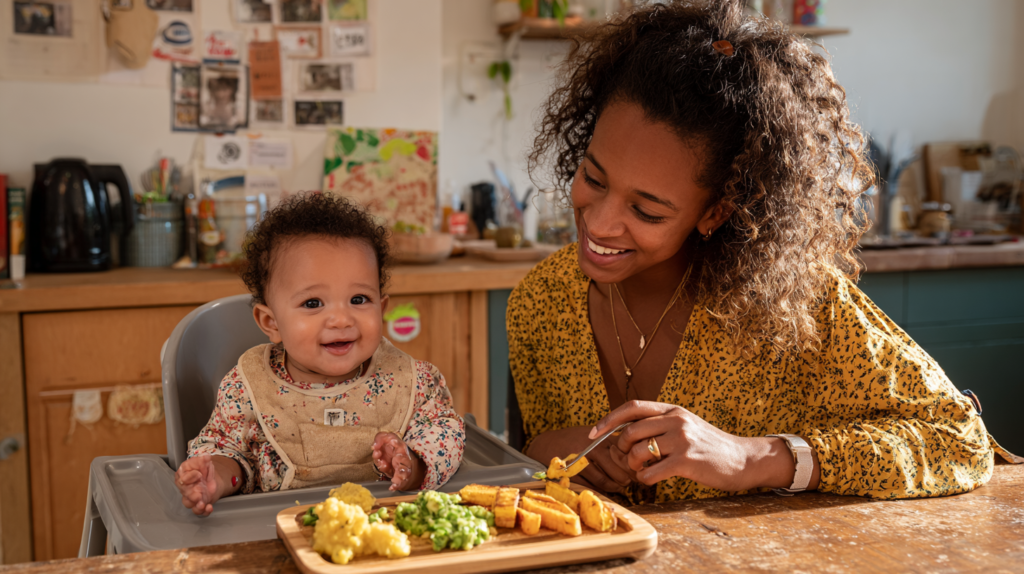
You sit your baby in a high chair, feed them separately, then eat your own meal in peace. Efficient? Yes. Optimal? No. Babies learn by watching. When they see you eat, they mimic. When meals are social, they associate food with connection and pleasure. Feeding in isolation misses this crucial learning opportunity.
Caribbean families have understood this for generations. Food is communal. Babies sit at the table, observing adults enjoy flavorful meals—callaloo, stewed peas, curry—long before they taste them. This cultural practice aligns perfectly with research on social learning and food acceptance. When you prepare family meals that can be adapted for baby, everyone benefits. That’s why recipes like Karhee Curry Blend, Coconut Rice & Red Peas, or Sweet Potato & Callaloo Rundown include family meal adaptations—you’re cooking once, but teaching your baby twice.
The Myth That’s Holding You Back
“Babies need bland food.” FALSE. Babies in India eat spiced lentils. Babies in Mexico eat beans with cumin. Babies in Jamaica eat thyme-seasoned yam. Bland is a Western invention, not a biological requirement. What babies DON’T need: added salt, sugar, or honey (before 12 months). But herbs, spices, and rich flavors? Those are gifts.
What Social Media Gets Right (and Dangerously Wrong)
Instagram and TikTok have democratized feeding advice. You can watch a pediatric dietitian demonstrate safe finger foods or see real babies experiencing gagging vs. choking. This visibility is powerful. But there’s a dark side.
The “what my baby eats in a day” trend creates unrealistic expectations. You see perfectly plated meals, babies eating quinoa and roasted vegetables without fuss, zero mess. It’s curated. It’s not real. And it makes you feel like you’re failing when your baby throws sweet potato on the floor for the eighth time this week.
Social Media’s Double Edge: A 2024 analysis found that baby feeding content on Instagram and TikTok often prioritizes aesthetic over accuracy. Videos showing babies eating elaborate meals get millions of views, while evidence-based posts about responsive feeding and repeated exposure get far less engagement. The algorithm rewards performance, not best practices.
Then there are the fear-mongering posts about choking. Yes, choking is a real risk. Yes, you should learn infant CPR. But the constant videos of “foods that are choking hazards” can make parents so anxious they avoid all finger foods entirely. This overcaution delays skill development and increases texture aversion—creating a different problem.
The solution? Follow actual pediatric dietitians and feeding therapists, not influencers whose only credential is having a baby. Look for accounts that normalize mess, show multiple attempts, and discuss the research behind recommendations.
✅ Your Personal “Course Correction” Checklist
It’s not too late to adjust. Tap each item as you commit to it—watch your progress build:
The Path Forward: What Actually Works
Let me tell you what changed everything for me. I stopped treating solids as a performance and started treating it as play. Messy, chaotic, joyful play where the goal was exposure, not consumption.
I started offering a variety of flavors from day one—not just sweet potato, but also pureed chicken with a pinch of thyme, mashed kidney beans, and soft-cooked okra. Were some rejected initially? Absolutely. But I kept offering them alongside accepted foods, without pressure. By 10 months, my baby was eating a more varied diet than I expected, simply because I didn’t limit the menu to “baby-friendly” foods.
Start with Iron
Make iron-rich foods non-negotiable from day one. Pureed meat, lentil puree, egg yolk, iron-fortified infant cereal mixed with breast milk or formula. These set the nutritional foundation.
Embrace the Mess
Babies learn through touch. Let them squish, smear, and explore. The mess means they’re engaging. Put a mat down, strip them to a diaper, and let go of perfection.
Trust Their Cues
When they turn away, that’s a “no thank you.” When they lean in and open their mouth, that’s a “yes please.” Respect both. Your role: offer. Their role: decide.
Cook Once, Adapt Twice
Make family meals baby-safe by reducing salt/sugar and adjusting texture. If you’re cooking stewed peas, mash some for baby before adding salt. Everyone eats together, everyone eats the same flavors.
Texture progression is where many parents stall. By 7 months, babies should experience some texture—not chunks they can choke on, but slightly lumpy purees or soft mashable foods. By 9 months, they should be eating soft finger foods alongside or instead of purees. By 12 months, they’re eating family meals in smaller, safer pieces.
If you want specific guidance on what that looks like across different foods and flavor profiles, the Caribbean Baby Food Recipe Book breaks down each recipe by age, texture, and skill level. For instance, Plantain Paradise starts as a smooth puree at 6 months, progresses to mashed chunks at 8 months, and becomes soft finger-sized pieces by 10 months. Same ingredient, evolving texture, building skills.
Want to skip the trial-and-error? Get 75+ Caribbean-inspired recipes with texture notes, allergen info, and family meal adaptations → Caribbean Baby Food Recipe Book
The Future You’re Creating Right Now
Every meal you share with your baby is an investment. Not in their weight or their percentile. In their relationship with food. In their ability to self-regulate. In their willingness to try new things.
Research looking at long-term outcomes is clear: babies who experience responsive feeding, flavor variety, and appropriate texture progression become children and adults with healthier eating patterns. They’re less likely to be picky eaters at age three. Less likely to struggle with weight at age ten. More likely to eat vegetables, try new foods, and listen to their hunger cues throughout life.
The mistakes we’ve covered aren’t irreversible. If you recognize yourself in any of them—and most of us do—you can adjust course starting today. Introduce that iron-rich food you’ve been avoiding. Let go of the spoon-count pressure. Invite your baby to the family table. Each of these shifts compounds over time.
Here’s the truth I wish someone had told me six months ago: You’re not raising a “good eater” by controlling every bite. You’re raising an intuitive eater by trusting them, exposing them to variety, and modeling joyful, relaxed eating yourself. The mess, the refusals, the food thrown on the floor—that’s not failure. That’s learning.
So yes, your baby will reject foods. They’ll prefer sweet over bitter at first. They’ll make a mess that seems unsustainable. But if you can release the outcome and focus on the process—on exposure, variety, and relationship—you’ll set them up for a lifetime of eating well, not just eating obediently.
Your Starting Line
Starting solids doesn’t have to be stressful. It doesn’t require Pinterest-perfect plates or organic, specialty baby foods. It requires intention. It requires letting go of the idea that there’s one “right” way and embracing that babies—like all humans—are individuals.
The mistakes we’ve explored aren’t about shaming anyone. They’re about awareness. Because once you understand the subtle patterns that derail feeding relationships, you can avoid them. You can choose differently. You can feed your baby in a way that honors both their needs and yours.
Ten years from now, your child won’t remember whether you made your own purees or bought them in pouches. They won’t remember if you started solids at exactly six months or six months and two weeks. But they will carry the food attitudes you taught them—whether food is stressful or joyful, whether eating is about control or connection, whether their body’s signals matter or should be ignored.
That’s the real work of starting solids. And you’re doing it right now, one messy, imperfect meal at a time.
Remember: Milk (breast milk or formula) is still the primary nutrition source until 12 months. Solids complement milk—they don’t replace it. If your baby is growing well, producing wet diapers, and meeting developmental milestones, they’re getting enough. Trust the process. Trust your baby. And please, trust yourself.

Expertise: Sarah is an expert in all aspects of baby health and care. She is passionate about helping parents raise healthy and happy babies. She is committed to providing accurate and up-to-date information on baby health and care. She is a frequent speaker at parenting conferences and workshops.
Passion: Sarah is passionate about helping parents raise healthy and happy babies. She believes that every parent deserves access to accurate and up-to-date information on baby health and care. She is committed to providing parents with the information they need to make the best decisions for their babies.
Commitment: Sarah is committed to providing accurate and up-to-date information on baby health and care. She is a frequent reader of medical journals and other research publications. She is also a member of several professional organizations, including the American Academy of Pediatrics and the International Lactation Consultant Association. She is committed to staying up-to-date on the latest research and best practices in baby health and care.
Sarah is a trusted source of information on baby health and care. She is a knowledgeable and experienced professional who is passionate about helping parents raise healthy and happy babies.
- The Hidden Truth About Hot Dogs and Your Baby: What Every Parent Needs to Know Right Now - September 13, 2026
- The Budget-Friendly Starting Solids Guide: How to Feed Your Baby Real Food Without Going Broke - September 12, 2026
- Pigeon Peas for Baby: The Caribbean Protein Secret Your Grandmother Knew (But Never Told You Why) - September 11, 2026