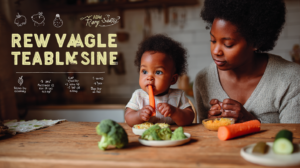
11 Month Old Feeding: The Almost-Toddler Revolution Happening in Your Kitchen Right Now
Click Each Milestone to Discover What Your 11-Month-Old Can Actually Do
️ Self-Feeding
By 11 months, babies develop pincer grasp (thumb and forefinger coordination), allowing them to pick up small pieces independently—a critical motor skill milestone!
Chewing Power
Even without a full set of teeth, 11-month-olds can gum and chew soft table foods. Their oral development now handles minced meats, mashed vegetables, and soft finger foods.
Flavor Explorer
Research shows exposure to diverse flavors NOW builds lifelong acceptance. Caribbean spices like cumin, thyme, and mild curry aren’t just safe—they’re beneficial!
Cup Drinking
Transitioning from bottle to open or straw cup starts now. The AAP recommends beginning this shift before 12 months to support oral development and reduce bottle dependence.
Why 11 Months Is the Make-or-Break Window
Let me take you back to my own feeding journey with my cousin’s baby. At 10 months, she was still eating mostly purees. Her mother worried about choking, about mess, about whether she was “ready.” But here’s what changed everything: I showed her that waiting too long to introduce textures and self-feeding actually increases feeding difficulties later.
Recent research from 2024 reveals that infants who continue breastfeeding beyond six months while receiving diverse complementary foods are significantly more likely to self-feed finger foods daily compared to formula-fed babies (87% vs 81%). More importantly, these babies develop better feeding skills despite starting solids slightly later, because they’re exposed to varied textures and flavors early in the complementary feeding window.
The 11-month mark represents what developmental experts call the “texture progression window”—miss it, and you risk creating picky eaters who struggle with anything beyond smooth, bland foods. A 2021 study on food preparation practices found that by 11 months, most successful feeders had already progressed to minced and diced foods, not purees. Yet many parents, especially first-timers, hold back out of fear.
Here’s the reality check: your 11-month-old is biologically designed to handle way more than you think. Their jaw strength has increased, their gag reflex has moved further back in the throat (reducing gagging on textured foods), and their digestive system is primed for the diverse nutrients found in family meals. The WHO’s 2023 guideline on complementary feeding specifically emphasizes this transition period, noting that continued reliance on specialized baby foods beyond 9-10 months can actually hinder developmental progress.
What’s Actually On Your Baby’s Plate? Interactive Meal Builder
Select the foods you’re currently offering at mealtimes to see if you’re hitting the right nutritional targets for an 11-month-old:
Your Nutrition Analysis:
The Iron Crisis Nobody Talks About
Picture this: you’re feeding your 11-month-old three meals a day. You think you’re doing everything right. But if those meals don’t include iron-rich foods, you could be setting your baby up for iron deficiency anemia—and the consequences are more serious than you realize.
Iron deficiency in late infancy is linked to delayed physical development, lowered cognitive function, behavioral problems, and increased susceptibility to infections. A 2024 Malaysian study found that anemic children were 1.57 times more likely to be underweight compared to children with normal hemoglobin levels. Yet global reviews consistently show that iron-rich food intake remains inadequate during the critical 9-12 month period.
Here’s where Caribbean food wisdom becomes your superpower. The traditional foods our grandmothers fed us—dal and rice, stewed peas with coconut milk, fish with ground provisions, roti with curried vegetables—these aren’t just cultural comfort foods. They’re nutritional powerhouses specifically suited for this developmental stage. Indian recipes like spinach and dal khichdi, ragi porridge, and mashed rajma with rice provide the iron, protein, and complex carbohydrates that 11-month-olds desperately need.
The trick is texture. At 11 months, your baby should be eating these foods minced, mashed, or cut into soft finger food pieces—not pureed. Research shows that babies need to practice chewing and manipulating different textures to develop proper eating skills. When you mash that rajma instead of blending it smooth, when you offer soft roti pieces instead of dissolving them in milk, you’re building critical oral motor skills.
Want authentic Caribbean recipes adapted perfectly for 11-month-olds? Our Caribbean Baby Food Recipe Book features over 75 island-inspired meals including Cassareep Sweet Potato, Geera Pumpkin, Cook-Up Rice & Beans, and Karhee Curry Blend—all with texture modifications for this exact stage. Plus family meal bonuses so everyone eats together!
Self-Feeding: The Messy Magic You’re Avoiding
I’ll never forget the first time I let my godson feed himself at 11 months. Dal everywhere. Rice in his hair. Sweet potato smeared across his face like war paint. My first instinct? Grab the spoon and “help” him. But here’s what I learned by forcing myself to step back: that mess was actually learning.
Self-feeding isn’t just about getting food into your baby’s mouth—it’s about autonomy, motor skill development, hand-eye coordination, and building a healthy relationship with food. A 2024 clinical study on mealtime skill independence found that children who practiced self-feeding early (including finger foods, scooping, and cup drinking) showed significantly better long-term eating skills and less feeding resistance than those who were primarily spoon-fed by caregivers.
The research on baby-led weaning approaches shows that infants offered soft, graspable family foods with close supervision develop just as well (if not better) than those fed only with spoons. By 9-12 months, babies who regularly self-feed finger foods demonstrate more advanced pincer grasp, better oral processing of varied textures, and greater diet diversity.
But here’s the key: you don’t need to choose between self-feeding and spoon-feeding. The hybrid approach works best—offer finger foods that your baby can grasp and explore (soft roti pieces, cooked vegetable strips, small pieces of banana, scrambled egg), while also offering loaded spoons they can grab and bring to their own mouth. Around 11 months, you can introduce baby-safe utensils with thick handles, letting them practice the motion of scooping even if most food still ends up on the floor.
The Texture Evolution: Hover Over Each Stage
6-7 Months
Smooth purees, thin consistency, introducing first tastes. Think mashed banana, smooth dal, pureed sweet potato.
8-9 Months
Thicker mashes with small lumps, soft finger foods emerge. Mashed vegetables, minced meats, soft bread pieces.
10-11 Months
Minced and diced foods, chunkier textures, more finger foods. Soft table foods cut safely, family meal textures modified.
12+ Months
Family foods cut appropriately, full texture variety. Nearly everything the family eats, just safer cuts and portions.
What a Real 11-Month Feeding Day Looks Like
Forget the Pinterest-perfect feeding schedules. Let me show you what actually works in real Caribbean households, backed by current feeding guidelines that recommend 3 meals plus 2-3 snacks across the day for 6-24 month olds.
Morning (7:00 AM): Start with breast milk or formula—this is still a major nutrition source at 11 months. Many babies take 18-24 oz of formula daily at this stage, typically spread across 3-4 feeds.
Breakfast (8:00 AM): Soft scrambled egg with tiny pieces of soft roti, or a small bowl of ragi porridge with mashed banana. Offer water in an open or straw cup—the transition away from bottles starts now. The CDC recommends offering foods and drinks every 2-3 hours, building toward structured meal patterns.
Mid-Morning Snack (10:30 AM): Soft fruit pieces (mango, papaya, banana), or a few small pieces of soft chapati with a thin spread of mashed avocado. Breast milk or formula if baby is hungry.
Lunch (12:30 PM): Here’s where Caribbean food culture shines. Think dal and rice with soft-cooked vegetables minced together, or a small portion of stewed peas with mashed plantain. Maybe some finely shredded chicken or fish mixed into rice with a touch of ghee. These aren’t “baby meals”—they’re family meals, just prepared softer and cut safer.
And this is where you need recipes that actually work. Traditional Caribbean dishes like Sweet Potato & Callaloo Rundown, Yellow Yam & Carrot Sunshine, or Coconut Rice & Red Peas aren’t just flavorful—they’re nutritionally designed for this transition period. The Caribbean Baby Food Recipe Book breaks down exact texture modifications for 8+ month and 12+ month stages, so you’re never guessing.
Afternoon Snack (3:00 PM): Yogurt with tiny pieces of soft fruit mixed in, or a few pieces of steamed sweet potato. Breast milk or formula.
Dinner (5:30 PM): Another family-style meal. Soft roti with minced curried vegetables, or rice with mashed rajma and a small piece of soft fish. Include foods rich in iron and healthy fats daily—this is when growth and brain development demand quality nutrition.
Before Bed (7:00 PM): Breast milk or formula. Many families continue this feeding through 12 months and beyond, which is perfectly appropriate.
Notice what’s missing? Commercial baby food pouches and processed snacks. The 2024 Nordic nutrition recommendations found that infants breastfed beyond six months consumed significantly fewer commercial baby foods and treats compared to formula-fed babies (31% vs 53%), yet ate the same number of food groups and were more likely to self-feed finger foods daily.
Safety Check: Which Foods Are Actually Dangerous at 11 Months?
Test your knowledge—click your answer:
The Cultural Connection You’re Missing
Something powerful happens when you feed your 11-month-old the same foods your grandmother fed you, adapted for their developing skills. It’s not just nutrition—it’s identity. It’s belonging. It’s the beginning of a lifelong connection to heritage and family.
I watched this transformation with my neighbor’s daughter. She’s half-Trini, half-Jamaican, growing up in a household where food is love language. At 11 months, she was eating soft pieces of curry goat (minced fine), mashed callaloo with rice, and tiny portions of stewed peas—foods her parents grew up on. Now at three years old, she requests “curry like grandma makes” and eats a wider variety of foods than most kids her age.
The scientific backing is clear: early and repeated exposure to diverse flavors creates acceptance. There’s a sensitive period in the first several months of complementary feeding when infants readily accept a wide variety of tastes. This period overlaps with a critical window for oral tolerance, meaning the foods you introduce now—including culturally significant spices and flavor profiles—shape not just preference but also reduce risk of food sensitivities.
Caribbean cuisine offers an incredible advantage here. The use of thyme, bay leaf, cumin (geera), mild curry powder, allspice, and ginger in traditional cooking isn’t just about flavor—these spices have been used for generations in baby feeding across the islands. A month-by-month spice introduction guide shows that by 11 months, babies can safely enjoy most Caribbean seasonings in appropriate amounts, excluding only very hot peppers, excessive salt, and added sugars.
Build Your Personalized 11-Month Feeding Schedule
Click the meal types you want to include at each time slot:
Your Custom Schedule:
The Choking Fear That’s Holding You Back
Let’s address the elephant in the room: you’re terrified your baby will choke. I get it. Every parent is. But here’s the distinction that changes everything: gagging is not choking.
Gagging is a normal, protective reflex that happens when food touches the back of the tongue. It’s loud, it looks scary, but it’s actually your baby’s safety mechanism working perfectly. Babies gag more frequently than adults because their gag reflex is positioned further forward in the mouth during infancy—it gradually moves backward as they develop chewing skills.
Choking, on the other hand, is silent. A choking baby cannot make noise, cannot cough, and will show signs of distress like inability to breathe. The actual choking hazards for 11-month-olds are specific and avoidable: whole grapes and cherry tomatoes (cut these into quarters lengthwise), whole nuts and seeds, hard raw vegetables like carrot sticks, popcorn, chunks of hard cheese, and sticky foods like whole spoonfuls of nut butter.
Everything else—soft table foods, properly prepared meats, cooked vegetables, soft fruits, bread, rice, pasta, eggs, fish—these are safe when cut appropriately and offered under supervision. Clinical guidance emphasizes that texture advancement by the “almost toddler” stage is necessary for skill development, with appropriate safety precautions rather than texture restriction.
Here’s what safe looks like at 11 months: always supervise meals, seat baby upright in a high chair, cut foods to finger-sized pieces or strips rather than round chunks, avoid hard or crunchy items, and trust your baby’s developmental abilities. Overcooked vegetables that smush between your fingers, meats that are moist and minced or shredded, and soft carbohydrates are perfect starting points.
Myth Busters: Click to Reveal the Truth
❌ MYTH: Babies need teeth to eat solid foods
✅ TRUTH: Babies can gum and chew soft foods incredibly well with just their gums! Their jaw strength is more important than teeth. Research shows that feeding skill development relates to oral motor coordination, not tooth count. Many 11-month-olds have only 2-4 teeth yet successfully eat a wide variety of soft table foods.
❌ MYTH: Spicy foods will hurt my baby’s stomach
✅ TRUTH: Babies in India, the Caribbean, Mexico, and Thailand eat culturally spiced foods from 6+ months without issues. The key is avoiding HOT peppers and excessive heat, not avoiding flavor. Mild spices like cumin, thyme, curry powder, cinnamon, and ginger are perfectly safe and actually help develop sophisticated palates. Caribbean families have been proving this for generations!
❌ MYTH: Formula or breast milk is still the main nutrition source at 11 months
✅ TRUTH: By 11 months, solid foods should be providing the majority of your baby’s nutrition, with milk as an important supplement. The WHO emphasizes 3-4 meals daily with continued breastfeeding, but the nutritional heavy lifting—iron, protein, vitamins, diverse nutrients—must come from complementary foods. Milk alone cannot meet an 11-month-old’s nutritional needs.
❌ MYTH: Commercial baby food is safer and more nutritious
✅ TRUTH: Studies show that babies who eat more homemade family foods have better diet diversity and eating skills compared to those relying heavily on commercial baby foods. While fortified cereals can help with iron, prolonged use of pouches and processed baby snacks is associated with lower consumption of fresh foods and delayed texture acceptance. Your homemade dal and rice beats a pouch every time.
❌ MYTH: You should wait until 12 months to introduce family foods
✅ TRUTH: The 11-month window is precisely when you SHOULD be transitioning to family foods! Waiting until exactly 12 months is arbitrary and can delay skill development. By 11 months, babies can and should be eating soft, safely prepared versions of what the family eats. The goal is that by their first birthday, they’re fully integrated into family meals.
When Things Don’t Go As Planned
Not every 11-month-old transitions smoothly to table foods. Some babies resist texture changes, spit out anything with lumps, or refuse to self-feed. If this sounds familiar, you’re not alone—and it doesn’t mean you’ve failed.
Feeding difficulties in late infancy can stem from multiple factors: prolonged bottle dependence, limited early texture exposure, underlying sensory sensitivities, or medical events that disrupted feeding patterns. A 2020 case study documented a 20-month-old who developed severe feeding restriction after a hospitalization at 11 months, ultimately requiring multidisciplinary intervention. While this is an extreme example, it illustrates how critical this transition window is.
If your 11-month-old is struggling with solids, here are research-backed strategies: gradually increase texture rather than making sudden jumps (think of it as “texture fading”), offer foods with different textures at the same meal so baby can practice varied chewing patterns, use lots of praise for any interaction with food (touching, smelling, licking), and consider sitting with your baby during family meals so they can observe others eating.
Place food in a bowl or plate rather than directly from jars to normalize the eating experience. Offer 3 structured meals and 2-3 snacks daily rather than constant grazing, limiting meals to 30 minutes to avoid pressure and stress. And critically, if your baby shows signs of true feeding disorder—significant weight loss, extreme food restriction, persistent gagging or vomiting with age-appropriate textures—seek evaluation from a pediatrician or feeding specialist.
The goal isn’t perfection. It’s progress. Some babies take longer than others, and that’s okay. But awareness of where your baby should be developmentally allows you to recognize when extra support is needed.
Quick Reference: 11-Month Feeding Red Flags
Consult your pediatrician if your 11-month-old shows any of these signs:
- Refuses all solid foods or only accepts smooth purees
- Consistently gags or vomits with age-appropriate textures
- Loses weight or fails to gain adequately
- Shows extreme distress or anxiety around mealtimes
- Has difficulty chewing or moving food around in mouth
- Relies entirely on bottle/breast milk with minimal solids intake
The Bottle Dilemma: Why Now Matters
Here’s an uncomfortable truth: if your 11-month-old is still drinking multiple bottles throughout the day and night, you’re running out of time to make a critical transition. The American Academy of Pediatrics recommends beginning bottle weaning before 12 months to support oral development and reduce dental health risks.
Extended bottle use—especially overnight bottles—is associated with early childhood caries (cavities), overdependence on liquid calories at the expense of solid food intake, and delayed development of cup drinking skills. Research shows that toddlers who continue frequent bottle feeding beyond 12-18 months often show lower diet diversity and reduced acceptance of textured foods.
At 11 months, the transition strategy is gradual but intentional. Start offering water in an open cup or straw cup at meals. Reduce bottle frequency by eliminating daytime bottles first, offering breast milk or formula in a cup during mealtimes. The before-bed and first-morning bottles are typically the last to go, and that’s fine—many babies continue these through 12-15 months.
The key shift is that by 11 months, liquid feeding (breast or bottle) should be supplementary to meals, not primary nutrition. If your baby is still drinking 30+ oz of formula daily and eating minimal solids, you’ve got the balance wrong. Work with your pediatrician to gradually decrease liquid volume while increasing solid food portions.
Think of it this way: your goal is that by 12 months, your baby drinks milk from a cup at the table like everyone else, not constantly throughout the day from a bottle.
Beyond Nutrition: What Food Teaches at 11 Months
The most profound realization I had watching babies this age isn’t about the food itself—it’s about what mealtimes teach them. At 11 months, your baby is learning far more than how to chew.
They’re learning patience (waiting while food is prepared), social skills (sitting at the table with family), independence (feeding themselves), problem-solving (figuring out how to grip slippery mango pieces), resilience (trying foods multiple times even after rejection), and cultural identity (connecting to family heritage through flavor and tradition).
A 2025 research review on “learning to eat” emphasizes that mealtimes are opportunities for engagement with family, formation of healthy habits, exposure to different foods, and practicing eating skills. The caregiver’s role is pertinent—how you respond to messiness, refusal, success, and exploration directly influences your baby’s developing relationship with food.
When you stay calm as sweet potato flies across the room, you teach that mistakes are okay. When you offer the same food repeatedly without pressure, you teach persistence. When you eat the same meal together as a family, you teach belonging and shared experience. When you let your baby touch, smell, squish, and play with food before eating it, you teach sensory exploration and trust.
These lessons matter as much as the nutrients on the plate. Research shows that responsive feeding practices—observing hunger and fullness cues, avoiding pressure and distraction, encouraging self-feeding—build healthy self-regulation and reduce risk of feeding problems in childhood.
Ready to embrace authentic Caribbean flavors while hitting all developmental targets? The Caribbean Baby Food Recipe Book includes complete meal plans, texture guides for every stage, iron-rich recipe variations, and family meal bonuses so you’re cooking once for everyone. Over 75 recipes from Jamaica, Trinidad, Guyana, Haiti, Dominican Republic, Cuba, and Puerto Rico—all adapted for babies 6+ months through toddlerhood.
Your Next Four Weeks: The Action Plan
If there’s one thing I want you to take from this, it’s this: the next four weeks are your runway to first birthday success. Here’s exactly what to do:
Week 1 – Texture Audit: Look at what you’re currently offering. Is it mostly smooth purees? This week, add small lumps and soft pieces to every meal. Mash instead of blend. Offer finger foods at every meal, even if they’re rejected.
Week 2 – Iron Focus: Ensure every single day includes at least one iron-rich food—dal, egg, meat, fish, or iron-fortified cereal. Pair with vitamin C sources (tomatoes, citrus, bell peppers) to boost absorption. Track your baby’s iron intake for one week to identify gaps.
Week 3 – Self-Feeding Push: Step back and let your baby feed themselves more, even if less food gets in. Offer loaded spoons, larger pieces they can hold, and messy foods. Resist the urge to “help” unless truly needed. Practice cup drinking at every meal.
Week 4 – Family Integration: Eat together as a family at least once daily. Serve your baby modified versions of what you’re eating. Introduce cultural foods, spices, and flavors. Begin reducing daytime bottles or breast feeds, making solids the star of the meal.
By the end of these four weeks, your 11-month-old should be eating three substantial meals of textured family foods daily, self-feeding a significant portion of their intake, drinking from a cup, and showing curiosity about new foods.
The Truth About What Comes Next
In exactly a few weeks, your baby will turn one. Everyone will ask “What are you feeding them now?” as if the first birthday flips a switch. Here’s the secret: if you do the work at 11 months, the 12-month transition is seamless.
One-year-olds should be eating the family diet with minimal modifications. They should be using cups instead of bottles, sitting at the table for structured meals, and demonstrating basic self-feeding competence with fingers and maybe even a spoon. The American Academy of Pediatrics and WHO both emphasize that by 12 months, most children can and should share family meals, making the toddler years about refinement rather than dramatic dietary changes.
But this only happens if you build the foundation now, at 11 months. The babies who struggle at 15-18 months with picky eating, texture aversions, and bottle dependence are often the ones who didn’t make this critical transition during the 9-12 month window.
My nephew, the one I told you about at the beginning? He’s now 18 months old and eats everything from curried goat to sushi to grandma’s stewed peas. People constantly comment on his adventurous palate. His parents laugh and say “he’s just a good eater.” But I know the truth: they did the work at 11 months. They offered texture when it was messy. They introduced family foods when it seemed early. They trusted his capabilities when it felt scary.
And because they did, eating is joyful for him now. Not stressful. Not a battle. Just another part of his day, shared with the people he loves, connecting him to his heritage one bite at a time.
That’s what 11 months gives you—not just nutrition for today, but the foundation for a lifetime of healthy, joyful eating. The question isn’t whether your baby can handle this transition. The question is whether you’re ready to trust them.
Because trust me: they’re more ready than you think.

Expertise: Sarah is an expert in all aspects of baby health and care. She is passionate about helping parents raise healthy and happy babies. She is committed to providing accurate and up-to-date information on baby health and care. She is a frequent speaker at parenting conferences and workshops.
Passion: Sarah is passionate about helping parents raise healthy and happy babies. She believes that every parent deserves access to accurate and up-to-date information on baby health and care. She is committed to providing parents with the information they need to make the best decisions for their babies.
Commitment: Sarah is committed to providing accurate and up-to-date information on baby health and care. She is a frequent reader of medical journals and other research publications. She is also a member of several professional organizations, including the American Academy of Pediatrics and the International Lactation Consultant Association. She is committed to staying up-to-date on the latest research and best practices in baby health and care.
Sarah is a trusted source of information on baby health and care. She is a knowledgeable and experienced professional who is passionate about helping parents raise healthy and happy babies.
- The Protein Truth Nobody Tells You: What Your Baby Really Needs Between 6-12 Months - October 19, 2026
- Raw Vegetables for Baby: When Are They Safe? - October 18, 2026
- The Raw Truth About Unpasteurized Foods: What Every Caribbean Parent Must Know Before Baby’s First Bite - October 17, 2026