Heavy Metals in Baby Food: The Truth Behind the Headlines (And What You Can Actually Do About It)
Let’s Play Detective
Click on the metal below that you think poses the BIGGEST risk to your baby’s developing brain:
Here’s something that’ll make your stomach drop: in 2021, a U.S. congressional report revealed that some baby food ingredients contained arsenic levels up to 91 times higher than drinking water limits, lead up to 177 times higher, and cadmium up to 69 times higher. Let that sink in. The foods specifically marketed to our most vulnerable little ones—the jars with smiling babies on the label—had metal levels that would make industrial waste blush.
But before you toss every jar in your pantry and spiral into a Google rabbit hole at 2 AM (been there, done that), I need you to take a breath. Because here’s what the headlines don’t tell you: the story of heavy metals in baby food isn’t about evil companies deliberately poisoning our children. It’s about environmental contamination, agricultural practices, and regulatory gaps—and more importantly, it’s about what you can actually control.
When my nephew started solids, my sister called me in tears after reading one of those “toxic baby food” articles. She’d been feeding him the same rice cereal for weeks. The guilt was eating her alive. But here’s what I told her then, and what I’m telling you now: knowledge is power, panic is not. Understanding the real risks—not the sensationalized ones—gives you the tools to make informed choices without losing your mind in the process.
The truth is, heavy metals in baby food are a legitimate concern, but they’re also part of a bigger picture that includes soil contamination, water quality, and yes, even that “organic” label you’ve been trusting. By the time you finish reading this, you’ll understand exactly where these metals come from, which foods are the biggest culprits, what the new regulations actually mean, and most importantly, the simple, practical steps you can take today to dramatically reduce your baby’s exposure without turning mealtime into a chemistry experiment.
Where Do These Metals Actually Come From? (Spoiler: It’s Not What You Think)
Let’s clear up the biggest misconception right now: food companies aren’t adding heavy metals to baby food. I know, I know—when you see those astronomical numbers, it feels intentional. But the reality is far more complicated and, frankly, more insidious.
Heavy metals like arsenic, lead, cadmium, and mercury exist naturally in the earth’s soil and water. They’ve been there for millions of years. The problem is that modern industrial practices—mining, smelting, pesticide use, and pollution—have dramatically increased their concentration in agricultural areas. When crops grow in contaminated soil or are irrigated with contaminated water, they absorb these metals through their roots. It’s not a manufacturing issue; it’s an environmental one.
Rice is the perfect example. Rice paddies require flooding, and unfortunately, flooded conditions make arsenic more available for the rice plant to absorb. That’s why rice-based products—rice cereal, rice crackers, rice puffs—consistently show higher arsenic levels than other grains. The rice isn’t “bad”; the growing conditions just make it more susceptible to contamination.
Root vegetables present a similar challenge. Carrots, sweet potatoes, and beets grow underground, in direct contact with soil. If that soil contains lead or cadmium—which many agricultural soils do, especially in areas with historical industrial activity—those vegetables will absorb them. The “organic” label doesn’t protect against this, by the way. Organic farming prohibits synthetic pesticides and fertilizers, but it can’t eliminate metals already present in the soil from decades of previous contamination.
The Shocking Truth About “Clean” Foods
Even foods you think are “safe” might surprise you…
High-Risk Foods You Probably Didn’t Suspect:
- Rice-based products: Infant rice cereal shows some of the highest arsenic levels—up to 100 ppb was considered acceptable until recent guidelines.
- Fruit juice (especially apple): Both arsenic and lead concentrate in juice products, plus they add unnecessary sugars to baby’s diet.
- Root vegetables: Carrots, sweet potatoes, and beets can accumulate lead and cadmium from soil—even when homemade.
- Teething biscuits & rice crackers: These seemingly harmless snacks often combine rice with root vegetable flours, doubling exposure.
- Some tropical produce: Depending on regional soil conditions, certain imported produce may have higher contamination.
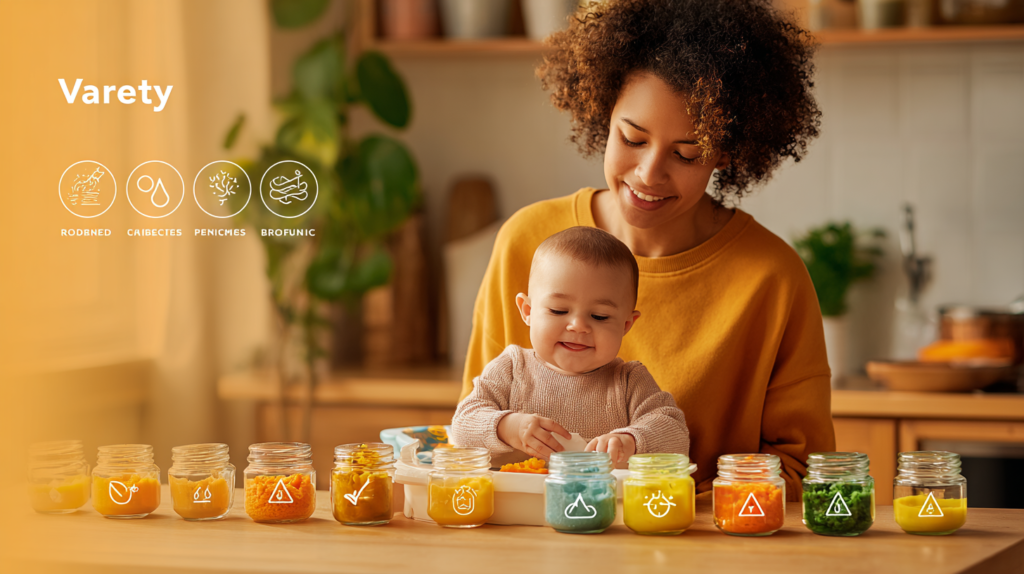
The key takeaway: No single food is “toxic,” but relying heavily on rice-based products creates unnecessary risk. Variety is your best defense.
This is where things get tricky for us Caribbean parents. Many of our traditional first foods—like rice, root vegetables, and ground provisions—are exactly the foods that tend to accumulate more heavy metals. But before you panic, remember: these foods have nourished generations of healthy Caribbean babies. The difference now is that we have more information and can make small adjustments to reduce risk without abandoning our cultural foods entirely.
Take sweet potato, for instance. It’s a Caribbean staple and an excellent first food—rich in beta-carotene, fiber, and vitamins. The solution isn’t to eliminate it; it’s to rotate it with other options like breadfruit, green banana, plantain, or yam, and to source from areas with cleaner soil when possible. The same principle applies to rice: instead of serving it daily, alternate with other grains like oats, millet, quinoa, or even our traditional cornmeal.
If you’re looking for tried-and-tested Caribbean baby food recipes that naturally incorporate variety and minimize heavy-metal risk foods, the Caribbean Baby Food Recipe Book includes over 75 recipes featuring diverse ingredients like eddoes, dasheen, breadfruit, and callaloo—traditional foods that offer excellent nutrition with built-in variety.
The Real Numbers: What Recent Studies Actually Found
U.S. baby food products tested in 2022 showed elevated arsenic & lead in worst-case scenarios
European baby products analyzed in 2022—most within limits but still contributing to cumulative exposure
Expected reduction in lead exposure from baby foods with new FDA guidelines (2025)
Let’s talk actual data, not fear-mongering headlines. A comprehensive 2022 risk assessment analyzed 36 commercially available baby foods in the United States and found that certain products had hazard index values above 1 for arsenic and lead when babies consumed them frequently. A hazard index above 1 suggests potential non-cancer health concerns with regular exposure—not immediate toxicity, but cumulative risk over time.
In Europe, a 2022 Polish study examined 397 ready-to-eat baby products and detected arsenic, cadmium, lead, and mercury in many of them. The good news? Most fell within health-based guidance values. The not-so-good news? Even low levels contribute to a child’s total exposure when combined with water, dust, and other environmental sources.
Perhaps most concerning was a 2023 study from Ghana that tested infant foods and found hazard index values ranging from 2.7 to 6.8 for some products—well above acceptable thresholds. This highlights an important global disparity: regulatory oversight and soil quality vary dramatically by region, and imported baby foods may not meet the same standards as domestically produced ones.
But here’s where the story gets more hopeful. In January 2025, the FDA finalized new action levels for lead in processed baby foods: approximately 10 parts per billion (ppb) for most fruits, vegetables, and mixed dishes, and 20 ppb for root vegetables and dry cereals. These voluntary limits are projected to reduce lead exposure from baby foods by 20-30%. It’s a step forward, though many pediatric health experts argue the limits should be even lower, especially for arsenic.
What these numbers tell us is this: heavy metal exposure from baby food is a real, measurable concern—but it’s also manageable. Your baby isn’t going to suffer immediate harm from eating rice cereal or carrot purée. The risk is cumulative and long-term, which means small, consistent changes in feeding practices can make a significant difference. We’re talking about protecting developing brains over months and years, not preventing acute poisoning.
What Pediatricians and Researchers Are Actually Saying (Beyond the Panic)
Here’s where I wish every parent would pause and take a deep breath. Because while the internet wants you to believe that baby food is basically a neurotoxin cocktail, the actual medical consensus is far more measured—and way more helpful.
The American Academy of Pediatrics has been clear: heavy metal findings in baby food are genuinely concerning and deserve attention, but baby food is just one component of a child’s total exposure. AAP guidance emphasizes that the benefits of starting appropriate complementary foods on time far outweigh the risks of trace metal exposure—provided parents take simple precautionary steps.
What are those steps? According to leading pediatric organizations, the top recommendations are straightforward: limit rice-based foods and rice-based snacks, avoid fruit juice entirely (it offers no nutritional benefit babies can’t get from whole fruit), rotate your starch sources instead of relying on the same grain every day, and include a variety of proteins, fruits, and vegetables in your baby’s diet.
Toxicologists and environmental health researchers take a slightly harder line. Many argue there is no truly “safe” level of lead for neurodevelopment, and they’re pushing for stricter, health-based limits with actual enforcement mechanisms. Right now, FDA action levels are voluntary guidelines—companies aren’t legally required to meet them. Public health advocates want that to change, and legislation like the proposed Baby Food Safety Act of 2024 aims to give the FDA authority to set and enforce mandatory limits.
Dr. Philip Landrigan, a pediatrician and leading environmental health researcher, has stated that while typical dietary exposure to heavy metals from baby food won’t cause immediate toxicity, chronic low-level exposure during critical developmental windows can subtly impact cognitive function, behavior, and academic performance years later. The effects are often small on an individual level but significant at a population level.
Expert Bottom Line: You don’t need to eliminate any specific food entirely. The goal is variety—rotate grains, diversify vegetables, include different protein sources. Think of it like a financial portfolio: diversification reduces risk.
One thing that really frustrates me—and frustrates the pediatricians I’ve spoken with—is how social media amplifies the most extreme claims. Yes, there are lawsuits alleging that heavy metal contamination in baby food causes autism and ADHD. But here’s the scientific reality: while high-level heavy metal exposure is absolutely linked to neurodevelopmental problems, causally connecting typical dietary levels from baby food alone to specific diagnoses like autism is scientifically complex and not well established.
That doesn’t mean we should ignore the issue. It means we should focus on what we can control: making smart, informed choices about what we feed our babies without succumbing to fear or guilt. Because let me tell you, parental guilt helps no one—least of all your baby.
The Regulatory Landscape: What’s Changed (and What Hasn’t)
The Timeline of Action
So what does all this regulatory movement actually mean for you, sitting in your kitchen trying to decide what to feed your seven-month-old?
First, the good news: there’s more transparency than ever before. Thanks to California’s new labeling law, many baby food brands now provide QR codes on packaging that link to detailed, batch-specific testing results for lead, arsenic, cadmium, and mercury. Scan the code with your phone, and you’ll see exactly what’s in that jar or pouch. Some companies publish monthly reports; others update quarterly. It’s not perfect, but it’s lightyears ahead of where we were just five years ago.
Second, the FDA’s “Closer to Zero” plan is exactly what it sounds like: a phased approach to reduce contamination over time. The new lead action levels are a first step, with guidance on arsenic, cadmium, and mercury expected to follow. Critics argue the timeline is too slow and the levels too lenient, but supporters say gradual implementation gives manufacturers time to adjust sourcing, reformulate products, and adopt better testing without creating food shortages or massive price hikes.
The big caveat? These are action levels, not legal limits. Companies aren’t required to comply. The FDA uses action levels to guide its own enforcement decisions—products that exceed them may be subject to recalls or regulatory action—but there’s no automatic penalty for non-compliance. That’s why advocacy groups are pushing for the Baby Food Safety Act, which would give FDA the authority to set mandatory, enforceable limits.
Here’s my take: regulation is important, but you can’t wait for the government to solve this problem for you. Even with stricter limits, heavy metals will never be completely eliminated from food because they exist in the environment. Your best bet is to educate yourself, choose brands that voluntarily exceed FDA guidelines, and follow the simple dietary strategies that minimize exposure regardless of what regulators decide.
The Caribbean Parent’s Dilemma: Balancing Tradition and Safety
Now let’s talk about what this means for those of us raising babies with Caribbean flavors and traditions. Because honestly, when I first started researching this topic, my heart sank. Rice and peas? Sweet potato? Cornmeal porridge? These are foundational foods in Caribbean baby feeding—foods that carry culture, memory, and generations of nourishment.
But here’s what I’ve learned: you don’t have to choose between cultural identity and safety. You just have to be strategic.
Take rice, for example. In Jamaican, Trinidadian, Guyanese, and many other Caribbean traditions, rice is a daily staple. But instead of serving rice cereal every morning or rice-based snacks throughout the day, you can rotate it with other traditional grains. Cornmeal porridge one day, oats with coconut milk the next, millet porridge (popular in parts of the Caribbean and West Africa) another day, and yes, rice on occasion. You’re still honoring tradition; you’re just adding variety.
Root vegetables—sweet potato, yam, cassava, dasheen, eddoes—are another cornerstone of Caribbean baby feeding. These ground provisions are nutrient-dense, culturally significant, and generally well-tolerated by babies. The key is not to rely on the same one every single day. If you made sweet potato purée yesterday, try breadfruit today. Tomorrow, maybe a green banana mash. The weekend, a little steamed yam with coconut oil.
Your Baby’s Diet Diversity Score
Check off the foods your baby ate in the last week. More variety = lower heavy metal risk!
One thing I love about Caribbean cuisine is that it’s naturally suited to this approach. We already have incredible ingredient diversity—from callaloo to christophine, ackee to soursop. We’re not limited to the standard carrots-and-peas baby food repertoire. Our traditional diet gives us a built-in advantage if we lean into that variety instead of defaulting to the same few convenience foods.
For detailed Caribbean baby food recipes that emphasize diverse ingredients and food rotation, check out the Caribbean Baby Food Recipe Book, which includes traditional recipes like Cornmeal Porridge Dreams, Simple Metemgee Style Mash, Plantain Paradise, and Dasheen Bush Silk—all designed with both nutrition and cultural authenticity in mind.
And let’s talk about homemade food for a second. Making your own baby food from fresh ingredients is wonderful and has many benefits—you control the ingredients, avoid added sugars and preservatives, and can introduce authentic flavors. But homemade doesn’t automatically mean “heavy-metal-free.” If you’re steaming sweet potatoes or blending rice porridge, those ingredients still came from the same agricultural systems as the ones used in commercial baby food. The metals are in the soil and water, remember?
That said, homemade food does give you more control over variety and sourcing. You can choose to buy organic root vegetables (which may come from less contaminated soil, though not guaranteed), rotate your ingredients more frequently, and avoid the rice-heavy bias of many commercial baby cereals. Just don’t fall into the trap of thinking homemade is a magic shield against environmental contaminants.
Myths, Misinformation, and the Stories We Tell Ourselves
Myth vs. Truth
“Organic baby food doesn’t contain heavy metals.”
Organic certification addresses pesticides and synthetic inputs, not heavy metals already in soil and water. Studies show organic products can have similar heavy metal levels to conventional ones.
“All baby food brands are equally contaminated.”
Testing shows significant variation between brands and even between batches of the same product. Brands that test frequently and publish results tend to have lower levels because they’re actively managing sourcing.
“One jar of baby food with heavy metals will harm my baby.”
Heavy metal risk is cumulative over time, not acute. A single jar won’t cause harm. It’s the daily, repeated exposure over months that matters. That’s actually good news—it means small changes make a real difference.
“Baby food is the main source of heavy metal exposure.”
Babies are exposed through multiple pathways: water (especially if you have old pipes), house dust, soil, toys, and yes, food. Addressing baby food alone, while ignoring lead paint or contaminated water, misses the bigger picture.
“I need to avoid all rice, root vegetables, and carrots.”
You need to rotate them, not eliminate them. These foods offer important nutrients. The problem is reliance on them meal after meal, day after day. Variety is the solution.
One of the most damaging myths I see circulating on social media is the idea that heavy metals in baby food directly cause autism or ADHD. Let me be crystal clear: there is no established causal link between typical dietary heavy metal exposure from baby food and these specific neurodevelopmental conditions. That doesn’t mean heavy metals are harmless—they’re not. High-level exposures are absolutely associated with cognitive and behavioral problems. But the leap from “rice cereal contains measurable arsenic” to “this baby food caused my child’s autism diagnosis” is scientifically unsupported and spreads unnecessary fear.
What is true is that chronic, low-level heavy metal exposure during critical developmental periods—particularly the first two years—can subtly affect brain development in ways that might not become apparent until a child reaches school age. We’re talking about potential impacts on IQ, attention, behavior, and learning—small but measurable effects at a population level. This is serious, but it’s not the same as causing a specific diagnosis.
Another persistent myth is that expensive, premium baby food brands are safer. While some higher-end brands do invest more in testing and sourcing, price alone is not a reliable indicator. Independent testing has found concerning levels in both budget and premium products. What matters more is whether the brand transparently publishes test results and actively works to minimize contamination.
What You Can Actually Do Today (The Practical, Non-Overwhelming Action Plan)
✅ Your Heavy Metal Risk Reduction Checklist
Click each action as you implement it. Even 3-4 of these will make a meaningful difference!
Here’s the thing: you don’t have to do all of these things perfectly, all at once. You’re not aiming for zero exposure (that’s impossible); you’re aiming to reduce cumulative risk over time. Even implementing three or four of these strategies will meaningfully lower your baby’s total heavy metal intake.
Start with the easiest changes. If your baby currently eats rice cereal every morning, switch to oatmeal or a multi-grain option. If you’re buying pouches for convenience, check which brands publish testing data and switch to one of those. If you’ve been giving juice as a treat, just stop—babies don’t need it, and eliminating it removes an unnecessary exposure source.
As you build confidence, add more variety to your baby’s diet. Introduce new vegetables, try different grains, experiment with legumes and proteins. The goal is a colorful, diverse plate (or bowl, or high chair tray) that naturally distributes risk across many different food sources instead of concentrating it in a few high-exposure items.
And please, please let go of the guilt if you’ve been feeding your baby rice cereal for months or relied heavily on sweet potato purées. You didn’t know, and even if you did, you were doing your best with the information you had. What matters now is what you do moving forward. Your baby is resilient, and the changes you make today will benefit them for years to come.
Looking Ahead: The Future of Baby Food Safety
So where is all of this heading? What can we expect in the next few years as parents, regulators, and advocates push for safer baby food?
First, expect tighter regulations. The FDA’s Closer to Zero initiative is just beginning. Lead action levels came first because lead is the most extensively studied neurotoxin with the clearest no-safe-level consensus. Arsenic, cadmium, and mercury guidance will likely follow, possibly with even lower limits as testing technology improves and more research accumulates.
There’s also growing momentum for mandatory, enforceable standards rather than voluntary action levels. If the Baby Food Safety Act or similar legislation passes, the FDA would gain explicit authority to set numeric limits and penalize non-compliance. That would be a game-changer—shifting the burden from parents trying to decode testing reports to regulators holding companies accountable.
On the technology side, advances in agricultural practices offer hope. Precision farming techniques, soil remediation strategies, and ingredient traceability systems can help manufacturers source from lower-contamination areas and identify problematic supply chains before products reach shelves. Some companies are already working with farmers to test and amend soil, choose less absorbent crop varieties, and implement irrigation practices that minimize metal uptake.
Consumer demand for transparency will also drive change. As more parents learn to check QR codes and compare testing data, brands that refuse to publish results will lose market share. Companies are realizing that transparency isn’t just good ethics; it’s good business. Expect to see more detailed labeling, third-party certifications, and marketing around heavy-metal testing in the coming years.
From a public health perspective, pediatricians and health organizations are getting better at communicating balanced, actionable information rather than either downplaying the issue or stoking panic. Resources like the AAP’s guidance on heavy metals in baby food and the Healthy Babies Bright Futures initiative provide evidence-based recommendations that parents can actually implement without losing their minds.
Want Caribbean Baby Food Recipes Built on Variety?
Introducing diverse, traditional ingredients is easier when you have a trusted recipe guide. The Caribbean Baby Food Recipe Book includes over 75 recipes featuring ingredients like breadfruit, callaloo, dasheen, plantain, and coconut milk—naturally reducing reliance on high-risk foods while celebrating authentic island flavors.
Get Your Copy & Start CookingThe truth is, this issue isn’t going away anytime soon. Heavy metals are in the environment, and short of massive soil remediation projects and drastic changes to industrial practices, they’ll remain part of our food supply. But that doesn’t mean we’re powerless. Knowledge, variety, and strategic choices give you significant control over your baby’s exposure.
Bringing It All Home: Feeding Your Baby with Confidence, Not Fear
Let’s circle back to where we started. When my sister called me in tears about the rice cereal, the most important thing I told her wasn’t about parts per billion or FDA action levels. It was this: your love, your care, and your willingness to learn and adjust are what matter most. Your baby isn’t defined by one jar of food or one batch of cereal. They’re shaped by the cumulative care you provide—nutritionally, emotionally, developmentally—over months and years.
The heavy metals conversation is important, but it’s just one piece of the parenting puzzle. Yes, make informed choices about what you feed your baby. Yes, prioritize variety and reduce reliance on high-risk foods. But also remember to zoom out and see the bigger picture: a baby who is loved, nurtured, fed consistently, and exposed to a wide range of healthy foods will thrive.
In Caribbean culture, food is never just about nutrition. It’s about family, tradition, identity, and love. When you prepare a bowl of cornmeal porridge with a little cinnamon and nutmeg, or mash ripe plantain with coconut milk, or steam breadfruit and let your baby explore the texture, you’re not just feeding them calories and nutrients. You’re introducing them to their heritage, building their palate, and creating memories.
Don’t let fear rob you of that joy. Heavy metals are a real concern, and we should take reasonable steps to minimize exposure. But we should also trust in the resilience of our children, the wisdom of our traditions (adapted with modern knowledge), and our own ability to make good decisions.
Here’s what I want you to walk away with: you are not a perfect parent, and you don’t need to be. You’re a good-enough parent who cares deeply, seeks information, and does your best with the resources you have. That is more than enough. Your baby is lucky to have you.
Start small. Pick two or three changes from the action checklist and implement them this week. Maybe you swap rice cereal for oatmeal. Maybe you try a new vegetable your baby hasn’t had before. Maybe you check your baby food brand’s website for testing data and switch if needed. Whatever you choose, you’re moving in the right direction.
And if you ever feel overwhelmed—because let’s be honest, parenting is overwhelming even without worrying about invisible contaminants—remember this: generations of Caribbean babies grew up healthy, strong, and brilliant eating these same foods. We have more information now, and we can use it wisely. But we don’t have to abandon our roots or our common sense in the process.
Feed your baby with confidence. Introduce them to the flavors of home. Celebrate each new food, each milestone, each messy, beautiful moment of discovery. And trust that the small, thoughtful choices you make every day—about food, about safety, about love—add up to something extraordinary: a healthy, happy child who knows they are cherished.
You’ve got this, mama. You’ve got this, papa. And most importantly, your baby has got you—and that’s the best ingredient of all.

Expertise: Sarah is an expert in all aspects of baby health and care. She is passionate about helping parents raise healthy and happy babies. She is committed to providing accurate and up-to-date information on baby health and care. She is a frequent speaker at parenting conferences and workshops.
Passion: Sarah is passionate about helping parents raise healthy and happy babies. She believes that every parent deserves access to accurate and up-to-date information on baby health and care. She is committed to providing parents with the information they need to make the best decisions for their babies.
Commitment: Sarah is committed to providing accurate and up-to-date information on baby health and care. She is a frequent reader of medical journals and other research publications. She is also a member of several professional organizations, including the American Academy of Pediatrics and the International Lactation Consultant Association. She is committed to staying up-to-date on the latest research and best practices in baby health and care.
Sarah is a trusted source of information on baby health and care. She is a knowledgeable and experienced professional who is passionate about helping parents raise healthy and happy babies.
- Heavy Metals in Baby Food: The Truth Behind the Headlines (And What You Can Actually Do About It) - November 15, 2026
- Parent Mental Health: When Family Criticizes Your Feeding Choices - November 14, 2026
- Baby Nutrition Essentials: Building a Balanced Diet for Babies 6-12 Months - November 13, 2026